stop start DODGE CHARGER 2007 6.G Owner's Manual
[x] Cancel search | Manufacturer: DODGE, Model Year: 2007, Model line: CHARGER, Model: DODGE CHARGER 2007 6.GPages: 384, PDF Size: 6.4 MB
Page 215 of 384
The electronic brake force distribution (EBD) prevents the
rear wheels from over-braking and provides greater
control of available braking forces applied to the rear
axle.
When the vehicle is driven over 7 mph (11 km/h), you
may also hear a slight clicking sound as well as some
related motor noises. These noises are the system per-
forming its self check cycle to ensure that the ABS system
is working properly. This self check occurs each time the
vehicle is started and accelerated past 7 mph (11 km/h).
ABS is activated during braking under certain road or
stopping conditions. ABS-inducing conditions can in-
clude ice, snow, gravel, bumps, railroad tracks, loose
debris, or panic stops.You also may experience the following when the brake
system goes into Anti-lock:
•The ABS motor running (it may continue to run for a
short time after the stop),
•the clicking sound of solenoid valves,
•brake pedal pulsations,
•and a slight drop or fall away of the brake pedal at the
end of the stop.
These are all normal characteristics of ABS.
STARTING AND OPERATING 215
5
Page 216 of 384
WARNING!
•The Anti-Lock Brake System contains sophisticated
electronic equipment that may be susceptible to
interference caused by improperly installed or high
output radio transmitting equipment. This interfer-
ence can cause possible loss of anti-lock braking
capability. Installation of such equipment should be
performed by qualified professionals.
•Pumping of the Anti-Lock Brakes will diminish their
effectiveness and may lead to an accident. Pumping
makes the stopping distance longer. Just press firmly
on your brake pedal when you need to slow down or
stop.
•Anti-lock system (ABS) cannot prevent the natural
laws of physics from acting on the vehicle, nor can it
increase braking or steering efficiency beyond that
afforded by the condition of the vehicle brakes and
tires or the traction afforded.
•The ABS cannot prevent accidents, including those
resulting from excessive speed in turns, following
another vehicle too closely, or hydroplaning. Only a
safe, attentive, and skillful driver can prevent acci-
dents.
•The capabilities of an ABS equipped vehicle must
never be exploited in a reckless or dangerous man-
ner, which could jeopardize the user’s safety or the
safety of others.
All vehicle wheels and tires must be the same size and
type and tires must be properly inflated to produce
accurate signals for the computer.
Anti-Lock Brake Light
The ABS light monitors the Anti-Lock Brake Sys-
tem. The light will come on when the ignition
switch is turned to the ON position and may stay on for
as long as four seconds.
If the ABS light remains on or comes on while driving, it
indicates that the Anti-Lock portion of the brake system
is not functioning and that service is required. However,
the conventional brake system will continue to operate
normally if the BRAKE warning light is not on.
If the ABS light is on, the brake system should be serviced
as soon as possible to restore the benefits of Anti-Lock
brakes. If the ABS light does not come on when the
Ignition switch is turned to the ON position, have the
bulb repaired as soon as possible.
If both the Brake Warning Light and the ABS Light
remain on, the Anti-Lock brakes (ABS) and Electronic
216 STARTING AND OPERATING
Page 220 of 384
BRAKE ASSIST SYSTEM (BAS) — IF EQUIPPED
WARNING!
The BAS (Brake Assist System) cannot prevent the
natural laws of physics from acting on the vehicle,
nor can it increase the traction afforded by prevail-
ing road conditions. The BAS cannot prevent acci-
dents, including those resulting from excessive
speed in turns, driving on very slippery surfaces, or
hydroplaning. Only a safe, attentive, and skillful
driver can prevent accidents. The capabilities of a
BAS-equipped vehicle must never be exploited in a
reckless or dangerous manner, which could jeopar-
dize the user’s safety or the safety of others.
The Brake Assist System (BAS) is standard on vehicles
equipped with Electronic Stability Program (ESP). The
BAS is designed to optimize the vehicle’s braking capa-
bility during emergency braking maneuvers. The system
applies optimum pressure to the brakes in emergency
braking conditions than might otherwise be afforded
solely by the driver’s braking style. This can help reduce
braking distances. The BAS complements the Anti-Lock
Brake System (ABS). Applying the brakes very quickly
results in the best BAS assistance. To receive the benefit of
the system, you must apply continuous braking power
during the stopping sequence. Do not reduce brake pedal
pressure. Once the brake pedal is released, the BAS is
deactivated.
220 STARTING AND OPERATING
Page 232 of 384
WARNING!
Overloading of your tires is dangerous. Overloading
can cause tire failure, affect vehicle handling, and
increase your stopping distance. Use tires of the
recommended load capacity for your vehicle. Never
overload them.
TIRES — GENERAL INFORMATION
Tire Pressure
Proper tire inflation pressure is essential to the safe and
satisfactory operation of your vehicle. Three primary
areas are affected by improper tire pressure:
1. Safety—
WARNING!
•Improperly inflated tires are dangerous and can
cause accidents.
•Under inflation increases tire flexing and can
result in tire failure.
•Over inflation reduces a tire’s ability to cushion
shock. Objects on the road and chuckholes can cause
damage that result in tire failure.
•Unequal tire pressures can cause steering prob-
lems. You could lose control of your vehicle.
•Over inflated or under inflated tires can affect
vehicle handling and can fail suddenly, resulting in
loss of vehicle control.
•Unequal tire pressures from one side of the vehicle
to the other can cause the vehicle to drift to the right
or left.
•Always drive with each tire inflated to the recom-
mended cold tire inflation pressure.
232 STARTING AND OPERATING
Page 240 of 384
SELF–SEALING TIRES — IF EQUIPPED
A non-hardening viscous sealant applied to the inner
liner of each tire fills punctures up to 0.19 in. (5 mm) to
minimize the loss of air pressure. This contributes to the
safety of the vehicle by significantly reducing the prob-
ability of a roadside stop due to a flat tire.
TIRE CHAINS
Use only compact chains, or other traction aids that meet
SAE type “Class S” specifications. Chains must be the
proper size for the vehicle, as recommended by the chain
manufacturer.
NOTE:Do not use tire chains on a compact spare tire.
CAUTION!
To avoid damage to your vehicle or tires, observe the
following precautions:
•Because of restricted chain clearance between tires
and other suspension components, it is important
that only chains in good condition are used. Broken
chains can cause serious damage. Stop the vehicle
immediately if noise occurs that could indicate
chain breakage. Remove the damaged parts of the
chain before further use.
•Install chains on the rear wheels as tightly as
possible and then retighten after driving about12mile (0.8 km).
•Do not exceed 30 mph (48 km/h).
•Drive cautiously and avoid severe turns and large
bumps, especially with a loaded vehicle.
•Use on Rear Wheels only.
•Do not drive for prolonged period on dry pave-
ment.
•Observe the tire chain manufacturer’s instructions
on the method of installation, operating speed, and
conditions for use. Always use the lower suggested
operating speed of the chain manufacturer if dif-
ferent from the speed recommended by the manu-
facture.
240 STARTING AND OPERATING
Page 244 of 384
CAUTION!
•The TPMS has been optimized for the original
equipment tires and wheels. TPMS pressures and
warning have been established for the tire size
equipped on your vehicle. Undesirable system
operation or sensor damage may result when
using replacement equipment that is not of the
same size, type, and/or style. After-market wheels
can cause sensor damage. Do not use tire sealant
from a can, or balance beads if your vehicle is
equipped with a TPMS, as damage to the sensors
may result.
•After inspecting or adjusting the tire pressure,
always reinstall the valve stem cap. This will
prevent moisture and dirt from entering the valve
stem, which could damage the Tire Pressure
Monitoring Sensor.
NOTE:
•
The TPMS is not intended to replace normal tire care
and maintenance, or to provide warning of a tire
failure or condition.
•The TPMS should not be used as a tire pressure gauge
while adjusting your tire pressure.
•Driving on a significantly under-inflated tire causes
the tire to overheat and can lead to tire failure.
Under-inflation also reduces fuel efficiency and tire
tread life, and may affect the vehicle’s handling and
stopping ability.
•The TPMS is not a substitute for proper tire mainte-
nance, and it is the driver ’s responsibility to maintain
correct tire pressure, even if under-inflation has not
reached the level to trigger illumination of the Tire
Pressure Monitoring Telltale light.
244 STARTING AND OPERATING
Page 245 of 384
Base System — If Equipped
The Tire Pressure Monitor System (TPMS) uses wireless
technology with wheel rim mounted electronic sensors to
monitor tire pressure levels. Sensors, mounted to each
wheel as part of the valve stem, transmit tire pressure
readings to the Receiver Module.
NOTE:It is particularly important for you to check the
tire pressure in all of the tires on your vehicle regularly
and to maintain the proper pressure.
The TPMS consists of the following components:
•Receiver Module
•4 Tire Pressure Monitoring Sensors
•Tire Pressure Monitoring Telltale Light
Tire Pressure Monitoring Low Pressure Warnings
The Tire Pressure Monitoring Telltale Light will
illuminate in the instrument cluster and an audible
chime will sound when tire pressure is low in one
or more of the four active road tires. The audible chime
will sound once every ignition cycle for each condition
that it detects. Should this occur, you should stop as soonas possible, check the inflation pressure of each tire on
your vehicle, and inflate each tire to the vehicle’s recom-
mended cold placard pressure value. Once the system
receives the updated tire pressures, the system will
automatically update and the Tire Pressure Monitoring
Telltale Light will turn off. The vehicle may need to be
driven for up to 10 minutes above 15 mph (25 km/h) in
order for the TPMS to receive this information. Low
pressure in the spare tire will not cause the Tire Pressure
Monitoring Telltale Light to illuminate or the chime to
sound.
Check TPMS Warning
The Tire Pressure Monitoring Telltale Light will flash on
and off for 60 seconds and an audible chime will sound
when a system fault is detected. The flash cycle will
repeat every ten minutes, without an audible chime, until
the fault condition no longer exists. If the ignition key is
cycled, this sequence will repeat, providing the system
fault still exists.
STARTING AND OPERATING 245
5
Page 247 of 384
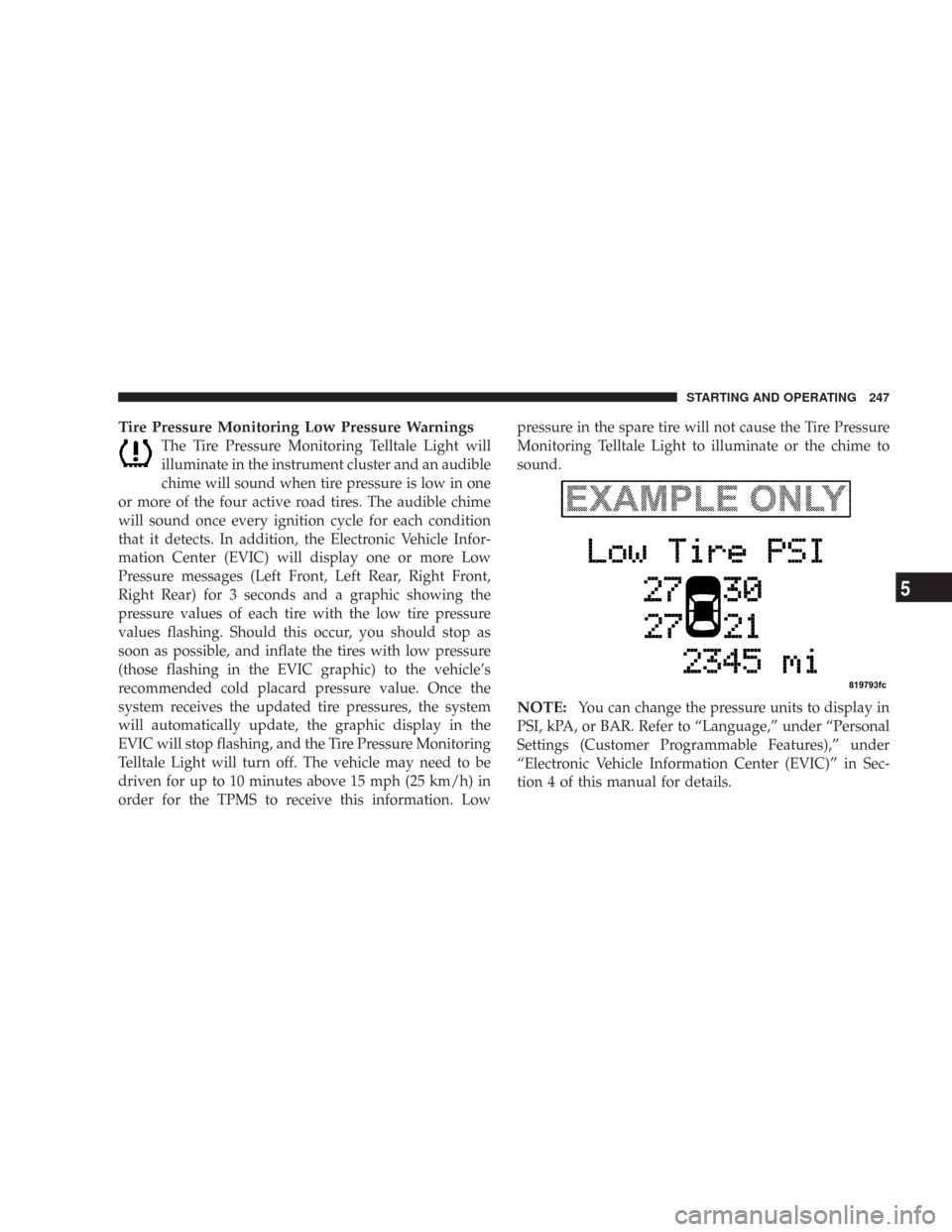
Tire Pressure Monitoring Low Pressure Warnings
The Tire Pressure Monitoring Telltale Light will
illuminate in the instrument cluster and an audible
chime will sound when tire pressure is low in one
or more of the four active road tires. The audible chime
will sound once every ignition cycle for each condition
that it detects. In addition, the Electronic Vehicle Infor-
mation Center (EVIC) will display one or more Low
Pressure messages (Left Front, Left Rear, Right Front,
Right Rear) for 3 seconds and a graphic showing the
pressure values of each tire with the low tire pressure
values flashing. Should this occur, you should stop as
soon as possible, and inflate the tires with low pressure
(those flashing in the EVIC graphic) to the vehicle’s
recommended cold placard pressure value. Once the
system receives the updated tire pressures, the system
will automatically update, the graphic display in the
EVIC will stop flashing, and the Tire Pressure Monitoring
Telltale Light will turn off. The vehicle may need to be
driven for up to 10 minutes above 15 mph (25 km/h) in
order for the TPMS to receive this information. Lowpressure in the spare tire will not cause the Tire Pressure
Monitoring Telltale Light to illuminate or the chime to
sound.
NOTE:You can change the pressure units to display in
PSI, kPA, or BAR. Refer to “Language,” under “Personal
Settings (Customer Programmable Features),” under
“Electronic Vehicle Information Center (EVIC)” in Sec-
tion 4 of this manual for details.
STARTING AND OPERATING 247
5
Page 249 of 384
NOTE:The compact spare tire (if so equipped) does not
have a tire pressure monitoring sensor. Therefore, the
TPMS will not monitor the pressure in the compact spare
tire. However, if you install the compact spare tire in
place of a road tire that has a pressure below the
low-pressure warning limit, the Tire Pressure Monitoring
Telltale Light will remain ON and a chime will still sound
each ignition key cycle. In addition, the EVIC will still
display a low-pressure message and a flashing pressure
value in the graphic display. Once you repair or replace
the original road tire, and reinstall it on the vehicle in
place of the compact spare, the TPMS will update auto-
matically. In addition, the Tire Pressure Monitoring Tell-
tale Light will turn OFF, and the graphic in the EVIC will
stop flashing and display a new pressure value, as long
no tire pressure is below the low-pressure warning limit
in any of the four active road tires. The vehicle may need
to be driven for up to 10 minutes above 15 mph (25
km/h) in order for the TPMS to receive this information.General Information
This device complies with part 15 of the FCC rules and
RSS 210 of Industry Canada. Operation is subject to the
following conditions:
•This device may not cause harmful interference.
•This device must accept any interference received,
including interference that may cause undesired op-
eration.
The tire pressure sensors are covered under one of the
following licenses:
United States.....................KR5S120123
Canada........................2671-S120123
STARTING AND OPERATING 249
5
Page 253 of 384
•The use of fuel additives, which are now being sold as
octane enhancers, are not recommended. Most of these
products contain high concentrations of methanol.
Fuel system damage or vehicle performance problems
resulting from the use of such fuels or additives are not
the responsibility of the manufacturer.
NOTE:Intentional tampering with emissions control
systems can result in civil penalties being assessed
against you.
Carbon Monoxide Warnings
WARNING!
Carbon monoxide (CO) in exhaust gases is deadly.
Follow the precautions below to prevent carbon
monoxide poisoning:
•Do not inhale exhaust gases. They contain carbon
monoxide, a colorless and odorless gas, which can kill.
Never run the engine in a closed area, such as a
garage, and never sit in a parked vehicle with the
engine running for an extended period. If the vehicle is
stopped in an open area with the engine running for
more than a short period, adjust the ventilation system
to force fresh, outside air into the vehicle.
•Guard against carbon monoxide with proper mainte-
nance. Have the exhaust system inspected every time
the vehicle is raised. Have any abnormal conditions
repaired promptly. Until repaired, drive with all side
windows fully open.
•Keep the trunk closed when driving your vehicle to
prevent carbon monoxide and other poisonous ex-
haust gases from entering the vehicle.
STARTING AND OPERATING 253
5