engine DODGE CHARGER 2008 6.G Repair Manual
[x] Cancel search | Manufacturer: DODGE, Model Year: 2008, Model line: CHARGER, Model: DODGE CHARGER 2008 6.GPages: 466, PDF Size: 6.37 MB
Page 289 of 466

Synchronizing ESP
The malfunction indicator light for the ESP is
combined with BAS indicator. If the power
supply is interrupted (battery disconnected or
discharged), the ESP/BAS malfunction indica-
tor light may illuminate with the engine running. If this
should occur, turn the steering wheel completely to the
left and then to the right. The ESP/BAS malfunction
indicator light should go out.
ESP/BAS Malfunction Indicator and ESP/TCS
Indicator Lights
The malfunction indicator light for the ESP is
combined with the BAS indicator. The yellow
ESP/BAS malfunction indicator light and the
yellow ESP/TCS indicator light in the instru-
ment cluster both come on when the ignition switch is
turned to the ªONº position. They should go out with the
engine running.The system will turn the ESP/BAS malfunction indicator
light on continuously while the engine running if it
detects a malfunction in either the ESP or the BAS or
both. If the light remains on after several ignition cycles,
and you have driven the vehicle several miles at speeds
greater than 30 mph (48 km/h), and the ESP is synchro-
nized (refer to Synchronizing ESP), see your authorized
dealer as soon as possible to have the problem diagnosed
and corrected.
STARTING AND OPERATING 289
5
Page 302 of 466

Compact Spare Tire Ð If Equipped
The compact spare is for temporary emergency use with
radial tires. It is engineered to be used on your style
vehicle only. Since this tire has limited tread life, the
original tire should be repaired (or replaced) and rein-
stalled at the first opportunity.
WARNING!
Temporary use spare tires are for emergency use only.
With these tires, do not drive more than 50 mph (80
km/h). Temporary-use spare tires have limited tread
life. When the tread is worn to the tread wear
indicators, the temporary use spare tire needs to be
replaced. Be sure to follow the warnings, which
apply to your spare. Failure to do so could result in
spare tire failure and loss of vehicle control.Do not install a wheel cover or attempt to mount a
conventional tire on the compact spare wheel, since the
wheel is designed specifically for the compact spare.
Do not install more than one compact spare tire/wheel
on the vehicle at any given time.
CAUTION!
Because of the reduced ground clearance, do not take
your vehicle through an automatic car wash with the
compact spare installed. Damage to the vehicle may
result.
Limited Use Spare Ð If Equipped
The limited use spare tire is for temporary emergency use
on your vehicle. This tire is identified by a limited use
spare tire warning label located on the limited use spare
tire and wheel assembly. This tire may look like the
302 STARTING AND OPERATING
Page 319 of 466

The tire pressure sensors are covered under one of the
following licenses:
United States.....................KR5S120123
Canada........................2671-S120123
FUEL REQUIREMENTS
2.7L Engine
The 2.7L engine is designed to meet all
emissions regulations and provide excel-
lent fuel economy and performance when
using high quality unleaded ªregularº
gasoline having an octane rating of 87. The
use of premium gasoline is not recom-
mended. Under normal conditions, the use of premium
gasoline will not provide a benefit over high quality
regular gasolines, and in some circumstances may result
in poorer performance.
3.5L and 5.7L Engines
The 3.5L & 5.7L engine is designed to meet
all emissions regulations and provide sat-
isfactory fuel economy and performance
when using high quality unleaded gaso-
line having an octane range of 87 to 89. The
manufacturer recommends the use of 89
octane for optimum performance. The use of premium
gasoline is not recommended. Under normal conditions,
the use of premium gasoline will not provide a benefit
over high quality regular and mid-grade gasolines, and
in some circumstances may result in poorer performance.
Light spark knock at low engine speeds is not harmful to
your engine. However, continued heavy spark knock at
high speeds can cause damage and immediate service is
required. Poor quality gasoline can cause problems such
as hard starting, stalling, and hesitations. If you experi-
ence these symptoms, try another brand of gasoline
before considering service for the vehicle.
STARTING AND OPERATING 319
5
Page 320 of 466

Over 40 auto manufacturers worldwide have issued and
endorsed consistent gasoline specifications (the World-
wide Fuel Charter, WWFC) which define fuel properties
necessary to deliver enhanced emissions, performance,
and durability for your vehicle. The manufacturer recom-
mends the use of gasoline that meets the WWFC speci-
fications if they are available.
Reformulated Gasoline
Many areas of the country require the use of cleaner
burning gasoline referred to as ªReformulated Gasoline.º
Reformulated gasolines contain oxygenates, and are spe-
cifically blended to reduce vehicle emissions and im-
prove air quality.
The manufacturer supports the use of reformulated gaso-
lines. Properly blended reformulated gasolines will pro-
vide excellent performance and durability of engine and
fuel system components.
Gasoline/Oxygenate Blends
Some fuel suppliers blend unleaded gasoline with oxy-
genates such as 10% ethanol, MTBE, and ETBE. Oxygen-
ates are required in some areas of the country during the
winter months to reduce carbon monoxide emissions.
Fuels blended with these oxygenates may be used in
your vehicle.
CAUTION!
DO NOT use gasolines containing Methanol or E85
Ethanol. Use of these blends may result in starting
and driveability problems and may damage critical
fuel system components.
320 STARTING AND OPERATING
Page 322 of 466

²The use of leaded gas is prohibited by Federal law.
Using leaded gasoline can impair engine performance,
and damage the emission control system.
²An out-of-tune engine, or certain fuel or ignition
malfunctions, can cause the catalytic converter to
overheat. If you notice a pungent burning odor or
some light smoke, your engine may be out of tune or
malfunctioning and may require immediate service.
Contact your dealer for service assistance.
²The use of fuel additives, which are now being sold as
octane enhancers, is not recommended. Most of these
products contain high concentrations of methanol.
Fuel system damage or vehicle performance problems
resulting from the use of such fuels or additives is not
the responsibility of the manufacturer.
NOTE:Intentional tampering with emissions control
systems can result in civil penalties being assessed
against you.
Carbon Monoxide Warnings
WARNING!
Carbon monoxide (CO) in exhaust gases is deadly.
Follow the precautions below to prevent carbon
monoxide poisoning:
²Do not inhale exhaust gases. They contain carbon
monoxide, a colorless and odorless gas, which can kill.
Never run the engine in a closed area, such as a
garage, and never sit in a parked vehicle with the
engine running for an extended period. If the vehicle is
stopped in an open area with the engine running for
more than a short period, adjust the ventilation system
to force fresh, outside air into the vehicle.
322 STARTING AND OPERATING
Page 325 of 466
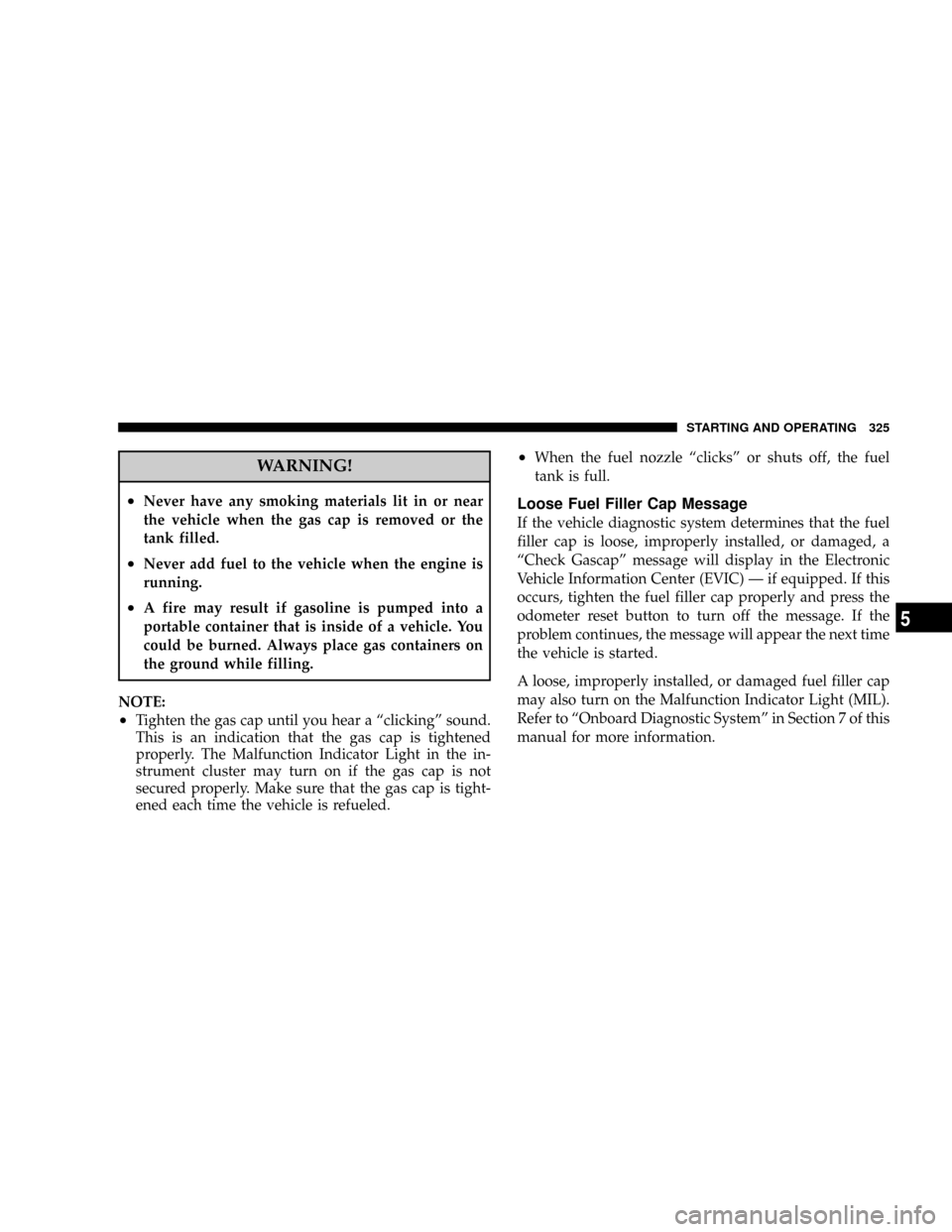
WARNING!
²Never have any smoking materials lit in or near
the vehicle when the gas cap is removed or the
tank filled.
²Never add fuel to the vehicle when the engine is
running.
²A fire may result if gasoline is pumped into a
portable container that is inside of a vehicle. You
could be burned. Always place gas containers on
the ground while filling.
NOTE:
²Tighten the gas cap until you hear a ªclickingº sound.
This is an indication that the gas cap is tightened
properly. The Malfunction Indicator Light in the in-
strument cluster may turn on if the gas cap is not
secured properly. Make sure that the gas cap is tight-
ened each time the vehicle is refueled.
²When the fuel nozzle ªclicksº or shuts off, the fuel
tank is full.
Loose Fuel Filler Cap Message
If the vehicle diagnostic system determines that the fuel
filler cap is loose, improperly installed, or damaged, a
ªCheck Gascapº message will display in the Electronic
Vehicle Information Center (EVIC) Ð if equipped. If this
occurs, tighten the fuel filler cap properly and press the
odometer reset button to turn off the message. If the
problem continues, the message will appear the next time
the vehicle is started.
A loose, improperly installed, or damaged fuel filler cap
may also turn on the Malfunction Indicator Light (MIL).
Refer to ªOnboard Diagnostic Systemº in Section 7 of this
manual for more information.
STARTING AND OPERATING 325
5
Page 334 of 466
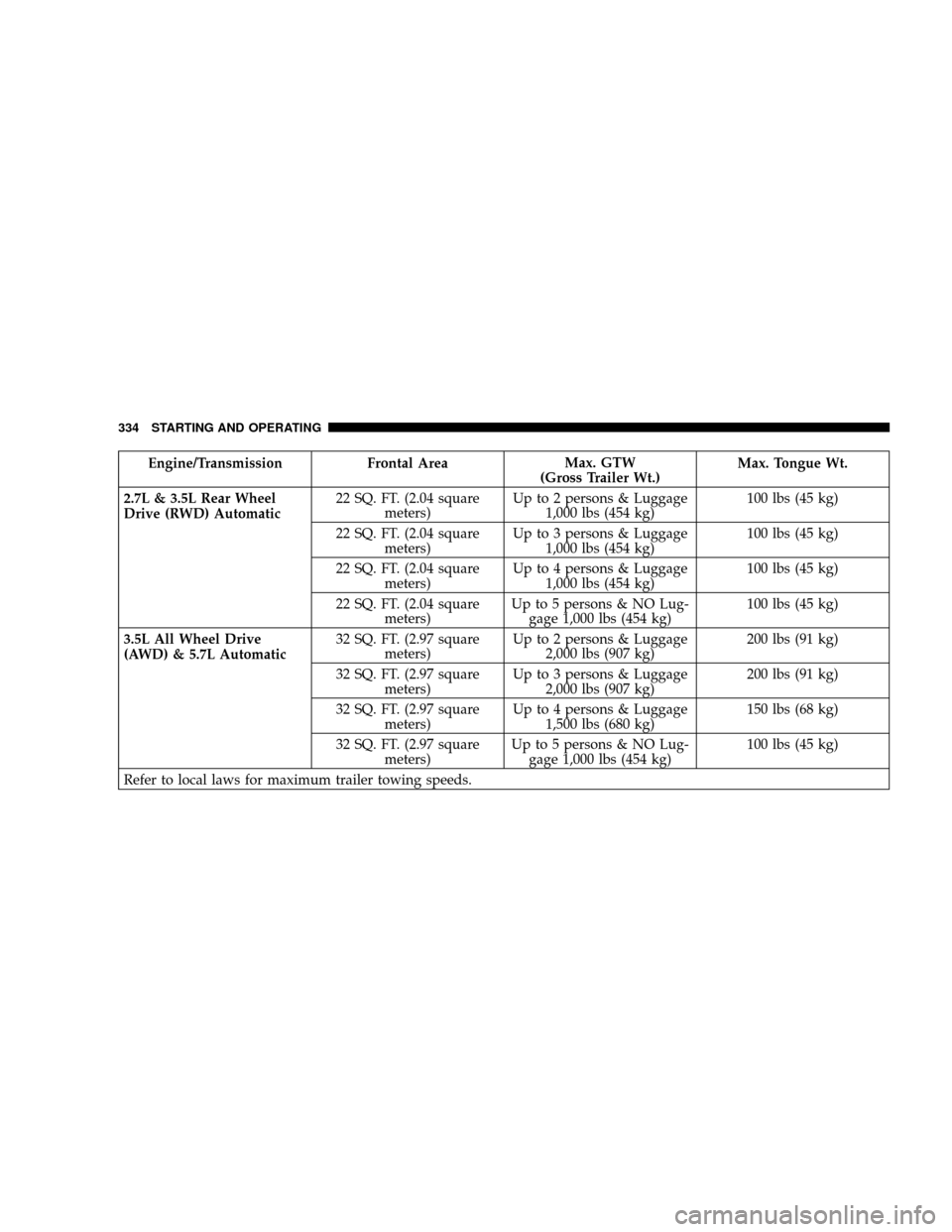
Engine/Transmission Frontal AreaMax. GTW
(Gross Trailer Wt.)Max. Tongue Wt.
2.7L & 3.5L Rear Wheel
Drive (RWD) Automatic22 SQ. FT. (2.04 square
meters)Up to 2 persons & Luggage
1,000 lbs (454 kg)100 lbs (45 kg)
22 SQ. FT. (2.04 square
meters)Up to 3 persons & Luggage
1,000 lbs (454 kg)100 lbs (45 kg)
22 SQ. FT. (2.04 square
meters)Up to 4 persons & Luggage
1,000 lbs (454 kg)100 lbs (45 kg)
22 SQ. FT. (2.04 square
meters)Up to 5 persons & NO Lug-
gage 1,000 lbs (454 kg)100 lbs (45 kg)
3.5L All Wheel Drive
(AWD) & 5.7L Automatic32 SQ. FT. (2.97 square
meters)Up to 2 persons & Luggage
2,000 lbs (907 kg)200 lbs (91 kg)
32 SQ. FT. (2.97 square
meters)Up to 3 persons & Luggage
2,000 lbs (907 kg)200 lbs (91 kg)
32 SQ. FT. (2.97 square
meters)Up to 4 persons & Luggage
1,500 lbs (680 kg)150 lbs (68 kg)
32 SQ. FT. (2.97 square
meters)Up to 5 persons & NO Lug-
gage 1,000 lbs (454 kg)100 lbs (45 kg)
Refer to local laws for maximum trailer towing speeds.
334 STARTING AND OPERATING
Page 337 of 466

²When hauling cargo, or towing a trailer, do not
overload your vehicle or trailer. Overloading can cause
a loss of control, poor performance, or damage to
brakes, axle, engine, transmission, steering, suspen-
sion, chassis structure, or tires.
²Safety chains must always be used between your
vehicle and trailer. Always connect the chains to the
frame or hook retainers of the vehicle hitch. Cross the
chains under the trailer tongue and allow enough
slack for turning corners.
²Vehicles with trailers should not be parked on a grade.
When parking, apply the parking brake on the tow
vehicle. Put the tow vehicle automatic transmission in
P for Park. Always, block or9chock9the trailer wheels.
²GCWR must not be exceeded.
²Total weight must be distributed between the tow
vehicle and the trailer such that the following four
ratings are not exceeded:1. GVWR
2. GTW
3. GAWR
4. Tongue weight rating for the trailer hitch utilized
(This requirement may limit the ability to always
achieve the 10% to 15% range of tongue weight as a
percentage of total trailer weight).
Towing Requirements Ð Tires
þ
Do not attempt to tow a trailer while using a compact
spare tire.
þProper tire inflation pressures are essential to the safe
and satisfactory operation of your vehicle. Refer to
ªTires±General Informationº in this section for infor-
mation on tire pressures and for proper tire inflation
procedures.
STARTING AND OPERATING 337
5
Page 341 of 466

Towing Tips
Before setting out on a trip, practice turning, stopping,
and backing the trailer in an area located away from
heavy traffic.
Towing Tips Ð Automatic Transmission
The ªDº range can be selected when towing. However, if
frequent shifting occurs while in this range, the ª3º range
should be selected.
NOTE:Using the ª3º range while operating the vehicle
under heavy operating conditions will improve perfor-
mance and extend transmission life by reducing exces-
sive shifting and heat build up. This action will also
provide better engine braking.
If you REGULARLY tow a trailer for more than 45
minutes of continuous operation, then change the auto-
matic transamission fluid and filter according to the
interval specified for ªpolice, taxi, fleet, or frequent trailer
towingº in the ªMaintenance Scheduleº in this manual.
Towing Tips Ð Electronic Speed Control (If
Equipped)
þ
Don't use in hilly terrain or with heavy loads.
þWhen using the speed control, if you experience speed
drops greater than 10 mph (16 km/h), disengage until
you can get back to cruising speed.
þUse speed control in flat terrain and with light loads to
maximize fuel efficiency.
Towing Tips Ð Autostickt(If Equipped)
þ
For vehicles equipped with Autostick.tBy using the
Autosticktmodes, and selecting a specific gear range,
frequent shifting can be avoided. The highest gear
range should be selected that allows for adequate
performance. For example, choose ª4º if the desired
speed can be maintained. Choose ª3º or ª2º if needed
to maintain the desired speed.
STARTING AND OPERATING 341
5
Page 342 of 466

þExtended driving at high RPM should be avoided to
prevent excess heat generation. A reduction in vehicle
speed may be required to avoid extended driving at
high RPM. Return to a higher gear range or vehicle
speed when road conditions and RPM level allows.
Towing Tips Ð Cooling System
To reduce potential for engine and transmission over-
heating, take the following actions:
þCity Driving
When stopped for short periods, put transmission in ªNº
(Neutral) and increase engine idle speed.
þHighway Driving
Reduce speed.
þAir Conditioning
Turn off temporarily.
þRefer to ªCooling Systemº under ªMaintenance Pro-
ceduresº in Section 7 of this manual for more informa-
tion.
RECREATIONAL TOWING (BEHIND
MOTORHOME, ETC.)
TOWING THIS VEHICLE BEHIND ANOTHER
VEHICLE (Flat towing with all four wheels on the
ground)
Recreational towing for this vehicle is not recommended.
NOTE:If the vehicle requires towing, make sure all four
wheels are off the ground.
342 STARTING AND OPERATING