phone DODGE CHARGER 2012 7.G Manual PDF
[x] Cancel search | Manufacturer: DODGE, Model Year: 2012, Model line: CHARGER, Model: DODGE CHARGER 2012 7.GPages: 594, PDF Size: 4.48 MB
Page 567 of 594
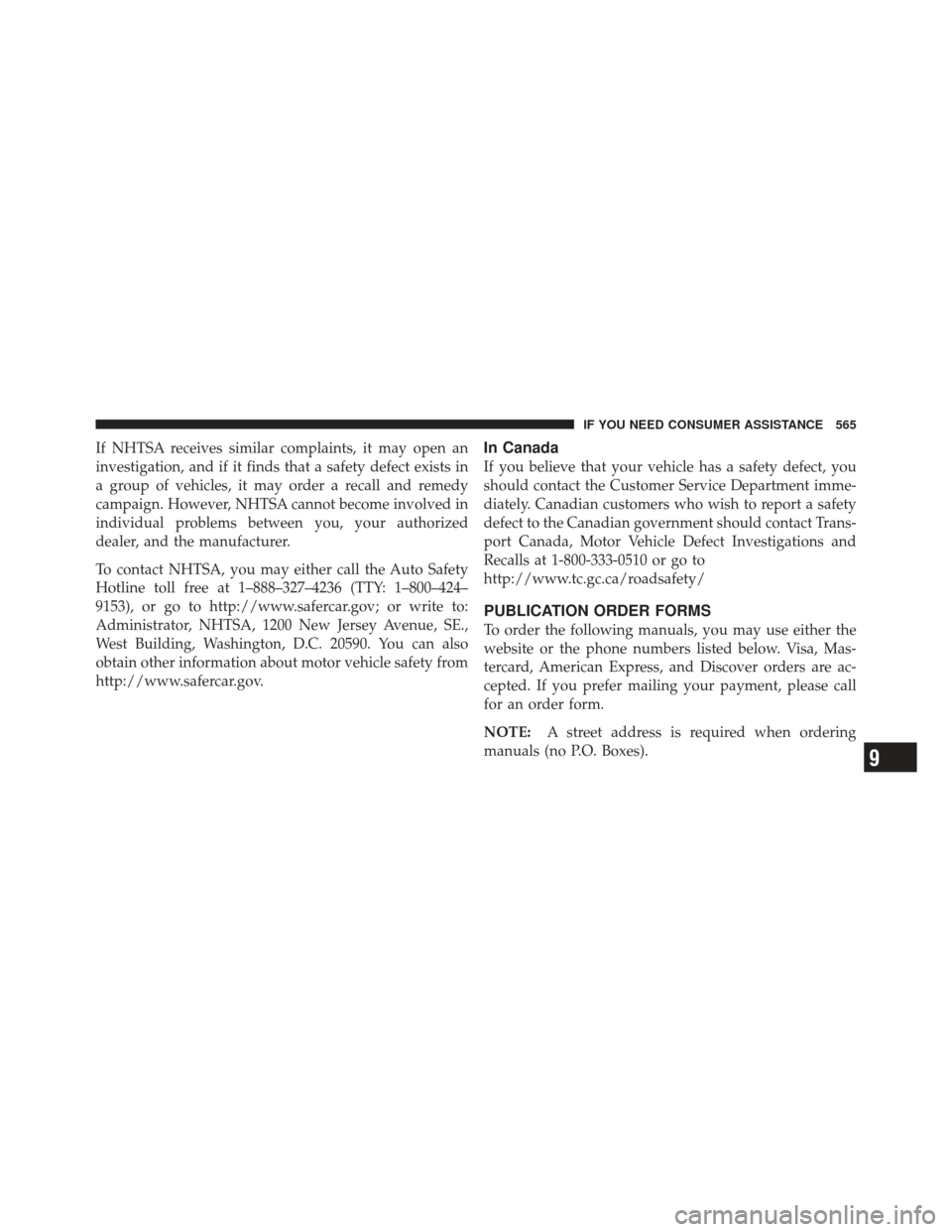
If NHTSA receives similar complaints, it may open an
investigation, and if it finds that a safety defect exists in
a group of vehicles, it may order a recall and remedy
campaign. However, NHTSA cannot become involved in
individual problems between you, your authorized
dealer, and the manufacturer.
To contact NHTSA, you may either call the Auto Safety
Hotline toll free at 1–888–327–4236 (TTY: 1–800–424–
9153), or go to http://www.safercar.gov; or write to:
Administrator, NHTSA, 1200 New Jersey Avenue, SE.,
West Building, Washington, D.C. 20590. You can also
obtain other information about motor vehicle safety from
http://www.safercar.gov.In Canada
If you believe that your vehicle has a safety defect, you
should contact the Customer Service Department imme-
diately. Canadian customers who wish to report a safety
defect to the Canadian government should contact Trans-
port Canada, Motor Vehicle Defect Investigations and
Recalls at 1-800-333-0510 or go to
http://www.tc.gc.ca/roadsafety/
PUBLICATION ORDER FORMS
To order the following manuals, you may use either the
website or the phone numbers listed below. Visa, Mas-
tercard, American Express, and Discover orders are ac-
cepted. If you prefer mailing your payment, please call
for an order form.
NOTE:A street address is required when ordering
manuals (no P.O. Boxes).
9
IF YOU NEED CONSUMER ASSISTANCE 565
Page 574 of 594
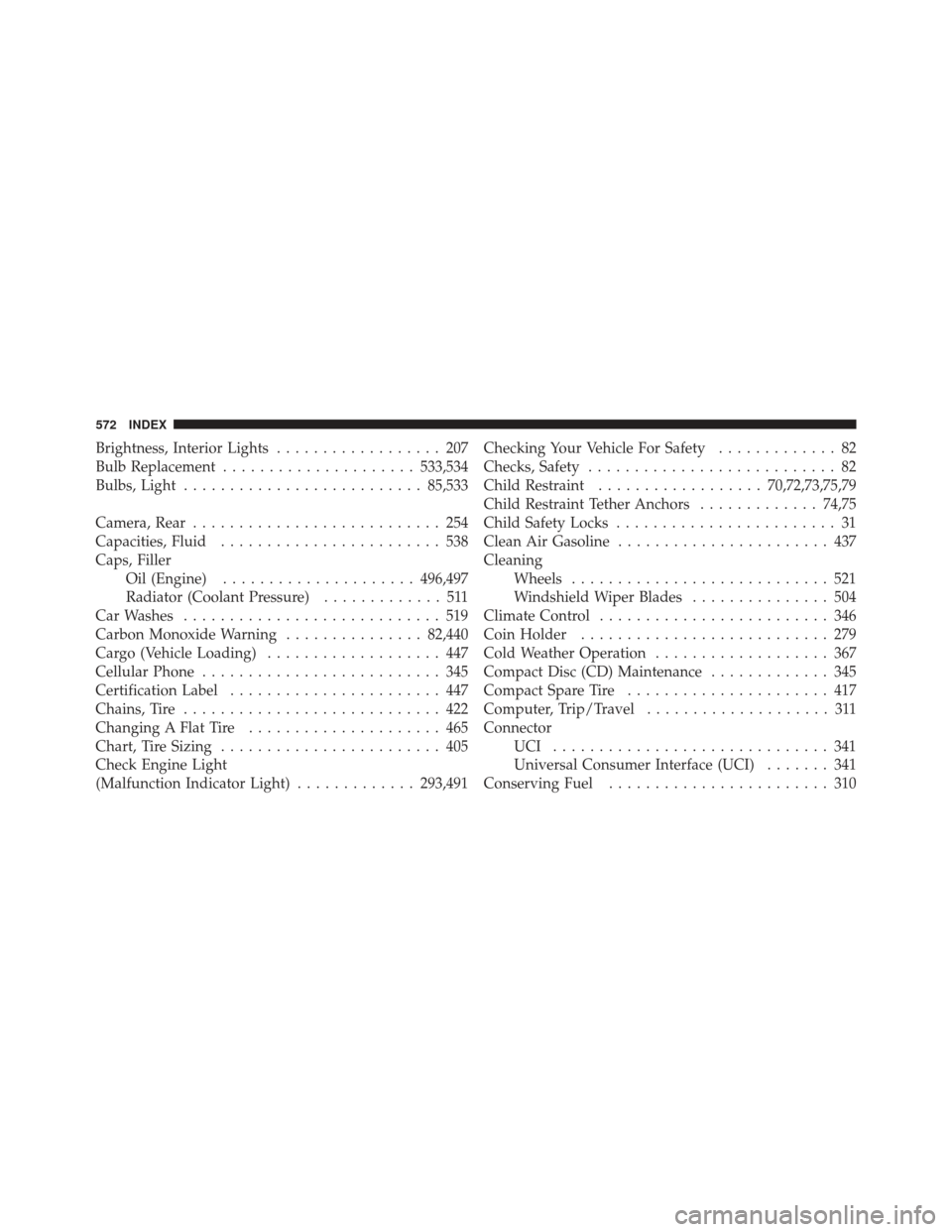
Brightness, Interior Lights.................. 207
Bulb Replacement ..................... 533,534
Bulbs, Light .......................... 85,533
Camera, Rear ........................... 254
Capacities, Fluid ........................ 538
Caps, Filler Oil (Engine) ..................... 496,497
Radiator (Coolant Pressure) ............. 511
Car Washes ............................ 519
Carbon Monoxide Warning ...............82,440
Cargo (Vehicle Loading) ................... 447
Cellular Phone .......................... 345
Certification Label ....................... 447
Chains, Tire ............................ 422
Changing A Flat Tire ..................... 465
Chart, Tire Sizing ........................ 405
Check Engine Light
(Malfunction Indicator Light) .............293,491Checking Your Vehicle For Safety
............. 82
Checks, Safety ........................... 82
Child Restraint .................. 70,72,73,75,79
Child Restraint Tether Anchors .............74,75
Child Safety Locks ........................ 31
Clean Air Gasoline ....................... 437
Cleaning Wheels ............................ 521
Windshield Wiper Blades ............... 504
Climate Control ......................... 346
Coin Holder ........................... 279
Cold Weather Operation ................... 367
Compact Disc (CD) Maintenance ............. 345
Compact Spare Tire ...................... 417
Computer, Trip/Travel .................... 311
Connector UCI .............................. 341
Universal Consumer Interface (UCI) ....... 341
Conserving Fuel ........................ 310
572 INDEX
Page 593 of 594
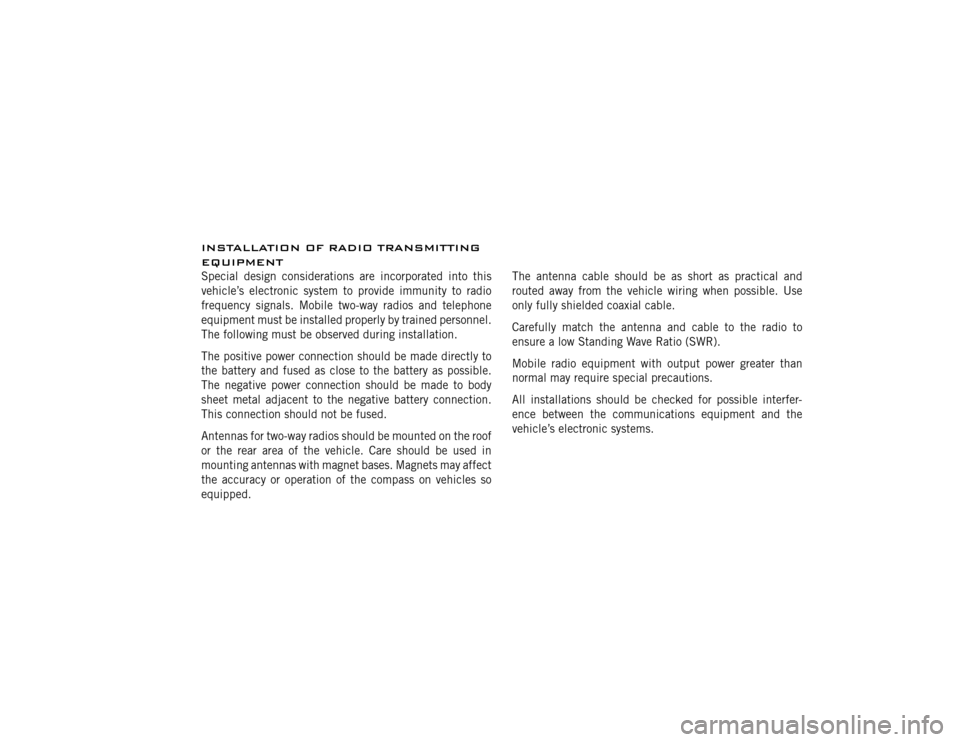
INSTALLATION OF RADIO TRANSMITTING
EQUIPMENTSpecial design considerations are incorporated into this
vehicle’s electronic system to provide immunity to radio
frequency signals. Mobile two-way radios and telephone
equipment must be installed properly by trained personnel.
The following must be observed during installation.
The positive power connection should be made directly to
the battery and fused as close to the battery as possible.
The negative power connection should be made to body
sheet metal adjacent to the negative battery connection.
This connection should not be fused.
Antennas for two-way radios should be mounted on the roof
or the rear area of the vehicle. Care should be used in
mounting antennas with magnet bases. Magnets may affect
the accuracy or operation of the compass on vehicles so
equipped.The antenna cable should be as short as practical and
routed away from the vehicle wiring when possible. Use
only fully shielded coaxial cable.
Carefully match the antenna and cable to the radio to
ensure a low Standing Wave Ratio (SWR).
Mobile radio equipment with output power greater than
normal may require special precautions.
All installations should be checked for possible interfer-
ence between the communications equipment and the
vehicle’s electronic systems.