check engine DODGE CHARGER 2013 7.G Owner's Manual
[x] Cancel search | Manufacturer: DODGE, Model Year: 2013, Model line: CHARGER, Model: DODGE CHARGER 2013 7.GPages: 631, PDF Size: 4.58 MB
Page 542 of 631
Checking Oil Level – 5.7L Engine
To assure proper engine lubrication, the engine oil must
be maintained at the correct level. Check the oil level at
regular intervals, such as every fuel stop. The best time to
check the engine oil level is about five minutes after a
fully warmed engine is shut off.
Checking the oil while the vehicle is on level ground will
improve the accuracy of the oil level readings. Maintain
the oil level in the “SAFE” range. Adding 1.0 qt (1.0 L) of
oil when the reading is at the bottom of the “SAFE” range
will result in an oil level at the top of the “SAFE” range
on these engines.
CAUTION!
Overfilling or underfilling will cause oil aeration or
loss of oil pressure. This could damage your engine.
Change Engine Oil
The oil change indicator system will remind you that it is
time to take your vehicle in for scheduled maintenance.
Refer to the “Maintenance Schedule” for further informa-
tion.
NOTE:Under no circumstances should oil change inter-
vals exceed 10,000 miles (16,000 km) or twelve months,
whichever occurs first.
Engine Oil Selection
For best performance and maximum protection under all
types of operating conditions, the manufacturer only
recommends engine oils that are API Certified and meet
the requirements of Chrysler Material Standard MS-6395.
540 MAINTAINING YOUR VEHICLE
Page 552 of 631
Adding Washer Fluid
The windshield washer fluid reservoir is located in the
front of the engine compartment. Be sure to check the
fluid level at regular intervals. Fill the reservoir with
windshield washer solvent (not radiator antifreeze) and
operate the system for a few seconds to flush out the
residual water.
When refilling the washer fluid reservoir, apply some
washer fluid to a cloth or towel and wipe the wiper
blades clean. This will help blade performance.
To prevent freeze-up of your windshield washer system
in cold weather, select a solution or mixture that meets or
exceeds the temperature range of your climate. This
rating information can be found on most washer fluid
containers.The fluid reservoir will hold nearly 1 gal (4 L) of washer
fluid when the message “Low Washer Fluid” appears in
the Electronic Vehicle Information Center (EVIC) (if
equipped).
WARNING!
Commercially available windshield washer solvents
are flammable. They could ignite and burn you. Care
must be exercised when filling or working around
the washer solution.
Exhaust System
The best protection against carbon monoxide entry into
the vehicle body is a properly maintained engine exhaust
system.
550 MAINTAINING YOUR VEHICLE
Page 555 of 631
Cooling System
WARNING!
•When working near the radiator cooling fan, dis-
connect the fan motor lead or turn the ignition
switch to the LOCK position. The fan is tempera-
ture controlled and can start at any time the igni-
tion switch is in the ON position.
• You or others can be badly burned by hot engine
coolant (antifreeze) or steam from your radiator. If
you see or hear steam coming from under the hood,
do not open the hood until the radiator has had
time to cool. Never try to open a cooling system
pressure cap when the radiator is hot.
Coolant Checks
Check engine coolant (antifreeze) protection every
12 months (before the onset of freezing weather, where
applicable). If the engine coolant (antifreeze) is dirty or
rusty in appearance, the system should be drained,
flushed, and refilled with fresh coolant. Check the front
of the radiator for any accumulation of bugs, leaves, etc.
If dirty, clean by gently spraying water from a garden
hose vertically down the face of the condenser.
Check the coolant recovery bottle tubing for brittle rubber,
cracking, tears, cuts, and tightness of the connection at the
bottle and radiator. Inspect the entire system for leaks.
With the engine at normal operating temperature (but
not running), check the cooling system pressure cap for
proper vacuum sealing by draining a small amount of
engine coolant (antifreeze) from the radiator drain cock.7
MAINTAINING YOUR VEHICLE 553
Page 559 of 631
Disposal Of Used Engine Coolant
Used ethylene glycol-based engine coolant (antifreeze) is
a regulated substance requiring proper disposal. Check
with your local authorities to determine the disposal
rules for your community. To prevent ingestion by ani-
mals or children, do not store ethylene glycol-based
engine coolant in open containers or allow it to remain in
puddles on the ground. If ingested by a child or pet, seek
emergency assistance immediately. Clean up any ground
spills immediately.
Coolant Level
The coolant bottle provides a quick visual method for
determining that the coolant level is adequate. With the
engine OFF and cold, the level of the engine coolant
(antifreeze) in the bottle should be between the ranges
indicated on the bottle.The radiator normally remains completely full, so there is
no need to remove the radiator cap unless checking for
engine coolant (antifreeze) freeze point or replacing cool-
ant. Advise your service attendant of this. As long as the
engine operating temperature is satisfactory, the coolant
bottle need only be checked once a month.
When additional engine coolant (antifreeze) is needed to
maintain the proper level, only OAT coolant that meets the
requirements of Chrysler Material Standard MS-12106
should be added to the coolant bottle. Do not overfill.
Points To Remember
NOTE:
When the vehicle is stopped after a few miles/
kilometers of operation, you may observe vapor coming
from the front of the engine compartment. This is nor-
mally a result of moisture from rain, snow, or high
humidity accumulating on the radiator and being vapor-
ized when the thermostat opens, allowing hot engine
coolant (antifreeze) to enter the radiator.7
MAINTAINING YOUR VEHICLE 557
Page 560 of 631
If an examination of your engine compartment shows no
evidence of radiator or hose leaks, the vehicle may be
safely driven. The vapor will soon dissipate.
•Do not overfill the coolant expansion bottle.
• Check the coolant freeze point in the radiator and in
the coolant expansion bottle. If engine coolant (anti-
freeze) needs to be added, the contents of the coolant
expansion bottle must also be protected against
freezing.
• If frequent engine coolant (antifreeze) additions are
required, the cooling system should be pressure tested
for leaks. •Maintain engine coolant (antifreeze) concentration at a
minimum of 50% OAT coolant (conforming to MS-12106)
and distilled water for proper corrosion protection of
your engine which contains aluminum components.
• Make sure that the coolant expansion bottle overflow
hoses are not kinked or obstructed.
• Keep the front of the radiator clean. If your vehicle is
equipped with air conditioning, keep the front of the
condenser clean.
•
Do not change the thermostat for Summer or Winter
operation. If replacement is ever necessary, install ONLY
the correct type thermostat. Other designs may result in
unsatisfactory engine coolant (antifreeze) performance,
poor gas mileage, and increased emissions.
558 MAINTAINING YOUR VEHICLE
Page 564 of 631
Special Additives
The manufacturer strongly recommends against using
any special additives in the transmission.
Automatic Transmission Fluid (ATF) is an engineered
product and its performance may be impaired by supple-
mental additives. Therefore, do not add any fluid addi-
tives to the transmission. The only exception to this
policy is the use of special dyes for diagnosing fluid
leaks. Avoid using transmission sealers as they may
adversely affect seals.
CAUTION!
Do not use chemical flushes in your transmission as
the chemicals can damage your transmission compo-
nents. Such damage is not covered by the New
Vehicle Limited Warranty.
Fluid Level Check
The fluid level is preset at the factory and does not require
adjustment under normal operating conditions. Routine
fluid level checks are not required, therefore the transmis-
sion has no dipstick. Your authorized dealer can check your
transmission fluid level using special service tools.
If you notice fluid leakage or transmission malfunction,
visit your authorized dealer immediately to have the
transmission fluid level checked. Operating the vehicle
with an improper fluid level can cause severe transmis-
sion damage.
CAUTION!
•If a transmission fluid leak occurs, visit your au-
thorized dealer immediately. Severe transmission
damage may occur. Your authorized dealer has the
proper tools to adjust the fluid level accurately.
562 MAINTAINING YOUR VEHICLE
Page 591 of 631
NOTE:Under no circumstances should oil change inter-
vals exceed 10,000 miles (16,000 km) or twelve months,
whichever comes first.
Once A Month Or Before A Long Trip:
• Check engine oil level
• Check windshield washer fluid level
• Check the tire inflation pressures and look for unusual
wear or damage
• Check the fluid levels of the coolant reservoir, brake
master cylinder, power steering and transmission as
needed
• Check function of all interior and exterior lights
Required Maintenance Intervals.
Refer to the maintenance schedules on the following
page for the required maintenance intervals.At Every Oil Change Interval As Indicated By Oil Change Indicator System:
•Change oil and filter
• Rotate the tires. Rotate at the first sign of
irregular wear, even if it occurs before the
oil indicator system turns on.
• Inspect battery and clean and tighten terminals as
required
• Inspect automatic transmission fluid if equipped
with dipstick
• Inspect brake pads, shoes, rotors, drums, hoses
and park brake
• Inspect engine cooling system protection and
hoses
• Inspect exhaust system
• Inspect engine air cleaner if using in dusty or
off-road conditions
8
M
A I
N T
E
N
A
N
C E
S
C
H E
D
U L
E
SMAINTENANCE SCHEDULES 589
Page 612 of 631
Brightness, Interior Lights...................228
Bulb Replacement ........................ .579
Bulbs, Light ............................ .102
Camera, Rear ........................... .279
Capacities, Fluid ......................... .584
Caps, Filler Oil (Engine) .......................... .541
Radiator (Coolant Pressure) ................556
Carbon Monoxide Warning ...................99
Cargo (Vehicle Loading) ....................489
Car Washes ............................ .565
Cellular Phone .......................... .375
Certification Label ........................ .489
Chains, Tire ............................ .463
Changing A Flat Tire ...................... .509
Chart, Tire Sizing ........................ .443
Check Engine Light (Malfunction Indicator Light) . .319
Checking Your Vehicle For Safety ...............98Checks, Safety
............................98
Child Restraint ............................76
Child Safety Locks .........................33
Clean Air Gasoline ....................... .477
Cleaning Wheels .............................. .566
Climate Control ......................... .375
Coin Holder ............................ .304
Cold Weather Operation ....................397
Compact Disc (CD) Maintenance ..............374
Compact Spare Tire ....................... .458
Computer, Trip/Travel ..................... .338
Connector UCI................................ .371
Universal Consumer Interface (UCI) ..........371
Conserving Fuel ......................... .336
Console, Floor .......................... .304
Contract, Service ......................... .600
Coolant Pressure Cap (Radiator Cap) ...........556
610 INDEX
Page 614 of 631
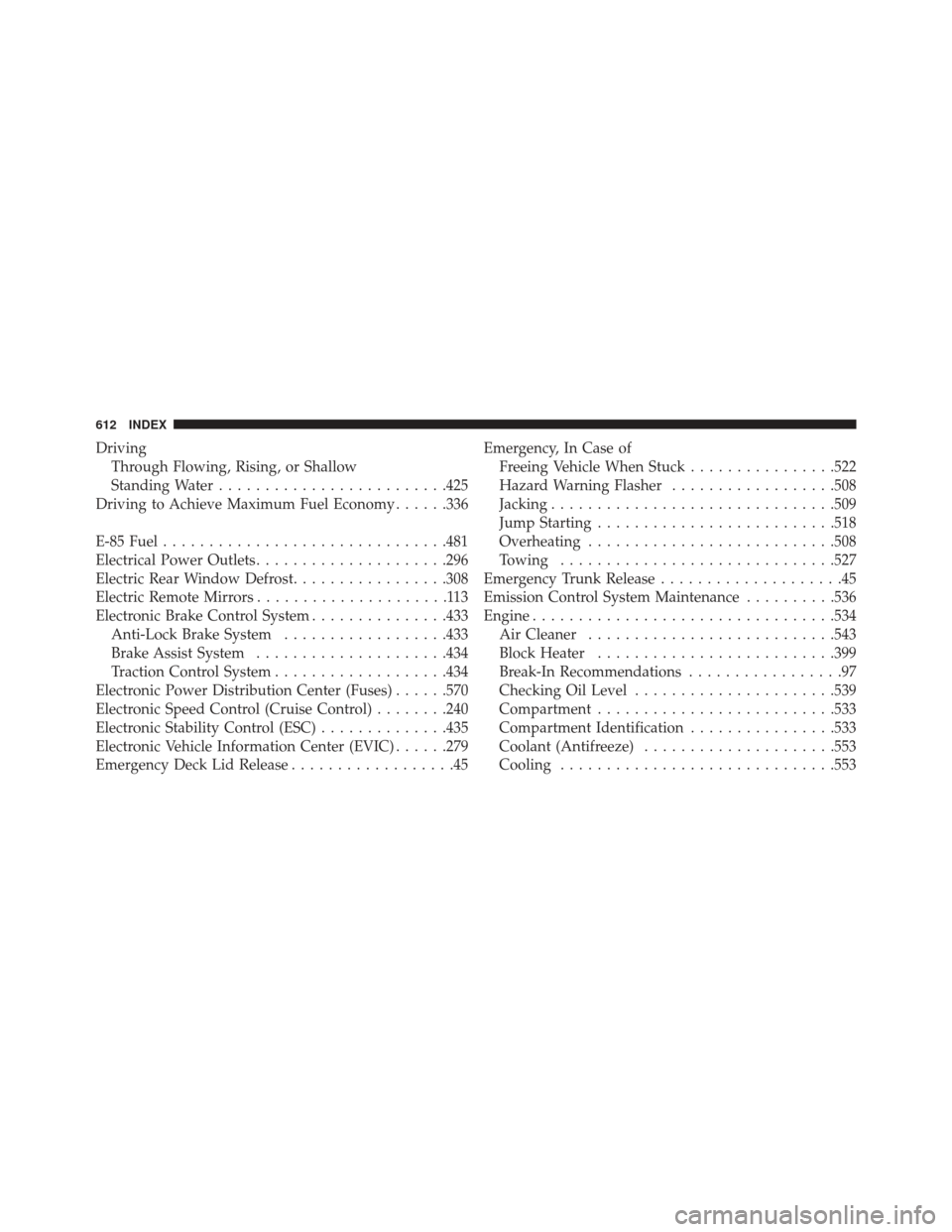
DrivingThrough Flowing, Rising, or Shallow
Standing Water ........................ .425
Driving to Achieve Maximum Fuel Economy ......336
E-85 Fuel .............................. .481
Electrical Power Outlets .....................296
Electric Rear Window Defrost .................308
Electric Remote Mirrors .....................113
Electronic Brake Control System ...............433
Anti-Lock Brake System ..................433
Brake Assist System .....................434
Traction Control System ...................434
Electronic Power Distribution Center (Fuses) ......570
Electronic Speed Control (Cruise Control) ........240
Electronic Stability Control (ESC) ..............435
Electronic Vehicle Information Center (EVIC) ......279
Emergency Deck Lid Release ..................45Emergency, In Case of
Freeing Vehicle When Stuck ................522
Hazard Warning Flasher ..................508
Jacking .............................. .509
Jump Starting ......................... .518
Overheating .......................... .508
Towing ............................. .527
Emergency Trunk Release ....................45
Emission Control System Maintenance ..........536
Engine ................................ .534
Air Cleaner .......................... .543
Block Heater ......................... .399
Break-In Recommendations .................97
Checking Oil Level ..................... .539
Compartment ......................... .533
Compartment Identification ................533
Coolant (Antifreeze) .....................553
Cooling ............................. .553
612 INDEX
Page 616 of 631
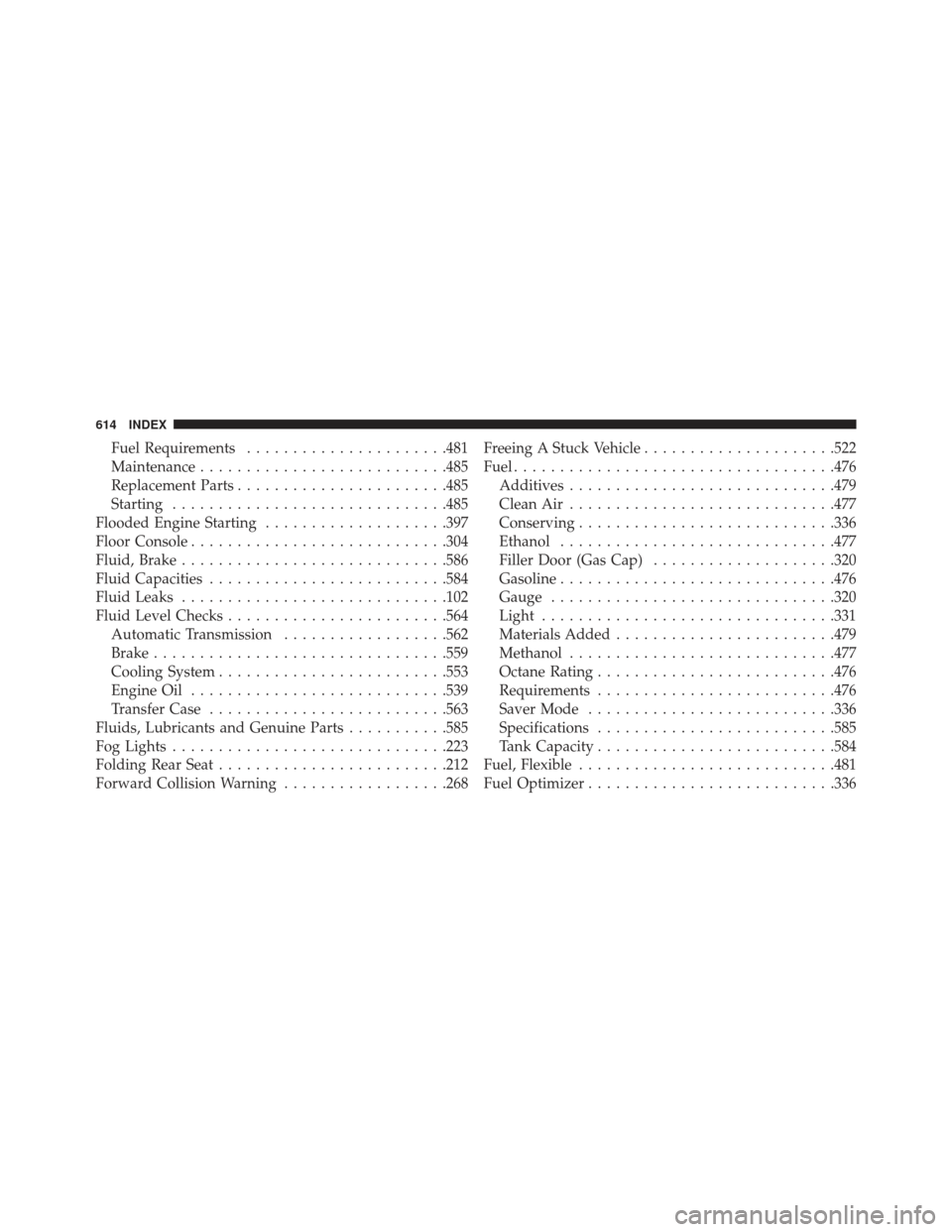
Fuel Requirements..................... .481
Maintenance .......................... .485
Replacement Parts ...................... .485
Starting ............................. .485
Flooded Engine Starting ....................397
Floor Console ........................... .304
Fluid, Brake ............................ .586
Fluid Capacities ......................... .584
Fluid Leaks ............................ .102
Fluid Level Checks ....................... .564
Automatic Transmission ..................562
Brake ............................... .559
Cooling System ........................ .553
Engine Oil ........................... .539
Transfer Case ......................... .563
Fluids, Lubricants and Genuine Parts ...........585
Fog Lights ............................. .223
Folding Rear Seat ........................ .212
Forward Collision Warning ..................268 Freeing A Stuck Vehicle
.....................522
Fuel .................................. .476
Additives ............................ .479
Clean Air ............................ .477
Conserving ........................... .336
Ethanol ............................. .477
Filler Door (Gas Cap) ....................320
Gasoline ............................. .476
Gauge .............................. .320
Light ............................... .331
Materials Added ....................... .479
Methanol ............................ .477
Octane Rating ......................... .476
Requirements ......................... .476
Saver Mode .......................... .336
Specifications ......................... .585
T
ank Capacity ......................... .584
Fuel, Flexible ........................... .481
Fuel Optimizer .......................... .336
614 INDEX