transmission DODGE CHARGER 2014 7.G Owner's Manual
[x] Cancel search | Manufacturer: DODGE, Model Year: 2014, Model line: CHARGER, Model: DODGE CHARGER 2014 7.GPages: 148, PDF Size: 3.77 MB
Page 103 of 148
BATTERY LOCATION
The battery is stored under an access cover in the trunk. Remote battery posts are located
on the right side of the engine compartment for jump-starting.
JUMP-STARTING
If your vehicle has a discharged battery it can be jump-started using a set of jumper cables
and a battery in another vehicle or by using a portable battery booster pack.
Jump-starting can be dangerous if done improperly so please follow the procedures in this
section carefully.
NOTE:
When using a portable battery booster pack
follow the manufacturer’s operating instruc-
tions and precautions.
Preparations For Jump-Start
The battery is stored under an access cover
in the trunk. Remote battery posts are lo-
cated on the right side of the engine com-
partment for jump-starting.
NOTE:
The remote battery posts are viewed by
standing on the right side of the vehicle
looking over the fender.
• Set the parking brake, shift the automatic transmission into PARK and turn the ignition toOFF.
• Turn off the heater, radio, and all unnecessary electrical accessories.
• If using another vehicle to jump-start the battery, park the vehicle within the jumper cables reach, set the parking brake and make sure the ignition is OFF.
WHAT TO DO IN EMERGENCIES
101
Page 105 of 148
WARNING!
• When temperatures are below the freezing point, electrolyte in a discharged batterymay freeze. Do not attempt jump-starting because the battery could rupture or
explode and cause personal injury. Battery temperature must be brought above
freezing point before attempting a jump-start.
• Take care to avoid the radiator cooling fan whenever the hood is raised. It can start anytime the ignition switch is on. You can be injured by moving fan blades.
• Remove any metal jewelry, such as watch bands or bracelets, that might make an
inadvertent electrical contact. You could be severely injured.
•
Batteries contain sulfuric acid that can burn your skin or eyes and generate hydrogen gas
which is flammable and explosive. Keep open flames or sparks away from the battery.
• Do not allow vehicles to touch each other as this could establish a ground connection
and personal injury could result.
• Failure to follow this procedure could result in personal injury or property damage due to battery explosion.
• Do not connect the cable to the negative post (-)of the discharged battery. The
resulting electrical spark could cause the battery to explode and could result in
personal injury.
SHIFT LEVER OVERRIDE — 5 SPEED TRANSMISSION
• If a malfunction occurs and the shift lever cannot be moved out of the PARK posi-
tion, you can use the following procedure
to temporarily move the shift lever:
1. Turn the engine OFF.
2. Firmly apply the parking brake.
3. Remove the rubber liner from the storage tray (located next to the
shifter on the center console).
4. Press and maintain firm pressure on the brake pedal.
5. Insert a screwdriver or similar tool into the access port (in the left side
of the storage bin), and push and
hold the override release lever in.
6. Move the shift lever to the NEUTRAL position.
7. The vehicle may then be started in NEUTRAL.
8. Reinstall the rubber storage bin liner.
1 — Shift Lever Override Access Port
WHAT TO DO IN EMERGENCIES
103
Page 106 of 148
MANUAL PARK RELEASE — 8 SPEED TRANSMISSION
WARNING!
Always secure your vehicle by fully applying the parking brake, before activating the
Manual Park Release. Activating the Manual Park Release will allow your vehicle to roll
away if it is not secured by the parking brake or by proper connection to a tow vehicle.
Activating the Manual Park Release on an unsecured vehicle could lead to serious injury
or death for those in or around the vehicle.
• In order to push or tow the vehicle in cases where the transmission will not shift out of PARK (such as a dead battery), a Manual Park Release is available. Follow these steps to
use the Manual Park Release:
1. Firmly apply the parking brake.
2. Remove the console storage bin to access the Manual Park Release lever.
3. Using a small screwdriver or similar tool, fish the tether strap up through the opening in the console base.
WHAT TO DO IN EMERGENCIES
104
Page 108 of 148
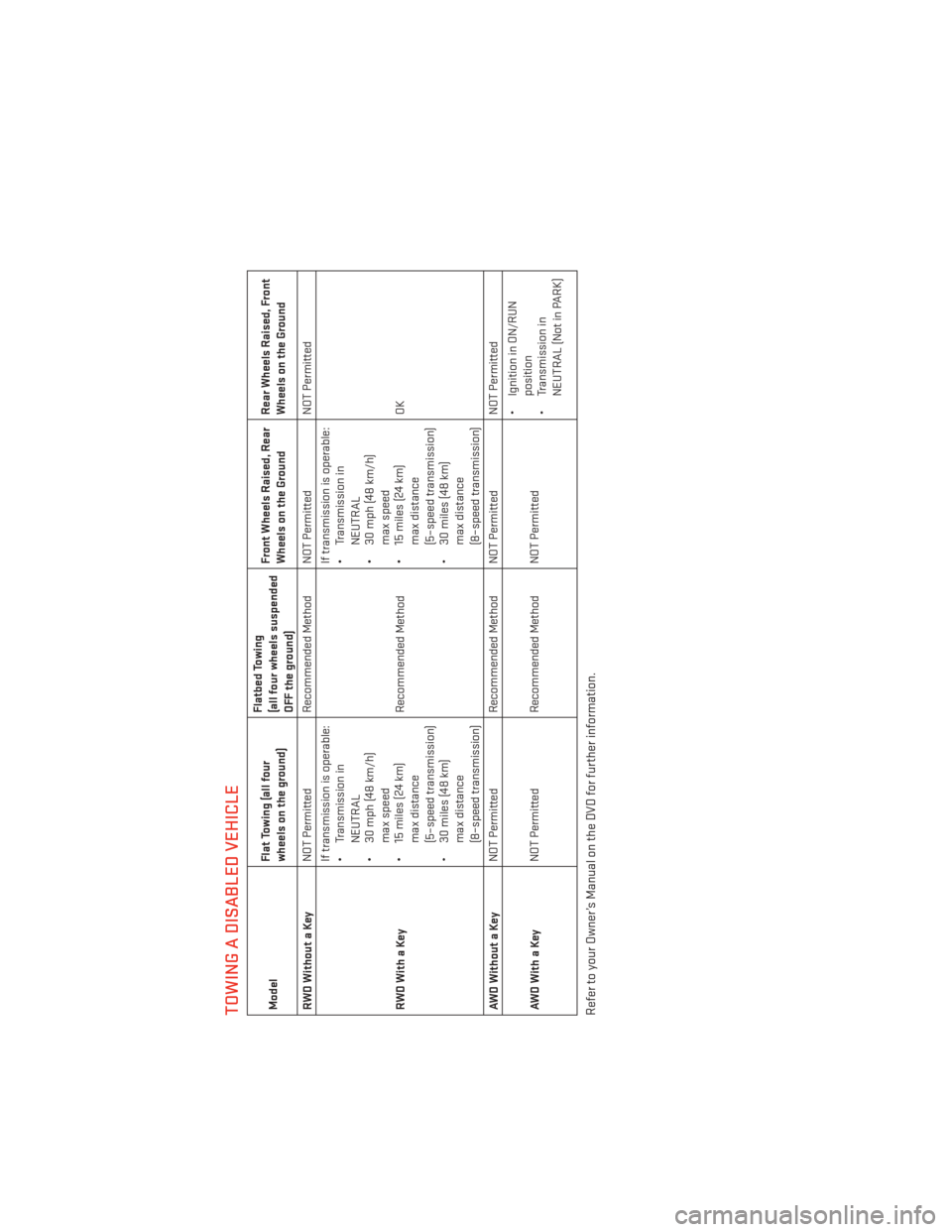
TOWING A DISABLED VEHICLEModelFlat Towing (all four
wheels on the ground) Flatbed Towing
(all four wheels suspended
OFF the ground)Front Wheels Raised, Rear
Wheels on the Ground
Rear Wheels Raised, Front
Wheels on the Ground
RWDWithoutaKey NOT Permitted Recommended Method NOT Permitted NOT Permitted
RWDWithaKey If transmission is operable:
• Transmission in
NEUTRAL
• 30 mph (48 km/h)
max speed
• 15 miles (24 km)
max distance
(5–speed transmission)
• 30 miles (48 km)
max distance
(8–speed transmission) Recommended Method If transmission is operable:
• Transmission in
NEUTRAL
• 30 mph (48 km/h)
max speed
• 15 miles (24 km)
max distance
(5–speed transmission)
• 30 miles (48 km)
max distance
(8–speed transmission) OK
AWDWithoutaKey NOT Permitted
Recommended Method NOT Permitted NOT Permitted
AWDWithaKey NOT Permitted
Recommended Method NOT Permitted • Ignition in ON/RUN
position
• Transmission in
NEUTRAL (Not in PARK)Refer to your Owner’s Manual on the DVD for further information.
WHAT TO DO IN EMERGENCIES
106
Page 109 of 148
FREEING A STUCK VEHICLE
If your vehicle becomes stuck in mud, sand or snow, it can often be moved using a rocking
motion. Turn the steering wheel right and left to clear the area around the front wheels.
Then, shift back and forth between REVERSE and DRIVE, while gently pressing the accel-
erator. Use the least amount of accelerator pedal pressure that will maintain the rocking
motion, without spinning the wheels or racing the engine.
NOTE:
Press the “ESC Off” switch, to place the Electronic Stability Control (ESC) system in “Partial
Off” mode, before rocking the vehicle. Once the vehicle has been freed, press the “ESC Off”
switch again to restore "ESC On" mode.
CAUTION!
• When “rocking” a stuck vehicle by shifting between REVERSE and DRIVE, do not spinthe wheels faster than 15 mph (24 km/h), or drivetrain damage may result.
• Revving the engine or spinning the wheels too fast may lead to transmission over-
heating and failure. It can also damage the tires. Do not spin the wheels above
30 mph (48 km/h) while in gear (no transmission shifting occurring).
WARNING!
Fast spinning tires can be dangerous. Forces generated by excessive wheel speeds may
cause tire damage or failure. A tire could explode and injure someone. Do not spin your
vehicle's wheels faster than 30 mph (48 km/h) when you are stuck. Do not let anyone
near a spinning wheel, no matter what the speed.
WHAT TO DO IN EMERGENCIES
107
Page 116 of 148
FLUIDS AND CAPACITIES
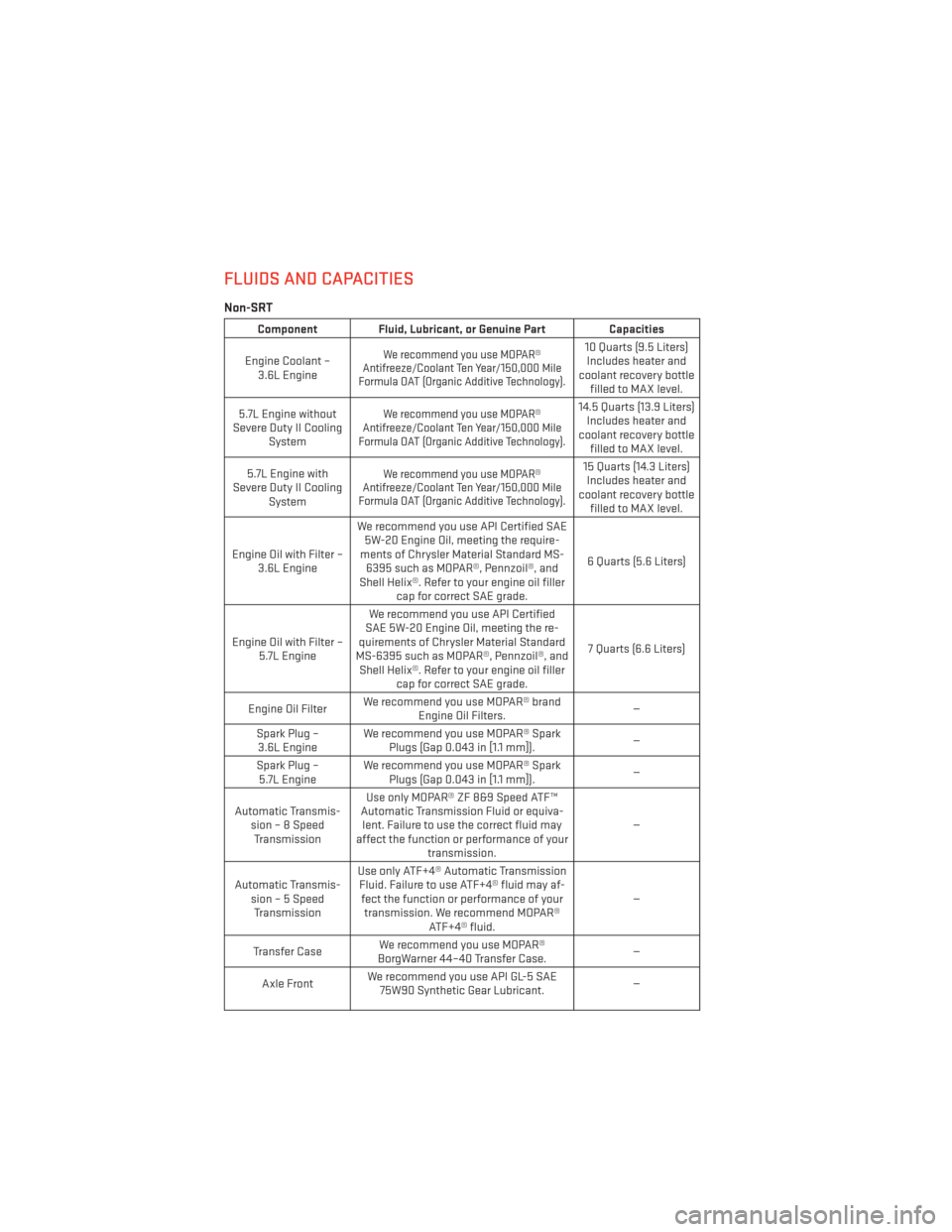
Non-SRT
Component Fluid, Lubricant, or Genuine PartCapacities
Engine Coolant – 3.6L Engine
We recommend you use MOPAR®
Antifreeze/Coolant Ten Year/150,000 Mile
Formula OAT (Organic Additive Technology).10 Quarts (9.5 Liters)
Includes heater and
coolant recovery bottle filled to MAX level.
5.7L Engine without
Severe Duty II Cooling System
We recommend you use MOPAR®
Antifreeze/Coolant Ten Year/150,000 Mile
Formula OAT (Organic Additive Technology).14.5 Quarts (13.9 Liters) Includes heater and
coolant recovery bottle filled to MAX level.
5.7L Engine with
Severe Duty II Cooling System
We recommend you use MOPAR®
Antifreeze/Coolant Ten Year/150,000 Mile
Formula OAT (Organic Additive Technology).15 Quarts (14.3 Liters)
Includes heater and
coolant recovery bottle filled to MAX level.
Engine Oil with Filter – 3.6L Engine We recommend you use API Certified SAE
5W-20 Engine Oil, meeting the require-
ments of Chrysler Material Standard MS- 6395 such as MOPAR®, Pennzoil®, and
Shell Helix®. Refer to your engine oil filler cap for correct SAE grade. 6 Quarts (5.6 Liters)
Engine Oil with Filter – 5.7L Engine We recommend you use API Certified
SAE 5W-20 Engine Oil, meeting the re-
quirements of Chrysler Material Standard
MS-6395 such as MOPAR®, Pennzoil®, and Shell Helix®. Refer to your engine oil filler cap for correct SAE grade. 7 Quarts (6.6 Liters)
Engine Oil Filter We recommend you use MOPAR® brand
Engine Oil Filters. —
Spark Plug – 3.6L Engine We recommend you use MOPAR® Spark
Plugs (Gap 0.043 in [1.1 mm]). —
Spark Plug – 5.7L Engine We recommend you use MOPAR® Spark
Plugs (Gap 0.043 in [1.1 mm]). —
Automatic Transmis- sion – 8 SpeedTransmission Use only MOPAR® ZF 8&9 Speed ATF™
Automatic Transmission Fluid or equiva- lent. Failure to use the correct fluid may
affect the function or performance of your transmission. —
Automatic Transmis- sion – 5 SpeedTransmission Use only ATF+4® Automatic Transmission
Fluid. Failure to use ATF+4® fluid may af- fect the function or performance of your transmission. We recommend MOPAR® ATF+4® fluid. —
Transfer Case We recommend you use MOPAR®
BorgWarner 44–40 Transfer Case. —
Axle Front We recommend you use API GL-5 SAE
75W90 Synthetic Gear Lubricant. —
MAINTAINING YOUR VEHICLE
114
Page 117 of 148
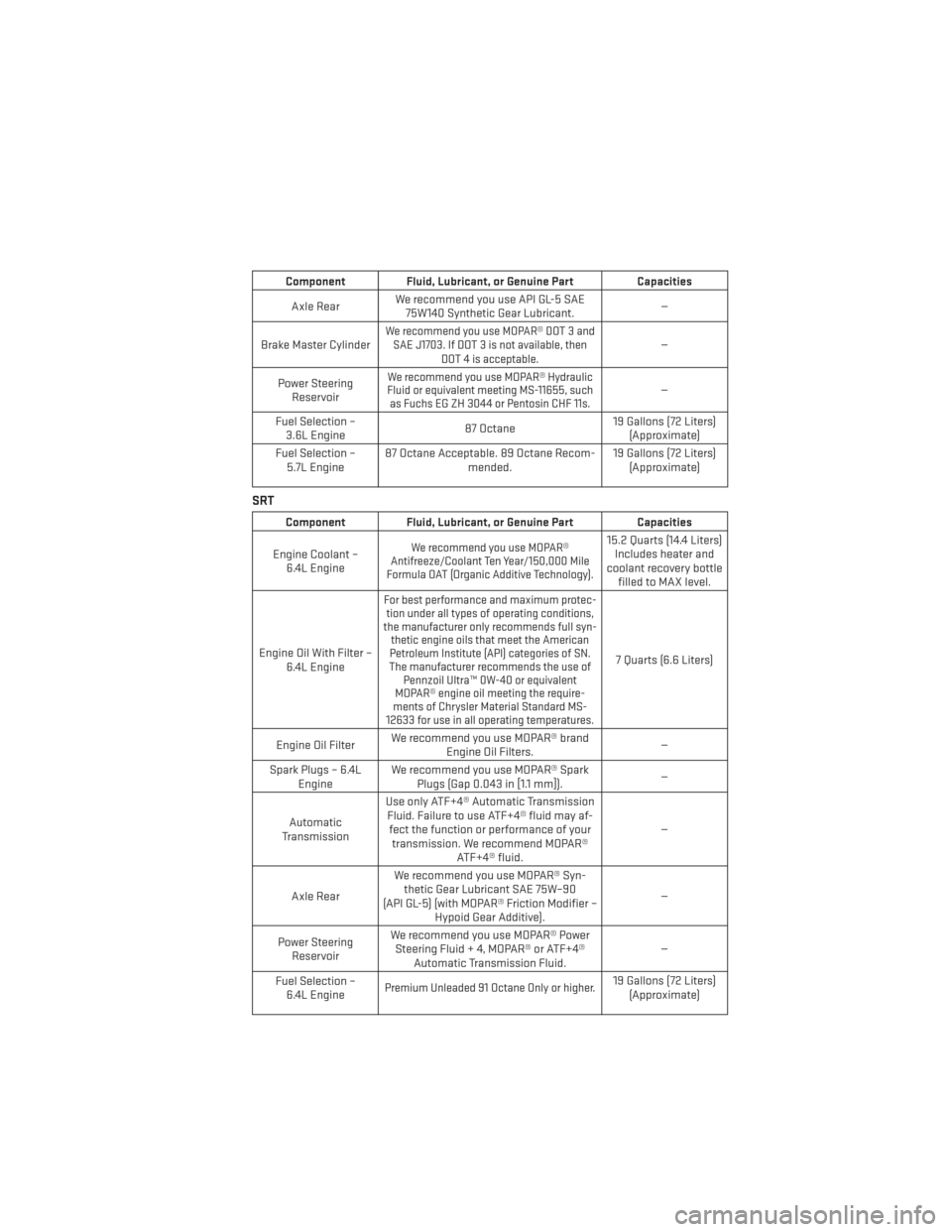
Component Fluid, Lubricant, or Genuine PartCapacities
Axle Rear We recommend you use API GL-5 SAE
75W140 Synthetic Gear Lubricant. —
Brake Master Cylinder
We recommend you use MOPAR® DOT 3 and SAE J1703. If DOT 3 is not available, then DOT 4 is acceptable.—
Power Steering Reservoir
We recommend you use MOPAR® Hydraulic
Fluid or equivalent meeting MS-11655, such as Fuchs EG ZH 3044 or Pentosin CHF 11s.—
Fuel Selection – 3.6L Engine 87 Octane19 Gallons (72 Liters)
(Approximate)
Fuel Selection – 5.7L Engine 87 Octane Acceptable. 89 Octane Recom-
mended. 19 Gallons (72 Liters)
(Approximate)
SRT
Component Fluid, Lubricant, or Genuine Part Capacities
Engine Coolant – 6.4L Engine
We recommend you use MOPAR®
Antifreeze/Coolant Ten Year/150,000 Mile
Formula OAT (Organic Additive Technology).15.2 Quarts (14.4 Liters)
Includes heater and
coolant recovery bottle filled to MAX level.
Engine Oil With Filter – 6.4L Engine
For best performance and maximum protec-tion under all types of operating conditions,
the manufacturer only recommends full syn- thetic engine oils that meet the American
Petroleum Institute (API) categories of SN.
The manufacturer recommends the use of Pennzoil Ultra™ 0W-40 or equivalent
MOPAR® engine oil meeting the require-
ments of Chrysler Material Standard MS-
12633 for use in all operating temperatures.
7 Quarts (6.6 Liters)
Engine Oil Filter We recommend you use MOPAR® brand
Engine Oil Filters. —
Spark Plugs – 6.4L Engine We recommend you use MOPAR® Spark
Plugs (Gap 0.043 in [1.1 mm]). —
Automatic
Transmission Use only ATF+4® Automatic Transmission
Fluid. Failure to use ATF+4® fluid may af- fect the function or performance of your transmission. We recommend MOPAR® ATF+4® fluid. —
Axle Rear We recommend you use MOPAR® Syn-
thetic Gear Lubricant SAE 75W–90
(API GL-5) (with MOPAR® Friction Modifier – Hypoid Gear Additive). —
Power Steering Reservoir We recommend you use MOPAR® Power
Steering Fluid + 4, MOPAR® or ATF+4® Automatic Transmission Fluid. —
Fuel Selection – 6.4L Engine
Premium Unleaded 91 Octane Only or higher.19 Gallons (72 Liters) (Approximate)
MAINTAINING YOUR VEHICLE
115
Page 120 of 148
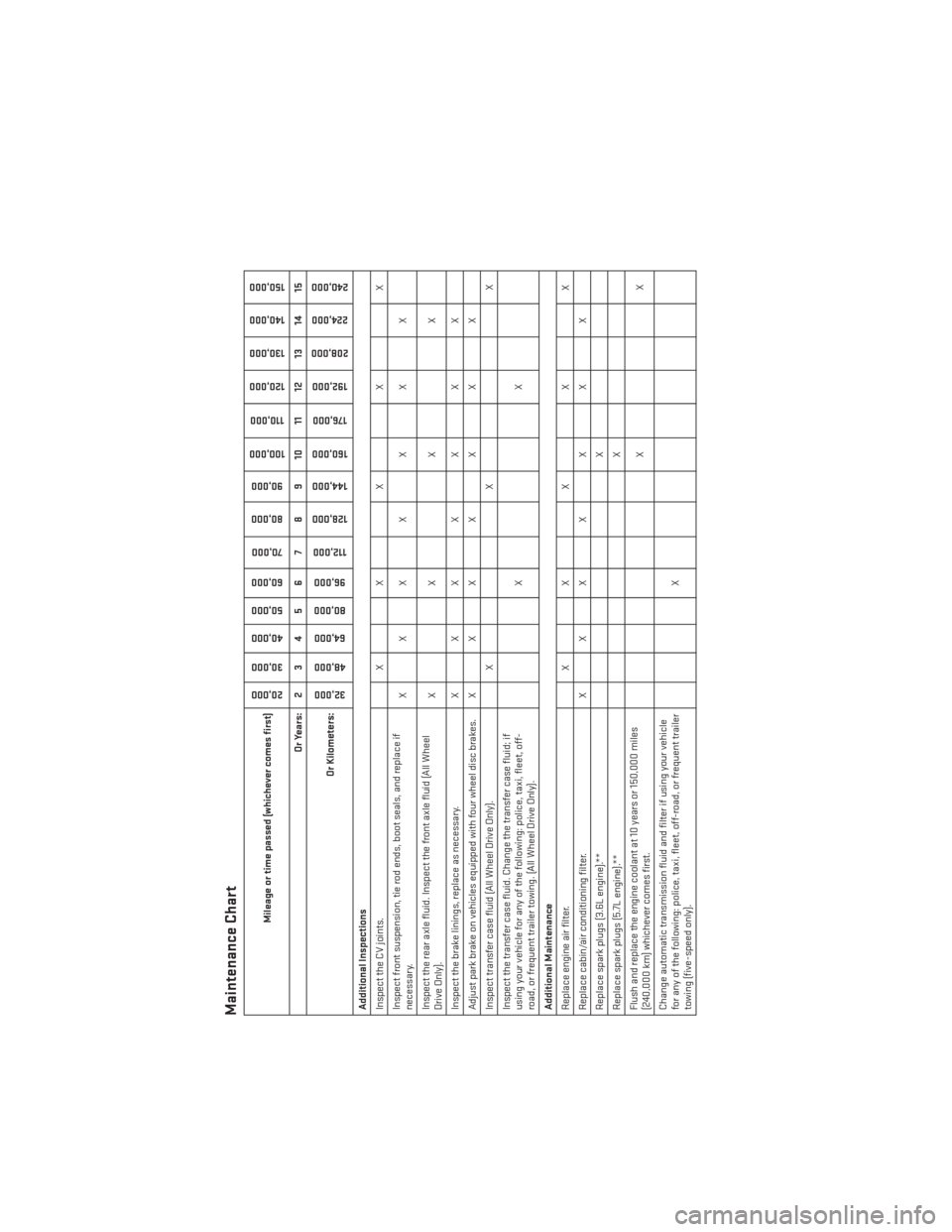
Maintenance Chart
Mileage or time passed (whichever comes first)
20,00030,000
40,000
50,000
60,000
70,000
80,000 90,000
100,000
110,000
120,000 130,000
140,000
150,000
Or Years: 2 3 4 5 6 7 8 9 10 11 12 13 14 15
Or Kilometers:
32,000
48,000
64,000
80,000
96,000
112,000
128,000 144,000
160,000
176,000
192,000
208,000 224,000
240,000
Additional Inspections
Inspect the CV joints. X X X X X
Inspect front suspension, tie rod ends, boot seals, and replace if
necessary. XXX X X X X
Inspect the rear axle fluid. Inspect the front axle fluid (All Wheel
Drive Only). XX X X
Inspect the brake linings, replace as necessary. X X X X X X X
Adjust park brake on vehicles equipped with four wheel disc brakes. X X X X X X X
Inspect transfer case fluid (All Wheel Drive Only). X X X
Inspect the transfer case fluid. Change the transfer case fluid; if
using your vehicle for any of the following: police, taxi, fleet, off-
road, or frequent trailer towing. (All Wheel Drive Only). XX
Additional Maintenance
Replace engine air filter. X X X X X
Replace cabin/air conditioning filter. X X X X X X X
Replace spark plugs (3.6L engine).** X
Replace spark plugs (5.7L engine).** X
Flush and replace the engine coolant at 10 years or 150,000 miles
(240,000 km) whichever comes first. XX
Change automatic transmission fluid and filter if using your vehicle
for any of the following: police, taxi, fleet, off-road, or frequent trailer
towing (five-speed only). X
MAINTAINING YOUR VEHICLE
118
Page 121 of 148
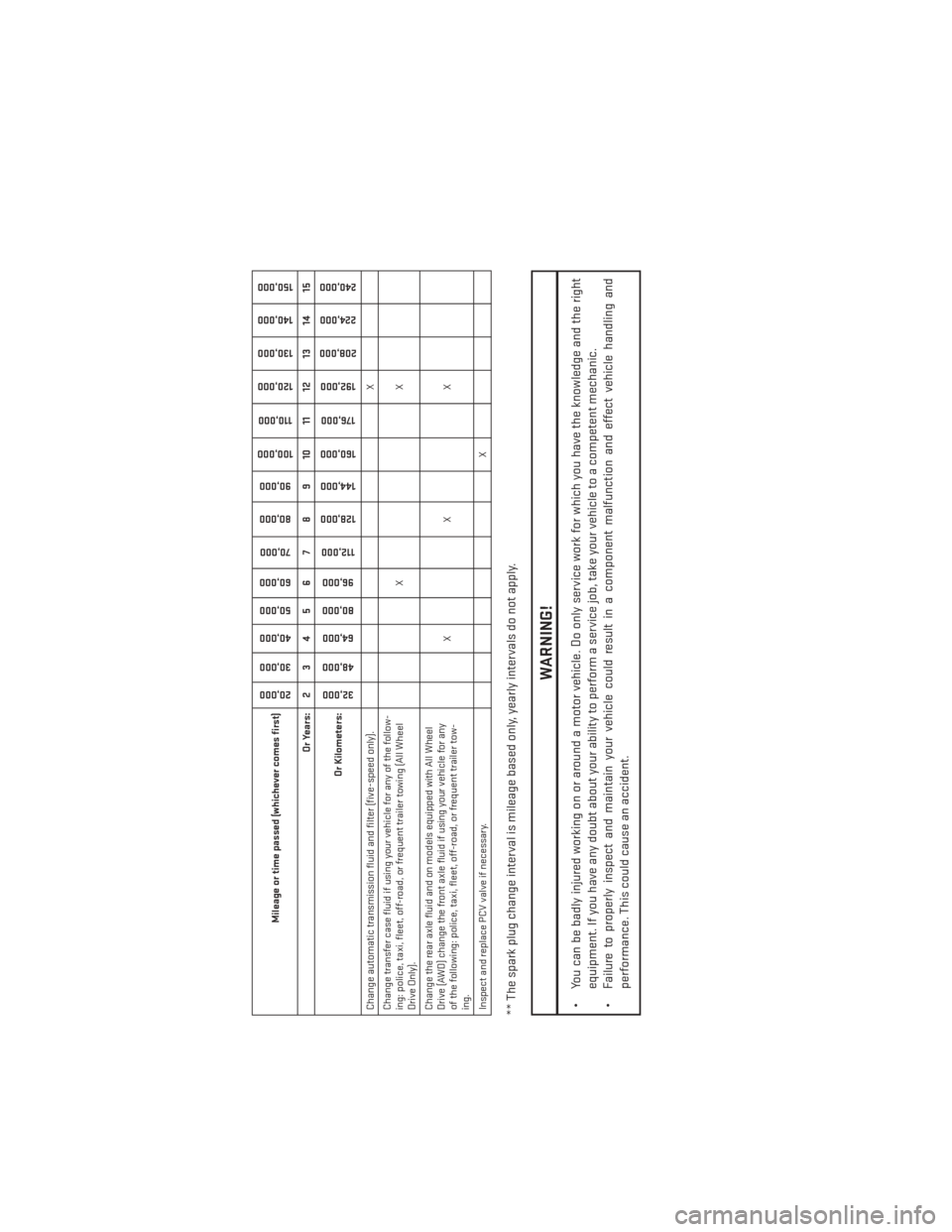
Mileage or time passed (whichever comes first)
20,00030,000
40,000
50,000
60,000
70,000
80,000 90,000
100,000
110,000
120,000 130,000
140,000
150,000
Or Years: 2 3 4 5 6 7 8 9 10 11 12 13 14 15
Or Kilometers:
32,000
48,000
64,000
80,000
96,000
112,000
128,000 144,000
160,000
176,000
192,000
208,000 224,000
240,000
Change automatic transmission fluid and filter (five-speed only). X
Change transfer case fluid if using your vehicle for any of the follow-
ing: police, taxi, fleet, off-road, or frequent trailer towing (All Wheel
Drive Only). XX
Change the rear axle fluid and on models equipped with All Wheel
Drive (AWD) change the front axle fluid if using your vehicle for any
of the following: police, taxi, fleet, off-road, or frequent trailer tow-
ing. XX X
Inspect and replace PCV valve if necessary. X** The spark plug change interval is mileage based only, yearly intervals do not apply.
WARNING!
• You can be badly injured working on or around a motor vehicle. Do only service work for which you have the knowledge and the right
equipment. If you have any doubt about your ability to perform a service job, take your vehicle to a competent mechanic.
• Failure to properly inspect and maintain your vehicle could result in a component malfunction and effect vehicle handling and
performance. This could cause an accident.
MAINTAINING YOUR VEHICLE
119
Page 125 of 148
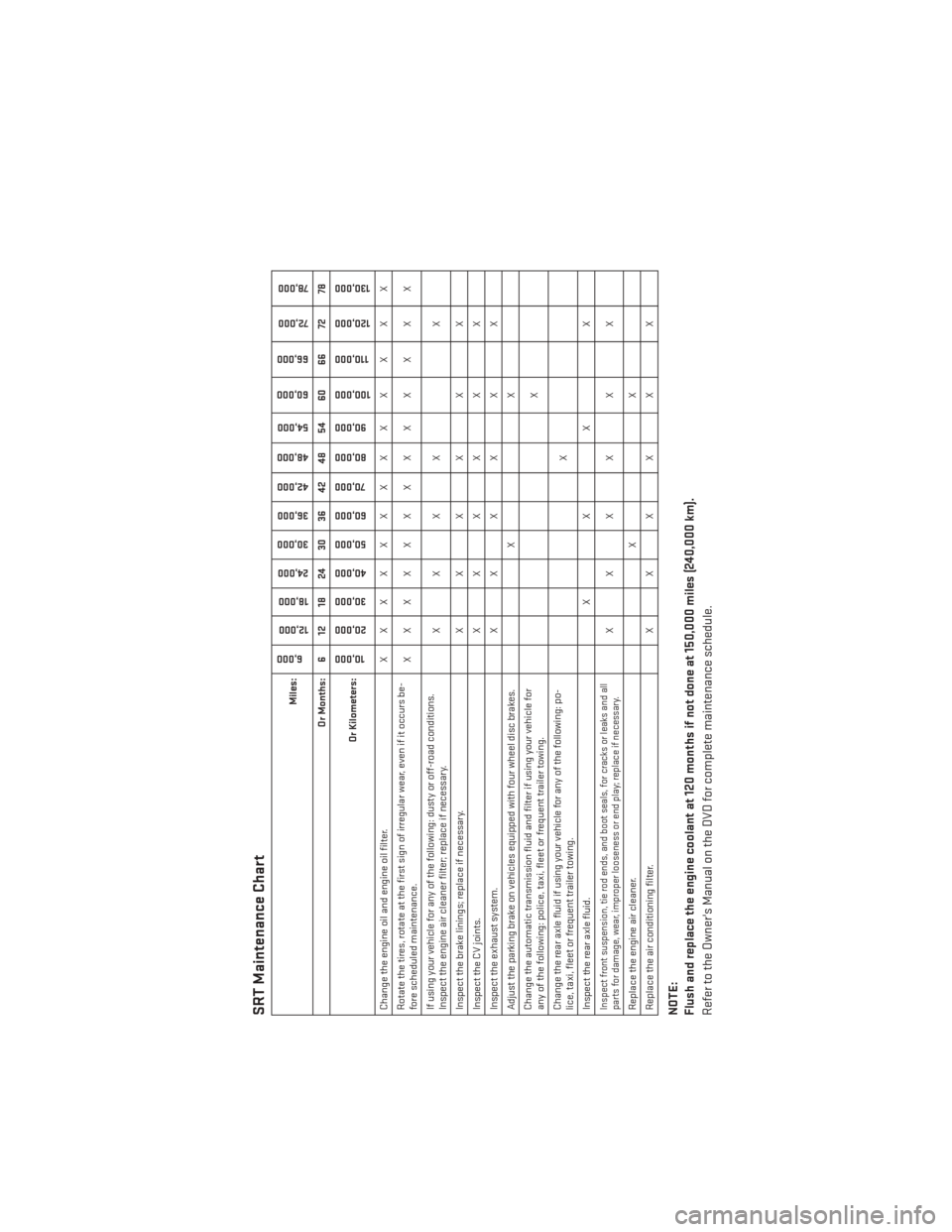
SRT Maintenance Chart
Miles:
6,000
12,000
18,000
24,000
30,000
36,000
42,000
48,000
54,000
60,000
66,000
72,000
78,000
Or Months: 6 12 18 24 30 36 42 48 54 60 66 72 78
Or Kilometers:
10,000
20,000 30,000
40,000
50,000
60,000 70,000
80,000
90,000
100,000
110,000
120,000 130,000
Change the engine oil and engine oil filter. X X XXXXX X X X X X X
Rotate the tires, rotate at the first sign of irregular wear, even if it occurs be-
fore scheduled maintenance. XXXXXXX X X X X X X
If using your vehicle for any of the following: dusty or off-road conditions.
Inspect the engine air cleaner filter; replace if necessary. XX X X
X
Inspect the brake linings; replace if necessary. X X X XXX
Inspect the CV joints. X X X XXX
Inspect the exhaust system. X X X XXX
Adjust the parking brake on vehicles equipped with four wheel disc brakes. XX
Change the automatic transmission fluid and filter if using your vehicle for
any of the following: police, taxi, fleet or frequent trailer towing. X
Change the rear axle fluid if using your vehicle for any of the following: po-
lice, taxi, fleet or frequent trailer towing. X
Inspect the rear axle fluid. XX X XInspect front suspension, tie rod ends, and boot seals, for cracks or leaks and all
parts for damage, wear, improper looseness or end play; replace if necessary.
XX X X X X
Replace the engine air cleaner. X X
Replace the air conditioning filter. X X X X X X
NOTE:
Flush and replace the engine coolant at 120 months if not done at 150,000 miles (240,000 km).
Refer to the Owner's Manual on the DVD for complete maintenance schedule.
MAINTAINING YOUR VEHICLE
123