wiring DODGE CHARGER 2015 7.G Owners Manual
[x] Cancel search | Manufacturer: DODGE, Model Year: 2015, Model line: CHARGER, Model: DODGE CHARGER 2015 7.GPages: 638, PDF Size: 16.56 MB
Page 73 of 638
System Reset Procedure
In order to reset the Enhanced Accident Response System
functions after an event, the ignition must be changed
from ignition START or ON/RUN to ignition OFF.
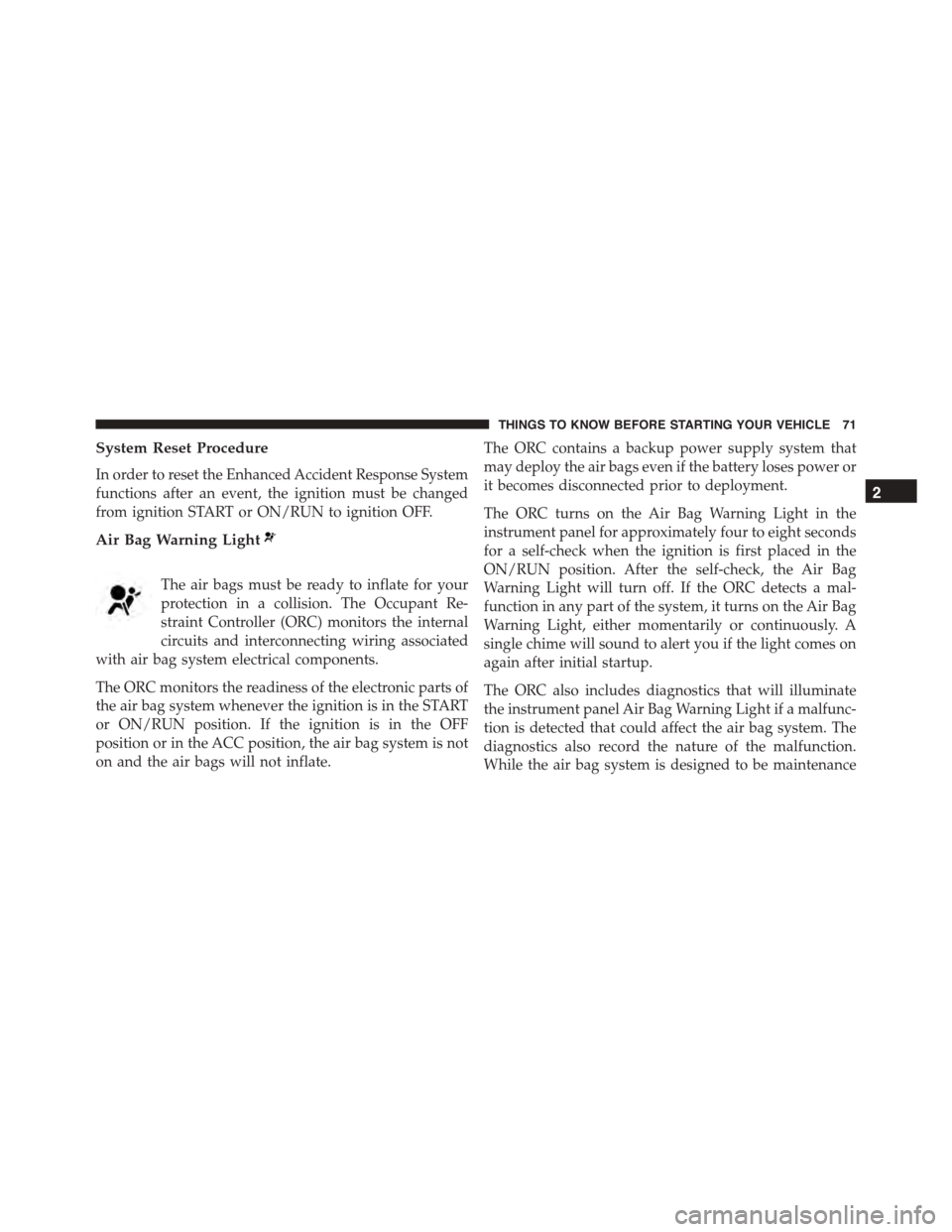
Air Bag Warning Light
The air bags must be ready to inflate for your
protection in a collision. The Occupant Re-
straint Controller (ORC) monitors the internal
circuits and interconnecting wiring associated
with air bag system electrical components.
The ORC monitors the readiness of the electronic parts of
the air bag system whenever the ignition is in the START
or ON/RUN position. If the ignition is in the OFF
position or in the ACC position, the air bag system is not
on and the air bags will not inflate.
The ORC contains a backup power supply system that
may deploy the air bags even if the battery loses power or
it becomes disconnected prior to deployment.
The ORC turns on the Air Bag Warning Light in the
instrument panel for approximately four to eight seconds
for a self-check when the ignition is first placed in the
ON/RUN position. After the self-check, the Air Bag
Warning Light will turn off. If the ORC detects a mal-
function in any part of the system, it turns on the Air Bag
Warning Light, either momentarily or continuously. A
single chime will sound to alert you if the light comes on
again after initial startup.
The ORC also includes diagnostics that will illuminate
the instrument panel Air Bag Warning Light if a malfunc-
tion is detected that could affect the air bag system. The
diagnostics also record the nature of the malfunction.
While the air bag system is designed to be maintenance
2
THINGS TO KNOW BEFORE STARTING YOUR VEHICLE 71
Page 75 of 638
Redundant Air Bag Warning Light
If a fault with the Air Bag Warning Light is detected,
which could affect the Supplemental Restraint System
(“SRS”), the Redundant Air Bag Warning Light will
illuminate on the instrument panel. The Redundant Air
Bag Warning Light will stay on until the fault is cleared.
In addition, a single chime will sound to alert you that
the Redundant Air Bag Warning Light has come on and
a fault has been detected. If the Redundant Air Bag
Warning Light comes on intermittently or remains on
while driving have an authorized dealer service the
vehicle immediately. For additional information regard-
ing the Redundant Air Bag Warning Light refer to the
“Instrument Panel” section of this manual.
Maintaining Your Air Bag System
WARNING!
•Modifications to any part of the air bag system
could cause it to fail when you need it. You could
be injured if the air bag system is not there to
protect you. Do not modify the components or
wiring, including adding any kind of badges or
stickers to the steering wheel hub trim cover or the
upper right side of the instrument panel. Do not
modify the front bumper, vehicle body structure, or
add aftermarket side steps or running boards.
•It is dangerous to try to repair any part of the air
bag system yourself. Be sure to tell anyone who
works on your vehicle that it has an air bag system.
(Continued)
2
THINGS TO KNOW BEFORE STARTING YOUR VEHICLE 73
Page 491 of 638
•Trailer brakes are recommended for trailers over
1,000 lbs (454 kg) and required for trailers in excess of
2,000 lbs (907 kg).
WARNING!
•Do not connect trailer brakes to your vehicle’s
hydraulic brake lines. It can overload your brake
system and cause it to fail. You might not have
brakes when you need them and could have a
collision.
•Towing any trailer will increase your stopping
distance. When towing you should allow for addi-
tional space between your vehicle and the vehicle
in front of you. Failure to do so could result in a
collision.
CAUTION!
If the trailer weighs more than 1,000 lbs (454 kg)
loaded, it should have its own brakes and they
should be of adequate capacity. Failure to do this
could lead to accelerated brake lining wear, higher
brake pedal effort, and longer stopping distances.
Towing Requirements — Trailer Lights And Wiring
Whenever you pull a trailer, regardless of the trailer size,
stoplights and turn signals on the trailer are required for
motoring safety.
The Trailer Tow Package may include a four- and seven-
pin wiring harness. Use a factory approved trailer har-
ness and connector.
NOTE:Do not cut or splice wiring into the vehicles
wiring harness.
5
STARTING AND OPERATING 489
Page 634 of 638
Radial...............................447
Replacement...........................454
Rotation..............................457
Safety...............................432
Sizes................................434
Snow Tires............................449
Spare Tire.............................498
Spinning.............................453
Trailer Towing.........................488
Tread Wear Indicators....................453
Tire Safety Information.....................432
Tire Service Kit...........................507
Tongue Weight/Trailer Weight................484
To Open Hood...........................150
Towing................................479
Disabled Vehicle........................526
Guide...............................484
Recreational...........................492
Weight...............................484
Towing Vehicle Behind a Motorhome...........492
Traction................................412
Traction Control..........................423
Trailer Towing...........................479
Cooling System Tips.....................492
Hitches..............................482
Minimum Requirements..................486
Ti p s . . . . . . . . . . . . . . . . . . . . . . . . . . . . . . . ..491
Trailer and Tongue Weight.................484
Wiring...............................489
Trailer Towing Guide.......................484
Trailer Weight............................484
Transfer Case............................563
Fluid................................563
Maintenance...........................564
Transmission
Automatic............................398
Fluid................................561
Maintenance...........................561
632 INDEX
Page 637 of 638

INSTALLATION OF RADIO TRANSMITTING
EQUIPMENT
Special design considerations are incorporated into this
vehicle’s electronic system to provide immunity to radio
frequency signals. Mobile two-way radios and telephone
equipment must be installed properly by trained person-
nel. The following must be observed during installation.
The positive power connection should be made directly
to the battery and fused as close to the battery as possible.
The negative power connection should be made to body
sheet metal adjacent to the negative battery connection.
This connection should not be fused.
Antennas for two-way radios should be mounted on the
roof or the rear area of the vehicle. Care should be used
in mounting antennas with magnet bases. Magnets may
affect the accuracy or operation of the compass on
vehicles so equipped.
The antenna cable should be as short as practical and
routed away from the vehicle wiring when possible. Use
only fully shielded coaxial cable.
Carefully match the antenna and cable to the radio to
ensure a low Standing Wave Ratio (SWR).
Mobile radio equipment with output power greater than
normal may require special precautions.
All installations should be checked for possible interfer-
ence between the communications equipment and the
vehicle’s electronic systems.