child restraint DODGE CHARGER 2016 7.G Owner's Guide
[x] Cancel search | Manufacturer: DODGE, Model Year: 2016, Model line: CHARGER, Model: DODGE CHARGER 2016 7.GPages: 661, PDF Size: 4.7 MB
Page 99 of 661
2. Rotate or lift the cover to access the anchor directlybehind the seat where you are placing the child
restraint.
3. Route the tether strap to provide the most direct path for the strap between the anchor and the child seat. If
your vehicle is equipped with adjustable rear head
restraints, raise the head restraint, and where possible,
route the tether strap under the head restraint and
between the two posts. If not possible, lower the head
restraint and pass the tether strap around the outboard
side of the head restraint.
1 — Cover A — Tether Strap Hook
3 — Attaching Strap B — Tether Anchor
4. Attach the tether strap hook of the child restraint to the top tether anchorage as shown in the diagram.
Tether Strap Mounting
2
THINGS TO KNOW BEFORE STARTING YOUR VEHICLE 97
Page 100 of 661

5. Remove slack in the tether strap according to the childrestraint manufacturer ’s instructions.
WARNING!
•An incorrectly anchored tether strap could lead to
increased head motion and possible injury to the
child. Use only the anchorage position directly
behind the child seat to secure a child restraint top
tether strap.
• If your vehicle is equipped with a split rear seat,
make sure the tether strap does not slip into the
opening between the seatbacks as you remove
slack in the strap.
Center Tether Attachment
1. Lower the adjustable center head restraint to the full down position. 2. Route the tether strap over the seatback and head
restraint.
3. Attach the tether strap hook of the child restraint to the center tether anchorage located in the panel be-
tween the rear seatback and the rear window.
4. Remove slack in the tether strap according to the child restraint manufacturer ’s instructions.
Transporting Pets
Air Bags deploying in the front seat could harm your pet.
An unrestrained pet will be thrown about and possibly
injured, or injure a passenger during panic braking or in
a collision.
Pets should be restrained in the rear seat in pet harnesses
or pet carriers that are secured by seat belts.
98 THINGS TO KNOW BEFORE STARTING YOUR VEHICLE
Page 149 of 661
When the seatback is folded to the upright position, make
sure it is latched by strongly pulling on the top of the
seatback above the seat strap.
WARNING!
•Be certain that the seatback is securely locked into
position. If the seatback is not securely locked into
position, the seat will not provide the proper sta-
bility for child seats and/or passengers. An improp-
erly latched seat could cause serious injury.
• The cargo area in the rear of the vehicle (with the
rear seatbacks in the locked-up or folded down
position) should not be used as a play area by
children when the vehicle is in motion. They could
be seriously injured in a collision. Children should
be seated and using the proper restraint system.
Folded Rear Seatback
3
UNDERSTANDING THE FEATURES OF YOUR VEHICLE 147
Page 255 of 661
Cargo Area — Vehicles Equipped With 60/40
Split-Folding Rear Seat
The 60/40 split-folding rear seat provides cargo-carrying
versatility. The seatbacks fold down easily by pulling
nylon tabs between the seatbacks and the bolsters. When
the seats are folded down, they provide a continuous,
nearly-flat extension of the load floor.
When the seatback is folded to the upright position, make
sure it is latched by strongly pulling on the top of the
seatback above the seat strap.
WARNING!
•Be certain that the seatback is securely locked into
position. If the seatback is not securely locked into
position, the seat will not provide the proper stabil-
ity for child seats and/or passengers. An improperly
latched seat could cause serious injury.
(Continued)
WARNING! (Continued)
•The cargo area in the rear of the vehicle (with the
rear seatbacks in the locked-up or folded down
position) should not be used as a play area by
children when the vehicle is in motion. They could
be seriously injured in a collision. Children should
be seated and using the proper restraint system.
• To help protect against personal injury, passengers
should not be seated in the rear cargo area. The rear
cargo space is intended for load carrying purposes
only, not for passengers, who should sit in seats
and use seat belts.
3
UNDERSTANDING THE FEATURES OF YOUR VEHICLE 253
Page 641 of 661
Checking Your Vehicle For Safety..............100
Checks, Safety .......................... .100
Child Restraint ............................77
Child Restraints Booster Seats ...........................82
Center Seat LATCH ......................90
Child Restraints .........................77
Child Seat Installation .....................95
How To Stow An Unused ALR Seat Belt ........91
Infants And Child Restraints ................80
Install A LATCH-Compatible Child Restraint ....90
Lower Anchors And Tethers For Children .......84
Older Children And Child Restraints ..........80
Seating Positions ........................83
Child Safety Locks .........................34
Clean Air Gasoline ....................... .484
Cleaning Wheels .............................. .586
Climate Control ......................... .364Automatic
........................... .364
Coin Holder ............................ .251
Cold Weather Operation ....................413
Compact Spare Tire ....................... .469
Connector UCI................................ .361
Universal Consumer Interface (UCI) ..........361
Console, Floor .......................... .251
Contract, Service ......................... .629
Coolant Pressure Cap (Radiator Cap) ...........576
Cooling System .......................... .573
Adding Coolant (Antifreeze) ...............575
Coolant Capacity .......................611
Coolant Level ..................... .573, 577
Disposal Of Used Coolant .................577
Drain, Flush, And Refill ...................574
Inspection ........................... .577
Points To Remember .....................578
Pressure Cap ......................... .576
10
INDEX 639
Page 653 of 661
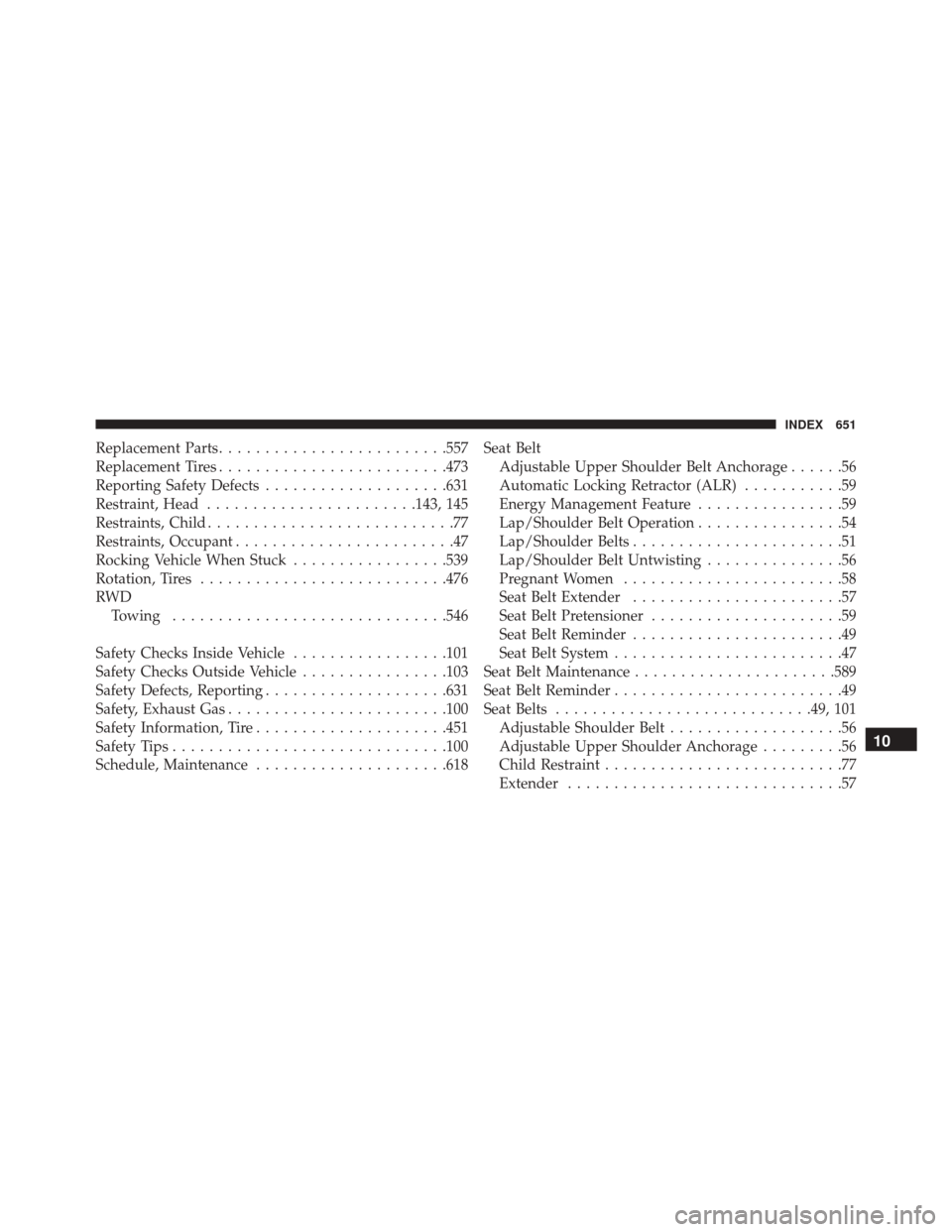
Replacement Parts........................ .557
Replacement Tires ........................ .473
Reporting Safety Defects ....................631
Restraint, Head ...................... .143, 145
Restraints, Child ...........................77
Restraints, Occupant ........................47
Rocking Vehicle When Stuck .................539
Rotation, Tires .......................... .476
RWD Towing ............................. .546
Safety Checks Inside Vehicle .................101
Safety Checks Outside Vehicle ................103
Safety Defects, Reporting ....................631
Safety, Exhaust Gas ....................... .100
Safety Information, Tire .....................451
Safety Tips ............................. .100
Schedule, Maintenance .....................618 Seat Belt
Adjustable Upper Shoulder Belt Anchorage ......56
Automatic Locking Retractor (ALR) ...........59
Energy Management Feature ................59
Lap/Shoulder Belt Operation ................54
Lap/Shoulder Belts .......................51
Lap/Shoulder Belt Untwisting ...............56
Pregnant Women ........................58
Seat Belt Extender .......................57
Seat Belt Pretensioner .....................59
Seat Belt Reminder .......................49
Seat Belt System .........................47
Seat Belt Maintenance ..................... .589
Seat Belt Reminder .........................49
Seat Belts ........................... .49, 101
Adjustable Shoulder Belt ...................56
Adjustable Upper Shoulder Anchorage .........56
Child Restraint ..........................77
Extender ..............................57
10
INDEX 651