warning lights DODGE CHARGER 2018 User Guide
[x] Cancel search | Manufacturer: DODGE, Model Year: 2018, Model line: CHARGER, Model: DODGE CHARGER 2018Pages: 553, PDF Size: 5.3 MB
Page 191 of 553
WARNING!
•Do not drill, cut, or tamper with the knee impact
bolsters in any way.
• Do not mount any accessories to the knee impact
bolsters such as alarm lights, stereos, citizen band
radios, etc.
Supplemental Driver Knee Air Bag
This vehicle is equipped with a Supplemental Driver Knee
Air Bag mounted in the instrument panel below the
steering column. The Supplemental Driver Knee Air Bag
provides enhanced protection during a frontal impact by
working together with the seat belts, pretensioners, and
front air bags.
Supplemental Side Air Bags
Supplemental Seat-Mounted Side Air Bags (SABs)
This vehicle is equipped with Supplemental Seat-Mounted
Side Air Bags (SABs).
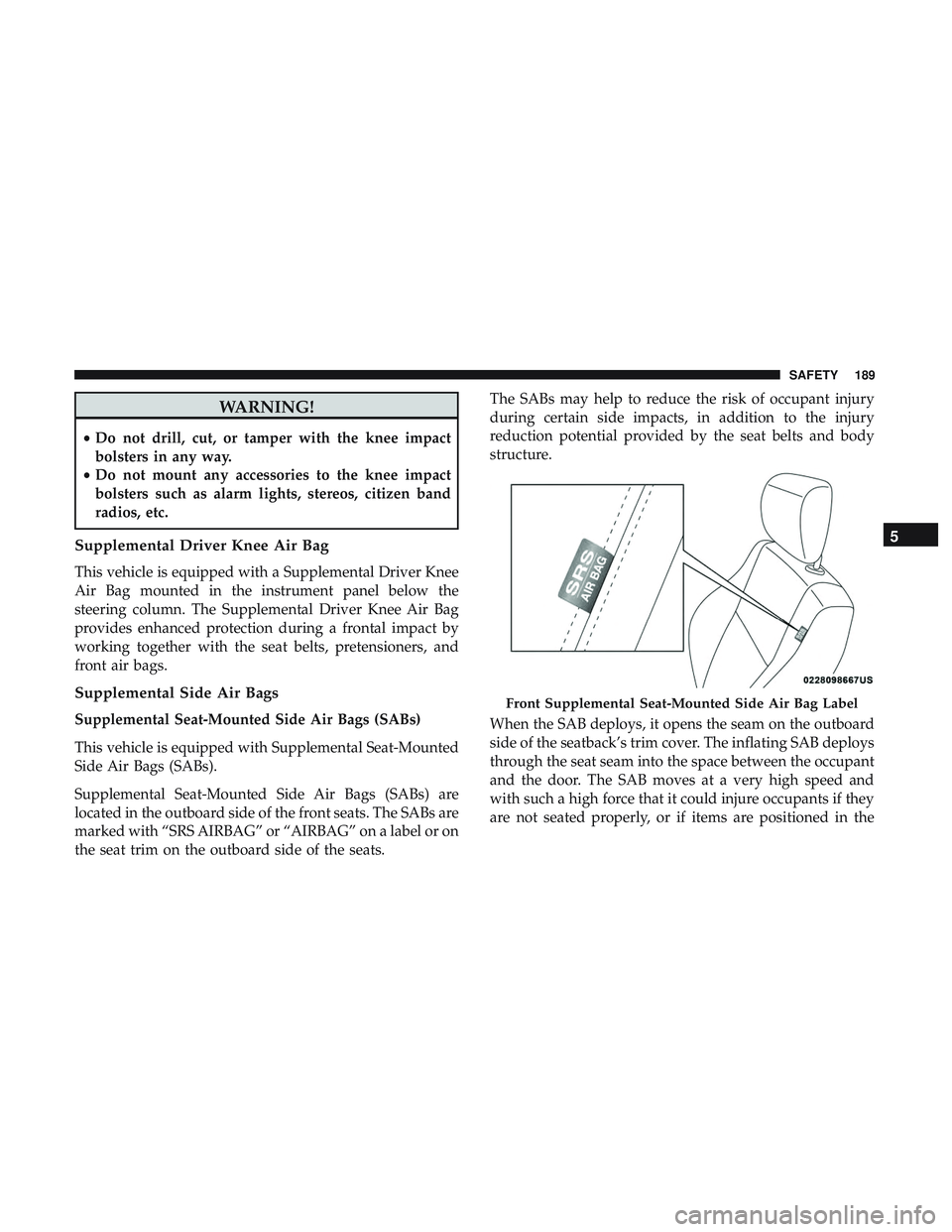
Supplemental Seat-Mounted Side Air Bags (SABs) are
located in the outboard side of the front seats. The SABs are
marked with “SRS AIRBAG” or “AIRBAG” on a label or on
the seat trim on the outboard side of the seats. The SABs may help to reduce the risk of occupant injury
during certain side impacts, in addition to the injury
reduction potential provided by the seat belts and body
structure.
When the SAB deploys, it opens the seam on the outboard
side of the seatback’s trim cover. The inflating SAB deploys
through the seat seam into the space between the occupant
and the door. The SAB moves at a very high speed and
with such a high force that it could injure occupants if they
are not seated properly, or if items are positioned in the
Front Supplemental Seat-Mounted Side Air Bag Label
5
SAFETY 189
Page 196 of 553
•As the air bags deflate, you may see some smoke-like
particles. The particles are a normal by-product of the
process that generates the non-toxic gas used for air bag
inflation. These airborne particles may irritate the skin,
eyes, nose, or throat. If you have skin or eye irritation,
rinse the area with cool water. For nose or throat
irritation, move to fresh air. If the irritation continues,
see your doctor. If these particles settle on your clothing,
follow the garment manufacturer ’s instructions for
cleaning.
Do not drive your vehicle after the air bags have deployed.
If you are involved in another collision, the air bags will
not be in place to protect you.
WARNING!
Deployed air bags and seat belt pretensioners cannot
protect you in another collision. Have the air bags, seat
belt pretensioners, and the seat belt retractor assem-
blies replaced by an authorized dealer immediately.
Also, have the Occupant Restraint Controller System
serviced as well. NOTE:
•
Air bag covers may not be obvious in the interior trim,
but they will open during air bag deployment.
• After any collision, the vehicle should be taken to an
authorized dealer immediately.
Enhanced Accident Response System
In the event of an impact, if the communication network
remains intact, and the power remains intact, depending
on the nature of the event, the ORC will determine whether
to have the Enhanced Accident Response System perform
the following functions:
•Cut off fuel to the engine (If Equipped)
• Cut off battery power to the electric motor (If Equipped)
• Flash hazard lights as long as the battery has power
• Turn on the interior lights, which remain on as long as
the battery has power or for 15 minutes from the
intervention of the Enhanced Accident Response Sys-
tem.
• Unlock the power door locks.
194 SAFETY
Page 219 of 553
WARNING!(Continued)
interference with the accelerator, brake, or clutch
pedals then re-install the floor mats.
• It is recommended to only use mild soap and water
to clean your floor mats. After cleaning, always check
your floor mat has been properly installed and is
secured to your vehicle using the floor mat fasteners
by lightly pulling mat.
Periodic Safety Checks You Should Make Outside
The Vehicle
Tires
Examine tires for excessive tread wear and uneven wear
patterns. Check for stones, nails, glass, or other objects
lodged in the tread or sidewall. Inspect the tread for cuts
and cracks. Inspect sidewalls for cuts, cracks, and bulges.
Check the wheel nuts for tightness. Check the tires (includ-
ing spare) for proper cold inflation pressure.
Lights
Have someone observe the operation of brake lights and
exterior lights while you work the controls. Check turn
signal and high beam indicator lights on the instrument
panel.
Door Latches
Check for proper closing, latching, and locking.
Fluid Leaks
Check area under the vehicle after overnight parking for
fuel, coolant, oil, or other fluid leaks. Also, if gasoline
fumes are detected or if fuel, or brake fluid leaks are
suspected. The cause should be located and corrected
immediately.
5
SAFETY 217
Page 244 of 553
FUEL SAVER TECHNOLOGY 5.7L AND 6.4L ONLY —
IF EQUIPPED
This feature offers improved fuel economy by shutting off
four of the engine’s eight cylinders during light load and
cruise conditions. The system is automatic with no driver
inputs or additional driving skills required.
NOTE:This system may take some time to return to full
functionality after a battery disconnect.
POWER STEERING
The electric power steering system will give you good
vehicle response and increased ease of maneuverability in
tight spaces. The system will vary its assist to provide light
efforts while parking and good feel while driving. If the
electric steering system experiences a fault that prevents it
from providing assist, you will still have the ability to steer
the vehicle manually.
WARNING!
Continued operation with reduced assist could pose a
safety risk to yourself and others. Service should be
obtained as soon as possible. Alternate electric power steering efforts can be selected
through the Uconnect System. Refer to ”Customer Pro-
grammable Features” within “Uconnect Settings” in “Mul-
timedia” for further information.
If the Electric Power Steering warning icon is
displayed and the “SERVICE POWER STEER-
ING” or the “POWER STEERING ASSIST OFF –
SERVICE SYSTEM” message is displayed within
the instrument cluster display, this indicates the vehicle
needs to be taken to the dealer for service. Refer to
“Warning Lights And Messages” in “Getting To Know
Your Instrument Panel” for further information.
NOTE:
• Even if the power steering assistance is no longer
operational, it is still possible to steer the vehicle. Under
these conditions there will be a substantial increase in
steering effort, especially at low speeds and during
parking maneuvers.
• If the condition persists, see your authorized dealer for
service.
242 STARTING AND OPERATING
Page 258 of 553
Indicator” icon, and the system adjusts vehicle speed
automatically to maintain the distance setting, regardless
of the set speed.
The vehicle will then maintain the set distance until:
•The vehicle ahead accelerates to a speed above the set
speed.
• The vehicle ahead moves out of your lane or view of the
sensor.
• The distance setting is changed.
• The system disengages. (Refer to the information on
ACC Activation).
The maximum braking applied by ACC is limited; how-
ever, the driver can always apply the brakes manually, if
necessary.
NOTE: The brake lights will illuminate whenever the ACC
system applies the brakes.
A Proximity Warning will alert the driver if ACC predicts
that its maximum braking level is not sufficient to maintain
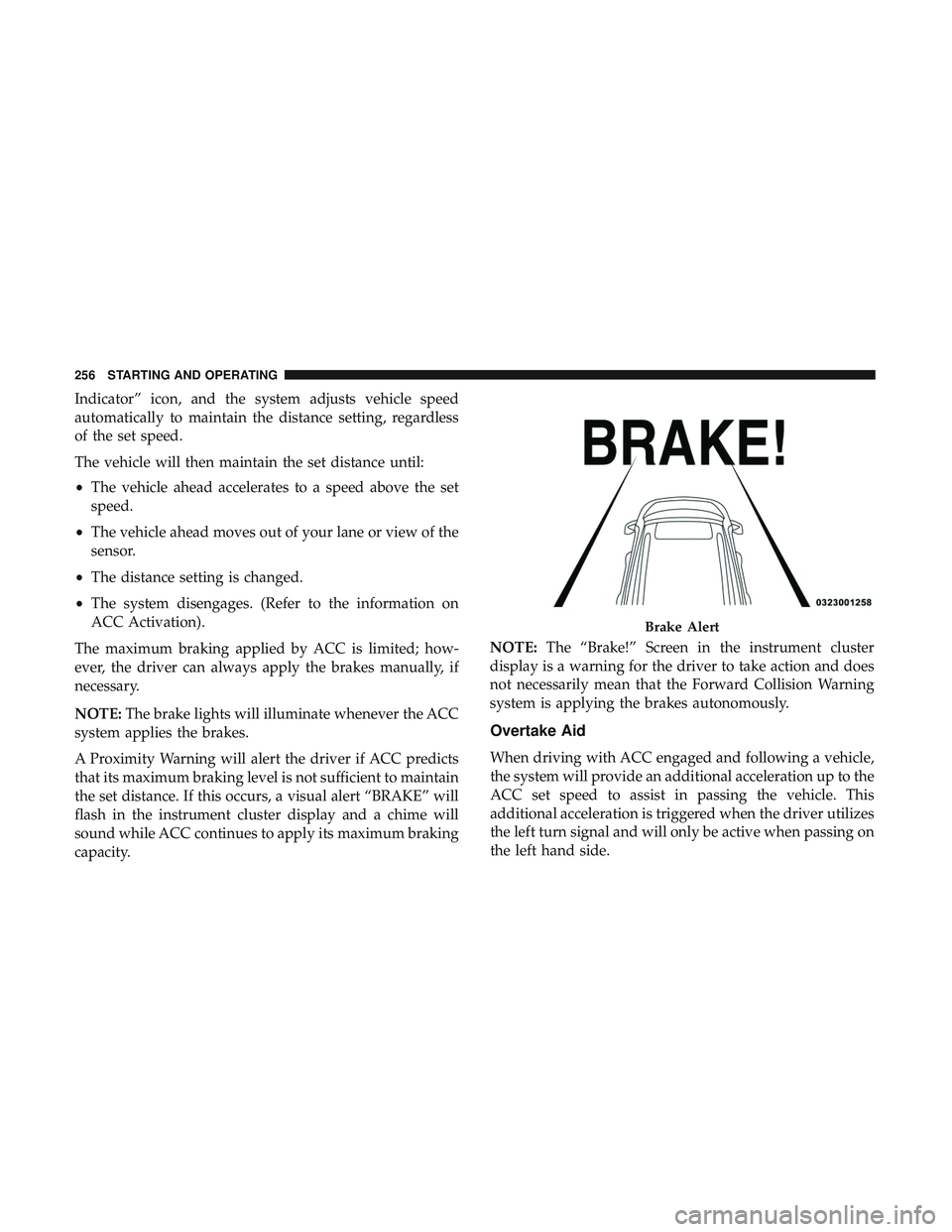
the set distance. If this occurs, a visual alert “BRAKE” will
flash in the instrument cluster display and a chime will
sound while ACC continues to apply its maximum braking
capacity. NOTE:
The “Brake!” Screen in the instrument cluster
display is a warning for the driver to take action and does
not necessarily mean that the Forward Collision Warning
system is applying the brakes autonomously.
Overtake Aid
When driving with ACC engaged and following a vehicle,
the system will provide an additional acceleration up to the
ACC set speed to assist in passing the vehicle. This
additional acceleration is triggered when the driver utilizes
the left turn signal and will only be active when passing on
the left hand side.
Brake Alert
256 STARTING AND OPERATING
Page 294 of 553
•Check for signs of tire wear or visible tire damage before
towing a trailer. Refer to “Tires” in “Servicing And
Maintenance” for the proper inspection procedure.
• When replacing tires, refer to “Tires” in “Servicing And
Maintenance” for the proper tire replacement proce-
dures. Replacing tires with a higher load carrying capac-
ity will not increase the vehicle’s GVWR and GAWR
limits.
Towing Requirements — Trailer Brakes
•Do not interconnect the hydraulic brake system or
vacuum system of your vehicle with that of the trailer.
This could cause inadequate braking and possible per-
sonal injury.
• An electronically actuated trailer brake controller is
required when towing a trailer with electronically actu-
ated brakes. When towing a trailer equipped with a
hydraulic surge actuated brake system, an electronic
brake controller is not required.
• Trailer brakes are recommended for trailers over
1,000 lbs (453 kg) and required for trailers in excess of
2,000 lbs (907 kg).
WARNING!
•Do not connect trailer brakes to your vehicle’s hy-
draulic brake lines. It can overload your brake sys-
tem and cause it to fail. You might not have brakes
when you need them and could have a collision.
• Towing any trailer will increase your stopping dis-
tance. When towing you should allow for additional
space between your vehicle and the vehicle in front
of you. Failure to do so could result in a collision.
CAUTION!
If the trailer weighs more than 1,000 lbs (453 kg)
loaded, it should have its own brakes and they should
be of adequate capacity. Failure to do this could lead to
accelerated brake lining wear, higher brake pedal
effort, and longer stopping distances.
Towing Requirements — Trailer Lights And Wiring
Whenever you pull a trailer, regardless of the trailer size,
stoplights and turn signals on the trailer are required for
motoring safety.
292 STARTING AND OPERATING
Page 311 of 553
Replacing Exterior Bulbs
Front Low/High Beam Headlamp And Park/Turn
Lamp — Models With Halogen Headlamps
1. Open the hood.
NOTE:Removal of the air cleaner filter housing may be
necessary prior to replacing bulbs in the headlamp assem-
bly on the driver side of the vehicle.
2. Remove the large dust cap from the headlamp housing by turning it counterclockwise.
3. Turn the bulb counterclockwise, and remove.
CAUTION!
Do not touch the new bulb with your fingers. Oil
contamination will severely shorten bulb life. If the
bulb comes in contact with any oily surface, clean the
bulb with rubbing alcohol.
4. Disconnect the bulb from the socket assembly and install the replacement bulb.
5. Reinstall the bulb and socket assembly into the head- lamp assembly, and then turn it clockwise. 6. Reinstall the dust cap.
Front Low/High Beam Headlamp And Park/Turn
Lamp — Models With High Intensity Discharge
Headlamps (HID)
The headlamps are a type of high voltage discharge tube.
High voltage can remain in the circuit even with the
headlamp switch off and the key removed.
Because of this,
you should not attempt to service a headlamp bulb
yourself. If a headlamp bulb fails, take your vehicle to an
authorized dealer for service.
WARNING!
A transient high voltage occurs at the bulb sockets of
HID headlamps when the headlamp switch is turned
ON. It may cause serious electrical shock or electrocu-
tion if not serviced properly. See your authorized
dealer for service.
NOTE: On vehicles equipped with HID headlamps, when
the headlamps are turned on, there is a blue hue to the
lights. This diminishes and becomes more white after
approximately 10 seconds, as the system charges.
7
IN CASE OF EMERGENCY 309
Page 537 of 553
Anti-Lock Warning Light.....................139
Apple CarPlay ............................524
Arming System Security Alarm ...........................33
Assist, Hill Start .......................... .153
Audio Systems (Radio) .......................437
Auto Down Power Windows ...................92
Automatic Door Locks ........................41
Automatic Headlights ........................67
Automatic High Beams .......................66
Automatic Temperature Control (ATC) ..........82, 88
Automatic Transmission ..................232, 388
Adding Fluid .....................388, 432, 434
Fluid And Filter Change ...................388
Fluid Change .......................... .388
Fluid Level Check ........................387
Fluid Type .......................387, 432, 434
Special Additives ........................ .387
Automatic Transmission Limp Home Mode .....41, 238
Autostick Operation ............................. .238
Auto Up Power Windows .....................92
AuxCord............................... .505
Auxiliary Electrical Outlet (Power Outlet) .........112AW D
Towing ............................... .348
Axle Fluid ............................432, 434
Axle Lubrication ........................432, 434
Back-Up .................................279
Battery ...............................133, 366
Charging System Light ....................133
Keyless Key Fob Replacement ................21
Location ...............................366
Belts, Seat ............................... .215
Body Mechanism Lubrication ..................375
B-Pillar Location .......................... .395
Brake Assist System ........................ .147
Brake Control System ........................147
Brake Fluid ....................... .385, 432, 434
Brake System ..........................385,
422
Fluid Check ..................... .385, 432, 434
Master Cylinder ........................ .385
Parking ...............................227
Warning Light .......................132, 422
Brake/Transmission Interlock ..................231
Break-In Recommendations, New Vehicle ..........226
Brightness, Interior Lights .....................72
12
INDEX 535
Page 540 of 553
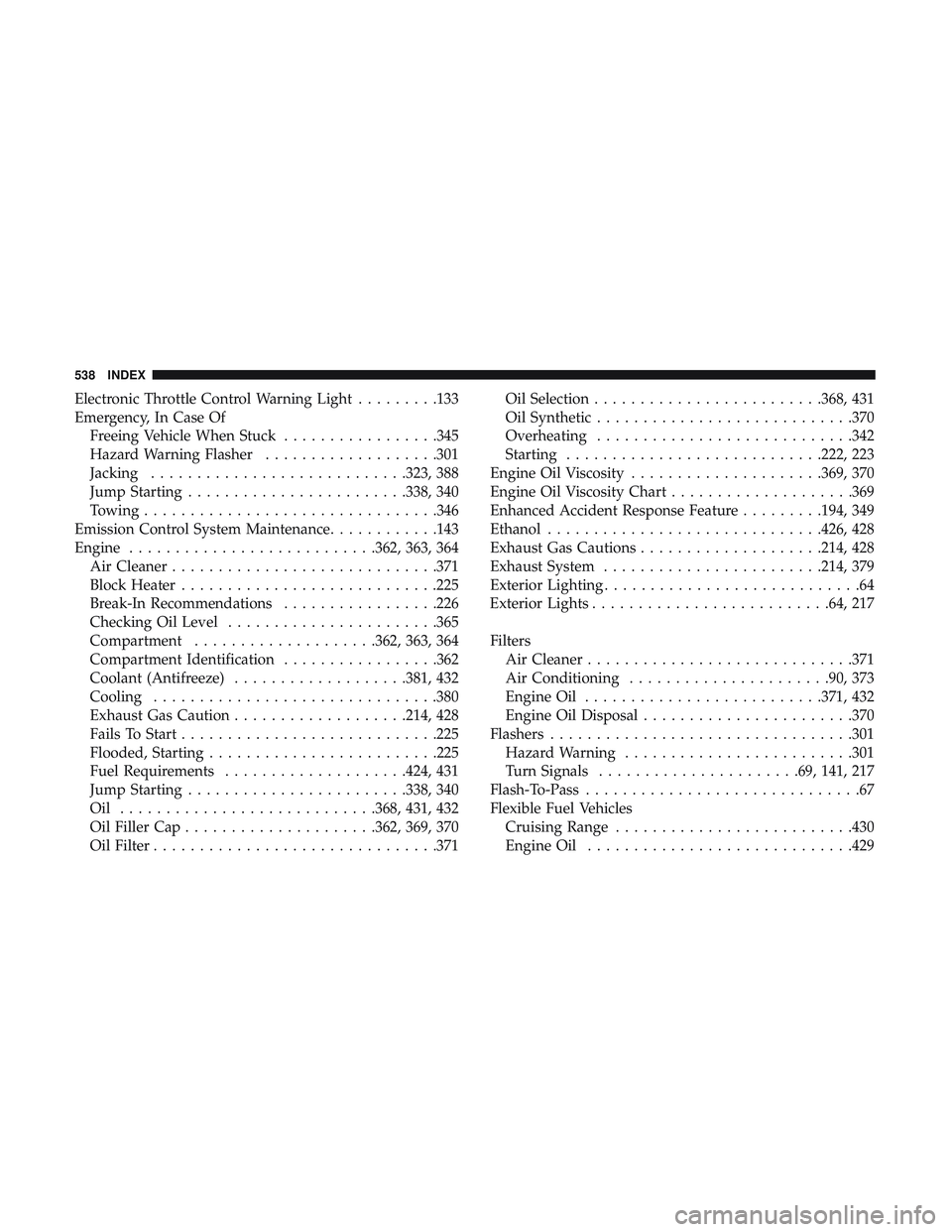
Electronic Throttle Control Warning Light.........133
Emergency, In Case Of Freeing Vehicle When Stuck .................345
Hazard Warning Flasher ...................301
Jacking ............................323, 388
Jump Starting ........................338, 340
Towing ............................... .346
Emission Control System Maintenance ............143
Engine .......................... .362, 363, 364
Air Cleaner ............................ .371
Block Heater ............................225
Break-In Recommendations .................226
Checking Oil Level .......................365
Compartment ....................362, 363, 364
Compartment Identification .................362
Coolant (Antifreeze) ...................381, 432
Cooling ...............................380
Exhaust Gas Caution ...................214, 428
Fails To Start ............................225
Flooded, Starting ........................ .225
Fuel Requirements ....................424, 431
Jump Starting ........................338, 340
Oil ............................368, 431, 432
Oil Filler Cap .....................362, 369, 370
Oil Filter ...............................371 Oil Selection
........................ .368, 431
Oil Synthetic ............................370
Overheating ............................342
Starting ............................222, 223
Engine Oil Viscosity .....................369, 370
Engine Oil Viscosity Chart ....................369
Enhanced Accident Response Feature .........194, 349
Ethanol ............................. .426, 428
Exhaust Gas Cautions ....................214, 428
Exhaust System ........................214, 379
Exterior Lighting............................
64
Exterior Lights ..........................64, 217
Filters Air Cleaner ............................ .371
Air Conditioning ..................... .90, 373
Engine Oil ..........................371, 432
Engine Oil Disposal .......................370
Flashers .................................301
Hazard Warning ........................ .301
Turn Signals ..................... .69, 141, 217
Flash-To-Pass ..............................67
Flexible Fuel Vehicles Cruising Range ..........................430
Engine Oil ............................ .429
538 INDEX
Page 541 of 553
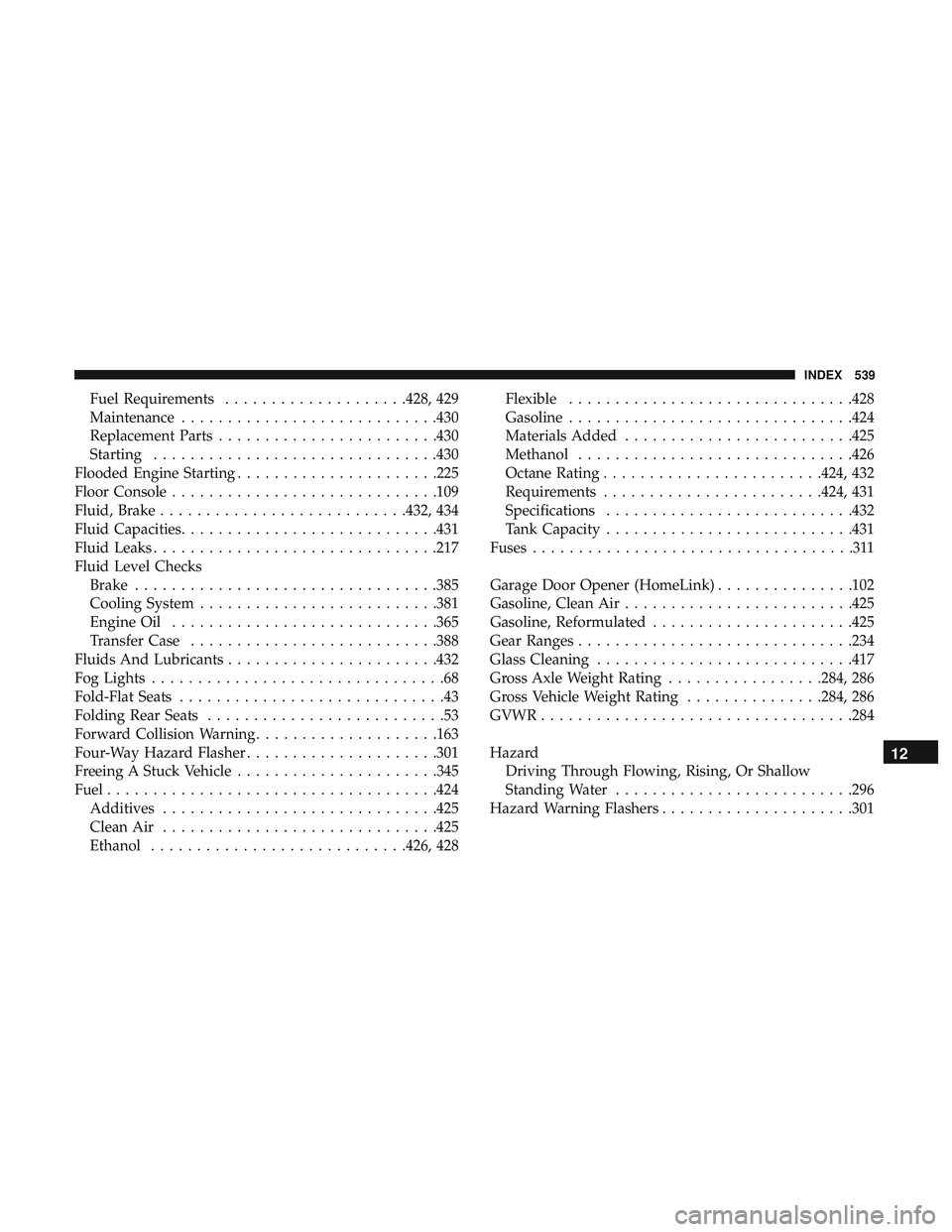
Fuel Requirements....................428, 429
Maintenance ............................430
Replacement Parts ........................430
Starting ...............................430
Flooded Engine Starting ..................... .225
Floor Console ............................ .109
Fluid, Brake .......................... .432, 434
Fluid Capacities ............................431
Fluid Leaks ...............................217
Fluid Level Checks Brake .................................385
Cooling System ..........................381
Engine Oil ............................ .365
Transfer Case .......................... .388
Fluids And Lubricants .......................432
Fog Lights ................................68
Fold-Flat Seats .............................43
Folding Rear Seats ..........................53
Forward Collision Warning ....................163
Four-Way Hazard Flasher .....................301
Freeing A Stuck Vehicle ..................... .345
Fuel ................................... .424
Additives ............................. .425
Clean Air ............................. .425
Ethanol ............................426, 428 Flexible
...............................428
Gasoline ...............................424
Materials Added ........................ .425
Methanol ............................. .426
Octane Rating ........................424, 432
Requirements ........................424, 431
Specifications .......................... .432
Tank Capacity .......................... .431
Fuses ...................................311
Garage Door Opener (HomeLink) ...............102
Gasoline, Clean Air ........................ .425
Gasoline, Reformulated ..................... .425
Gear
Ranges ............................. .234
Glass Cleaning ............................417
Gross Axle Weight Rating .................284, 286
Gross Vehicle Weight Rating ...............284, 286
GVWR ................................. .284
Hazard Driving Through Flowing, Rising, Or Shallow
Standing Water ..........................296
Hazard Warning Flashers .....................301
12
INDEX 539