weight DODGE CHARGER 2020 User Guide
[x] Cancel search | Manufacturer: DODGE, Model Year: 2020, Model line: CHARGER, Model: DODGE CHARGER 2020Pages: 412, PDF Size: 18.96 MB
Page 207 of 412
STARTING AND OPERATING205
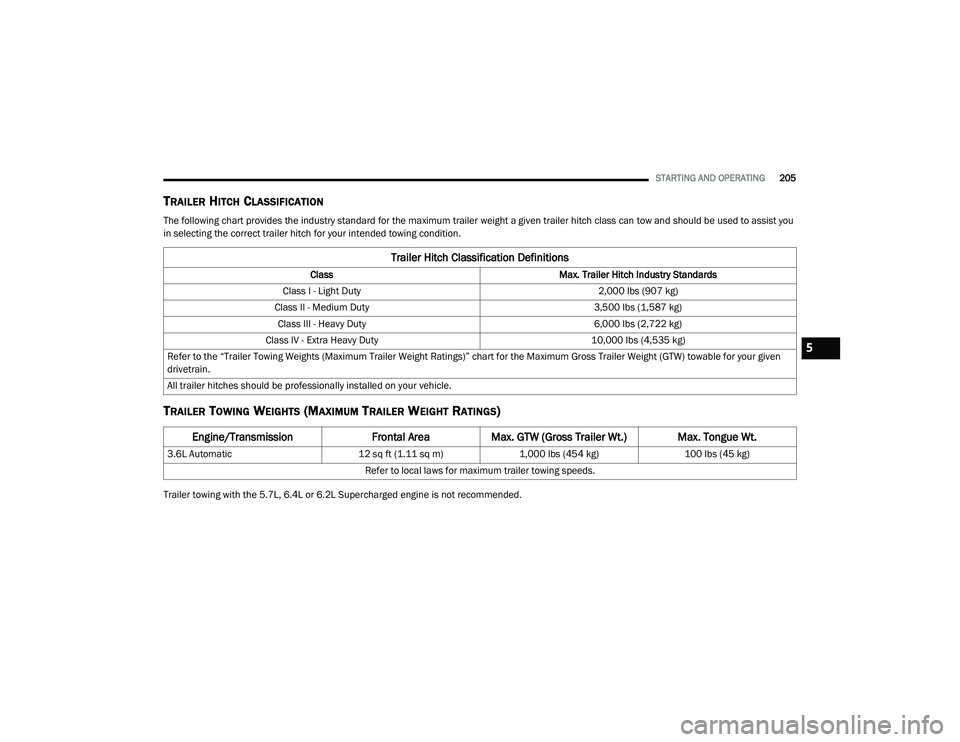
TRAILER HITCH CLASSIFICATION
The following chart provides the industry standard for the maximum trailer weight a given trailer hitch class can tow and should be used to assist you
in selecting the correct trailer hitch for your intended towing condition.
TRAILER TOWING WEIGHTS (MAXIMUM TRAILER WEIGHT RATINGS)
Trailer towing with the 5.7L, 6.4L or 6.2L Supercharged engine is not recommended.
Trailer Hitch Classification Definitions
Class Max. Trailer Hitch Industry Standards
Class I - Light Duty 2,000 lbs (907 kg)
Class II - Medium Duty 3,500 lbs (1,587 kg)
Class III - Heavy Duty 6,000 lbs (2,722 kg)
Class IV - Extra Heavy Duty 10,000 lbs (4,535 kg)
Refer to the “Trailer Towing Weights (Maximum Trailer Weight Ratings)” chart for the Maximum Gross Trailer Weight (GTW) towable for your given
drivetrain.
All trailer hitches should be professionally installed on your vehicle.
Engine/Transmission Frontal AreaMax. GTW (Gross Trailer Wt.) Max. Tongue Wt.
3.6L Automatic 12 sq ft (1.11 sq m)1,000 lbs (454 kg) 100 lbs (45 kg)
Refer to local laws for maximum trailer towing speeds.
5
20_LD_OM_EN_USC_t.book Page 205
Page 208 of 412
206STARTING AND OPERATING
(Continued)
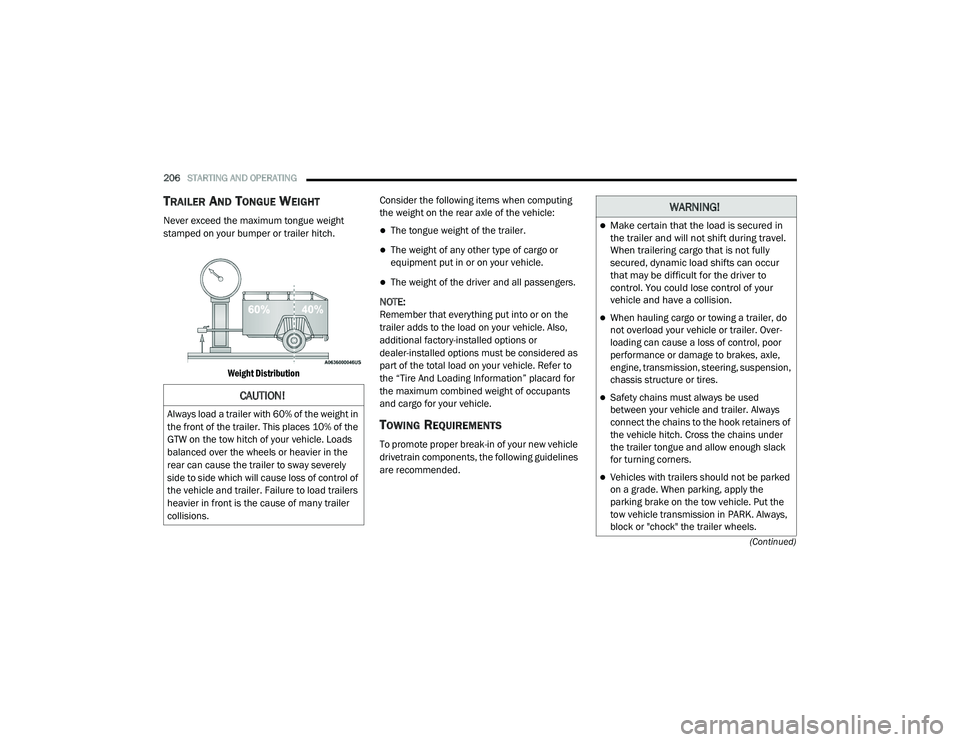
TRAILER AND TONGUE WEIGHT
Never exceed the maximum tongue weight
stamped on your bumper or trailer hitch.
Weight Distribution
Consider the following items when computing
the weight on the rear axle of the vehicle:The tongue weight of the trailer.
The weight of any other type of cargo or
equipment put in or on your vehicle.
The weight of the driver and all passengers.
NOTE:
Remember that everything put into or on the
trailer adds to the load on your vehicle. Also,
additional factory-installed options or
dealer-installed options must be considered as
part of the total load on your vehicle. Refer to
the “Tire And Loading Information” placard for
the maximum combined weight of occupants
and cargo for your vehicle.
TOWING REQUIREMENTS
To promote proper break-in of your new vehicle
drivetrain components, the following guidelines
are recommended.
CAUTION!
Always load a trailer with 60% of the weight in
the front of the trailer. This places 10% of the
GTW on the tow hitch of your vehicle. Loads
balanced over the wheels or heavier in the
rear can cause the trailer to sway severely
side to side which will cause loss of control of
the vehicle and trailer. Failure to load trailers
heavier in front is the cause of many trailer
collisions.
WARNING!
Make certain that the load is secured in
the trailer and will not shift during travel.
When trailering cargo that is not fully
secured, dynamic load shifts can occur
that may be difficult for the driver to
control. You could lose control of your
vehicle and have a collision.
When hauling cargo or towing a trailer, do
not overload your vehicle or trailer. Over -
loading can cause a loss of control, poor
performance or damage to brakes, axle,
engine, transmission, steering, suspension,
chassis structure or tires.
Safety chains must always be used
between your vehicle and trailer. Always
connect the chains to the hook retainers of
the vehicle hitch. Cross the chains under
the trailer tongue and allow enough slack
for turning corners.
Vehicles with trailers should not be parked
on a grade. When parking, apply the
parking brake on the tow vehicle. Put the
tow vehicle transmission in PARK. Always,
block or "chock" the trailer wheels.
20_LD_OM_EN_USC_t.book Page 206
Page 209 of 412
STARTING AND OPERATING207
(Continued)
Perform the maintenance listed in the
“Scheduled Servicing”. Refer to “Scheduled
Servicing” in “Servicing And Maintenance” for
the proper maintenance intervals. When towing
a trailer, never exceed the GAWR or GCWR
ratings.
Towing Requirements — Tires
Do not attempt to tow a trailer while using a
compact spare tire.
Do not drive more than 50 mph (80 km/h) when towing while using a full size spare tire.
Proper tire inflation pressures are essential
to the safe and satisfactory operation of your
vehicle. Refer to “Tires” in “Servicing And
Maintenance” for proper tire inflation proce -
dures.
Check the trailer tires for proper tire inflation
pressures before trailer usage.
Check for signs of tire wear or visible tire
damage before towing a trailer. Refer to
“Tires” in “Servicing And Maintenance” for
the proper inspection procedure.
When replacing tires, refer to “Tires” in
“Servicing And Maintenance” for the proper
tire replacement procedures. Replacing tires
with a higher load carrying capacity will not
increase the vehicle's GVWR and GAWR
limits.
Towing Requirements — Trailer Brakes
Do not interconnect the hydraulic brake
system or vacuum system of your vehicle
with that of the trailer. This could cause inad -
equate braking and possible personal injury.
An electronically actuated trailer brake
controller is required when towing a trailer
with electronically actuated brakes. When
towing a trailer equipped with a hydraulic
surge actuated brake system, an electronic
brake controller is not required.
Trailer brakes are recommended for trailers
over 1,000 lbs (453 kg) and required for
trailers in excess of 2,000 lbs (907 kg).
GCWR must not be exceeded.
Total weight must be distributed between
the tow vehicle and the trailer such that the
following four ratings are not exceeded :
Max loading as defined on the “Tire and
Loading Information” placard.
GTW
GAWR
Tongue weight rating for the trailer
hitch utilized.
CAUTION!
Do not tow a trailer at all during the first
500 miles (805 km) the new vehicle is
driven. The engine, axle or other parts could
be damaged.
WARNING! (Continued)
Then, during the first 500 miles (805 km)
that a trailer is towed, do not drive over
50 mph (80 km/h) and do not make starts
at full throttle. This helps the engine and
other parts of the vehicle wear in at the
heavier loads.
CAUTION! (Continued)
5
20_LD_OM_EN_USC_t.book Page 207
Page 293 of 412
SERVICING AND MAINTENANCE291
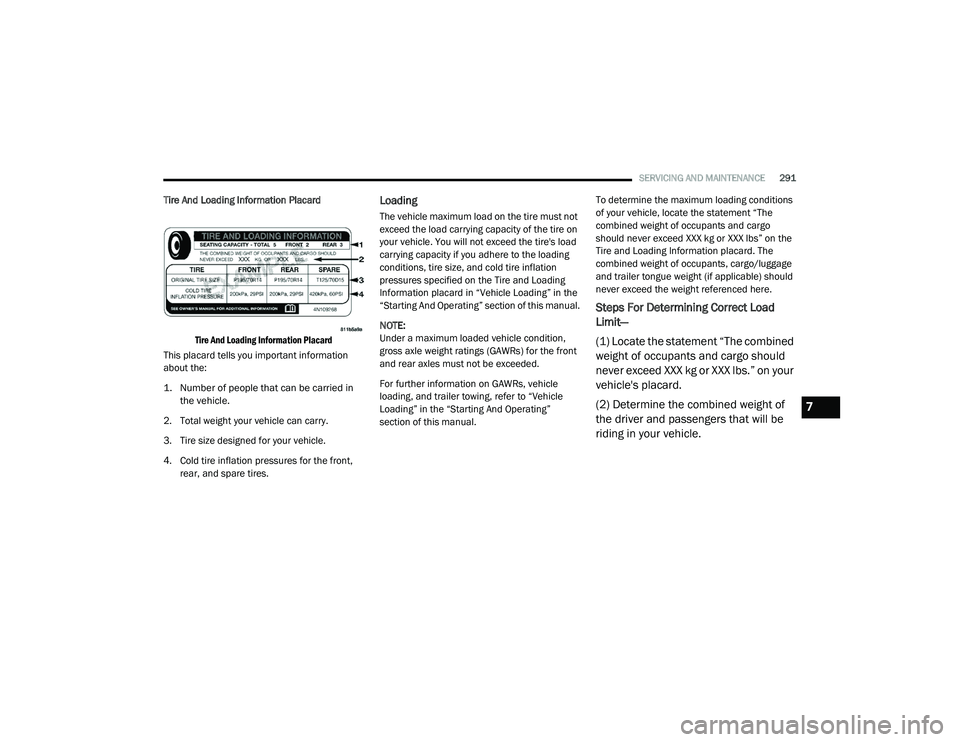
Tire And Loading Information Placard
Tire And Loading Information Placard
This placard tells you important information
about the:
1. Number of people that can be carried in the vehicle.
2. Total weight your vehicle can carry.
3. Tire size designed for your vehicle.
4. Cold tire inflation pressures for the front, rear, and spare tires.Loading
The vehicle maximum load on the tire must not
exceed the load carrying capacity of the tire on
your vehicle. You will not exceed the tire's load
carrying capacity if you adhere to the loading
conditions, tire size, and cold tire inflation
pressures specified on the Tire and Loading
Information placard in “Vehicle Loading” in the
“Starting And Operating” section of this manual.
NOTE:
Under a maximum loaded vehicle condition,
gross axle weight ratings (GAWRs) for the front
and rear axles must not be exceeded.
For further information on GAWRs, vehicle
loading, and trailer towing, refer to “Vehicle
Loading” in the “Starting And Operating”
section of this manual. To determine the maximum loading conditions
of your vehicle, locate the statement “The
combined weight of occupants and cargo
should never exceed XXX kg or XXX lbs” on the
Tire and Loading Information placard. The
combined weight of occupants, cargo/luggage
and trailer tongue weight (if applicable) should
never exceed the weight referenced here.
Steps For Determining Correct Load
Limit—
(1) Locate the statement “The combined
weight of occupants and cargo should
never exceed XXX kg or XXX lbs.” on your
vehicle's placard.
(2) Determine the combined weight of
the driver and passengers that will be
riding in your vehicle.
7
20_LD_OM_EN_USC_t.book Page 291
Page 294 of 412
292SERVICING AND MAINTENANCE
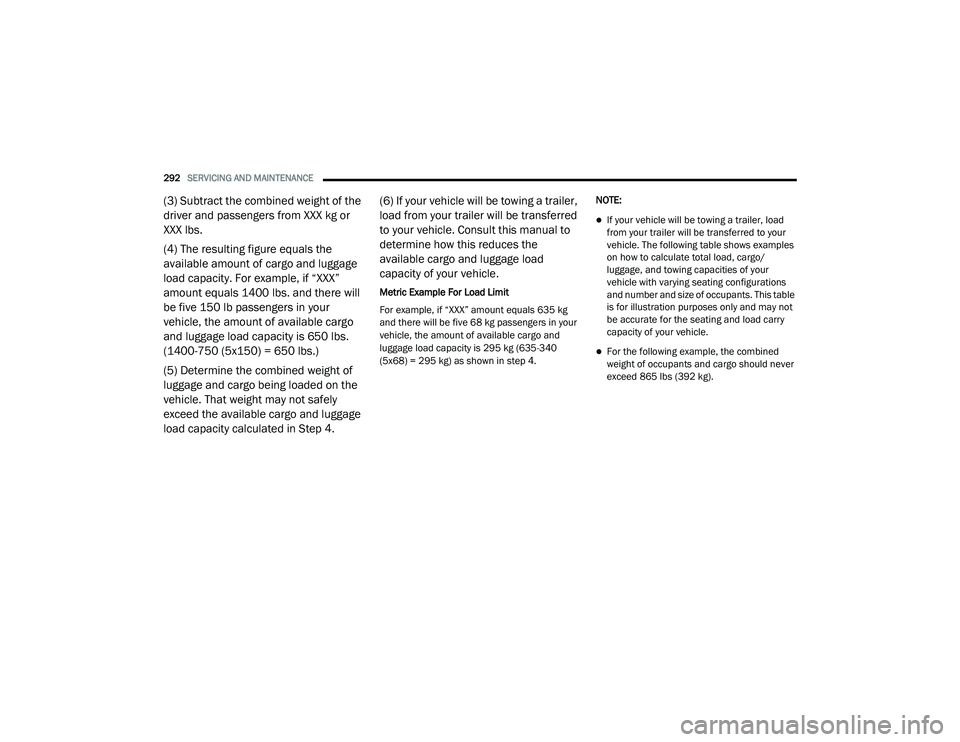
(3) Subtract the combined weight of the
driver and passengers from XXX kg or
XXX lbs.
(4) The resulting figure equals the
available amount of cargo and luggage
load capacity. For example, if “XXX”
amount equals 1400 lbs. and there will
be five 150 lb passengers in your
vehicle, the amount of available cargo
and luggage load capacity is 650 lbs.
(1400-750 (5x150) = 650 lbs.)
(5) Determine the combined weight of
luggage and cargo being loaded on the
vehicle. That weight may not safely
exceed the available cargo and luggage
load capacity calculated in Step 4. (6) If your vehicle will be towing a trailer,
load from your trailer will be transferred
to your vehicle. Consult this manual to
determine how this reduces the
available cargo and luggage load
capacity of your vehicle.
Metric Example For Load Limit
For example, if “XXX” amount equals 635 kg
and there will be five 68 kg passengers in your
vehicle, the amount of available cargo and
luggage load capacity is 295 kg (635-340
(5x68) = 295 kg) as shown in step 4.
NOTE:
If your vehicle will be towing a trailer, load
from your trailer will be transferred to your
vehicle. The following table shows examples
on how to calculate total load, cargo/
luggage, and towing capacities of your
vehicle with varying seating configurations
and number and size of occupants. This table
is for illustration purposes only and may not
be accurate for the seating and load carry
capacity of your vehicle.
For the following example, the combined
weight of occupants and cargo should never
exceed 865 lbs (392 kg).
20_LD_OM_EN_USC_t.book Page 292
Page 400 of 412
398 Engine Oil Viscosity
.............................. 273, 274Engine Oil Viscosity Chart.............................. 273
Enhanced Accident Response Feature.. 141, 249
Ethanol.......................................................... 311Exhaust Gas Cautions.......................... 155, 312Exhaust System................................... 155, 279Exterior Lighting............................................... 45Exterior Lights......................................... 45, 157
F
Filters Air Cleaner
................................................. 275Air Conditioning.................................. 63, 276Engine Oil............................... 274, 315, 318Engine Oil Disposal................................... 274Flashers......................................................... 212Hazard Warning......................................... 212Turn Signals..............................48, 103, 157Flash-To-Pass.................................................. 46Flooded Engine Starting................................ 162Floor Console................................................... 76Fluid Capacities................................... 313, 314Fluid Leaks.................................................... 158Fluid Level ChecksBrake........................................................ 284Cooling System.......................................... 281Engine Oil.................................................. 270Fluid, Brake....................... 315, 317, 318, 320
Fluids And Lubricants.......................... 315, 318Fog Lights........................................................ 48Fold-Flat Seats................................................. 32Folding Rear Seats........................................... 33Forward Collision Warning............................ 118Four-Way Hazard Flasher.............................. 212Freeing A Stuck Vehicle................................ 244Fuel............................................................... 309Additives................................................... 310Clean Air................................................... 310Ethanol..................................................... 311Gasoline................................................... 309Materials Added....................................... 310Methanol.................................................. 311Octane Rating................309, 310, 315, 318Requirements......................... 309, 313, 314Specifications.................................. 315, 318Tank Capacity.................................. 313, 314Fuses............................................................ 220
G
Garage Door Opener (HomeLink)..................... 71Gasoline, Clean Air........................................ 310Gasoline, Reformulated................................ 310Gear Ranges................................................. 168Glass Cleaning.............................................. 307Gross Axle Weight Rating..................... 202, 203Gross Vehicle Weight Rating................ 202, 203GVWR............................................................ 202
H
HazardDriving Through Flowing, Rising, Or Shallow Standing Water
....................... 211Hazard Warning Flashers.............................. 212Head Restraints........................................38, 39Head Rests............................................... 38, 39HeadlightsAutomatic....................................................47Cleaning.................................................... 305High Beam/Low Beam Select Switch..........46Lights On Reminder.....................................47On With Wipers............................................47Passing........................................................46Switch..........................................................45Time Delay...................................................47Washers.................................................... 270Heated Mirrors.................................................44Heater, Engine Block..................................... 162High Beam/Low Beam Select
(Dimmer) Switch..............................................46Hill Start Assist.............................................. 111HitchesTrailer Towing........................................... 205Holder, Coin.....................................................76HomeLink (Garage Door Opener).....................71Hood Prop........................................................68Hood Release...................................................68
20_LD_OM_EN_USC_t.book Page 398
Page 405 of 412
403
Time Delay Headlight
..................................................... 47Tire And Loading Information Placard........... 290Tire Markings................................................. 286Tire Safety Information.................................. 286Tire Service Kit........................... 234, 235, 237Tires..........................157, 293, 298, 299, 303Aging (Life Of Tires)................................... 296Air Pressure............................................... 293Chains............................................. 301, 302Changing................................ 229, 234, 286Compact Spare......................................... 299Flat Changing............................................ 234General Information............... 293, 298, 299High Speed................................................ 295Inflation Pressure...................................... 294Jacking............................................ 230, 286Life Of Tires............................................... 296Load Capacity.................................. 290, 291Pressure Monitoring System (TPMS).. 99, 120Quality Grading.......................................... 303Radial........................................................ 295Replacement................................... 234, 297
Rotation........................................... 302, 303Safety.............................................. 286, 293Sizes......................................................... 287Snow Tires................................................ 298Spare Tires....................230, 298, 299, 300Spinning................................................... 296Trailer Towing........................................... 207Tread Wear Indicators.............................. 296Wheel Mounting....................................... 234Wheel Nut Torque..................................... 308To Open Hood.................................................. 68Tongue Weight/Trailer Weight...................... 206Towing.......................................................... 203Behind A Motorhome................................ 210Disabled Vehicle....................................... 248Guide........................................................ 205Recreational............................................. 210Weight...................................................... 205Towing Behind A Motorhome........................ 210Traction......................................................... 210Traction Control............................................ 113
Trailer Towing................................................ 203Cooling System Tips.................................. 209Hitches..................................................... 205Minimum Requirements........................... 206Tips........................................................... 209Trailer And Tongue Weight........................ 206Wiring....................................................... 208Trailer Towing Guide..................................... 205Trailer Weight................................................ 205Transfer CaseFluid........................................315, 317, 318Transmission................................................. 167Automatic........................................ 167, 285Fluid.............................. 315, 317, 318, 320Maintenance............................................ 285Shifting..................................................... 165Transporting Pets.......................................... 155Tread Wear Indicators................................... 296Trunk Lid (Deck Lid).........................................68Trunk Release Remote Control........................68Turn Signals........................................... 48, 103
11
20_LD_OM_EN_USC_t.book Page 403