fuses DODGE CHARGER 2020 Owners Manual
[x] Cancel search | Manufacturer: DODGE, Model Year: 2020, Model line: CHARGER, Model: DODGE CHARGER 2020Pages: 412, PDF Size: 18.96 MB
Page 7 of 412
5
PARKSENSE REAR PARK ASSIST —
IF EQUIPPED ....................................................... 191 ParkSense Sensors ...................................192
ParkSense Warning Display ......................192
ParkSense Display ..................................... 192Enabling And Disabling ParkSense ..........194
Service The ParkSense Rear Park
Assist System .............................................195 Cleaning The ParkSense System ..............195
ParkSense System Usage Precautions ....195
LANESENSE — IF EQUIPPED ........................... 196
LaneSense Operation ................................196Turning LaneSense On Or Off ...................196LaneSense Warning Message ..................197
Changing LaneSense Status .....................199
PARKVIEW REAR BACK UP CAMERA ............. 199
REFUELING THE VEHICLE ................................. 200
VEHICLE LOADING ............................................ 202
Vehicle Certification Label ........................ 202Gross Vehicle Weight Rating (GVWR) .......202
Gross Axle Weight Rating (GAWR) ........... 202Overloading ................................................202
Loading ......................................................203
TRAILER TOWING .............................................. 203
Common Towing Definitions .....................203Trailer Hitch Classification ........................ 205Trailer Towing Weights (Maximum Trailer
Weight Ratings) ..........................................205 Trailer And Tongue Weight ....................... 206
Towing Requirements................................ 206
Towing Tips ................................................ 209
RECREATIONAL TOWING (BEHIND MOTORHOME,
ETC.) ....................................................................210
DRIVING TIPS ...................................................... 210
Driving On Slippery Surfaces .................... 210
Driving Through Water .............................. 211
IN CASE OF EMERGENCY
HAZARD WARNING FLASHERS .......................212
ASSIST AND SOS MIRROR — IF EQUIPPED .... 212General Information .................................. 216
BULB REPLACEMENT ........................................ 217
Replacement Bulbs ................................... 217
Replacing Exterior Bulbs ........................... 219
FUSES ..................................................................220
General Information .................................. 220Underhood Fuses ...................................... 221
Rear Interior Fuses .................................... 225
JACKING AND TIRE CHANGING ........................229
Jack Location/Spare Tire Stowage ........... 230
Preparations For Jacking........................... 230
Jacking And Changing A Tire ..................... 231Road Tire Installation ................................ 234 TIRE SERVICE KIT — IF EQUIPPED ................... 234
Tire Service Kit Storage............................. 234
Tire Service Kit Components And
Operation ................................................... 235 Tire Service Kit Usage Precautions .......... 235Sealing A Tire With Tire Service Kit .......... 237
JUMP STARTING ............................................... 240
Preparations For Jump Start ..................... 240
Jump Starting Procedure .......................... 241
IF YOUR ENGINE OVERHEATS ......................... 242
MANUAL PARK RELEASE — 8 – SPEED
TRANSMISSION ................................................. 243
FREEING A STUCK VEHICLE ............................. 244
SRT — TOWING A DISABLED VEHICLE ............ 246
NON SRT — TOWING A DISABLED VEHICLE ... 248 All Wheel Drive (AWD) Models .................. 249Rear-Wheel Drive (RWD) Models ............. 249
ENHANCED ACCIDENT RESPONSE SYSTEM
(EARS) ................................................................ 249
EVENT DATA RECORDER (EDR) ....................... 249
SERVICING AND MAINTENANCE
SCHEDULED SERVICING .................................. 250
3.6L And 5.7L Engines ............................. 250
6.2L Supercharged And 6.4L Engines ..... 254
20_LD_OM_EN_USC_t.book Page 5
Page 81 of 412
GETTING TO KNOW YOUR VEHICLE79
(Continued)
(Continued)
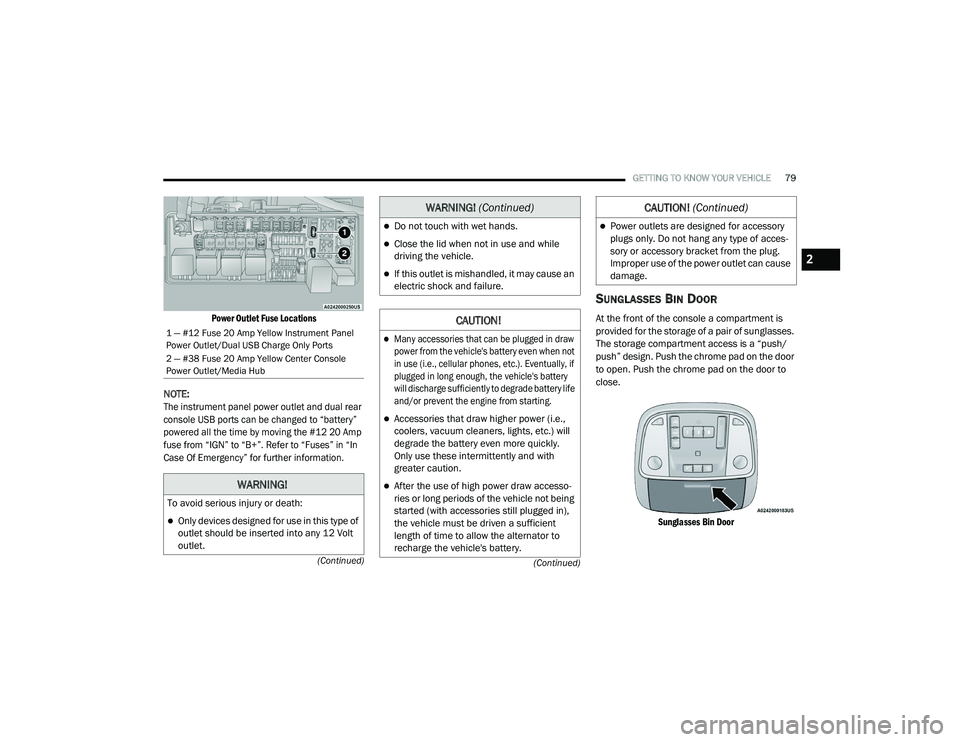
Power Outlet Fuse Locations
NOTE:
The instrument panel power outlet and dual rear
console USB ports can be changed to “battery”
powered all the time by moving the #12 20 Amp
fuse from “IGN” to “B+”. Refer to “Fuses” in “In
Case Of Emergency” for further information.
SUNGLASSES BIN DOOR
At the front of the console a compartment is
provided for the storage of a pair of sunglasses.
The storage compartment access is a “push/
push” design. Push the chrome pad on the door
to open. Push the chrome pad on the door to
close.
Sunglasses Bin Door
1 — #12 Fuse 20 Amp Yellow Instrument Panel
Power Outlet/Dual USB Charge Only Ports
2 — #38 Fuse 20 Amp Yellow Center Console
Power Outlet/Media Hub
WARNING!
To avoid serious injury or death:
Only devices designed for use in this type of
outlet should be inserted into any 12 Volt
outlet.
Do not touch with wet hands.
Close the lid when not in use and while
driving the vehicle.
If this outlet is mishandled, it may cause an
electric shock and failure.
CAUTION!
Many accessories that can be plugged in draw
power from the vehicle's battery even when not
in use (i.e., cellular phones, etc.). Eventually, if
plugged in long enough, the vehicle's battery
will discharge sufficiently to degrade battery life
and/or prevent the engine from starting.
Accessories that draw higher power (i.e.,
coolers, vacuum cleaners, lights, etc.) will
degrade the battery even more quickly.
Only use these intermittently and with
greater caution.
After the use of high power draw accesso -
ries or long periods of the vehicle not being
started (with accessories still plugged in),
the vehicle must be driven a sufficient
length of time to allow the alternator to
recharge the vehicle's battery.
WARNING! (Continued)
Power outlets are designed for accessory
plugs only. Do not hang any type of acces -
sory or accessory bracket from the plug.
Improper use of the power outlet can cause
damage.
CAUTION! (Continued)
2
20_LD_OM_EN_USC_t.book Page 79
Page 222 of 412
220IN CASE OF EMERGENCY
(Continued)
Front/Rear Side Marker Lamp
The Side Markers use LED lamps that are not
serviceable separately. The Side Markers must
be replaced as an assembly, see an authorized
dealer.
Front Fog Lamp
The Front Fog Lamps use LED sources that are
not serviceable separately. The Front Fog Lamp
must be replaced as an assembly; see an
authorized dealer.
Front Turn Signal Lamps
The Front Park/Turn function is part of the
headlamp assembly and use LED lamps that
are not serviceable separately. The headlamps
must be replaced as an assembly, see an
authorized dealer.
Backup Lamps
The Backup Lamps use LED sources that are
not serviceable separately. The Applique must
be replaced as an assembly; see an authorized
dealer.
License Lamp
The License Lamp uses an LED source that is
not serviceable separately. The License Lamp
must be replaced as an assembly; see an
authorized dealer.
Center High Mounted Stop Lamp (CHMSL)
The CHMSL Lamp uses LED sources that are
not serviceable separately. The CHMSL Lamp
must be replaced as an assembly; see an
authorized dealer.
FUSES
GENERAL INFORMATION
The fuses protect electrical systems against
excessive current.
When a device does not work, you must check
the fuse element inside the blade fuse for a
break/melt.
WARNING!
When replacing a blown fuse, always use
an appropriate replacement fuse with the
same amp rating as the original fuse. Never
replace a fuse with another fuse of higher
amp rating. Never replace a blown fuse with
metal wires or any other material. Do not
place a fuse inside a circuit breaker cavity
or vice versa. Failure to use proper fuses
may result in serious personal injury, fire
and/or property damage.
Before replacing a fuse, make sure that the
ignition is off and that all the other services
are switched off and/or disengaged.
If the replaced fuse blows again, contact an
authorized dealer.
If a general protection fuse for safety
systems (air bag system, braking system),
power unit systems (engine system, trans-
mission system) or steering system blows,
contact an authorized dealer.
WARNING! (Continued)
20_LD_OM_EN_USC_t.book Page 220
Page 223 of 412
IN CASE OF EMERGENCY221
Also, please be aware that when using power
outlets for extended periods of time with the
engine off may result in vehicle battery
discharge.
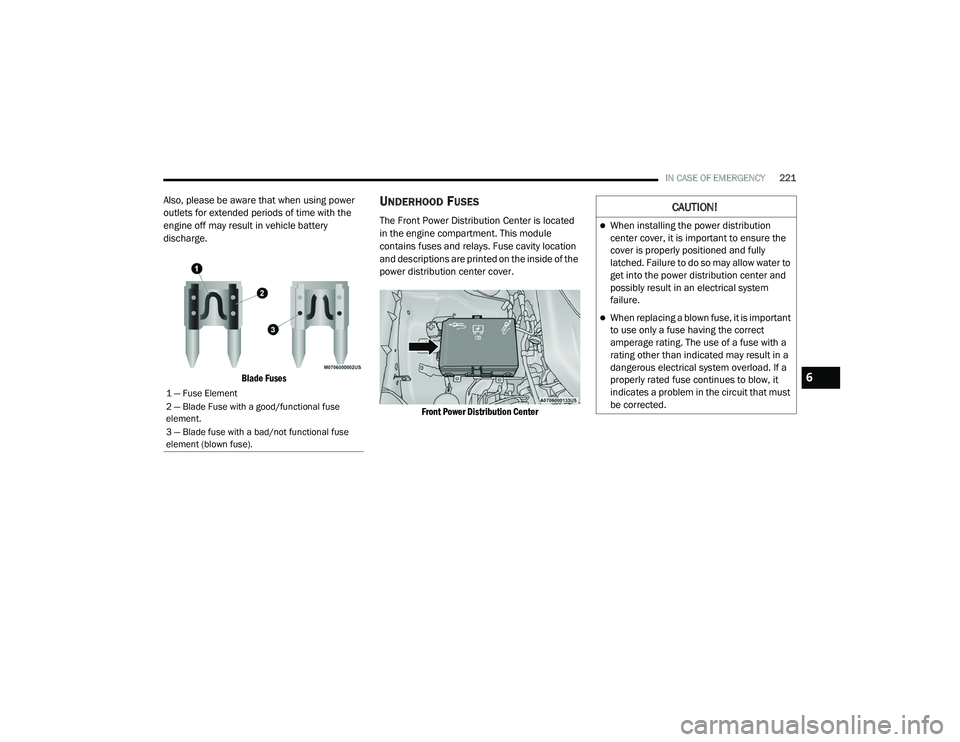
Blade Fuses
UNDERHOOD FUSES
The Front Power Distribution Center is located
in the engine compartment. This module
contains fuses and relays. Fuse cavity location
and descriptions are printed on the inside of the
power distribution center cover.
Front Power Distribution Center
1 — Fuse Element
2 — Blade Fuse with a good/functional fuse
element.
3 — Blade fuse with a bad/not functional fuse
element (blown fuse).
CAUTION!
When installing the power distribution
center cover, it is important to ensure the
cover is properly positioned and fully
latched. Failure to do so may allow water to
get into the power distribution center and
possibly result in an electrical system
failure.
When replacing a blown fuse, it is important
to use only a fuse having the correct
amperage rating. The use of a fuse with a
rating other than indicated may result in a
dangerous electrical system overload. If a
properly rated fuse continues to blow, it
indicates a problem in the circuit that must
be corrected.
6
20_LD_OM_EN_USC_t.book Page 221
Page 227 of 412
IN CASE OF EMERGENCY225
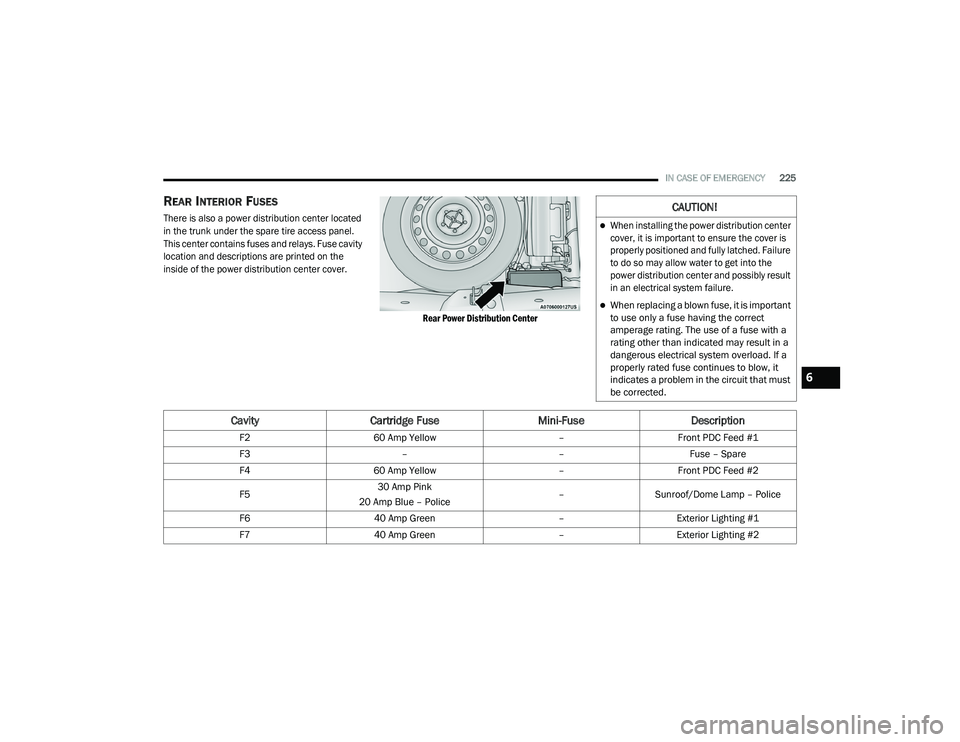
REAR INTERIOR FUSES
There is also a power distribution center located
in the trunk under the spare tire access panel.
This center contains fuses and relays. Fuse cavity
location and descriptions are printed on the
inside of the power distribution center cover.
Rear Power Distribution Center
CAUTION!
When installing the power distribution center
cover, it is important to ensure the cover is
properly positioned and fully latched. Failure
to do so may allow water to get into the
power distribution center and possibly result
in an electrical system failure.
When replacing a blown fuse, it is important
to use only a fuse having the correct
amperage rating. The use of a fuse with a
rating other than indicated may result in a
dangerous electrical system overload. If a
properly rated fuse continues to blow, it
indicates a problem in the circuit that must
be corrected.
CavityCartridge Fuse Mini-FuseDescription
F260 Amp Yellow –Front PDC Feed #1
F3 ––Fuse – Spare
F4 60 Amp Yellow –Front PDC Feed #2
F5 30 Amp Pink
20 Amp Blue – Police –
Sunroof/Dome Lamp – Police
F6 40 Amp Green –Exterior Lighting #1
F7 40 Amp Green –Exterior Lighting #2
6
20_LD_OM_EN_USC_t.book Page 225
Page 268 of 412
266SERVICING AND MAINTENANCE
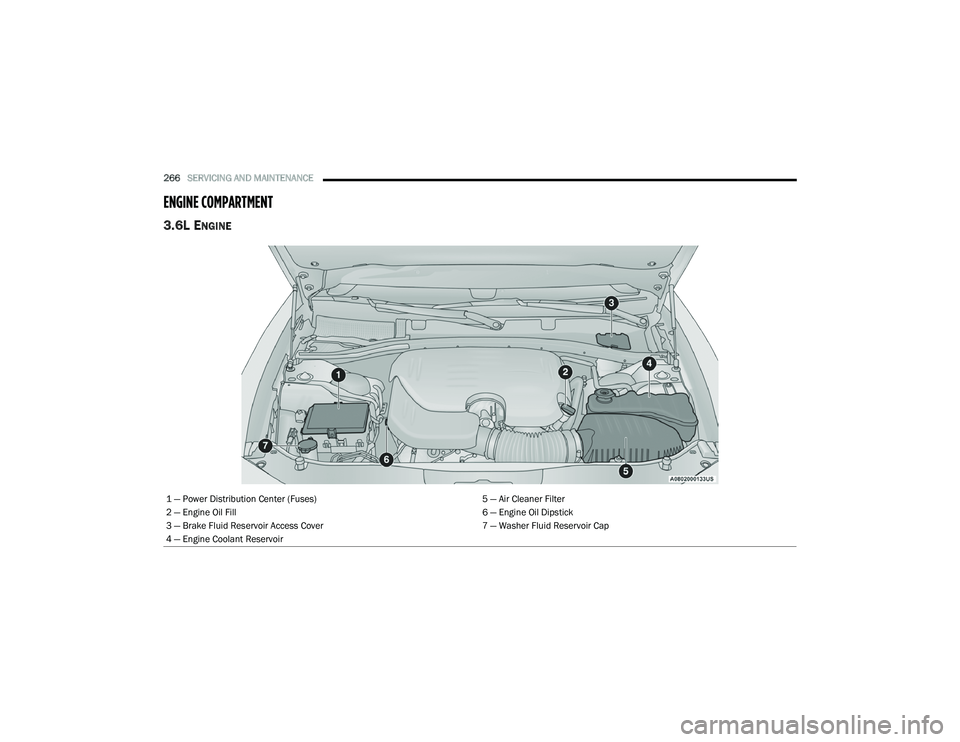
ENGINE COMPARTMENT
3.6L ENGINE
1 — Power Distribution Center (Fuses) 5 — Air Cleaner Filter
2 — Engine Oil Fill 6 — Engine Oil Dipstick
3 — Brake Fluid Reservoir Access Cover 7 — Washer Fluid Reservoir Cap
4 — Engine Coolant Reservoir
20_LD_OM_EN_USC_t.book Page 266
Page 269 of 412
SERVICING AND MAINTENANCE267
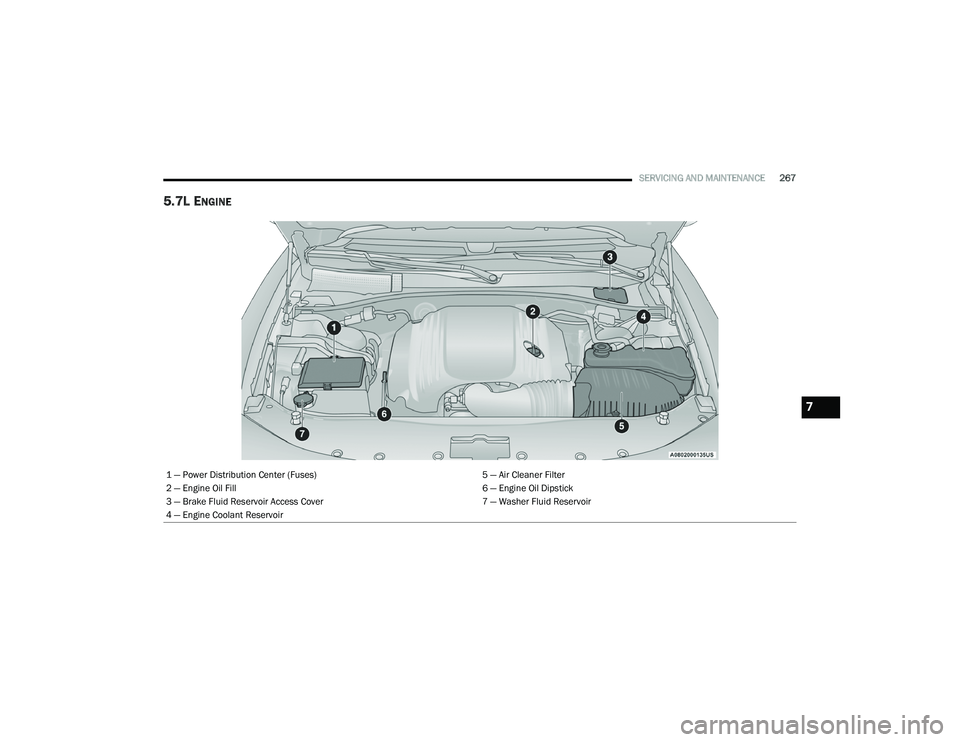
5.7L ENGINE
1 — Power Distribution Center (Fuses) 5 — Air Cleaner Filter
2 — Engine Oil Fill 6 — Engine Oil Dipstick
3 — Brake Fluid Reservoir Access Cover 7 — Washer Fluid Reservoir
4 — Engine Coolant Reservoir
7
20_LD_OM_EN_USC_t.book Page 267
Page 270 of 412
268SERVICING AND MAINTENANCE
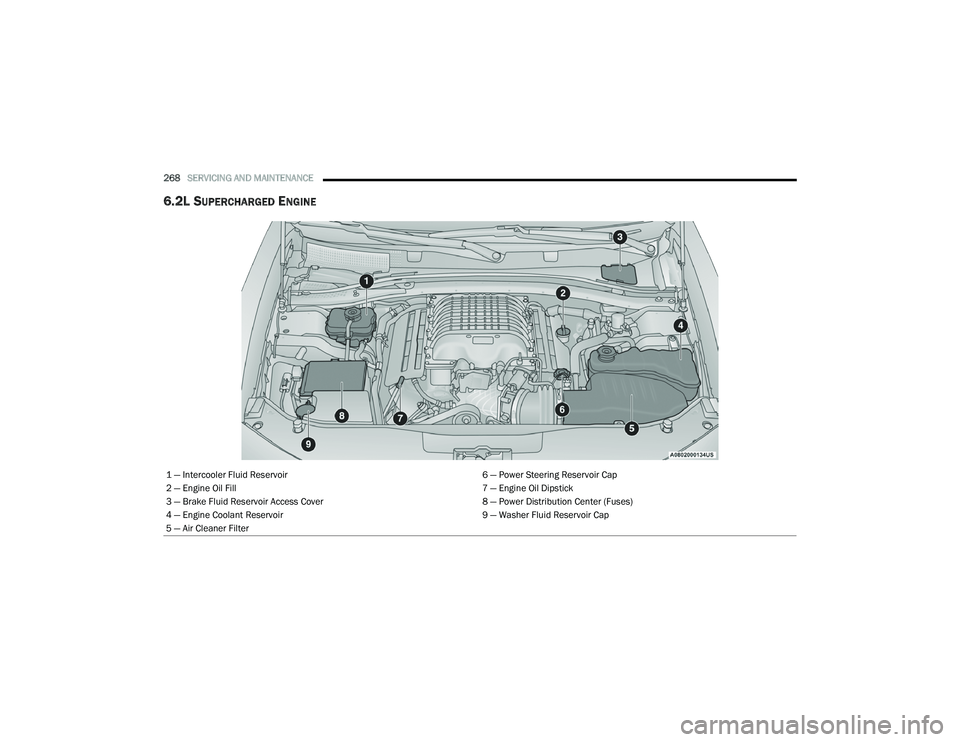
6.2L SUPERCHARGED ENGINE
1 — Intercooler Fluid Reservoir 6 — Power Steering Reservoir Cap
2 — Engine Oil Fill 7 — Engine Oil Dipstick
3 — Brake Fluid Reservoir Access Cover 8 — Power Distribution Center (Fuses)
4 — Engine Coolant Reservoir 9 — Washer Fluid Reservoir Cap
5 — Air Cleaner Filter
20_LD_OM_EN_USC_t.book Page 268
Page 271 of 412
SERVICING AND MAINTENANCE269
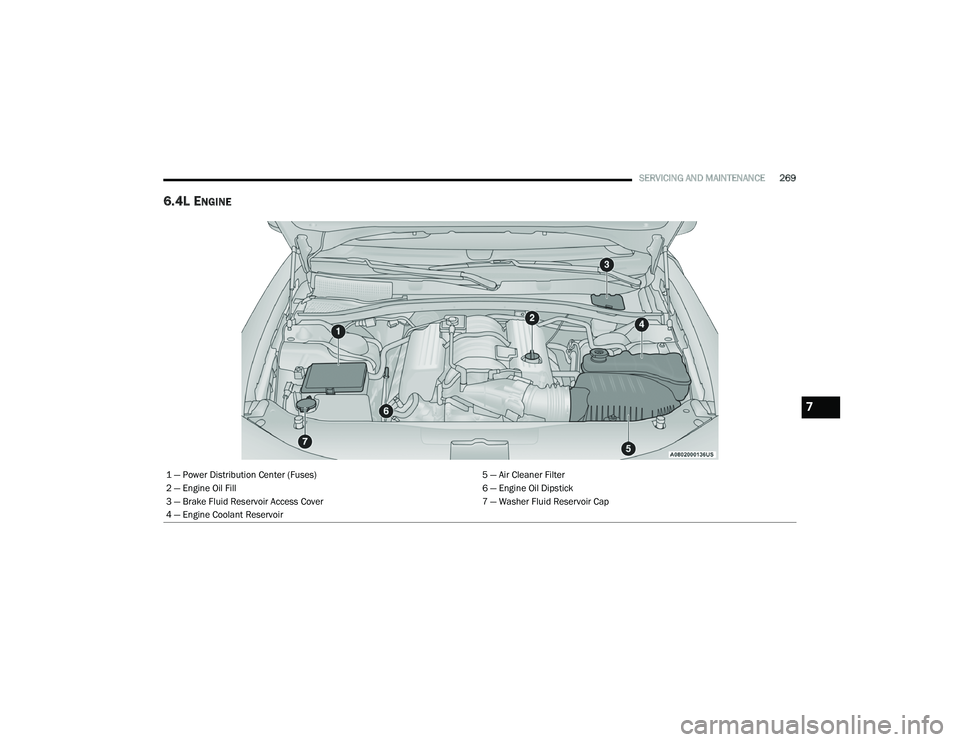
6.4L ENGINE
1 — Power Distribution Center (Fuses) 5 — Air Cleaner Filter
2 — Engine Oil Fill 6 — Engine Oil Dipstick
3 — Brake Fluid Reservoir Access Cover 7 — Washer Fluid Reservoir Cap
4 — Engine Coolant Reservoir
7
20_LD_OM_EN_USC_t.book Page 269
Page 399 of 412
397
Cooling System
.............................................. 280Adding Coolant (Antifreeze)....................... 282Coolant Level.................................. 281, 283Cooling Capacity.............................. 313, 314Disposal Of Used Coolant.......................... 283Drain, Flush, And Refill.............................. 281Inspection................................................. 283Points To Remember................................. 283Pressure Cap............................................. 282Radiator Cap............................................. 282Selection Of Coolant (Antifreeze).... 281, 313, 314, 315, 318Corrosion Protection...................................... 304Cruise Control (Speed Control)............ 175, 177Cruise Light......................................... 102, 103Cupholders...................................................... 77Customer Assistance..................................... 391Customer Programmable Features................322Cybersecurity................................................. 321
D
Daytime Running Lights................................... 45Dealer Service............................................... 272Deck Lid Power Release............................................ 68Defroster, Windshield.................................... 156Delay (Intermittent) Wipers.............................. 51Diagnostic System, Onboard......................... 104
Dimmer SwitchHeadlight..................................................... 46DipsticksOil (Engine)............................................... 270Disabled Vehicle Towing............................... 248DisposalAntifreeze (Engine Coolant)...................... 283Disturb.......................................................... 379Do Not Disturb.............................................. 388Door Ajar.......................................................... 96Door Ajar Light................................................. 96Door LocksAutomatic.................................................... 30Child-Protection Door Lock — Rear Doors.... 30Doors............................................................... 25Driver’s Seat Back Tilt...................................... 32DrivingThrough Flowing, Rising, Or Shallow Standing Water
.................................... 211
E
Electric Brake Control System....................... 107Anti-Lock Brake System............................ 106Electronic Roll Mitigation................. 108, 113Electric Remote Mirrors................................... 43
Electronic Power Distribution Center (Fuses)... 221
Electronic Speed Control (Cruise Control)..... 175Electronic Stability Control (ESC).................. 108Electronic Throttle Control Warning Light......... 96
Emergency, In Case OfFreeing Vehicle When Stuck..................... 244Hazard Warning Flasher........................... 212Jacking............................................. 229, 286Jump Starting.................................. 240, 241Towing...................................................... 248Emission Control System Maintenance......... 105Engine............................... 266, 267, 268, 269Air Cleaner................................................ 275Block Heater............................................. 162Break-In Recommendations..................... 163Checking Oil Level.................................... 270Compartment......................... 266, 267, 269Compartment Identification............. 266, 268Coolant (Antifreeze)................ 281, 315, 318Cooling...................................................... 280Exhaust Gas Caution....................... 155, 312Fails To Start............................................. 162Flooded, Starting...................................... 162Fuel Requirements.................309, 313, 314Jump Starting.................................. 240, 241Oil........................ 272, 313, 314, 315, 318Oil Filler Cap.................................... 266, 274Oil Filter.................................................... 274Oil Selection............................ 272, 313, 314Oil Synthetic.............................................. 274Overheating.............................................. 242Starting..................................................... 15911
20_LD_OM_EN_USC_t.book Page 397