brakes DODGE CHARGER 2021 Owner's Manual
[x] Cancel search | Manufacturer: DODGE, Model Year: 2021, Model line: CHARGER, Model: DODGE CHARGER 2021Pages: 320, PDF Size: 20.61 MB
Page 241 of 320
IN CASE OF EMERGENCY239
Emergency Gas Can Refueling
Most gas cans will not open the flapper doors.
A funnel is provided to allow emergency refueling
with a gas can.
See below steps for refueling:
1. Retrieve funnel from the spare tire storage area.
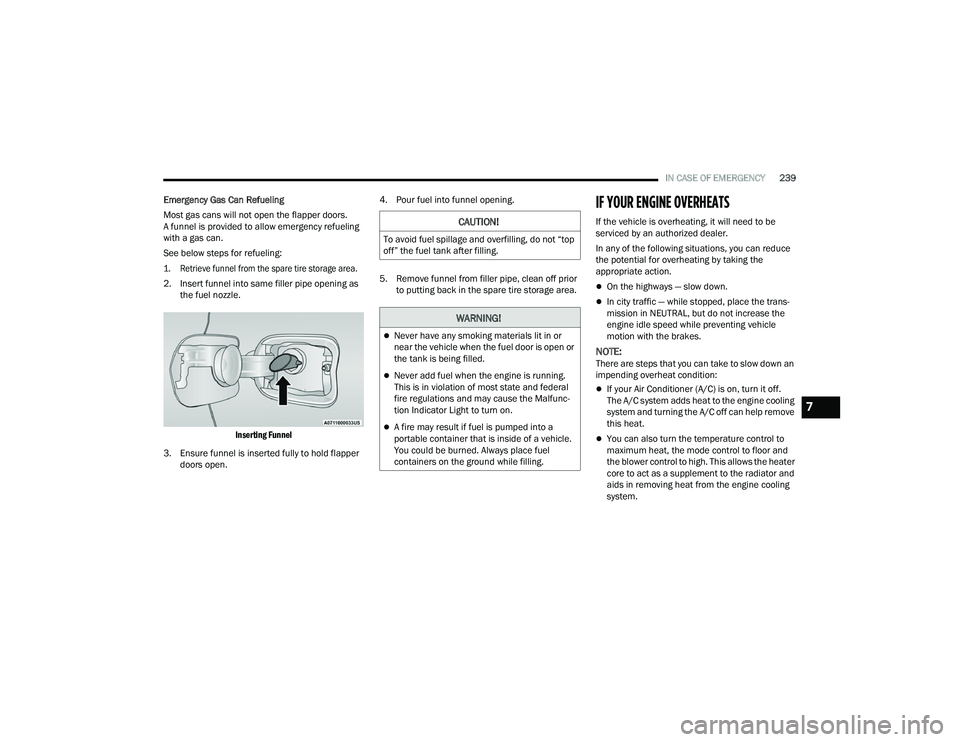
2. Insert funnel into same filler pipe opening as the fuel nozzle.
Inserting Funnel
3. Ensure funnel is inserted fully to hold flapper doors open. 4. Pour fuel into funnel opening.
5. Remove funnel from filler pipe, clean off prior
to putting back in the spare tire storage area.
IF YOUR ENGINE OVERHEATS
If the vehicle is overheating, it will need to be
serviced by an authorized dealer.
In any of the following situations, you can reduce
the potential for overheating by taking the
appropriate action.
On the highways — slow down.
In city traffic — while stopped, place the trans -
mission in NEUTRAL, but do not increase the
engine idle speed while preventing vehicle
motion with the brakes.
NOTE:There are steps that you can take to slow down an
impending overheat condition:
If your Air Conditioner (A/C) is on, turn it off.
The A/C system adds heat to the engine cooling
system and turning the A/C off can help remove
this heat.
You can also turn the temperature control to
maximum heat, the mode control to floor and
the blower control to high. This allows the heater
core to act as a supplement to the radiator and
aids in removing heat from the engine cooling
system.
CAUTION!
To avoid fuel spillage and overfilling, do not “top
off” the fuel tank after filling.
WARNING!
Never have any smoking materials lit in or
near the vehicle when the fuel door is open or
the tank is being filled.
Never add fuel when the engine is running.
This is in violation of most state and federal
fire regulations and may cause the Malfunc -
tion Indicator Light to turn on.
A fire may result if fuel is pumped into a
portable container that is inside of a vehicle.
You could be burned. Always place fuel
containers on the ground while filling.
7
21_LD_OM_EN_USC_t.book Page 239
Page 249 of 320
SERVICING AND MAINTENANCE247
Mileage or time passed (whichever comes first)
20,000
30,000
40,000
50,000
60,000
70,000
80,000
90,000
100,000
110,000
120,000
130,000
140,000
150,000
Or Years: 2 3 4 5 6 7 8 9 10 11 12 13 14 15
Or Kilometers:
32,000
48,000
64,000
80,000
96,000
112,000
128,000
144,000
160,000
176,000
192,000
208,000
224,000
240,000
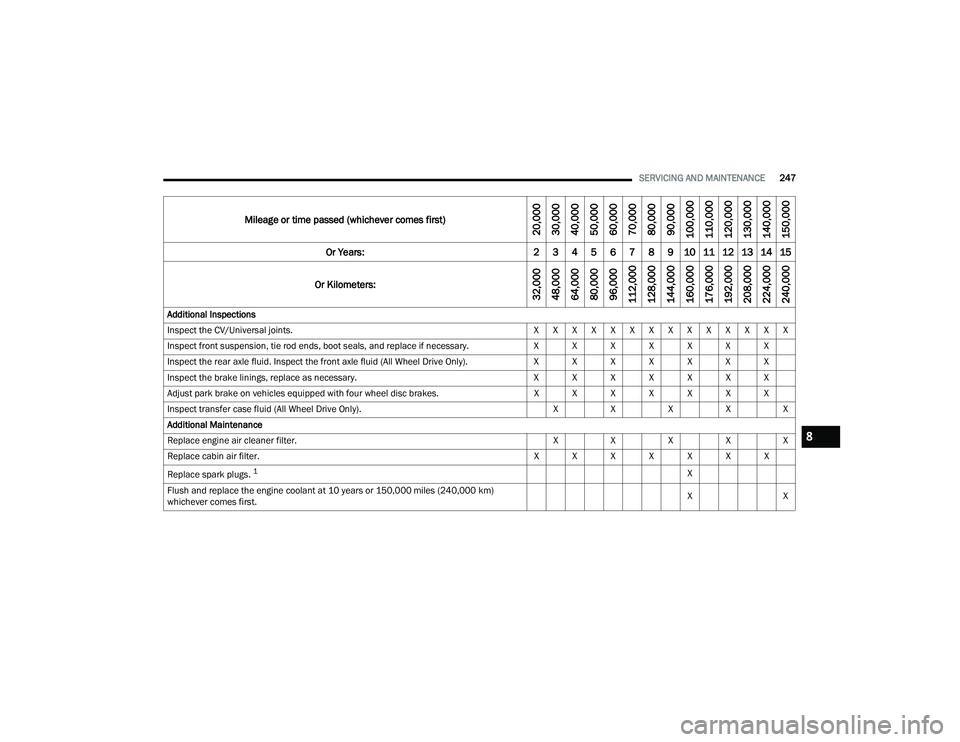
Additional Inspections
Inspect the CV/Universal joints. X X X X X X X X X X X X X X
Inspect front suspension, tie rod ends, boot seals, and replace if necessary. X X X X X X X
Inspect the rear axle fluid. Inspect the front axle fluid (All Wheel Drive Only). X X X X X X X
Inspect the brake linings, replace as necessary. X X X X X X X
Adjust park brake on vehicles equipped with four wheel disc brakes. X X X X X X X
Inspect transfer case fluid (All Wheel Drive Only). XXXXX
Additional Maintenance
Replace engine air cleaner filter. XXXXX
Replace cabin air filter. X X X X X X X
Replace spark plugs.
1X
Flush and replace the engine coolant at 10 years or 150,000 miles (240,000 km)
whichever comes first. X
X
8
21_LD_OM_EN_USC_t.book Page 247
Page 264 of 320
262SERVICING AND MAINTENANCE
(Continued)
If an examination of your engine compartment
shows no evidence of radiator or hose leaks, the
vehicle may be safely driven. The vapor will soon
dissipate.
Do not overfill the coolant expansion bottle.
Check the coolant freeze point in the radiator
and in the coolant expansion bottle. If engine
coolant needs to be added, the contents of the
coolant expansion bottle must also be protected
against freezing.
If frequent engine coolant additions are
required, the cooling system should be pressure
tested for leaks.
Maintain engine coolant concentration at a
minimum of 50% OAT coolant (conforming to
MS.90032) and distilled water for proper corro
-
sion protection of your engine which contains
aluminum components.
Make sure that the coolant expansion bottle
overflow hoses are not kinked or obstructed.
Keep the front of the radiator clean. If your
vehicle is equipped with air conditioning, keep
the front of the condenser clean.
Do not change the thermostat for Summer or
Winter operation. If replacement is ever neces -
sary, install ONLY the correct type thermostat.
Other designs may result in unsatisfactory
engine cooling performance, poor gas mileage,
and increased emissions.
BRAKE SYSTEM
In order to ensure brake system performance, all
brake system components should be inspected
periodically Ú page 245.
Fluid Level Check — Brake Master Cylinder
Check the fluid level in the master cylinder
immediately if the brake system warning light
indicates system failure.
Check the fluid level in the master cylinder when
performing underhood services.
Clean the top of the master cylinder area before
removing the cap. Add fluid to bring the level up to
the top of the “FULL” mark on the side of the
master cylinder reservoir.
Overfilling of fluid is not recommended because it
may cause leaking in the system.
Add enough fluid to bring the level up to the
requirements described on the brake fluid reservoir. With disc brakes, fluid level can be
expected to fall as the brake pads wear. However,
low fluid level may be caused by a leak and a
checkup may be needed.
Use only brake fluid that has been recommended
by the manufacturer, and has been kept in a tightly
closed container to avoid contamination from
foreign matter or moisture.
For further information Ú
page 300.
WARNING!
Riding the brakes can lead to brake failure and
possibly a collision. Driving with your foot resting
or riding on the brake pedal can result in
abnormally high brake temperatures, excessive
lining wear, and possible brake damage. You
would not have your full braking capacity in an
emergency.
WARNING!
Use only manufacturer's recommended brake
fluid Úpage 300. Using the wrong type of
brake fluid can severely damage your brake
system and/or impair its performance. The
proper type of brake fluid for your vehicle is
also identified on the original factory installed
hydraulic master cylinder reservoir.
To avoid contamination from foreign matter or
moisture, use only new brake fluid or fluid that
has been in a tightly closed container. Keep
the master cylinder reservoir cap secured at
all times. Brake fluid in a open container
absorbs moisture from the air resulting in a
lower boiling point. This may cause it to boil
unexpectedly during hard or prolonged
braking, resulting in sudden brake failure.
This could result in a collision.
21_LD_OM_EN_USC_t.book Page 262
Page 267 of 320
SERVICING AND MAINTENANCE265
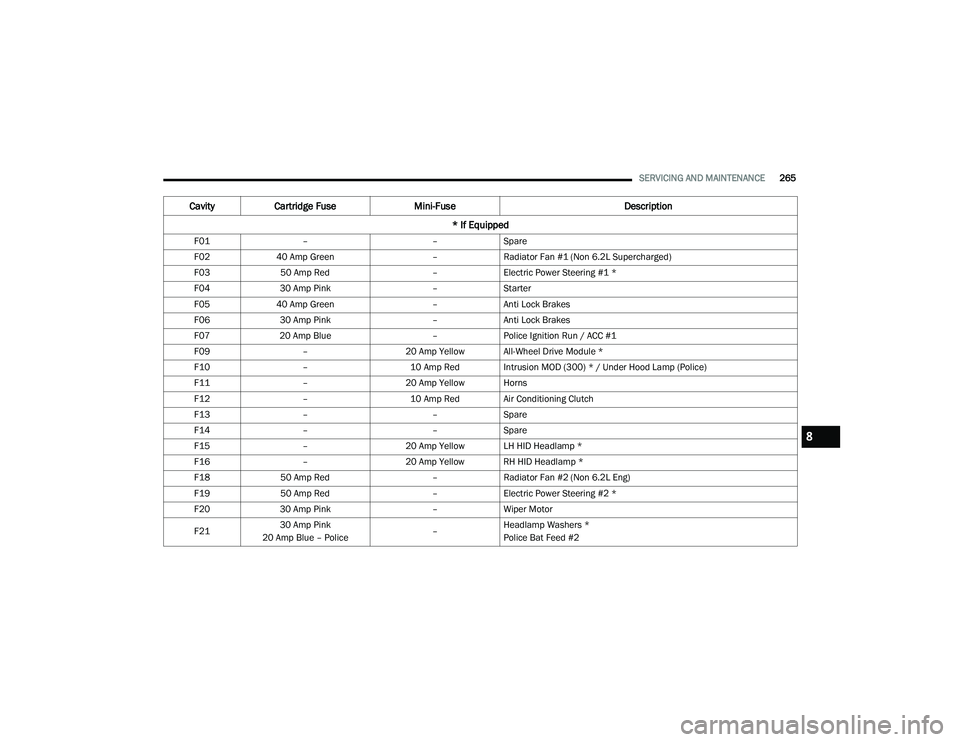
CavityCartridge Fuse Mini-Fuse Description
* If Equipped
F01 – –Spare
F02 40 Amp Green –Radiator Fan #1 (Non 6.2L Supercharged)
F03 50 Amp Red –Electric Power Steering #1 *
F04 30 Amp Pink –Starter
F05 40 Amp Green –Anti Lock Brakes
F06 30 Amp Pink –Anti Lock Brakes
F07 20 Amp Blue –Police Ignition Run / ACC #1
F09 –20 Amp Yellow All-Wheel Drive Module *
F10 –10 Amp Red Intrusion MOD (300) * / Under Hood Lamp (Police)
F11 –20 Amp Yellow Horns
F12 –10 Amp Red Air Conditioning Clutch
F13 – –Spare
F14 – –Spare
F15 –20 Amp Yellow LH HID Headlamp *
F16 –20 Amp Yellow RH HID Headlamp *
F18 50 Amp Red –Radiator Fan #2 (Non 6.2L Eng)
F19 50 Amp Red –Electric Power Steering #2 *
F20 30 Amp Pink –Wiper Motor
F21 30 Amp Pink
20 Amp Blue – Police –Headlamp Washers *
Police Bat Feed #2
8
21_LD_OM_EN_USC_t.book Page 265
Page 291 of 320
SERVICING AND MAINTENANCE289
WHEEL AND WHEEL TRIM CARE
All wheels and wheel trim, especially aluminum
and chrome plated wheels, should be cleaned
regularly using mild (neutral Ph) soap and water to
maintain their luster and to prevent corrosion.
Wash wheels with the same soap solution
recommended for the body of the vehicle and
remember to always wash when the surfaces are
not hot to the touch.
Your wheels are susceptible to deterioration
caused by salt, sodium chloride, magnesium
chloride, calcium chloride, etc., and other road
chemicals used to melt ice or control dust on dirt
roads. Use a soft cloth or sponge and mild soap to
wipe away promptly. Do not use harsh chemicals
or a stiff brush. They can damage the wheel’s
protective coating that helps keep them from
corroding and tarnishing. When cleaning extremely dirty wheels including
excessive brake dust, care must be taken in the
selection of tire and wheel cleaning chemicals and
equipment to prevent damage to the wheels.
Mopar® Wheel Treatment or Mopar® Chrome
Cleaner or their equivalent is recommended or
select a non-abrasive, non-acidic cleaner for
aluminum or chrome wheels.
NOTE:If you intend parking or storing your vehicle for an
extended period after cleaning the wheels with
wheel cleaner, drive your vehicle and apply the
brakes to remove the water droplets from the
brake components. This activity will remove the
red rust on the brake rotors and prevent vehicle
vibration when braking.
Dark Vapor Chrome, Black Satin Chrome, or Low
Gloss Clear Coat WheelsCAUTION!
Avoid products or automatic car washes that use
acidic solutions or strong alkaline additives or
harsh brushes. Many aftermarket wheel cleaners
and automatic car washes may damage the
wheel's protective finish. Such damage is not
covered by the New Vehicle Limited Warranty.
Only car wash soap, Mopar® Wheel Cleaner or
equivalent is recommended.
CAUTION!
Do not use scouring pads, steel wool, a bristle
brush, metal polishes or oven cleaner. These
products may damage the wheel's protective
finish. Such damage is not covered by the New
Vehicle Limited Warranty. Only car wash soap,
Mopar® Wheel Cleaner or equivalent is
recommended.
CAUTION!
If your vehicle is equipped with these specialty
wheels, DO NOT USE wheel cleaners, abrasives,
or polishing compounds. They will permanently
damage this finish and such damage is not
covered by the New Vehicle Limited Warranty.
HAND WASH ONLY USING MILD SOAP AND WATER
WITH A SOFT CLOTH. Used on a regular basis; this
is all that is required to maintain this finish.
8
21_LD_OM_EN_USC_t.book Page 289
Page 298 of 320
296
TECHNICAL SPECIFICATIONS
VEHICLE IDENTIFICATION NUMBER (VIN)
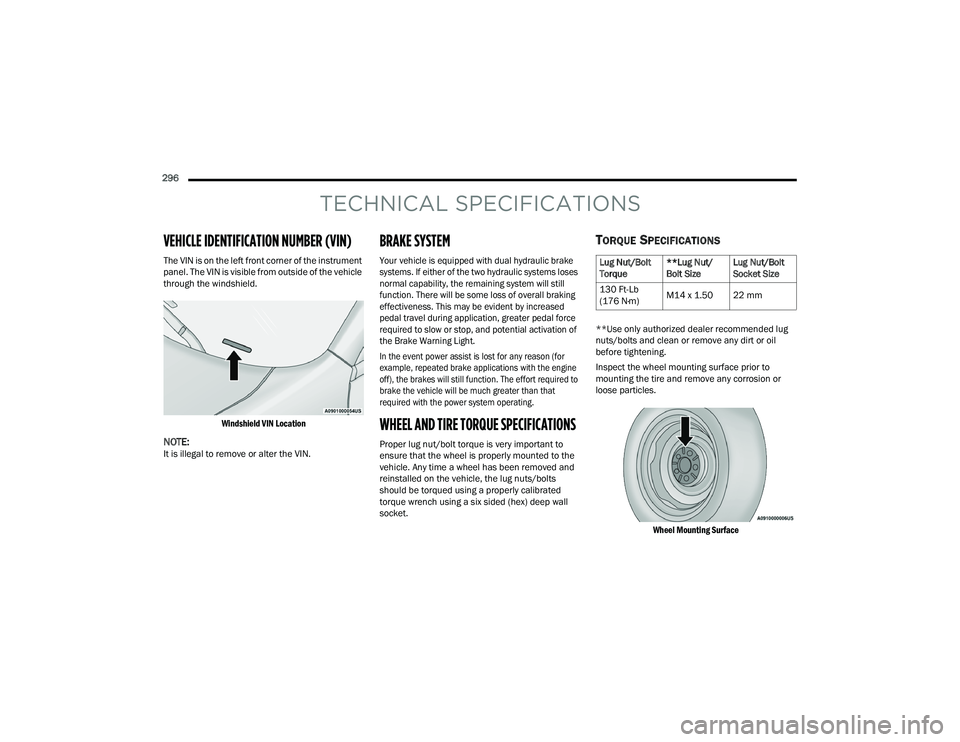
The VIN is on the left front corner of the instrument
panel. The VIN is visible from outside of the vehicle
through the windshield.
Windshield VIN Location
NOTE:It is illegal to remove or alter the VIN.
BRAKE SYSTEM
Your vehicle is equipped with dual hydraulic brake
systems. If either of the two hydraulic systems loses
normal capability, the remaining system will still
function. There will be some loss of overall braking
effectiveness. This may be evident by increased
pedal travel during application, greater pedal force
required to slow or stop, and potential activation of
the Brake Warning Light.
In the event power assist is lost for any reason (for
example, repeated brake applications with the engine
off), the brakes will still function. The effort required to
brake the vehicle will be much greater than that
required with the power system operating.
WHEEL AND TIRE TORQUE SPECIFICATIONS
Proper lug nut/bolt torque is very important to
ensure that the wheel is properly mounted to the
vehicle. Any time a wheel has been removed and
reinstalled on the vehicle, the lug nuts/bolts
should be torqued using a properly calibrated
torque wrench using a six sided (hex) deep wall
socket.
TORQUE SPECIFICATIONS
**Use only authorized dealer recommended lug
nuts/bolts and clean or remove any dirt or oil
before tightening.
Inspect the wheel mounting surface prior to
mounting the tire and remove any corrosion or
loose particles.
Wheel Mounting Surface
Lug Nut/Bolt
Torque **Lug Nut/
Bolt SizeLug Nut/Bolt
Socket Size
130 Ft-Lb
(176 N·m) M14 x 1.50 22 mm
21_LD_OM_EN_USC_t.book Page 296
Page 308 of 320
306
INDEX
A
About Your Brakes......................................... 296Adaptive Cruise Control (ACC)
(Cruise Control)................................................ 96Adding Engine Coolant (Antifreeze)............... 260Adding Fuel.................................................... 113Adding Washing Fluid.................................... 251Additives, Fuel............................................... 298AdjustForward....................................................... 31Rearward..................................................... 31Advance Phone Connectivity......................... 161Air Bag........................................................... 201Advance Front Air Bag............................... 201Air Bag Operation...................................... 203Air Bag Warning Light................................ 201Driver Knee Air Bag................................... 203Enhanced Accident Response......... 207, 244Event Data Recorder (EDR)....................... 244Front Air Bag............................................. 201If Deployment Occurs................................ 206Knee Impact Bolsters................................ 203Maintaining Your Air Bag System.............. 207Maintenance............................................. 207Redundant Air Bag Warning Light.............201Side Air Bags............................................. 203
Air Bag Light.................................. 74, 201, 220Air Cleaner, Engine
(Engine Air Cleaner Filter)............................. 254Air Conditioner Maintenance........................ 254Air Conditioner Refrigerant.................. 254, 255Air Conditioner System................................. 254Air Conditioning......................................... 48, 51Air Conditioning Filter..............................54, 255Air Conditioning, Operating Tips....................... 54Air Filter........................................................ 254Air PressureTires......................................................... 283AlarmArm The System.......................................... 20Rearm The System...................................... 20Security Alarm...................................... 20, 77Alarm SystemSecurity Alarm............................................. 20All Wheel DriveTowing...................................................... 244Alterations/ModificationsVehicle........................................................... 9Android Auto........................................ 163, 164Android Auto™
b
....................................... 163Antifreeze (Engine Coolant)................. 260, 299Disposal................................................... 261
Anti-Lock Brake System (ABS)....................... 180Anti-Lock Warning Light...................................77Apple CarPlay....................................... 163, 166Apple CarPlay®
b
...................................... 165Arming SystemSecurity Alarm.............................................20Assist, Hill Start............................................. 184Audio Settings............................................... 148Audio Systems (Radio).................................. 124Auto Down Power Windows..............................59Automatic Door Locks......................................24Automatic Headlights.......................................43Automatic High Beams.....................................43Automatic Temperature Control (ATC).......48, 53Automatic Transmission......................... 89, 263Adding Fluid..................................... 263, 301Fluid And Filter Change............................. 263Fluid Change............................................. 263Fluid Level Check...................................... 263Fluid Type........................................ 263, 301Special Additives...................................... 263Automatic Transmission Limp Home
Mode.........................................................24, 92AutoPark..........................................................84AutostickOperation.....................................................92
21_LD_OM_EN_USC_t.book Page 306
Page 314 of 320
312 P
Paddle Shift Mode
........................................... 92Paddle Shifters................................................ 92Paint Care...................................................... 293Pair (Link) Uconnect Phone To A Mobile
Phone
b
..................................................... 155Parking Brake.................................................. 87ParkSense System, Rear............................... 105Passing Light................................................... 43Passive Entry................................................... 22Performance.................................................... 69Personalized Main Menu Bar........................ 140Pets............................................................... 220Phone Mode.................................................. 152Pinch Protection.............................................. 61Placard, Tire And Loading Information........... 280Power Brakes....................................................... 296Deck Lid Release........................................ 63Distribution Center (Fuses)....................... 267Door Locks.................................................. 21Mirrors......................................................... 37Outlet (Auxiliary Electrical Outlet)................ 57Seats........................................................... 31Steering....................................................... 94Sunroof....................................................... 60Tilt/Telescoping Steering Column............... 25Windows...................................................... 58
Power SeatsForward....................................................... 31Lumbar........................................................ 32Rearward..................................................... 31Recline........................................................ 31Pregnant Women And Seat Belts.................. 199Preparation For Jacking................................ 226Presets......................................................... 148PretensionersSeat Belts................................................. 199Programmable Features............................... 125
R
Radial Ply Tires............................................. 284Radiator Cap (Coolant Pressure Cap)........... 261RadioPresets..................................................... 148Radio Controls.............................................. 141Radio Mode.................................................. 141Radio Operation................................... 141, 179Radio Remote Controls................................. 141Rain Sensitive Wiper System........................... 48Rear Axle (Differential).................................. 263Rear Camera................................................. 112Rear Cross Path............................................ 187Rear ParkSense System............................... 105Rear Seats, Folding.......................................... 30Rear Wheel Drive (RWD)Towing...................................................... 244
Recreational Towing...................................... 121Reformulated Gasoline................................. 297Refrigerant.................................................... 255Release, Hood..................................................62Reminder, Lights On........................................44Reminder, Seat Belt...................................... 194Remote ControlStarting System...........................................17Remote Keyless EntryArm The Alarm.............................................20Programming Additional Key Fobs...............15Unlatch The Trunk.......................................14Remote Sound System (Radio) Control......... 141Remote StartingExit Remote Start Mode...............................18Uconnect Customer Programmable Features..................................................19Uconnect Settings.......................................19Remote Starting System..................................17Remote Trunk Release.....................................63Replacement Bulbs....................................... 271Replacement Tires........................................ 286Reporting Safety Defects.............................. 304Restraints, Child............................................ 208Restraints, Head.......................................34, 35Rocking Vehicle When Stuck......................... 242Rotation, Tires............................................... 291
21_LD_OM_EN_USC_t.book Page 312