jump start DODGE CHARGER 2021 Owners Manual
[x] Cancel search | Manufacturer: DODGE, Model Year: 2021, Model line: CHARGER, Model: DODGE CHARGER 2021Pages: 320, PDF Size: 20.61 MB
Page 7 of 320
5
PERFORMANCE PAGES ...................................... 167 Home .............................................................. 168
Timers ............................................................ 170
Gauges ........................................................... 172G-Force ........................................................... 173Engine ............................................................ 173
Dynamometer (Dyno) .................................... 174
DODGE DRIVE MODES — IF EQUIPPED............. 174
Performance Control —
If Equipped..................................................... 174
RADIO OPERATION AND MOBILE PHONES...... 179
Regulatory And Safety Information .............. 179
SAFETY
SAFETY FEATURES .............................................. 180 Anti-Lock Brake System (ABS) ..................... 180
Electronic Brake Control (EBC) System ....... 181
AUXILIARY DRIVING SYSTEMS .......................... 185
Blind Spot Monitoring (BSM) —
If Equipped..................................................... 185
Forward Collision Warning (FCW) With
Mitigation Operation ..................................... 188
Tire Pressure Monitoring
System (TPMS) .............................................. 190 OCCUPANT RESTRAINT SYSTEMS ................... 193
Occupant Restraint Systems Features ....... 193
Important Safety Precautions ...................... 193Seat Belt Systems ........................................ 194Supplemental Restraint
Systems (SRS) ............................................... 200
Child Restraints ............................................. 208
SAFETY TIPS ....................................................... 220
Transporting Passengers .............................. 220Transporting Pets ......................................... 220
Safety Checks You Should Make Inside
The Vehicle ................................................... 220
Periodic Safety Checks You Should Make
Outside The Vehicle ...................................... 221
Exhaust Gas................................................... 222
Carbon Monoxide Warnings ......................... 222
IN CASE OF EMERGENCY
HAZARD WARNING FLASHERS ........................ 223
ASSIST AND SOS MIRROR — IF EQUIPPED ..... 223
JACKING AND TIRE CHANGING ......................... 226 Preparations For Jacking .............................. 226Jack Location/Spare Tire Stowage .............. 227Jacking Instructions ...................................... 228 TIRE SERVICE KIT — IF EQUIPPED ..................... 231
Tire Service Kit Storage ................................ 231Tire Service Kit Components And
Operation ....................................................... 231Tire Service Kit Usage Precautions .............. 232
Sealing A Tire With Tire Service Kit .............. 233
JUMP STARTING ................................................. 236
Preparations For Jump Start ........................ 236Jump Starting Procedure .............................. 237
REFUELING IN EMERGENCY .............................. 238
IF YOUR ENGINE OVERHEATS ........................... 239
MANUAL PARK RELEASE —
8-SPEED TRANSMISSION ................................... 240
FREEING A STUCK VEHICLE ............................... 242
TOWING A DISABLED VEHICLE .......................... 243 All Wheel Drive (AWD) Models...................... 244
Rear Wheel Drive (RWD) Models ................ 244
ENHANCED ACCIDENT RESPONSE
SYSTEM (EARS) ................................................... 244
EVENT DATA RECORDER (EDR) ......................... 244
21_LD_OM_EN_USC_t.book Page 5
Page 238 of 320
236IN CASE OF EMERGENCY
JUMP STARTING
If your vehicle has a discharged battery, it can be
jump started using a set of jumper cables and a
battery in another vehicle, or by using a portable
battery booster pack. Jump starting can be
dangerous if done improperly, so please follow the
procedures in this section carefully.
NOTE:When using a portable battery booster pack, follow
the manufacturer's operating instructions and
precautions.
PREPARATIONS FOR JUMP START
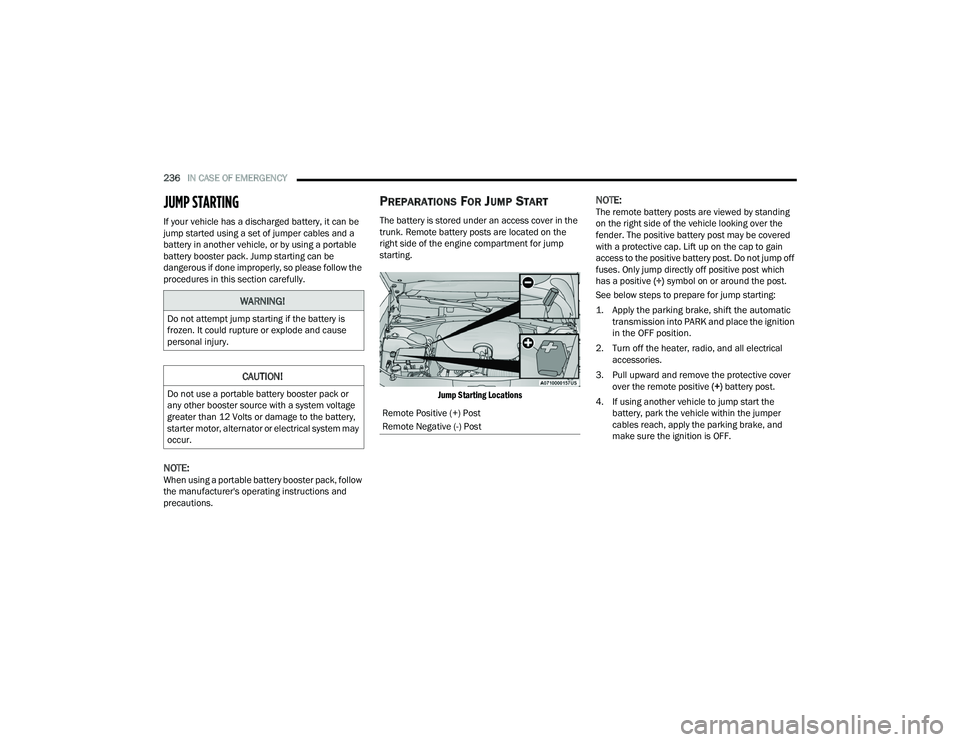
The battery is stored under an access cover in the
trunk. Remote battery posts are located on the
right side of the engine compartment for jump
starting.
Jump Starting Locations
NOTE:The remote battery posts are viewed by standing
on the right side of the vehicle looking over the
fender. The positive battery post may be covered
with a protective cap. Lift up on the cap to gain
access to the positive battery post. Do not jump off
fuses. Only jump directly off positive post which
has a positive (+) symbol on or around the post.
See below steps to prepare for jump starting:
1. Apply the parking brake, shift the automatic transmission into PARK and place the ignition
in the OFF position.
2. Turn off the heater, radio, and all electrical accessories.
3. Pull upward and remove the protective cover over the remote positive (+) battery post.
4. If using another vehicle to jump start the battery, park the vehicle within the jumper
cables reach, apply the parking brake, and
make sure the ignition is OFF.
WARNING!
Do not attempt jump starting if the battery is
frozen. It could rupture or explode and cause
personal injury.
CAUTION!
Do not use a portable battery booster pack or
any other booster source with a system voltage
greater than 12 Volts or damage to the battery,
starter motor, alternator or electrical system may
occur.
Remote Positive (+) Post
Remote Negative (-) Post
21_LD_OM_EN_USC_t.book Page 236
Page 239 of 320
IN CASE OF EMERGENCY237
JUMP STARTING PROCEDURE
Connecting The Jumper Cables
1. Connect the positive
(+) end of the jumper
cable to the remote positive (+)
post of the
vehicle with the discharged battery.
2. Connect the opposite end of the positive (+)
jumper cable to the positive (+) post of the
booster battery.
3. Connect the negative (-) end of the jumper
cable to the negative (-) post of the booster
battery. 4. Connect the opposite end of the negative
(-)
jumper cable to the remote negative (-) post
(exposed metallic/unpainted post of the
discharge vehicle) located directly behind the
underhood fuse box.
5. Start the engine in the vehicle that has the booster battery, let the engine idle a few
minutes, and then start the engine in the
vehicle with the discharged battery.
WARNING!
Do not allow vehicles to touch each other as
this could establish a ground connection and
personal injury could result.
WARNING!
Take care to avoid the radiator cooling fan
whenever the hood is raised. It can start
anytime the ignition switch is ON. You can be
injured by moving fan blades.
Remove any metal jewelry such as rings,
watch bands and bracelets that could make
an inadvertent electrical contact. You could be
seriously injured.
Batteries contain sulfuric acid that can burn
your skin or eyes and generate hydrogen gas
which is flammable and explosive. Keep open
flames or sparks away from the battery.
WARNING!
Failure to follow this jump starting procedure
could result in personal injury or property
damage due to battery explosion.
CAUTION!
Failure to follow these procedures could result in
damage to the charging system of the booster
vehicle or the discharged vehicle.
WARNING!
Do not connect the jumper cable to the negative
(-) post of the discharged battery. The resulting
electrical spark could cause the battery to
explode and could result in personal injury.
CAUTION!
Do not run the booster vehicle engine above
2,000 RPM since it provides no charging benefit,
wastes fuel, and can damage booster vehicle
engine.
7
21_LD_OM_EN_USC_t.book Page 237
Page 240 of 320
238IN CASE OF EMERGENCY
6. Once the engine is started, follow the discon -
nection procedure below.
Disconnecting The Jumper Cables
1. Disconnect the negative
(-) end of the jumper
cable from the remote negative (-)
post of the
vehicle with the discharged battery.
2. Disconnect the opposite end of the negative (-)
jumper cable from the negative (-) post of the
booster battery.
3. Disconnect the positive (+) end of the jumper
cable from the positive (+) post of the booster
battery.
4. Disconnect the opposite end of the positive (+)
jumper cable from the remote positive (+) post
of the vehicle with the discharged battery. If frequent jump starting is required to start your
vehicle you should have the battery and charging
system inspected at an authorized dealer.
REFUELING IN EMERGENCY
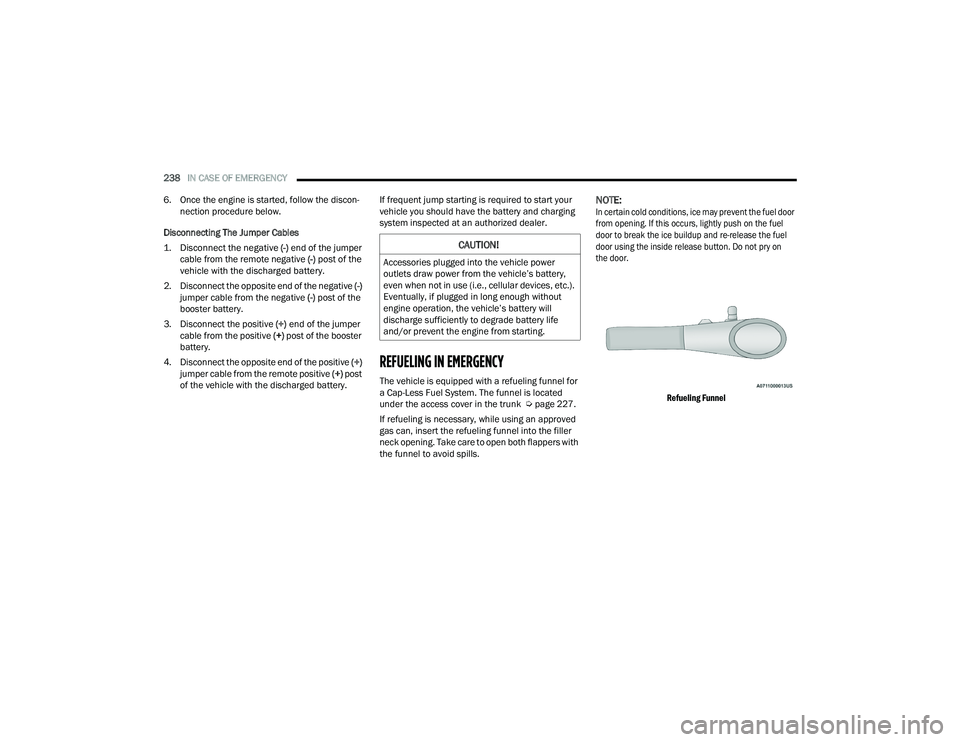
The vehicle is equipped with a refueling funnel for
a Cap-Less Fuel System. The funnel is located
under the access cover in the trunk Ú
page 227.
If refueling is necessary, while using an approved
gas can, insert the refueling funnel into the filler
neck opening. Take care to open both flappers with
the funnel to avoid spills.
NOTE:
In certain cold conditions, ice may prevent the fuel door
from opening. If this occurs, lightly push on the fuel
door to break the ice buildup and re-release the fuel
door using the inside release button. Do not pry on
the door.
Refueling Funnel
CAUTION!
Accessories plugged into the vehicle power
outlets draw power from the vehicle’s battery,
even when not in use (i.e., cellular devices, etc.).
Eventually, if plugged in long enough without
engine operation, the vehicle’s battery will
discharge sufficiently to degrade battery life
and/or prevent the engine from starting.
21_LD_OM_EN_USC_t.book Page 238
Page 254 of 320
252SERVICING AND MAINTENANCE
(Continued)
(Continued)
MAINTENANCE-FREE BATTERY
Your vehicle is equipped with a maintenance-free
battery. Water will never have to be added, and
periodic maintenance is not required.
NOTE:The battery is stored under an access cover in
the trunk. Remote battery terminals are located
in the engine compartment for jump starting
Ú page 236.
PRESSURE WASHING
Cleaning the engine compartment with a high
pressure washer is not recommended.
WARNING!
Commercially available windshield washer
solvents are flammable. They could ignite and
burn you. Care must be exercised when filling or
working around the washer solution.
WARNING!
Battery fluid is a corrosive acid solution and
can burn or even blind you. Do not allow
battery fluid to contact your eyes, skin, or
clothing. Do not lean over a battery when
attaching clamps. If acid splashes in eyes or
on skin, flush the area immediately with large
amounts of water Ú page 236.
Battery gas is flammable and explosive. Keep
flame or sparks away from the battery. Do not
use a booster battery or any other booster
source with an output greater than 12 Volts.
Do not allow cable clamps to touch each other.
Battery posts, terminals, and related accesso -
ries contain lead and lead compounds. Wash
hands after handling.
The battery in this vehicle has a vent hose that
should not be disconnected and should only
be replaced with a battery of the same type
(vented).
CAUTION!
It is essential when replacing the cables on
the battery that the positive cable is attached
to the positive post and the negative cable is
attached to the negative post. Battery posts
are marked positive (+) and negative (-) and
are identified on the battery case. Cable
clamps should be tight on the terminal posts
and free of corrosion.
WARNING!
If a “fast charger” is used while the battery is
in the vehicle, disconnect both vehicle battery
cables before connecting the charger to the
battery. Do not use a “fast charger” to provide
starting voltage.
CAUTION!
Precautions have been taken to safeguard all
parts and connections however, the pressures
generated by these machines is such that
complete protection against water ingress
cannot be guaranteed.
CAUTION!
21_LD_OM_EN_USC_t.book Page 252
Page 258 of 320
256SERVICING AND MAINTENANCE
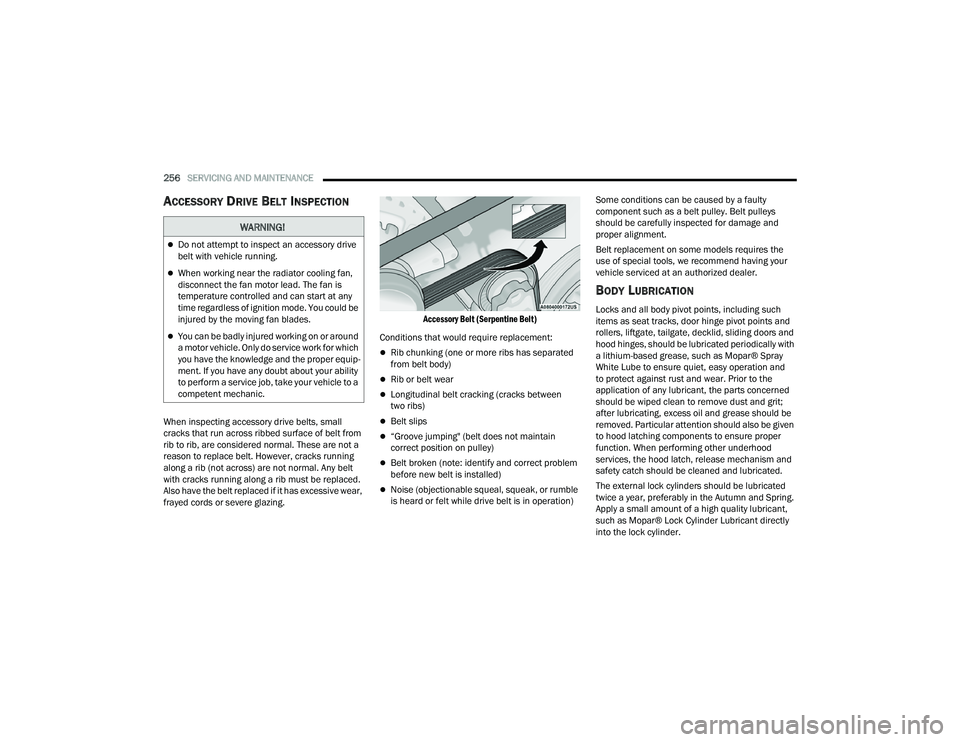
ACCESSORY DRIVE BELT INSPECTION
When inspecting accessory drive belts, small
cracks that run across ribbed surface of belt from
rib to rib, are considered normal. These are not a
reason to replace belt. However, cracks running
along a rib (not across) are not normal. Any belt
with cracks running along a rib must be replaced.
Also have the belt replaced if it has excessive wear,
frayed cords or severe glazing.
Accessory Belt (Serpentine Belt)
Conditions that would require replacement:
Rib chunking (one or more ribs has separated
from belt body)
Rib or belt wear
Longitudinal belt cracking (cracks between
two ribs)
Belt slips
“Groove jumping" (belt does not maintain
correct position on pulley)
Belt broken (note: identify and correct problem
before new belt is installed)
Noise (objectionable squeal, squeak, or rumble
is heard or felt while drive belt is in operation) Some conditions can be caused by a faulty
component such as a belt pulley. Belt pulleys
should be carefully inspected for damage and
proper alignment.
Belt replacement on some models requires the
use of special tools, we recommend having your
vehicle serviced at an authorized dealer.
BODY LUBRICATION
Locks and all body pivot points, including such
items as seat tracks, door hinge pivot points and
rollers, liftgate, tailgate, decklid, sliding doors and
hood hinges, should be lubricated periodically with
a lithium-based grease, such as Mopar® Spray
White Lube to ensure quiet, easy operation and
to protect against rust and wear. Prior to the
application of any lubricant, the parts concerned
should be wiped clean to remove dust and grit;
after lubricating, excess oil and grease should be
removed. Particular attention should also be given
to hood latching components to ensure proper
function. When performing other underhood
services, the hood latch, release mechanism and
safety catch should be cleaned and lubricated.
The external lock cylinders should be lubricated
twice a year, preferably in the Autumn and Spring.
Apply a small amount of a high quality lubricant,
such as Mopar® Lock Cylinder Lubricant directly
into the lock cylinder.
WARNING!
Do not attempt to inspect an accessory drive
belt with vehicle running.
When working near the radiator cooling fan,
disconnect the fan motor lead. The fan is
temperature controlled and can start at any
time regardless of ignition mode. You could be
injured by the moving fan blades.
You can be badly injured working on or around
a motor vehicle. Only do service work for which
you have the knowledge and the proper equip
-
ment. If you have any doubt about your ability
to perform a service job, take your vehicle to a
competent mechanic.
21_LD_OM_EN_USC_t.book Page 256
Page 310 of 320
308 Pressure Cap
............................................. 261Radiator Cap............................................. 261Selection Of Coolant (Antifreeze)........................ 260, 299, 300Corrosion Protection...................................... 293Cruise Control (Speed Control)................. 95, 96Cruise Light..................................................... 80Customer Assistance..................................... 302Customer Programmable Features................125Cybersecurity................................................. 124
D
Daytime Running Lights................................... 42Deck LidPower Release............................................ 63Defroster, Windshield.................................... 220De-Icer, Remote Start...................................... 19Deleting A Phone........................................... 157Diagnostic System, Onboard........................... 81Dimmer SwitchHeadlight..................................................... 43DipsticksOil (Engine)................................................ 251Disabled Vehicle Towing................................ 243Disc Drive...................................................... 150Disconnecting................................................ 157DisposalAntifreeze (Engine Coolant)....................... 261Disturb........................................................... 159Door Ajar.......................................................... 75
Door Ajar Light................................................. 75Door LocksAutomatic.................................................... 24Child-Protection Door Lock — Rear Doors.... 24Doors............................................................... 21Drag & Drop.................................................. 140Drive Modes.................................................. 174Driver Memory Presets................................. 148Driver’s Seat Back Tilt...................................... 29DrivingThrough Flowing, Rising, Or Shallow Standing Water
.................................... 122
E
Electric Brake Control System....................... 181Anti-Lock Brake System............................ 180Electronic Roll Mitigation................. 181, 185Electric Remote Mirrors................................... 37Electronic Power Distribution
Center (Fuses).............................................. 264Electronic Speed Control (Cruise Control)........ 95Electronic Stability Control (ESC).................. 182Electronic Throttle Control Warning Light......... 75Emergency Gas Can Refueling...................... 238Emergency, In Case OfFreeing Vehicle When Stuck..................... 242Hazard Warning Flasher........................... 223Jacking..................................................... 226Jump Starting.................................. 236, 237Towing...................................................... 243
Emission Control System Maintenance............82Engine.................................................. 249, 250Air Cleaner................................................ 254Block Heater................................................86Break-In Recommendations........................86Checking Oil Level.................................... 251Compartment.................................. 249, 250Compartment Identification...................... 249Coolant (Antifreeze)......................... 260, 300Cooling...................................................... 259Exhaust Gas Caution................................ 222Fails To Start................................................85Flooded, Starting.........................................85Fuel Requirements.......................... 297, 299Jump Starting.................................. 236, 237Oil...........................................253, 299, 300Oil Filler Cap............................................. 249Oil Filter.................................................... 254Oil Selection..................................... 253, 299Oil Synthetic.............................................. 253Overheating.............................................. 239Starting........................................................83Enhanced Accident Response
Feature................................................ 207, 244Ethanol.......................................................... 298Exhaust Gas Cautions................................... 222Exhaust System................................... 222, 258Exterior Lighting...............................................41Exterior Lights........................................ 41, 222
21_LD_OM_EN_USC_t.book Page 308
Page 312 of 320

310 I
Ignition
............................................................ 16Switch......................................................... 16Indicator Lights Blue............................................................. 81Green.......................................................... 80White........................................................... 80Yellow.......................................................... 79Information Center, Vehicle............................. 68Inside Rearview Mirror............................ 36, 223Instrument Cluster.................................... 65, 67Descriptions................................................ 80Display................................................. 67, 70Instrument Panel Lens Cleaning.................... 295Interior Appearance Care............................... 294Interior Lights.................................................. 45
J
Jack Location................................................. 227Jump Starting...................................... 236, 237
K
Key FobArm The System
.......................................... 20Programming Additional Key Fobs.............. 15Unlatch The Trunk....................................... 14Key Fob Battery Service
(Remote Keyless Entry)................................... 14Key Fob Programming
(Remote Keyless Entry)................................... 15
Keyless Enter 'n Go™................................ 22, 85Enter The Trunk........................................... 14Passive Entry............................................... 22Passive Entry Programming......................... 22Keys................................................................. 13
L
Lane Change And Turn Signals........................ 44Lane Change Assist......................................... 44LaneSense.................................................... 109Lap/Shoulder Belts....................................... 195Latches......................................................... 222Hood............................................................ 62Lead Free Gasoline....................................... 297Leaks, Fluid.................................................. 222Life Of Tires................................................... 285Light Bulbs........................................... 222, 271Lights............................................................ 222Adaptive Cruise Control (ACC) Set With Target Vehicle................................. 80Adaptive Cruise Control (ACC) Set Without Target Vehicle............................ 80Air Bag...................................... 74, 201, 220Automatic Headlights.................................. 43Brake Assist Warning............................... 183Brake Warning....................................74, 296Bulb Replacement.................................... 271Cruise.......................................................... 80Daytime Running......................................... 42
Dimmer Switch, Headlight.................... 42, 43ECO Mode Indicator.....................................80Electric Power Steering Fault.......................75Electronic Stability Control (ESC) Active Warning........................................77Electronic Stability Program(ESP) Indicator..................................................76Exterior.............................................. 41, 222Fog...............................................................44Forward Collision Warning (FCW) OFF Indicator..................................................79Front Fog Indicator......................................80Hazard Warning Flasher........................... 223Headlight Switch..........................................41Headlights............................................ 41, 44Headlights On With Wipers..........................43High Beam...................................................43High Beam Indicator....................................81High Beam/Low Beam Select......................43Instrument Cluster.......................................41Intensity Control..........................................46Interior.........................................................45LaneSense Indicator....................................80License..................................................... 274Lights On Reminder.....................................44Low Fuel......................................................78Low Washer Fluid Warning..........................78Malfunction Indicator (Check Engine)..........78
21_LD_OM_EN_USC_t.book Page 310