torque DODGE CHARGER 2022 User Guide
[x] Cancel search | Manufacturer: DODGE, Model Year: 2022, Model line: CHARGER, Model: DODGE CHARGER 2022Pages: 312, PDF Size: 18.99 MB
Page 222 of 312
220IN CASE OF EMERGENCY
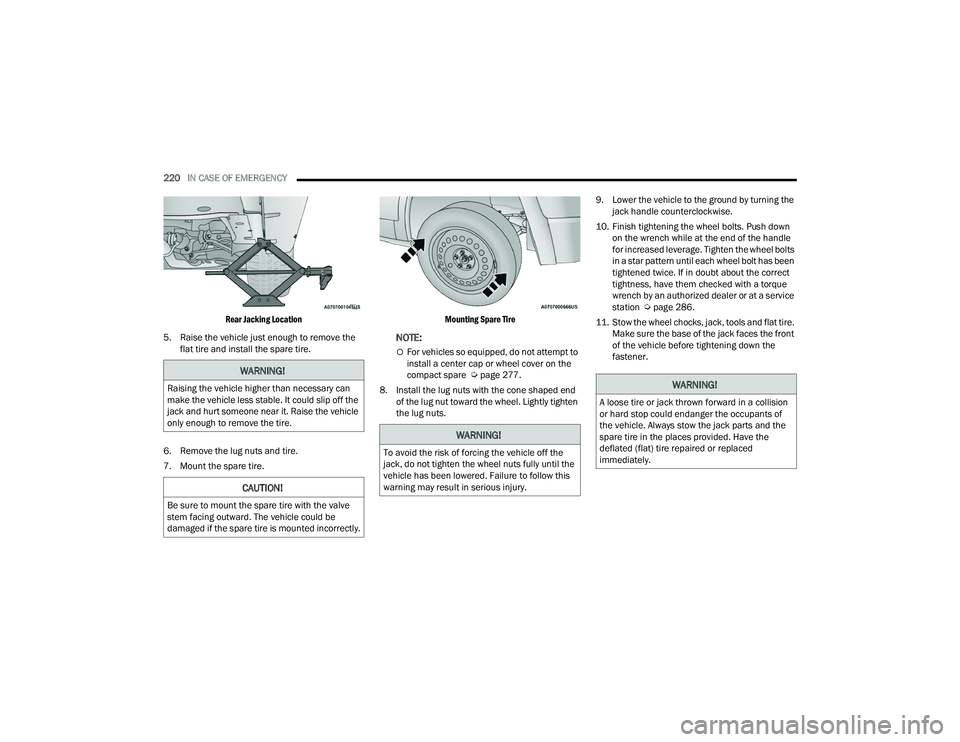
Rear Jacking Location
5. Raise the vehicle just enough to remove the flat tire and install the spare tire.
6. Remove the lug nuts and tire.
7. Mount the spare tire.
Mounting Spare Tire
NOTE:
For vehicles so equipped, do not attempt to
install a center cap or wheel cover on the
compact spare Ú
page 277.
8. Install the lug nuts with the cone shaped end of the lug nut toward the wheel. Lightly tighten
the lug nuts. 9. Lower the vehicle to the ground by turning the
jack handle counterclockwise.
10. Finish tightening the wheel bolts. Push down on the wrench while at the end of the handle
for increased leverage. Tighten the wheel bolts
in a star pattern until each wheel bolt has been
tightened twice. If in doubt about the correct
tightness, have them checked with a torque
wrench by an authorized dealer or at a service
station Ú page 286.
11. Stow the wheel chocks, jack, tools and flat tire. Make sure the base of the jack faces the front
of the vehicle before tightening down the
fastener.
WARNING!
Raising the vehicle higher than necessary can
make the vehicle less stable. It could slip off the
jack and hurt someone near it. Raise the vehicle
only enough to remove the tire.
CAUTION!
Be sure to mount the spare tire with the valve
stem facing outward. The vehicle could be
damaged if the spare tire is mounted incorrectly.
WARNING!
To avoid the risk of forcing the vehicle off the
jack, do not tighten the wheel nuts fully until the
vehicle has been lowered. Failure to follow this
warning may result in serious injury.
WARNING!
A loose tire or jack thrown forward in a collision
or hard stop could endanger the occupants of
the vehicle. Always stow the jack parts and the
spare tire in the places provided. Have the
deflated (flat) tire repaired or replaced
immediately.
22_LD_OM_EN_USC_t.book Page 220
Page 254 of 312
252SERVICING AND MAINTENANCE
(Continued)
Fluid Level Check
The fluid level is preset at the factory and does not
require adjustment under normal operating
conditions. Routine fluid level checks are not
required; therefore the transmission has no
dipstick. An authorized dealer can check your
transmission fluid level using special service tools.
If you notice fluid leakage or transmission
malfunction, visit an authorized dealer
immediately to have the transmission fluid level
checked. Operating the vehicle with an improper
fluid level can cause severe transmission damage.
Fluid And Filter Changes — 8-Speed
Transmission
Under normal operating conditions, the fluid
installed at the factory will provide satisfactory
lubrication for the life of the vehicle.
Routine fluid and filter changes are not required.
However, change the fluid and filter if the fluid
becomes contaminated (with water, etc.), or if the
transmission is disassembled for any reason.
Selection Of Lubricant
It is important to use the proper transmission fluid
to ensure optimum transmission performance and
life. Use only the manufacturer's specified
transmission fluid Úpage 291. It is important to
maintain the transmission fluid at the correct level
using the recommended fluid.
NOTE:No chemical flushes should be used in any trans -
mission; only the approved lubricant should be
used.
REAR AXLE
For normal service, periodic fluid level checks are
not required. When the vehicle is serviced for other
reasons the exterior surfaces of the axle assembly
should be inspected. If gear oil leakage is
suspected inspect the fluid level Ú page 291.
FUSES
General Information
CAUTION!
Do not use chemical flushes in your
transmission as the chemicals can damage your
transmission components. Such damage is not
covered by the New Vehicle Limited Warranty.
CAUTION!
If a transmission fluid leak occurs, visit an
authorized dealer immediately. Severe
transmission damage may occur. An authorized
dealer has the proper tools to adjust the fluid
level accurately.CAUTION!
Using a transmission fluid other than the
manufacturer’s recommended fluid may cause
deterioration in transmission shift quality and/or
torque converter shudder Úpage 291.
WARNING!
When replacing a blown fuse, always use an
appropriate replacement fuse with the same
amp rating as the original fuse. Never replace
a fuse with another fuse of higher amp rating.
The use of a fuse with a rating other than indi -
cated may result in a dangerous electrical
system overload. If a properly rated fuse
continues to blow, it indicates a problem in the
circuit that must be corrected. Never replace a
blown fuse with metal wires or any other mate -
rial. Do not place a fuse inside a circuit
breaker cavity or vice versa. Failure to use
proper fuses may result in serious personal
injury, fire and/or property damage.
22_LD_OM_EN_USC_t.book Page 252
Page 288 of 312
286
TECHNICAL SPECIFICATIONS
VEHICLE IDENTIFICATION NUMBER (VIN)
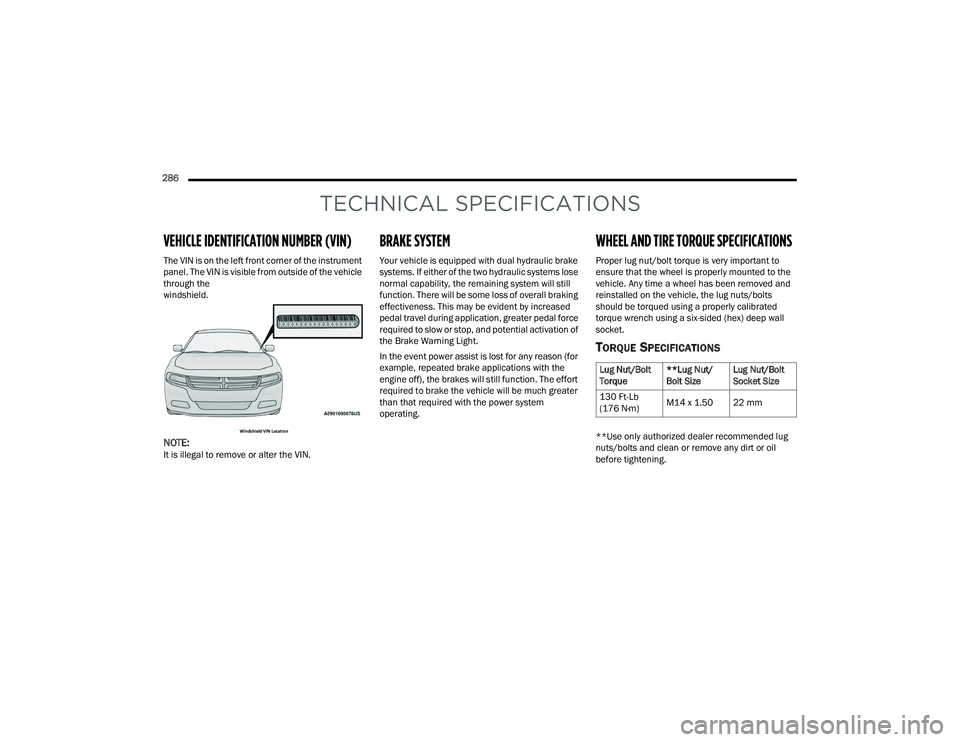
The VIN is on the left front corner of the instrument
panel. The VIN is visible from outside of the vehicle
through the
windshield.
Windshield VIN Location
NOTE:It is illegal to remove or alter the VIN.
BRAKE SYSTEM
Your vehicle is equipped with dual hydraulic brake
systems. If either of the two hydraulic systems lose
normal capability, the remaining system will still
function. There will be some loss of overall braking
effectiveness. This may be evident by increased
pedal travel during application, greater pedal force
required to slow or stop, and potential activation of
the Brake Warning Light.
In the event power assist is lost for any reason (for
example, repeated brake applications with the
engine off), the brakes will still function. The effort
required to brake the vehicle will be much greater
than that required with the power system
operating.
WHEEL AND TIRE TORQUE SPECIFICATIONS
Proper lug nut/bolt torque is very important to
ensure that the wheel is properly mounted to the
vehicle. Any time a wheel has been removed and
reinstalled on the vehicle, the lug nuts/bolts
should be torqued using a properly calibrated
torque wrench using a six-sided (hex) deep wall
socket.
TORQUE SPECIFICATIONS
**Use only authorized dealer recommended lug
nuts/bolts and clean or remove any dirt or oil
before tightening.
Lug Nut/Bolt
Torque**Lug Nut/
Bolt SizeLug Nut/Bolt
Socket Size
130 Ft-Lb
(176 N·m) M14 x 1.50 22 mm
22_LD_OM_EN_USC_t.book Page 286
Page 289 of 312
TECHNICAL SPECIFICATIONS287
Inspect the wheel mounting surface prior to
mounting the tire and remove any corrosion or
loose particles.
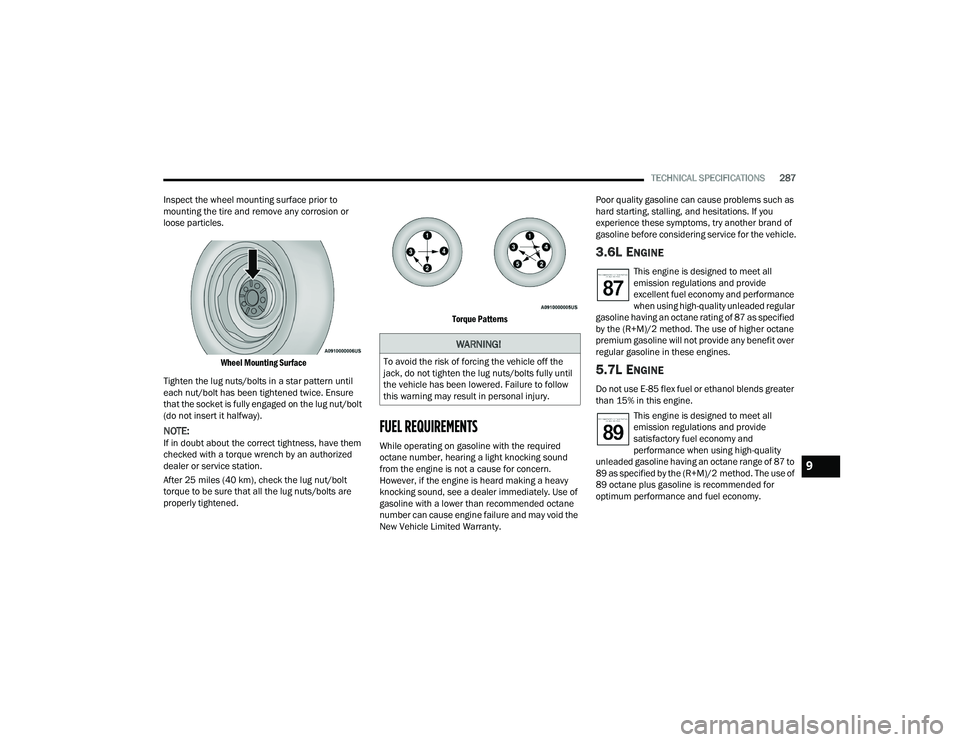
Wheel Mounting Surface
Tighten the lug nuts/bolts in a star pattern until
each nut/bolt has been tightened twice. Ensure
that the socket is fully engaged on the lug nut/bolt
(do not insert it halfway).
NOTE:If in doubt about the correct tightness, have them
checked with a torque wrench by an authorized
dealer or service station.
After 25 miles (40 km), check the lug nut/bolt
torque to be sure that all the lug nuts/bolts are
properly tightened.
Torque Patterns
FUEL REQUIREMENTS
While operating on gasoline with the required
octane number, hearing a light knocking sound
from the engine is not a cause for concern.
However, if the engine is heard making a heavy
knocking sound, see a dealer immediately. Use of
gasoline with a lower than recommended octane
number can cause engine failure and may void the
New Vehicle Limited Warranty.Poor quality gasoline can cause problems such as
hard starting, stalling, and hesitations. If you
experience these symptoms, try another brand of
gasoline before considering service for the vehicle.
3.6L ENGINE
This engine is designed to meet all
emission regulations and provide
excellent fuel economy and performance
when using high-quality unleaded regular
gasoline having an octane rating of 87 as specified
by the (R+M)/2 method. The use of higher octane
premium gasoline will not provide any benefit over
regular gasoline in these engines.
5.7L ENGINE
Do not use E-85 flex fuel or ethanol blends greater
than 15% in this engine.
This engine is designed to meet all
emission regulations and provide
satisfactory fuel economy and
performance when using high-quality
unleaded gasoline having an octane range of 87 to
89 as specified by the (R+M)/2 method. The use of
89 octane plus gasoline is recommended for
optimum performance and fuel economy.
WARNING!
To avoid the risk of forcing the vehicle off the
jack, do not tighten the lug nuts/bolts fully until
the vehicle has been lowered. Failure to follow
this warning may result in personal injury.
9
22_LD_OM_EN_USC_t.book Page 287
Page 308 of 312
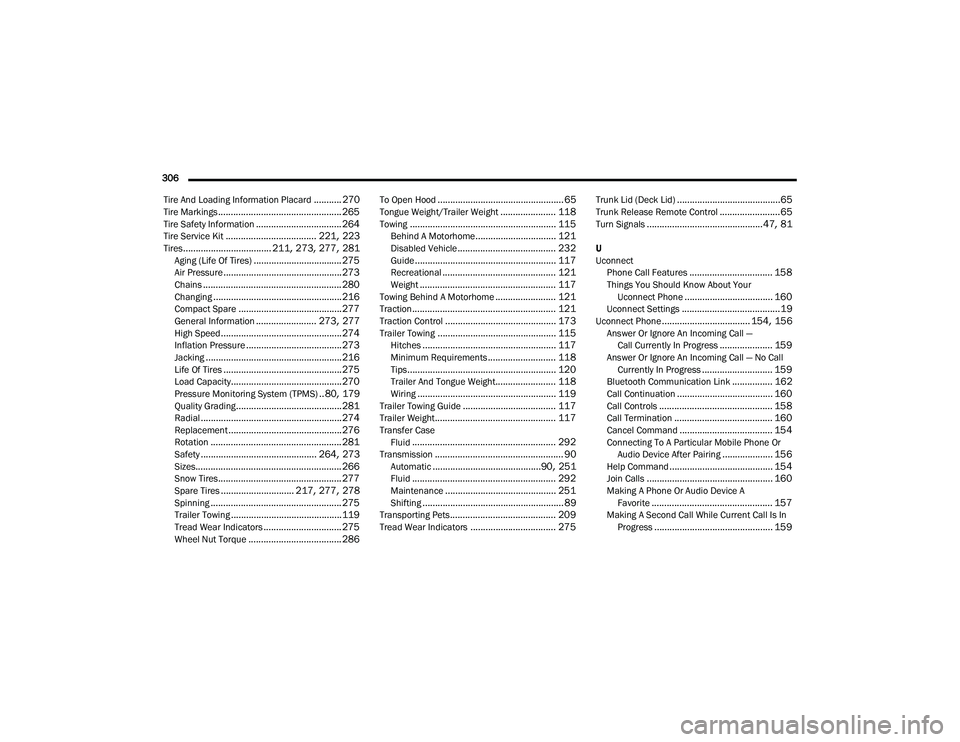
306 Tire And Loading Information Placard
........... 270Tire Markings................................................. 265Tire Safety Information.................................. 264Tire Service Kit.................................... 221, 223Tires................................... 211, 273, 277, 281Aging (Life Of Tires)................................... 275Air Pressure............................................... 273Chains....................................................... 280Changing................................................... 216Compact Spare......................................... 277General Information........................ 273, 277High Speed................................................ 274Inflation Pressure...................................... 273Jacking...................................................... 216Life Of Tires............................................... 275Load Capacity............................................ 270Pressure Monitoring System (TPMS).. 80, 179Quality Grading.......................................... 281Radial........................................................ 274Replacement............................................. 276Rotation.................................................... 281Safety.............................................. 264, 273Sizes.......................................................... 266Snow Tires................................................. 277Spare Tires............................. 217, 277, 278Spinning.................................................... 275Trailer Towing............................................ 119Tread Wear Indicators............................... 275Wheel Nut Torque..................................... 286
To Open Hood.................................................. 65Tongue Weight/Trailer Weight...................... 118Towing.......................................................... 115Behind A Motorhome................................ 121Disabled Vehicle....................................... 232Guide........................................................ 117Recreational............................................. 121Weight...................................................... 117Towing Behind A Motorhome........................ 121Traction......................................................... 121Traction Control............................................ 173Trailer Towing............................................... 115Hitches..................................................... 117Minimum Requirements........................... 118Tips........................................................... 120Trailer And Tongue Weight........................ 118Wiring....................................................... 119Trailer Towing Guide..................................... 117Trailer Weight................................................ 117Transfer Case Fluid......................................................... 292Transmission................................................... 90Automatic...........................................90, 251Fluid......................................................... 292Maintenance............................................ 251Shifting........................................................ 89Transporting Pets.......................................... 209Tread Wear Indicators.................................. 275
Trunk Lid (Deck Lid).........................................65Trunk Release Remote Control........................65Turn Signals..............................................47, 81
U
UconnectPhone Call Features
................................. 158Things You Should Know About Your Uconnect Phone................................... 160Uconnect Settings.......................................19Uconnect Phone................................... 154, 156Answer Or Ignore An Incoming Call — Call Currently In Progress..................... 159Answer Or Ignore An Incoming Call — No Call Currently In Progress............................ 159Bluetooth Communication Link................ 162Call Continuation...................................... 160Call Controls............................................. 158Call Termination....................................... 160Cancel Command..................................... 154Connecting To A Particular Mobile Phone Or Audio Device After Pairing.................... 156Help Command......................................... 154Join Calls.................................................. 160Making A Phone Or Audio Device A Favorite................................................ 157Making A Second Call While Current Call Is In Progress............................................... 159
22_LD_OM_EN_USC_t.book Page 306