engine overheat DODGE CHARGER 2023 User Guide
[x] Cancel search | Manufacturer: DODGE, Model Year: 2023, Model line: CHARGER, Model: DODGE CHARGER 2023Pages: 292, PDF Size: 13.05 MB
Page 218 of 292
216IN CASE OF EMERGENCY
3. Ensure funnel is inserted fully to hold flapper doors
open.
4. Pour fuel into funnel opening.
5. Remove funnel from filler pipe, clean off prior to putting back in the spare tire storage area.IF YOUR ENGINE OVERHEATS
If the vehicle is overheating, it will need to be serviced by
an authorized dealer.
Potential signs of vehicle overheating:
Temperature gauge is at HOT (H)
Strong smell of coolant
White smoke coming from engine or exhaust
Coolant bottle coolant has bubbles present
In the event it is observed that the temperature gauge is
moving towards or close to the HOT (H) position, you can
reduce the potential for overheating by taking the
appropriate action.
On the highways — slow down.
In city traffic — while stopped, place the transmission in
NEUTRAL (N), but do not increase the engine idle speed
while preventing vehicle motion with the brakes.
If your Air Conditioner (A/C) is on, turn it off. The A/C
system adds heat to the engine cooling system and
turning the A/C off can help remove this heat.
You can also turn the temperature control to maximum
heat, the mode control to floor and the blower control
to high. This allows the heater core to act as a supple -
ment to the radiator and aids in removing heat from the
engine cooling system.
MANUAL PARK RELEASE–8–SPEED
TRANSMISSION
CAUTION!
To avoid fuel spillage and overfilling, do not “top off” the
fuel tank after filling.
WARNING!
Never have any smoking materials lit in or near the
vehicle when the fuel door is open or the tank is
being filled.
Never add fuel when the engine is running. This is in
violation of most state and federal fire regulations
and may cause the Malfunction Indicator Light to
turn on.
A fire may result if fuel is pumped into a portable
container that is inside of a vehicle. You could be
burned. Always place fuel containers on the ground
while filling.
WARNING!
You or others can be badly burned by hot engine
coolant (antifreeze) or steam from your radiator. If you
see or hear steam coming from under the hood, do not
open the hood until the radiator has had time to cool.
Never try to open a cooling system pressure cap when
the radiator or coolant bottle is hot.
CAUTION!
Driving with a hot cooling system could damage your
vehicle. If the temperature gauge reads HOT (H), pull
over and stop the vehicle. Idle the vehicle with the air
conditioner turned off until the pointer drops back into
the normal range. If the pointer remains on HOT (H),
and you hear continuous chimes, turn the engine off
immediately and call for service.
WARNING!
Always secure your vehicle by fully applying the parking
brake before activating the Manual Park Release. In
addition, you should be seated in the driver's seat with
your foot firmly on the brake pedal when activating the
Manual Park Release. Activating the Manual Park
Release will allow your vehicle to roll away if it is not
secured by the parking brake, or by proper connection
to a tow vehicle. Activating the Manual Park Release on
an unsecured vehicle could lead to serious injury or
death for those in or around the vehicle.
23_LD_OM_EN_USC_t.book Page 216
Page 220 of 292

218IN CASE OF EMERGENCY
3. Pull up gently on the tether strap to confirm that the
lever is locked in its stowed position.
4. Tuck the tether strap into the base of the console. Reinstall the Manual Park Release cover and the
console storage bin.
When the lever is in the release position the access cover
cannot be reinstalled.
FREEING A STUCK VEHICLE
If your vehicle becomes stuck in mud, sand, or snow, it can
often be moved using a rocking motion. Turn the steering
wheel right and left to clear the area around the front
wheels. For vehicles with automatic transmission, push
and hold the lock button on the gear selector. Then shift
back and forth between DRIVE and REVERSE (with
automatic transmission) or FIRST gear and REVERSE
(with manual transmission), while gently pressing the
accelerator. Use the least amount of accelerator pedal
pressure that will maintain the rocking motion, without
spinning the wheels or racing the engine.NOTE:For vehicles with automatic transmission: Shifts between
DRIVE and REVERSE can only be achieved at wheel
speeds of 5 mph (8 km/h) or less. Whenever the trans -
mission remains in NEUTRAL for more than two seconds,
you must press the brake pedal to engage DRIVE or
REVERSE.
Push the ESC OFF button to place the Electronic Stability
Control (ESC) system in “Partial OFF” mode, before rocking
the vehicle
Úpage 166. Once the vehicle has been freed,
push the ESC OFF button again to restore “ESC On” mode.
CAUTION!
Racing the engine or spinning the wheels may lead to
transmission overheating and failure. Allow the engine
to idle with the transmission in NEUTRAL for at least
one minute after every five rocking-motion cycles. This
will minimize overheating and reduce the risk of clutch
or transmission failure during prolonged efforts to free
a stuck vehicle.
WARNING!
Fast spinning tires can be dangerous. Forces generated
by excessive wheel speeds may cause damage, or even
failure, of the axle and tires. A tire could explode and
injure someone. Do not spin your vehicle's wheels
faster than 30 mph (48 km/h) or for longer than 30
seconds continuously without stopping when you are
stuck and do not let anyone near a spinning wheel, no
matter what the speed.
CAUTION!
Racing the engine or spinning the wheels may lead to
transmission overheating and failure. Allow the
engine to idle with the transmission in NEUTRAL for
at least one minute after every five rocking-motion
cycles. This will minimize overheating and reduce the
risk of transmission failure during prolonged efforts
to free a stuck vehicle.
When “rocking” a stuck vehicle by shifting between
DRIVE and REVERSE, do not spin the wheels faster
than 15 mph (24 km/h), or drivetrain damage may
result.
Revving the engine or spinning the wheels too fast
may lead to transmission overheating and failure. It
can also damage the tires. Do not spin the wheels
above 30 mph (48 km/h) while in gear (no transmis -
sion shifting occurring).
23_LD_OM_EN_USC_t.book Page 218
Page 235 of 292
SERVICING AND MAINTENANCE233
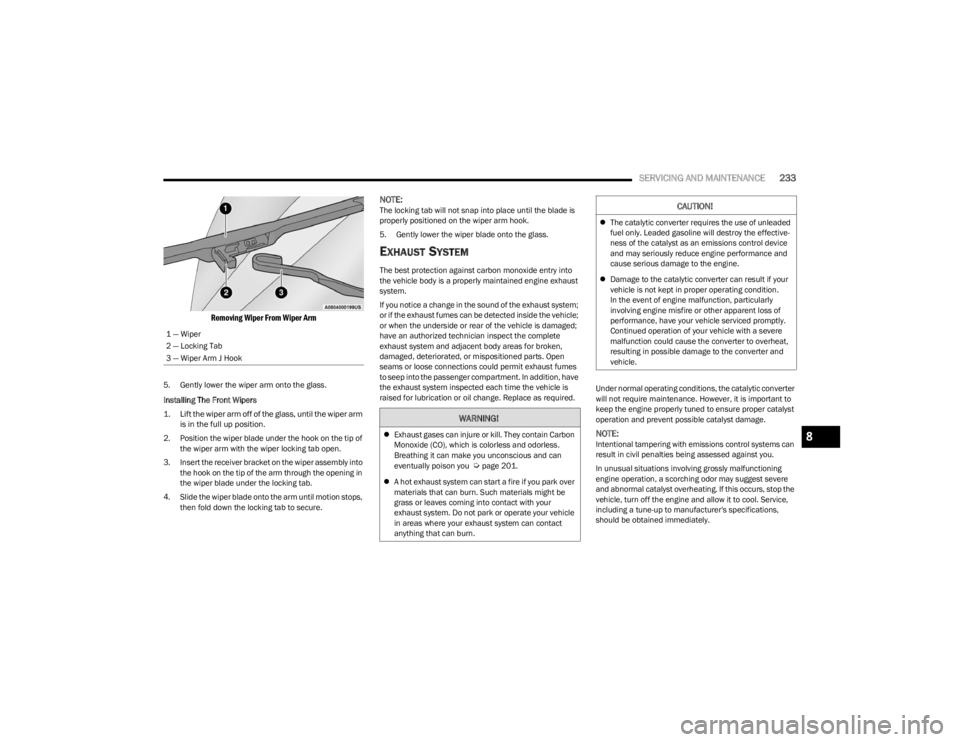
Removing Wiper From Wiper Arm
5. Gently lower the wiper arm onto the glass.
Installing The Front Wipers
1. Lift the wiper arm off of the glass, until the wiper arm
is in the full up position.
2. Position the wiper blade under the hook on the tip of the wiper arm with the wiper locking tab open.
3. Insert the receiver bracket on the wiper assembly into the hook on the tip of the arm through the opening in
the wiper blade under the locking tab.
4. Slide the wiper blade onto the arm until motion stops, then fold down the locking tab to secure.
NOTE:The locking tab will not snap into place until the blade is
properly positioned on the wiper arm hook.
5. Gently lower the wiper blade onto the glass.
EXHAUST SYSTEM
The best protection against carbon monoxide entry into
the vehicle body is a properly maintained engine exhaust
system.
If you notice a change in the sound of the exhaust system;
or if the exhaust fumes can be detected inside the vehicle;
or when the underside or rear of the vehicle is damaged;
have an authorized technician inspect the complete
exhaust system and adjacent body areas for broken,
damaged, deteriorated, or mispositioned parts. Open
seams or loose connections could permit exhaust fumes
to seep into the passenger compartment. In addition, have
the exhaust system inspected each time the vehicle is
raised for lubrication or oil change. Replace as required. Under normal operating conditions, the catalytic converter
will not require maintenance. However, it is important to
keep the engine properly tuned to ensure proper catalyst
operation and prevent possible catalyst damage.
NOTE:Intentional tampering with emissions control systems can
result in civil penalties being assessed against you.
In unusual situations involving grossly malfunctioning
engine operation, a scorching odor may suggest severe
and abnormal catalyst overheating. If this occurs, stop the
vehicle, turn off the engine and allow it to cool. Service,
including a tune-up to manufacturer's specifications,
should be obtained immediately.
1 — Wiper
2 — Locking Tab
3 — Wiper Arm J Hook
WARNING!
Exhaust gases can injure or kill. They contain Carbon
Monoxide (CO), which is colorless and odorless.
Breathing it can make you unconscious and can
eventually poison you
Úpage 201.
A hot exhaust system can start a fire if you park over
materials that can burn. Such materials might be
grass or leaves coming into contact with your
exhaust system. Do not park or operate your vehicle
in areas where your exhaust system can contact
anything that can burn.
CAUTION!
The catalytic converter requires the use of unleaded
fuel only. Leaded gasoline will destroy the effective -
ness of the catalyst as an emissions control device
and may seriously reduce engine performance and
cause serious damage to the engine.
Damage to the catalytic converter can result if your
vehicle is not kept in proper operating condition.
In the event of engine malfunction, particularly
involving engine misfire or other apparent loss of
performance, have your vehicle serviced promptly.
Continued operation of your vehicle with a severe
malfunction could cause the converter to overheat,
resulting in possible damage to the converter and
vehicle.
8
23_LD_OM_EN_USC_t.book Page 233
Page 237 of 292

SERVICING AND MAINTENANCE235
Some vehicles require special tools to add coolant
properly. Failure to fill these systems properly could
lead to severe internal engine damage. If any coolant is
needed to be added to the system please contact an
authorized dealer.
Adding Coolant
Your vehicle has been built with an improved engine
coolant (OAT coolant conforming to MS.90032) that
allows extended maintenance intervals. This engine
coolant (antifreeze) can be used up to 10 years or
150,000 miles (240,000 km) before replacement. To
prevent reducing this extended maintenance period, it is
important to use the same engine coolant (OAT coolant
conforming to MS.90032) throughout the life of your
vehicle.
Please review these recommendations for using Organic
Additive Technology (OAT) engine coolant that meets the
requirements of the manufacturer Material Standard
MS.90032. When adding engine coolant:
We recommend using Mopar® Antifreeze/Coolant
10 Year/150,000 Mile (240,000 km) Formula OAT
that meets the requirements of the manufacturer
Material Standard MS.90032.
Mix a minimum solution of 50% OAT engine coolant
that meets the requirements of the manufacturer
Material Standard MS.90032 and distilled water. Use
higher concentrations (not to exceed 70%) if tempera -
tures below −34°F (−37°C) are anticipated. Please
contact an authorized dealer for assistance.
Use only high purity water such as distilled or deionized
water when mixing the water/engine coolant solution.
The use of lower quality water will reduce the amount
of corrosion protection in the engine cooling system.
NOTE:
It is the owner's responsibility to maintain the proper
level of protection against freezing according to the
temperatures occurring in the area where the vehicle is
operated.
Some vehicles require special tools to add coolant
properly. Failure to fill these systems properly could
lead to severe internal engine damage. If any coolant is
needed to be added to the system, please contact an
authorized dealer.
Mixing engine coolant types is not recommended and
can result in cooling system damage. If HOAT and OAT
coolant are mixed in an emergency, have an authorized
dealer drain, flush, and refill with OAT coolant
(conforming to MS.90032) as soon as possible.
Cooling System Pressure Cap
The cap must be fully tightened to prevent loss of engine
coolant (antifreeze), and to ensure that engine coolant will
return to the radiator from the coolant expansion
bottle/recovery tank (if equipped).
The cap should be inspected and cleaned if there is any
accumulation of foreign material on the sealing surfaces.
Disposal Of Used Coolant
Used ethylene glycol-based coolant (antifreeze) is a
regulated substance requiring proper disposal. Check with
your local authorities to determine the disposal rules for
your community. To prevent ingestion by animals or
children, do not store ethylene glycol-based coolant in
open containers or allow it to remain in puddles on the
ground, clean up any ground spills immediately. If
ingested, seek emergency assistance immediately.
Coolant Level
The coolant bottle provides a quick visual method for
determining that the coolant level is adequate. With the
engine off and cold, the level of the engine coolant
(antifreeze) in the bottle should be between the ranges
indicated on the bottle.
WARNING!
Do not open hot engine cooling system. Never add
engine coolant (antifreeze) when the engine is over -
heated. Do not loosen or remove the cap to cool an
overheated engine. Heat causes pressure to build up
in the cooling system. To prevent scalding or injury,
do not remove the pressure cap while the system is
hot or under pressure.
Do not use a pressure cap other than the one speci -
fied for your vehicle. Personal injury or engine
damage may result.
8
23_LD_OM_EN_USC_t.book Page 235
Page 271 of 292

TECHNICAL SPECIFICATIONS269
GASOLINE/OXYGENATE BLENDS
Some fuel suppliers blend unleaded gasoline with
oxygenates such as ethanol.
Problems that result from using gasoline containing more
than 15% ethanol (E-15) or gasoline containing methanol
are not the responsibility of the manufacturer and may
void or not be covered under New Vehicle Limited
Warranty.
DO NOT USE E-85 IN NON-FLEX FUEL
V
EHICLES
Non-Flex Fuel Vehicles (FFV) are compatible with gasoline
containing up to 15% ethanol (E-15). Use of gasoline with
higher ethanol content may void the New Vehicle Limited
Warranty. If a Non-FFV vehicle is inadvertently fueled with E-85 fuel,
the engine will have some or all of these symptoms:
Operate in a lean mode.
OBD II Malfunction Indicator Light on.
Poor engine performance.
Poor cold start and cold drivability.
Increased risk for fuel system component corrosion.
CNG AND LP FUEL SYSTEM
M
ODIFICATIONS
Modifications that allow the engine to run on Compressed
Natural Gas (CNG) or Liquid Propane (LP) may result in
damage to the engine, emissions, and fuel system
components. Problems that result from running CNG or LP
are not the responsibility of the manufacturer and may
void or not be covered under the New Vehicle Limited
Warranty.
METHYLCYCLOPENTADIENYL
M
ANGANESE TRICARBONYL (MMT) IN
G
ASOLINE
MMT is a manganese-containing metallic additive that is
blended into some gasolines to increase octane. Gasoline
blended with MMT provides no performance advantage
beyond gasoline of the same octane number without
MMT. Gasoline blended with MMT reduces spark plug life
and reduces emissions system performance in some
vehicles. The manufacturer recommends that gasoline
without MMT be used in your vehicle. The MMT content of gasoline may not be indicated on the
gasoline pump; therefore, you should ask your gasoline
retailer whether the gasoline contains MMT. MMT is
prohibited in Federal and California reformulated
gasoline.
FUEL SYSTEM CAUTIONS
NOTE:Intentional tampering with the emissions control system
can result in civil penalties being assessed against you.
CAUTION!
DO NOT use E-85, gasoline containing methanol, or
gasoline containing more than 15% ethanol (E-15). Use
of these blends may result in starting and drivability
problems, damage critical fuel system components,
cause emissions to exceed the applicable standard,
and/or cause the Malfunction Indicator Light to
illuminate. Please observe pump labels as they should
clearly communicate if a fuel contains greater than
15% ethanol (E-15).
CAUTION!
Follow these guidelines to maintain your vehicle’s
performance:
The use of leaded gasoline is prohibited by Federal
law. Using leaded gasoline can impair engine perfor -
mance and damage the emissions control system.
An out-of-tune engine or certain fuel or ignition
malfunctions can cause the catalytic converter to
overheat. If you notice a pungent burning odor or
some light smoke, your engine may be out of tune or
malfunctioning and may require immediate service.
Contact an authorized dealer for service assistance.
The use of fuel additives, which are now being sold
as octane enhancers, is not recommended. Most of
these products contain high concentrations of meth -
anol. Fuel system damage or vehicle performance
problems resulting from the use of such fuels or addi -
tives is not the responsibility of the manufacturer
and may void or not be covered under the New
Vehicle Limited Warranty.
9
23_LD_OM_EN_USC_t.book Page 269
Page 282 of 292

280
Door LocksAutomatic ...................................................................23
Child-Protection Door Lock — Rear Doors ................24
Doors................................................................................ 21
Drag & Drop.................................................................. 128
Drive Modes ................................................................. 159
Driver Memory Presets ................................................ 135
Driver’s Seat Back Tilt ....................................................28
Driving Through Flowing, Rising, Or ShallowStanding Water .................................................. 110
EElectric Brake Control System..................................... 165Anti-Lock Brake System ......................................... 164
Electronic Roll Mitigation .............................. 165
, 168
Electric Remote Mirrors ..................................................36 Electronic Power Distribution Center (Fuses) ............ 238
Electronic Speed Control (Cruise Control) ..................... 86Electronic Stability Control (ESC) ................................ 166
Electronic Throttle Control Warning Light...................... 69Emergency Gas Can Refueling .................................... 215
Emergency, In Case Of Freeing Vehicle When Stuck .................................. 218
Hazard Warning Flasher ......................................... 202
Jacking..................................................................... 205
Jump Starting ................................................. 213
, 214
Towing ..................................................................... 219
Emission Control System Maintenance.........................75
Engine .................................................................. 225
, 226
Air Cleaner ............................................................... 229 Break-In Recommendations ..................................... 79
Checking Oil Level .................................................. 227Compartment ................................................. 225
, 226 Compartment Identification....................................225
Coolant (Antifreeze)....................................... 234
, 271
Cooling .....................................................................234
Exhaust Gas Caution ............................................... 201
Fails To Start .............................................................. 78
Flooded, Starting ....................................................... 78
Fuel Requirements ........................................ 268
, 270
Jump Starting................................................. 213, 214
Oil .......................................................... 228, 270, 271
Oil Filler Cap ............................................................. 225
Oil Filter ....................................................................229 Oil Selection ................................................... 228
, 270
Oil Synthetic ............................................................. 229
Overheating ............................................................. 216
Starting....................................................................... 76
Engine Oil Life Reset
b
................................................ 65
Enhanced Accident Response Feature ............. 188, 220
Ethanol .......................................................................... 269
Exhaust Gas Cautions ..................................................201
Exhaust System .................................................. 201
, 233
Exterior Lighting .............................................................. 40
Exterior Lights ........................................................40
, 201
FFilters Air Cleaner ............................................................... 229
Air Conditioning ................................................52
, 230
Engine Oil ................................................................. 229
Engine Oil Disposal..................................................229
Flashers ......................................................................... 202 Hazard Warning ....................................................... 202
Turn Signals ...............................................43
, 74, 201
Flash-To-Pass .................................................................. 42
Flooded Engine Starting ................................................. 78 Floor Console .................................................................. 53
Fluid Capacities ............................................................ 270
Fluid Leaks.................................................................... 201
Fluid Level Checks
Brake........................................................................ 236
Cooling System........................................................ 234Engine Oil................................................................. 227
Fluid, Brake................................................................... 272
Fog Lights........................................................................ 42
Fold-Flat Seats ................................................................ 28
Folding Rear Seats ......................................................... 29
Forward Collision Warning ........................................... 172
Four-Way Hazard Flasher ............................................. 202
Freeing A Stuck Vehicle ............................................... 218
Fuel................................................................................ 268 Additives .................................................................. 268
Clean Air .................................................................. 268
Ethanol..................................................................... 269Gasoline ................................................................... 268
Materials Added ...................................................... 268
Methanol ................................................................. 269
Octane Rating.................................................268
, 271
Requirements .................................................268, 270
Specifications .......................................................... 271
Tank Capacity .......................................................... 270
Fuses ............................................................................. 238
GGarage Door Opener (HomeLink) .................................. 36 Gasoline, Clean Air ....................................................... 268
Gasoline, Reformulated ............................................... 268
Gear Ranges ................................................................... 82
Glass Cleaning .............................................................. 266
23_LD_OM_EN_USC_t.book Page 280
Page 285 of 292

283
Synthetic.................................................................. 229
Viscosity................................................................... 270
Onboard Diagnostic System .................................... 74
, 75
Operating Precautions ....................................................74
Operator Manual Owner's Manual ...................................................... 276
Outside Rearview Mirrors ...............................................35
Overheating, Engine..................................................... 216
PPaddle Shift Mode ..........................................................83 Paddle Shifters................................................................83Paint Care ..................................................................... 264
Pair (link) Uconnect Phone To A mobile Phone
b
... 142
Panic Alarm .....................................................................13
Parking Brake ..................................................................79
ParkSense System, Rear ................................................94
Passing Light ...................................................................42
Passive Entry ...................................................................22
Performance....................................................................65
Personalized Main Menu Bar ...................................... 128
Pets ............................................................................... 199
Phone Mode ................................................................. 140
Pinch Protection .............................................................. 58
Placard, Tire And Loading Information ....................... 252
Power Brakes ..................................................................... 267
Deck Lid Release ....................................................... 59
Distribution Center (Fuses) .................................... 242 Door Locks .................................................................21
Mirrors ........................................................................36
Outlet (Auxiliary Electrical Outlet) ............................. 55
Seats...........................................................................30
Steering ...................................................................... 85 Sunroof....................................................................... 57
Tilt/Telescoping Steering Column ............................ 25
Windows..................................................................... 56
Power Seats Forward ...................................................................... 30
Lumbar ....................................................................... 31
Rearward.................................................................... 30
Recline ....................................................................... 31
Pregnant Women And Seat Belts ................................ 182
Preparation For Jacking ............................................... 205
Presets .......................................................................... 135
Pretensioners Seat Belts................................................................. 182
Programmable Features .............................................. 112
RRadial Ply Tires ............................................................. 256
Radiator Cap (Coolant Pressure Cap) ......................... 235
Radio Presets .....................................................................135
Radio Controls .............................................................. 130
Radio Mode ...................................................................130
Radio Operation .................................................. 130
, 163
Radio Remote Controls ................................................ 129
Rain Sensitive Wiper System ......................................... 46
Rear Axle (Differential) ................................................. 237
Rear Camera ................................................................. 100
Rear Cross Path ............................................................171
Rear ParkSense System................................................. 94
Rear Seats, Folding ........................................................ 29
Rear Wheel Drive (RWD) Towing ...................................................................... 220
Recreational Towing ..................................................... 109
Reformulated Gasoline ................................................ 268 Refrigerant .................................................................... 230
Release, Hood ................................................................ 59
Reminder, Lights On....................................................... 42
Reminder, Seat Belt ..................................................... 178
Remote Control Starting System ......................................................... 16
Remote Keyless Entry Arm The Alarm ........................................................... 19
Panic Alarm ............................................................... 13
Programming Additional Key Fobs ........................... 14
Unlatch The Trunk ..................................................... 13
Remote Sound System (Radio) Control ...................... 129
Remote Starting Exit Remote Start Mode............................................ 17
Uconnect Customer Programmable Features......... 18
Uconnect Settings ..................................................... 18
Remote Starting System ................................................ 16 Remote Trunk Release .................................................. 59
Replacement Bulbs ...................................................... 246
Replacement Tires ....................................................... 258
Reporting Safety Defects ............................................. 276
Restraints, Child ........................................................... 190
Restraints, Head............................................................. 33
Rocking Vehicle When Stuck ....................................... 218
Rotation, Tires .............................................................. 263
SSafety ............................................................................ 128
Safety Checks Inside Vehicle....................................... 199
Safety Checks Outside Vehicle .................................... 201
Safety Defects, Reporting ............................................ 276
Safety Features ............................................................ 128
Safety Information, Tire ............................................... 248
Safety Tips .................................................................... 199
11
23_LD_OM_EN_USC_t.book Page 283