window DODGE CHARGER SRT 2006 6.G Owner's Guide
[x] Cancel search | Manufacturer: DODGE, Model Year: 2006, Model line: CHARGER SRT, Model: DODGE CHARGER SRT 2006 6.GPages: 336, PDF Size: 9.85 MB
Page 183 of 336

adjusting the blower control knob (left knob) to a
position other than HI AUTO or LO AUTO.
•Most of the time, when in Automatic operation, you
can temporarily put the system into recirculation
mode by pressing the Recirc button. However, under
certain conditions in automatic the system is blowing
air out of the defrost vents. When these conditions are
present and the Recirc button is pressed the indicator
will flash and remain off. This tells you that you are
unable to go into recirculation mode at this time. If you
would like to go to Recirculation mode, you must first
move your mode knob to panel, panel/floor or floor,
then hit the recirc button. This feature will reduce the
possibility of window fogging.
Manual Operation
This system offers a full complement of manual override
features which consist of Blower Preferred Automatic,
Mode Preferred Automatic, or Blower and Mode Pre-
ferred Automatic. This means the customer can override
the blower, the mode, or both. There is a manual blower
range used when the AUTO setting is not desired. The
left control can be set to any fixed blower speed by
rotating the knob.
NOTE:Please read the Automatic Temperature Control
Operation Chart below for details.
UNDERSTANDING YOUR INSTRUMENT PANEL 183
4
Page 185 of 336

The operator can override the AUTO mode setting and
select the direction of the air by rotating the right mode
knob to one of the following positions.
•Defrost
Air is directed to the windshield through the
outlets at the base of the windshield. Air is
also directed to the front door windows through the
side window demister grilles.
•
Defrost/Floor
Air flows through the front and rear floor
outlets and the outlets at the base of the
windshield. Air is also directed to the front
door windows through the side window demister
grilles.
•
Floor
Air flows through the floor outlets located
under the instrument panel and into the rear
seating area through vents under the front seats.
•
Bi-Level
Air flows both through the outlets located in
the instrument panel and those located on thefloor. Air flows through the registers in the back of
the center console to the rear seat passengers. These
registers can be closed to block airflow.
•
Panel
Air flows through the outlets located in the
instrument panel. Air flows through the regis-
ters in the back of the center console to the rear seat
passengers. These registers can be closed to block
airflow.
Depress this button to turn on and off the air
conditioning during manual operation only. Con-
ditioned outside air is then directed through the
outlets selected on the mode control dial. The button
includes an LED that illuminates when manual operation
is selected.
NOTE:To manually control the air conditioning the
mode selector must be moved out of the AUTO position.
Press this button to turn on the rear window
defroster and the heated side mirrors (if
equipped). An LED in the button will illuminate when
UNDERSTANDING YOUR INSTRUMENT PANEL 185
4
Page 186 of 336

the rear window defroster is ON. The defroster automati-
cally turns off after approximately 10 minutes of opera-
tion for the first push of the button, and will turn off after
approximately 5 minutes for the second push of the
button.
CAUTION!
To avoid damaging the electrical conductors of the
rear window defroster, do not use scrapers, sharp
instruments, or abrasive window cleaners on the
interior surface of the window.
Labels can be peeled off after soaking with warm
water.
This button can be used to block out smoke,
odors, dust, high humidity, or if rapid cooling
is desired. The recirculation mode should only
be used temporarily. The button includes an
LED that illuminates when the recirculation mode is
active. You may use this feature separately.
NOTE:Extended use of recirculation may cause the
windows to fog. If the interior of the windows begins to
fog, press the “Recirculate” icon button to return to
outside air. Some temp./humidity conditions will cause
captured interior air to condense on windows and ham-
per visibility. For this reason, the system will not allow
“Recirculate” to be selected while in the defrost or
defrost/floor modes. Attempting to use the recirculation
while in these modes will cause the LED in the button to
blink and then turn off.
Summer Operation
The engine cooling system in air conditioned vehicles
must be protected with a high-quality antifreeze coolant
to provide proper corrosion protection and to protect
against engine overheating. A 50% solution of ethylene
glycol antifreeze coolant in water is recommended. Refer
to section 7, Maintenance Procedures, of this manual for
proper coolant selection.
186 UNDERSTANDING YOUR INSTRUMENT PANEL
Page 187 of 336

Winter Operation
Use of the air Recirculation mode during winter months
is not recommended because it may cause window
fogging.
NOTE:See Operating Tips chart (for Manual A/C
Control) at the end of this section for suggested control
settings in different weather conditions.
Vacation Storage
Anytime you store your vehicle, or keep it out of service
(i.e. vacation) for two weeks or more, run the air condi-
tioning system at idle for about five minutes in the fresh
air and high blower setting. This will insure adequate
system lubrication to minimize the possibility of com-
pressor damage when the system is started again.
Window Fogging
Interior fogging on the windshield can be quickly re-
moved by turning the mode selector to Defrost. The
Defrost/Floor mode can be used to maintain a clearwindshield and provide sufficient heating. If side win-
dow fogging becomes a problem increase blower speed.
Vehicle windows tend to fog on the inside in mild but
rainy or humid weather.
NOTE:Recirculate without A/C should not be used for
long periods as fogging may occur.
Outside Air Intake
Make sure the air intake, located directly in front of the
windshield, is free of obstructions such as leaves. Leaves
collected in the air intake may reduce airflow and if they
enter the plenum they could plug the water drains. In
winter months make sure the air intake is clear of ice,
slush and snow.
A/C Air Filter — If Equipped
The climate control system filters outside air containing
dust, pollen and some odors. Strong odors cannot be
totally filtered out. Refer to “Maintenance Procedures” in
your Owner’s Manual for filter replacement instructions.
UNDERSTANDING YOUR INSTRUMENT PANEL 187
4
Page 194 of 336
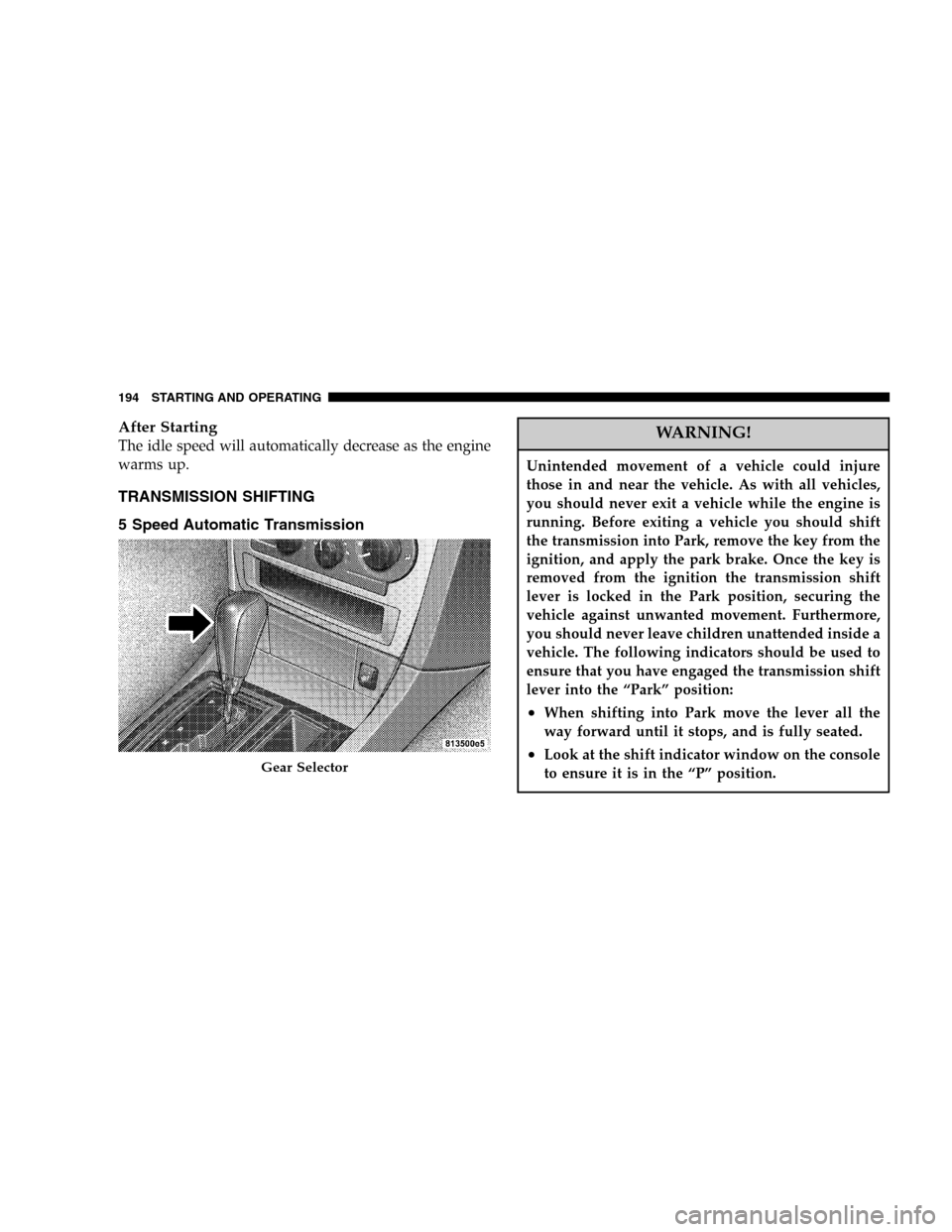
After Starting
The idle speed will automatically decrease as the engine
warms up.
TRANSMISSION SHIFTING
5 Speed Automatic Transmission
WARNING!
Unintended movement of a vehicle could injure
those in and near the vehicle. As with all vehicles,
you should never exit a vehicle while the engine is
running. Before exiting a vehicle you should shift
the transmission into Park, remove the key from the
ignition, and apply the park brake. Once the key is
removed from the ignition the transmission shift
lever is locked in the Park position, securing the
vehicle against unwanted movement. Furthermore,
you should never leave children unattended inside a
vehicle. The following indicators should be used to
ensure that you have engaged the transmission shift
lever into the “Park” position:
•When shifting into Park move the lever all the
way forward until it stops, and is fully seated.
•Look at the shift indicator window on the console
to ensure it is in the “P” position.Gear Selector
194 STARTING AND OPERATING
Page 204 of 336
The parking brake should always be applied when the
driver is not in the vehicle.
WARNING!
•Leaving children in a vehicle unattended is dan-
gerous for a number of reasons. A child or others
could be injured. Children should be warned not
to touch the parking brake, brake pedal or the
gear selector lever. Don’t leave the keys in the
ignition. A child could operate power windows,
other controls, or move the vehicle.
•Be sure the parking brake is fully disengaged
before driving: failure to do so can lead to brake
failure, and an accident.
BRAKE SYSTEM
In the event power assist is lost for any reason (for
example, repeated brake applications with the engine
off), the brakes will still function. The effort required to
brake the vehicle will be much greater than that required
with the power system operating.
Your vehicle is equipped with dual hydraulic
brake systems. If either of the two hydraulic
systems lose normal capability, the remaining
system will still function. There will be some
loss of overall braking effectiveness. This may be evident
by increased pedal travel during application, greater
pedal force required to slow or stop, and potential
activation of the Brake Warning Lamp.
204 STARTING AND OPERATING
Page 234 of 336
•The use of fuel additives which are now being sold as
octane enhancers are not recommended. Most of these
products contain high concentrations of methanol.
Fuel system damage or vehicle performance problems
resulting from the use of such fuels or additives are not
the responsibility of the manufacturer.
NOTE:Intentional tampering with emissions control
systems can result in civil penalties being assessed
against you.
Carbon Monoxide Warnings
WARNING!
Carbon monoxide (CO) in exhaust gases is deadly.
Follow the precautions below to prevent carbon
monoxide poisoning:
•Do not inhale exhaust gases. They contain carbon
monoxide, a colorless and odorless gas which can kill.
Never run the engine in a closed area, such as a
garage, and never sit in a parked vehicle with the
engine running for an extended period. If the vehicle is
stopped in an open area with the engine running for
more than a short period, adjust the ventilation system
to force fresh, outside air into the vehicle.
•Guard against carbon monoxide with proper mainte-
nance. Have the exhaust system inspected every time
the vehicle is raised. Have any abnormal conditions
repaired promptly. Until repaired, drive with all side
windows fully open.
•Keep the trunk closed when driving your vehicle to
prevent carbon monoxide and other poisonous ex-
haust gases from entering the vehicle.
234 STARTING AND OPERATING
Page 282 of 336
Interior Care
Use Mopar Fabric Cleaner or equivalent to clean fabric
upholstery and Mopar Carpet Cleaner for carpeting.
Interior Trim should be cleaned starting with a damp
cloth, or Mopar Satin Select. Do not use harsh cleaners or
Armorall. Use Mopar Total Clean to clean vinyl uphol-
stery.
Mopar Total Clean is specifically recommended for
leather upholstery.
Your leather upholstery can be best preserved by regular
cleaning with a damp soft cloth. Small particles of dirt
can act as an abrasive and damage the leather upholstery
and should be removed promptly with a damp cloth.
Stubborn soils can be removed easily with a soft cloth
and Mopar Total Clean or equivalent. Care should be
taken to avoid soaking your leather upholstery with any
liquid. Please do not use polishes, oils, cleaning fluids,
solvents, detergents, or ammonia based cleaners to clean
your leather upholstery. Application of a leather condi-
tioner is not required to maintain the original condition.WARNING!
Do not use volatile solvents for cleaning purposes.
Many are potentially flammable, and if used in
closed areas they may cause respiratory harm.
Glass Surfaces
All glass surfaces should be cleaned on a regular basis
with Mopar Glass Cleaner or any commercial household-
type glass cleaner. Never use an abrasive type cleaner.
Use caution when cleaning the inside rear window
equipped with electric defrosters or the right rear quarter
window equipped with the radio antenna. Do not use
scrapers or other sharp instruments which may scratch
the elements.
When cleaning the rear view mirror, spray cleaner on the
towel or rag that you are using. Do not spray cleaner
directly on the mirror.
282 MAINTAINING YOUR VEHICLE
Page 322 of 336

ABS (Anti-Lock Brake) System............. 205
Adding Engine Coolant (Antifreeze)......... 273
Adding Fuel.......................... 235
Adding Washer Fluid.................101,270
Additives, Fuel........................ 233
Adjustable Pedals....................... 93
Air Conditioner Maintenance.............. 267
Air Conditioning....................... 178
Air Conditioning Filter................187,268
Air Conditioning, Operating Tips........... 188
Air Conditioning Refrigerant.............. 268
Air Conditioning System................. 178
Air Pressure, Tires...................... 218
Airbag................................ 36
Airbag Deployment....................40,46
Airbag Light....................41,48,58,134
Airbag Maintenance...................... 48
Airbag, Side........................... 45
Airbag, Window......................37,45
Alarm System.......................... 22
Alignment and Balance.................. 223
Alterations/Modifications, Vehicle............ 7
Antenna, Satellite Radio.................. 172Antifreeze (Engine Coolant)............272,295
Disposal............................ 274
Anti-Lock Brake System (ABS)..........103,205
Anti-Lock Warning Light................. 138
Anti-Theft Security Alarm................. 22
Appearance Care....................... 280
Auto Down Power Windows............... 25
Auto Up Power Windows................. 25
Automatic Dimming Mirror................ 65
Automatic Door Locks.................... 17
Automatic Temperature Control............ 181
Automatic Transmission............194,278,279
Adding Fluid.....................279,296
Fluid and Filter Changes................ 279
Fluid Change........................ 279
Fluid Level Check..................... 278
Fluid Type.......................... 296
Autostick..........................196,201
Ball Joints............................ 269
Battery............................... 266
Jump Starting........................ 247
Keyless Transmitter Replacement.......... 22
322 INDEX
Page 324 of 336

Contract, Service....................... 316
Coolant Pressure Cap.................... 273
Cooling System........................ 271
Adding Coolant (Antifreeze)............. 273
Coolant Capacity..................... 295
Coolant Level.....................271,274
Disposal of Used Coolant............... 274
Drain, Flush, and Refill................. 272
Inspection........................... 274
Points to Remember................... 274
Pressure Cap........................ 273
Radiator Cap........................ 273
Selection of Coolant (Antifreeze)....272,295,296
Cruise Control (Speed Control)............. 108
Cup Holder........................122,283
Customer Assistance.................... 314
Data Recorder, Event..................... 48
Dealer Service......................... 258
Defroster, Rear Window.................. 178
Defroster, Windshield...............58,180,185
Delay (Intermittent) Wipers............... 101
Diagnostic System, Onboard............... 256Dimmer Switch, Headlight................. 99
Disposal
Antifreeze (Engine Coolant)............. 274
Door Locks............................ 15
Door Locks, Automatic................... 17
Door Opener, Garage.................... 112
Drive Belts............................ 262
Driving
On Slippery Surfaces.................. 249
DVD Player (Video Entertainment System).... 168
Electric Remote Mirrors................... 67
Electrical Power Outlets.................. 120
Electronic Brake Control System............ 103
Electronic Speed Control................. 108
Electronic Stability Program............... 104
Electronic Vehicle Information Center........ 139
Emergency, In Case of
Freeing Vehicle When Stuck............. 250
Hazard Warning Flasher................ 242
Jump Starting........................ 247
Overheating......................... 242
Towing............................. 251
324 INDEX