ABS DODGE CHARGER SRT 2007 6.G User Guide
[x] Cancel search | Manufacturer: DODGE, Model Year: 2007, Model line: CHARGER SRT, Model: DODGE CHARGER SRT 2007 6.GPages: 350, PDF Size: 5.51 MB
Page 206 of 350

WARNING!
²The Anti-Lock Brake System contains sophisticated
electronic equipment that may be susceptible to inter-
ference caused by improperly installed or high output
radio transmitting equipment. This interference can
cause possible loss of anti-lock braking capability. In-
stallation of such equipment should be performed by
qualified professionals.
²Pumping of the Anti-Lock Brakes will diminish their
effectiveness and may lead to an accident. Pumping
makes the stopping distance longer. Just press firmly on
your brake pedal when you need to slow down or stop.
²Anti-lock system (ABS) cannot prevent the natural laws
of physics from acting on the vehicle, nor can it increase
braking or steering efficiency beyond that afforded by
the condition of the vehicle brakes and tires or the
traction afforded.
²The ABS cannot prevent accidents, including those
resulting from excessive speed in turns, following an-
other vehicle too closely, or hydroplaning. Only a safe,
attentive, and skillful driver can prevent accidents.
²The capabilities of an ABS equipped vehicle must never
be exploited in a reckless or dangerous manner, which
could jeopardize the user's safety or the safety of others.
All vehicle wheels and tires must be the same size and
type and tires must be properly inflated to produce
accurate signals for the computer.
Anti-Lock Brake Light
The ABS light monitors the Anti-Lock Brake Sys-
tem. The light will come on when the ignition
switch is turned to the ON position and may stay on for
as long as four seconds.
If the ABS light remains on or comes on while driving, it
indicates that the Anti-Lock portion of the brake system
is not functioning and that service is required. However,
the conventional brake system will continue to operate
normally if the BRAKE warning light is not on.
If the ABS light is on, the brake system should be serviced
as soon as possible to restore the benefits of Anti-Lock
brakes. If the ABS light does not come on when the
Ignition switch is turned to the ON position, have the
bulb repaired as soon as possible.
If both the Brake Warning Light and the ABS Light
remain on, the Anti-Lock brakes (ABS) and Electronic
206 STARTING AND OPERATING
Page 207 of 350
Brake Force Distribution (EBD) systems are not function-
ing. Immediate repair to the ABS system is required.
POWER STEERING
The standard power steering system will give you good
vehicle response and increased ease of maneuverability
in tight spaces. The system will provide mechanical
steering capability if power assist is lost.
If for some reason the power assist is interrupted, it will
still be possible to steer your vehicle. Under these condi-
tions, you will observe a substantial increase in steering
effort, especially at very low vehicle speeds and during
parking maneuvers.
NOTE:Increased noise levels at the end of the steering
wheel travel are considered normal and do not indicate
that there is a problem with the power steering system.
Upon initial start-up in cold weather, the power
steering pump may make noise for a short amount of
time. This is due to the cold, thick fluid in the steering
system. This noise should be considered normal, and
does not in any way damage the steering system.
WARNING!
Continued operation with reduced power steering
assist could pose a safety risk to yourself and others.
Service should be obtained as soon as possible.
CAUTION!
Prolonged operation of the steering system at the
end of the steering wheel travel will increase the
steering fluid temperature and it should be avoided
when possible. Damage to the power steering pump
may occur.
STARTING AND OPERATING 207
5
Page 208 of 350

ELECTRONIC BRAKE CONTROL SYSTEM
Your vehicle is equipped with an advanced electronic
brake control system commonly referred to as ESP. This
system includes the ABS (Anti-Lock Brake System), the
TCS (Traction Control System), the BAS (Brake Assist
System), and the ESP (Electronic Stability Program).
These systems work together to enhance both vehicle
stability and control in various driving conditions.
ABS (Anti-Lock Brake System)
This system aids the driver in maintaining vehicle control
under adverse braking conditions by controlling hydrau-
lic brake pressure. This prevents wheel lock-up to help
avoid skidding on slippery surfaces during braking. For
more information about ABS, refer to ªAnti-Lock Brake
Systemº in Section 5 of this manual.
WARNING!
The ABS (Anti-Lock Brake System) cannot prevent
the natural laws of physics from acting on the
vehicle, nor can it increase the traction afforded by
prevailing road conditions. The ABS cannot prevent
accidents, including those resulting from excessive
speed in turns, driving on very slippery surfaces, or
hydroplaning. Only a safe, attentive, and skillful
driver can prevent accidents. The capabilities of an
ABS-equipped vehicle must never be exploited in a
reckless or dangerous manner, which could jeopar-
dize the user's safety or the safety of others.
TCS (Traction Control System)
This system monitors the amount of wheel spin of each
driven wheel. If wheel spin is detected, brake pressure is
applied to the slipping wheel(s) and engine power is
reduced to provide enhanced acceleration and stability.
208 STARTING AND OPERATING
Page 209 of 350

BAS (Brake Assist System)
This system complements the Anti-Lock Brake System
(ABS) by optimizing the vehicle braking capability dur-
ing emergency braking maneuvers. This system detects
an emergency braking situation by sensing the rate and
amount of brake application and then applies optimum
pressure to the brakes. This can help reduce braking
distances.
Applying the brakes very quickly results in the best BAS
assistance. To receive the benefits of this system, you
must apply continuous brake pedal pressure during the
stopping sequence. Do not reduce brake pedal pressure
unless braking is no longer desired. Once the brake pedal
is released, the BAS is deactivated.WARNING!
The BAS (Brake Assist System) cannot prevent the
natural laws of physics from acting on the vehicle,
nor can it increase the traction afforded by prevail-
ing road conditions. The BAS cannot prevent acci-
dents, including those resulting from excessive
speed in turns, driving on very slippery surfaces, or
hydroplaning. Only a safe, attentive, and skillful
driver can prevent accidents. The capabilities of a
BAS-equipped vehicle must never be exploited in a
reckless or dangerous manner, which could jeopar-
dize the user's safety or the safety of others.
ESP (Electronic Stability Program)
This system enhances directional control and stability of
the vehicle under various driving conditions. The ESP
corrects for oversteering and understeering the vehicle
by applying the brake of the appropriate wheel. Engine
power may also be reduced to assist in counteracting the
condition of oversteer or understeer and help the vehicle
maintain the desired path.
STARTING AND OPERATING 209
5
Page 214 of 350

NOTE:
²
P (Passenger)-Metric tire sizing is based on U.S. design
standards. P-Metric tires have the letter ªPº molded
into the sidewall preceding the size designation. Ex-
ample: P215/65R15 95H.
²European Metric tire sizing is based on European
design standards. Tires designed to this standard have
the tire size molded into the sidewall beginning with
the section width. The letter9P9is absent from this tire
size designation. Example: 215/65R15 96H
²LT (Light Truck)-Metric tire sizing is based on U.S.
design standards. The size designation for LT-Metrictires is the same as for P-Metric tires except for the
letters ªLTº that are molded into the sidewall preced-
ing the size designation. Example: LT235/85R16.
²Temporary Spare tires are high-pressure compact
spares designed for temporary emergency use only.
Tires designed to this standard have the letter ªTº
molded into the sidewall preceding the size designa-
tion. Example: T145/80D18 103M.
²High Flotation tire sizing is based on U.S. design
standards and it begins with the tire diameter molded
into the sidewall. Example: 31x10.5 R15 LT.
Tire Sizing Chart
EXAMPLE:
Size Designation:
P= Passenger car tire size based on U.S. design standards
(....blank....(= Passenger car tire based on European design standards
LT= Light Truck tire based on U.S. design standards
T= Temporary Spare tire
31= Overall Diameter in Inches (in)
215= Section Width in Millimeters (mm)
214 STARTING AND OPERATING
Page 215 of 350

EXAMPLE:
65= Aspect Ratio in Percent (%)
ÐRatio of section height to section width of tire.
10.5= Section Width in Inches (in)
R= Construction Code
Ð9R9means Radial Construction.
Ð9D9means Diagonal or Bias Construction.
15= Rim Diameter in Inches (in)
Service Description:
95= Load Index
ÐA numerical code associated with the maximum load a tire can carry.
H= Speed Symbol
ÐA symbol indicating the range of speeds at which a tire can carry a load corresponding
to its load index under certain operating conditions.
ÐThe maximum speed corresponding to the Speed Symbol should only be achieved un-
der specified operating conditions. (i.e. tire pressure, vehicle loading, road conditions,
and posted speed limits).
Load Identification:
(....blank....(= Absence of any text on sidewall of the tire indicates a Standard Load (SL) Tire
Extra Load (XL)= Extra Load (or Reinforced) Tire
Light Load= Light Load Tire
STARTING AND OPERATING 215
5
Page 251 of 350
WARNING!
²Do not attempt to repair a tire on the side of the vehicle
close to traffic. Pull far enough off the road to avoid the
danger of being hit when operating the jack or repairing
a tire.
²Cuts or punctures larger than approximately 0.16 in. (4
mm), tire damage caused by driving with extremely low
tire pressure or on a flat tire, or a damaged wheel can
pose a hazard while driving. TIREFIT should not be
used in such circumstances. Do not drive the vehicle
under such circumstances. Contact your nearest autho-
rized dealer for assistance.
²Take care not to allow the contents of TIREFIT to come
in contact with hair, eyes or clothing. TIREFIT is harm-
ful if inhaled, swallowed or absorbed through the skin:
It causes skin, eye and respiratory irritation. Any contact
with eyes or skin should be flushed immediately with
plenty of water. If clothing comes in contact with
TIREFIT, change clothing as soon as possible.
²In case of allergic reaction or rash, consult a physician
immediately. Keep TIREFIT out of reach of children. If
swallowed, rinse mouth immediately with plenty of
water and drink plenty of water. Do not induce vomit-
ing! Consult a physician immediately.
Keep away from open flame or heat source.
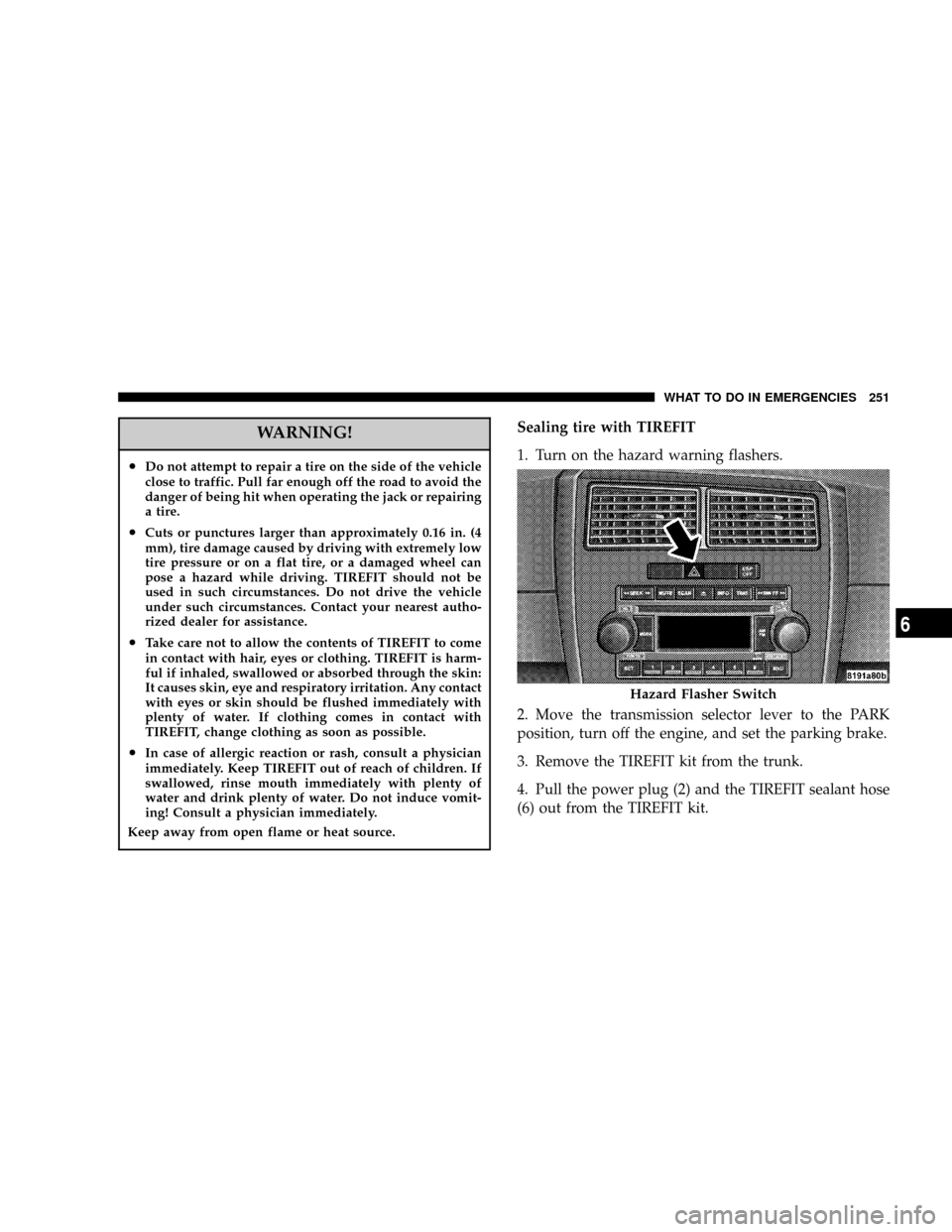
Sealing tire with TIREFIT
1. Turn on the hazard warning flashers.
2. Move the transmission selector lever to the PARK
position, turn off the engine, and set the parking brake.
3. Remove the TIREFIT kit from the trunk.
4. Pull the power plug (2) and the TIREFIT sealant hose
(6) out from the TIREFIT kit.
Hazard Flasher Switch
WHAT TO DO IN EMERGENCIES 251
6
Page 292 of 350

Cavity Car-
tridge
FuseMini
FuseDescription
1ÐÐÐ
2ÐÐÐ
3 Ð 15 Amp
BlueAdjustable Pedals - if
equipped
4 Ð 20 Amp
YellowAC Clutch/Horn
5ÐÐÐ
6 Ð 15 Amp
BlueFront Control Module
(FCM)
7 Ð 20 Amp
YellowFog Lights
8 Ð 15 Amp
BlueLights ± License, Park,
Side Marker, Stop, Turn
9 Ð 15 Amp
BlueFront Control Module
(FCM)
10 Ð 5 Amp
OrangePowertrain Control
Module (PCM)/StarterCavity Car-
tridge
FuseMini
FuseDescription
11 Ð 25 Amp
ClearAuto Shutdown/
Powertrain Control
Module (PCM)
12ÐÐÐ
13ÐÐÐ
14 Ð 25 Amp
ClearPowertrain Control
Module (PCM)
15 Ð 20 Amp
YellowInjectors, Ignition Coils
16ÐÐÐ
17 30 Amp
PinkÐ Anti-lock Brakes System
(ABS) Valves/
Powertrain Control
Module (PCM)
18 30 Amp
PinkÐ Windshield Wiper/
Washer
19 50 Amp
RedÐ Radiator Fan
292 MAINTAINING YOUR VEHICLE
Page 293 of 350

Cavity Car-
tridge
FuseMini
FuseDescription
20 20 Amp
BlueÐ Starter
21 50 Amp
RedÐ Anti-lock Brakes System
(ABS) Pump Motor
22 40 Amp
GreenÐ AC Clutch/Radiator Fan
High Ð Low
23ÐÐÐ
24 60 Amp
YellowÐ Radiator Fan
25 30 Amp
PinkÐ Front Control Module
(FCM)
26ÐÐÐ
27 30 Amp
PinkÐ Front Control Module
(FCM)CAUTION!
²When installing the Power Distribution Center
cover, it is important to ensure the cover is prop-
erly positioned and fully latched. Failure to do so
may allow water to get into the Power Distribu-
tion Center, and possibly result in an electrical
system failure.
²When replacing a blown fuse, it is important to
use only a fuse having the correct amperage
rating. The use of a fuse with a rating other than
indicated may result in a dangerous electrical
system overload. If a properly rated fuse contin-
ues to blow, it indicates a problem in the circuit
that must be corrected.
Fuses (Rear Power Distribution Center)
There is also a power distribution center located in the
rear compartment under the spare tire access panel. This
center contains fuses and relays.
MAINTAINING YOUR VEHICLE 293
7
Page 330 of 350

Service Contract
You may have purchased a service contract for your
vehicle to help protect you from the high cost of unex-
pected repairs after your manufacturer's new vehicle
limited warranty expires. The manufacturer stands be-
hind only the manufacturer's Service Contracts. If you
purchased a manufacturer's Service Contract, you will
receive Plan Provisions and an Owner Identification Card
in the mail within three weeks of your vehicle delivery
date. If you have any questions about your service
contract, call the manufacturer's Service Contract Na-
tional Customer Hotline at 1-800-521-9922.
The manufacturer will not stand behind any service
contract that is not the manufacturer's Service Contract. It
is not responsible for any service contract other than the
manufacturer's Service Contract. If you purchased a
service contract that is not a manufacturer's Service
Contract, and you require service after your manufactur-
er's new vehicle limited warranty expires, please refer to
your contract documents, and contact the person listed in
those documents.We appreciate that you have made a major investment
when you purchased your new vehicle. Your dealer has
also made a major investment in facilities, tools, and
training to assure that you are absolutely delighted with
your ownership experience. You'll be pleased with their
sincere efforts to resolve any warranty issues or related
concerns.
WARRANTY INFORMATION (U.S. Vehicles Only)
See the Warranty Information Booklet for the terms and
provisions of DaimlerChrysler's warranties applicable to
this vehicle.
MOPARTPARTS
Mopartfluids, lubricants, parts, and accessories are
available from your dealer. They will help you keep your
vehicle operating at its best.
330 IF YOU NEED CONSUMER ASSISTANCE