flat tire DODGE CHARGER SRT 2007 6.G User Guide
[x] Cancel search | Manufacturer: DODGE, Model Year: 2007, Model line: CHARGER SRT, Model: DODGE CHARGER SRT 2007 6.GPages: 350, PDF Size: 5.51 MB
Page 223 of 350

CAUTION!
After inspecting or adjusting the tire pressure, al-
ways reinstall the valve stem cap (if equipped). This
will prevent moisture and dirt from entering the
valve stem, which could damage the valve stem.
Inflation pressures specified on the placard are always
ªcold tire inflation pressure.º Cold tire inflation pressure
is defined as the tire pressure after the vehicle has not
been driven for at least 3 hours, or driven less than 1 mile
(1 km) after a 3 hour period. The cold tire inflation
pressure must not exceed the maximum inflation pres-
sure molded into the tire sidewall.
Check tire pressures more often if subject to a wide range
of outdoor temperatures, as tire pressures vary with
temperature changes.
Tire pressures change by approximately 1 psi (7 kPa) per
12É F (7É C) of air temperature change. Keep this in mind
when checking tire pressure inside a garage, especially in
the winter.Example: If garage temperature = 68É F (20É C) and the
outside temperature = 32É F (0É C) then the cold tire
inflation pressure should be increased by 3 psi (21 kPa),
which equals 1 psi (7 kPa) for every 12É F (7É C) for this
outside temperature condition.
Tire pressure may increase from 2 to 6 psi (13 to 40 kPa)
during operation. DO NOT reduce this normal pressure
build up or your tire pressure will be too low.
Tire Pressures for High Speed Operation
The manufacturer advocates driving at safe speeds
within posted speed limits. Where speed limits or condi-
tions are such that the vehicle can be driven at high
speeds, maintaining correct tire inflation pressure is very
important. Increased tire pressure and reduced vehicle
loading may be required for high-speed vehicle opera-
tion. Refer to original equipment or an authorized tire
dealer for recommended safe operating speeds, loading
and cold tire inflation pressures.
STARTING AND OPERATING 223
5
Page 226 of 350
Replacement Tires
The tires on your new vehicle provide a balance of many
characteristics. They should be inspected regularly for
wear and correct cold tire inflation pressure. The manu-
facturer strongly recommends that you use tires equiva-
lent to the originals in size, quality and performance
when replacement is needed (refer to the paragraph on
ªTread Wear Indicatorsº). Refer to the ªTire and Loading
Informationº placard for the size designation of your tire.
The service description and load identification will be
found on the original equipment tire. Failure to use
equivalent replacement tires may adversely affect the
safety, handling, and ride of your vehicle. We recommend
that you contact your original equipment or an autho-
rized tire dealer with any questions you may have on tire
specifications or capability.WARNING!
²Do not use a tire, wheel size or rating other than
that specified for your vehicle. Some combina-
tions of unapproved tires and wheels may change
suspension dimensions and performance charac-
teristics, resulting in changes to steering, han-
dling, and braking of your vehicle. This can cause
unpredictable handling and stress to steering and
suspension components. You could lose control
and have an accident resulting in serious injury or
death. Use only the tire and wheel sizes with load
ratings approved for your vehicle.
²Never use a tire with a smaller load index or
capacity, other than what was originally equipped
on your vehicle. Using a tire with a smaller load
index could result in tire overloading and failure.
You could lose control and have an accident.
²Failure to equip your vehicle with tires having
adequate speed capability can result in sudden
tire failure and loss of vehicle control.
226 STARTING AND OPERATING
Page 230 of 350

Tire Rotation Ð All Season Tires
The suggested rotation method for vehicles equipped
with all season tires is the ªforward-crossº as shown in
the following diagram.
TIRE PRESSURE MONITOR SYSTEM (TPMS) Ð IF
EQUIPPED
²
The Tire Pressure Monitor System (TPMS) will warn
the driver of a low tire pressure based on the vehicle
recommended cold placard pressure.
²The tire pressure will vary with temperature by about
1 psi (6.9 kPa) for every 12ÉF (6.5ÉC). This means that
when the outside temperature decreases, the tire pres-
sure will decrease. Tire pressure should always be set
based on cold inflation tire pressure. This is defined as
the tire pressure after the vehicle has not been driven
for at least 3 hours, or driven less than 1 mile (1 km)
after a 3 hour period. The cold tire inflation pressure
must not exceed the maximum inflation pressure
molded into the tire sidewall. Refer to the ªTires ±
General Informationº in this section for information
on how to properly inflate the vehicle's tires. The tire
pressure will also increase as the vehicle is driven - this
is normal and there should be no adjustment for this
increased pressure.
230 STARTING AND OPERATING
Page 231 of 350

²The TPM System will warn the driver of a low tire
pressure if the tire pressure falls below the low-
pressure warning limit for any reason, including low
temperature effects.
²The TPM System will continue to warn the driver of
low tire pressure as long as the condition exists, and
will not turn off until the tire pressure is at or above
the recommended cold placard pressure. Once the low
tire pressure warning (Tire Pressure Monitoring Tell-
tale Light) illuminates, you must increase the tire
pressure to the recommended cold placard pressure in
order for the Tire Pressure Monitoring Telltale Light to
turn off. The system will automatically update and the
Tire Pressure Monitoring Telltale Light will turn off
once the system receives the updated tire pressures.
The vehicle may need to be driven for up to 10 minutes
above 15 mph (25 km/h) in order for the TPMS to
receive this information.
þFor example, your vehicle may have a recom-
mended cold (parked for more than 3 hours) placard
pressure of 30 psi (207 kPa). If the ambient tempera-
ture is 68ÉF (20ÉC) and the measured tire pressure is27 psi (186 kPa), a temperature drop to 20ÉF (-7ÉC)
will decrease the tire pressure to approximately 23
psi (157 kPa). This tire pressure is sufficiently low
enough to turn ON the Tire Pressure Monitoring
Telltale light. Driving the vehicle may cause the tire
pressure to rise to approximately 27 psi (186 kPa),
but the Tire Pressure Monitoring Telltale Light will
still be ON. In this situation, the Tire Pressure
Monitoring Telltale Light will turn OFF only after
the tires are inflated to the vehicle's recommended
cold placard pressure value.
NOTE:Seasonal temperature changes will affect tire
pressure, and the TPMS will monitor the actual tire
pressure in the tire.
STARTING AND OPERATING 231
5
Page 232 of 350
CAUTION!
²The TPMS has been optimized for the original
equipment tires and wheels. TPMS pressures and
warning have been established for the tire size
equipped on your vehicle. Undesirable system
operation or sensor damage may result when
using replacement equipment that is not of the
same size, type, and/or style. After-market wheels
can cause sensor damage. Do not use tire sealant
from a can, or balance beads if your vehicle is
equipped with a TPMS, as damage to the sensors
may result.
²After inspecting or adjusting the tire pressure,
always reinstall the valve stem cap. This will
prevent moisture and dirt from entering the valve
stem, which could damage the Tire Pressure
Monitoring Sensor.
NOTE:
²
The TPMS is not intended to replace normal tire care
and maintenance, or to provide warning of a tire
failure or condition.
²The TPMS should not be used as a tire pressure gauge
while adjusting your tire pressure.
²Driving on a significantly under-inflated tire causes
the tire to overheat and can lead to tire failure.
Under-inflation also reduces fuel efficiency and tire
tread life, and may affect the vehicle's handling and
stopping ability.
²The TPMS is not a substitute for proper tire mainte-
nance, and it is the driver 's responsibility to maintain
correct tire pressure, even if under-inflation has not
reached the level to trigger illumination of the Tire
Pressure Monitoring Telltale light.
Base System Ð If Equipped
The Tire Pressure Monitor System (TPMS) uses wireless
technology with wheel rim mounted electronic sensors to
232 STARTING AND OPERATING
Page 233 of 350
monitor tire pressure levels. Sensors, mounted to each
wheel as part of the valve stem, transmit tire pressure
readings to the Receiver Module.
NOTE:It is particularly important for you to check the
tire pressure in all of the tires on your vehicle regularly
and to maintain the proper pressure.
The TPMS consists of the following components:
²Receiver Module
²4 Tire Pressure Monitoring Sensors
²Tire Pressure Monitoring Telltale Light
Tire Pressure Monitoring Low Pressure Warnings
The Tire Pressure Monitoring Telltale Light will
illuminate in the instrument cluster and an audible
chime will sound when tire pressure is low in one
or more of the four active road tires. The audible chime
will sound once every ignition cycle for each condition
that it detects. Should this occur, you should stop as soon
as possible, check the inflation pressure of each tire on
your vehicle, and inflate each tire to the vehicle's recom-
mended cold placard pressure value. Once the systemreceives the updated tire pressures, the system will
automatically update and the Tire Pressure Monitoring
Telltale Light will turn off. The vehicle may need to be
driven for up to 10 minutes above 15 mph (25 km/h) in
order for the TPMS to receive this information. Low
pressure in the spare tire will not cause the Tire Pressure
Monitoring Telltale Light to illuminate or the chime to
sound.
NOTE:The compact spare tire (if so equipped) does not
have a tire pressure monitoring sensor. Therefore, the
TPMS will not monitor the pressure in the compact spare
tire. However, if you install the compact spare tire in
place of a road tire that has a pressure below the
low-pressure warning limit, the Tire Pressure Monitoring
Telltale Light will remain ON and a chime will still sound
each ignition key cycle. Once you repair or replace the
original road tire, and reinstall it on the vehicle in place of
the compact spare, the TPMS will update automatically
and the Tire Pressure Monitoring Telltale Light will turn
OFF, as long no tire pressure is below the low-pressure
warning limit in any of the four active road tires. The
STARTING AND OPERATING 233
5
Page 234 of 350
vehicle may need to be driven for up to 10 minutes above
15 mph (25 km/h) in order for the TPMS to receive this
information.
Check TPMS Warning
The Tire Pressure Monitoring Telltale Light will flash on
and off for 60 seconds and an audible chime will sound
when a system fault is detected. The flash cycle will
repeat every ten minutes, without an audible chime, until
the fault condition no longer exists. If the ignition key is
cycled, this sequence will repeat, providing the system
fault still exists.
Premium System Ð If Equipped
The Tire Pressure Monitor System (TPMS) uses wireless
technology with wheel rim mounted electronic sensors to
monitor tire pressure levels. Sensors, mounted to each
wheel as part of the valve stem, transmit tire pressure
readings to the Receiver Module.
NOTE:It is particularly important for you to check the
tire pressure in all of the tires on your vehicle regularly
and to maintain the proper pressure.
The TPMS consists of the following components:
²Receiver Module
²4 Tire Pressure Monitoring Sensors
²3 Trigger Modules (mounted in three of the four
wheel-wells)
²Various Tire Pressure Monitoring System Messages,
which display in the Electronic Vehicle Information
Center (EVIC)
²Tire Pressure Monitoring Telltale Light
Tire Pressure Monitoring Low Pressure Warnings
The Tire Pressure Monitoring Telltale Light will
illuminate in the instrument cluster and an audible
chime will sound when tire pressure is low in one
or more of the four active road tires. The audible chime
will sound once every ignition cycle for each condition
that it detects. In addition, the Electronic Vehicle Infor-
mation Center (EVIC) will display one or more Low
Pressure messages (Left Front, Left Rear, Right Front,
Right Rear) for 3 seconds and a graphic showing the
pressure values of each tire with the low tire pressure
values flashing. Should this occur, you should stop as
soon as possible, and inflate the tires with low pressure
234 STARTING AND OPERATING
Page 247 of 350
WHAT TO DO IN EMERGENCIES
CONTENTS
mHazard Warning Flasher.................248
mIf Your Engine Overheats................248
mTIREFIT Tire Repair....................249
mJump-Starting Procedures................254
mFreeing A Stuck Vehicle.................257
mTowing A Disabled Vehicle...............258NWithout The Ignition Key...............258
NTowing This Vehicle Behind Another Vehicle
(Flat Towing With All Four Wheels On The
Ground)............................258
NTowing This Vehicle Behind Another Vehicle
With A Tow Dolly.....................259
6
Page 251 of 350
WARNING!
²Do not attempt to repair a tire on the side of the vehicle
close to traffic. Pull far enough off the road to avoid the
danger of being hit when operating the jack or repairing
a tire.
²Cuts or punctures larger than approximately 0.16 in. (4
mm), tire damage caused by driving with extremely low
tire pressure or on a flat tire, or a damaged wheel can
pose a hazard while driving. TIREFIT should not be
used in such circumstances. Do not drive the vehicle
under such circumstances. Contact your nearest autho-
rized dealer for assistance.
²Take care not to allow the contents of TIREFIT to come
in contact with hair, eyes or clothing. TIREFIT is harm-
ful if inhaled, swallowed or absorbed through the skin:
It causes skin, eye and respiratory irritation. Any contact
with eyes or skin should be flushed immediately with
plenty of water. If clothing comes in contact with
TIREFIT, change clothing as soon as possible.
²In case of allergic reaction or rash, consult a physician
immediately. Keep TIREFIT out of reach of children. If
swallowed, rinse mouth immediately with plenty of
water and drink plenty of water. Do not induce vomit-
ing! Consult a physician immediately.
Keep away from open flame or heat source.
Sealing tire with TIREFIT
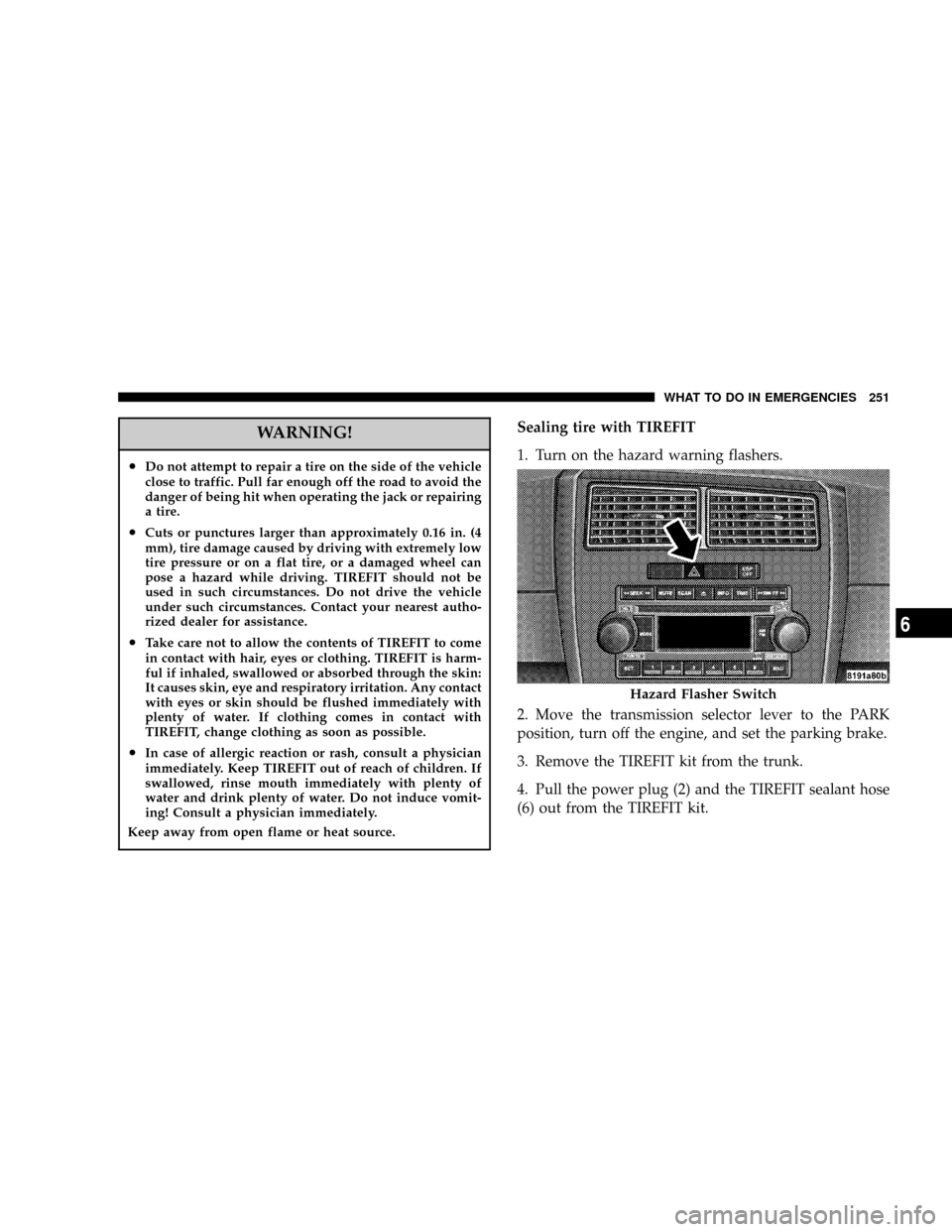
1. Turn on the hazard warning flashers.
2. Move the transmission selector lever to the PARK
position, turn off the engine, and set the parking brake.
3. Remove the TIREFIT kit from the trunk.
4. Pull the power plug (2) and the TIREFIT sealant hose
(6) out from the TIREFIT kit.
Hazard Flasher Switch
WHAT TO DO IN EMERGENCIES 251
6
Page 252 of 350
5. Unscrew the valve cap from the valve on the deflated
tire.
6. Screw the fitting at the end of TIREFIT sealant hose (6)
coming from the sealant bottle (5) onto the tire valve.
7. Insert the power plug (2) into the power point on the
instrument panel.
8. Leave the parking brake set and the transmission
selector lever in PARK and start the engine.
9. Press the switch (3) on the air pump to I (ON). The air
pump should start to inflate the tire and the tire sealant
(white fluid) will flow from the sealant bottle (5) through
the TIREFIT sealant hose (6) and into the tire.
10. Allow the air pump to run for five minutes and then
read the pressure gauge (4). If the tire inflates to 26 psi
(1.8 bar) or greater, proceed to Step 19 of this procedure.
If not, proceed to the following step.
11. Press the air pump switch (3) to 0 (OFF). Then,
disconnect the TIREFIT system from the tire and place it
back in the vehicle.12. Release the parking brake and drive the vehicle back
and forth approximately 30 feet (9.1 m) to distribute the
sealant more evenly within the tire.
13. Turn on the hazard warning flashers.
14. Move the transmission selector lever to the PARK
position, turn off the engine, and set the parking brake.
15. Disconnect the air pump hose (1) from the underside
of the sealant bottle (5) by flipping the hose valve open.
16. Connect the air pump hose valve to the tire valve and
flip the hose valve closed.
17. Leave the parking brake set and the transmission
selector lever in PARK and start the engine.
18. Press the switch (3) on the air pump to I (ON). The air
pump should inflate the tire to at least 26 psi (1.8 bar)
within five minutes. If the tire inflates to this level,
proceed to the following step.NOTE:If a tire pressure of
26 psi (1.8 bar) is not obtained within five minutes, the
tire is too badly damaged. Do not attempt to drive the
vehicle further. Call for assistance.
252 WHAT TO DO IN EMERGENCIES