belt DODGE CHARGER SRT 2007 6.G Owner's Guide
[x] Cancel search | Manufacturer: DODGE, Model Year: 2007, Model line: CHARGER SRT, Model: DODGE CHARGER SRT 2007 6.GPages: 350, PDF Size: 5.51 MB
Page 190 of 350

STARTING PROCEDURES
Before starting your vehicle, adjust your seat, adjust the
inside and outside mirrors, fasten your seat belt, and if
present, instruct all other occupants to buckle their seat
belts.
WARNING!
²Never leave children alone in a vehicle. Leaving
children in a vehicle unattended is dangerous for a
number of reasons. A child or others could be
seriously or fatally injured. Don't leave the keys in
the ignition. A child could operate power windows,
other controls, or move the vehicle.
²Do not leave animals or children inside parked
vehicles in hot weather; interior heat build up may
cause serious injury or death.
²Be sure to turn off the engine if you want to rest or
sleep in your car. Accidents can be caused by inad-
vertently moving the gear selection lever or by
pressing the accelerator pedal. This may cause exces-
sive heat in the exhaust system, resulting in over-
heating and vehicle fire, which may cause serious or
fatal injuries.
Automatic Transmission
The gear selector must be in the NEUTRAL or PARK
position before you can start the engine. Apply the brakes
before shifting into any driving gear.
Normal Starting
Normal Starting of either a cold or a warm engine is
obtained without pumping or depressing the accelerator
pedal. Turn the key to the ªSTARTº position and release
when the engine starts. If the engine has not started
within 3 seconds, slightly depress the accelerator pedal
while continuing to crank. If the engine fails to start
within 15 seconds, turn the key to the ªLOCKº position,
wait 10 to 15 seconds, then repeat the normal starting
procedure.
Extremely Cold Weather (below220ÉF or229ÉC)
To insure reliable starting at these temperatures, use of an
externally powered electric engine block heater (available
from your dealer) is recommended.
190 STARTING AND OPERATING
Page 256 of 350
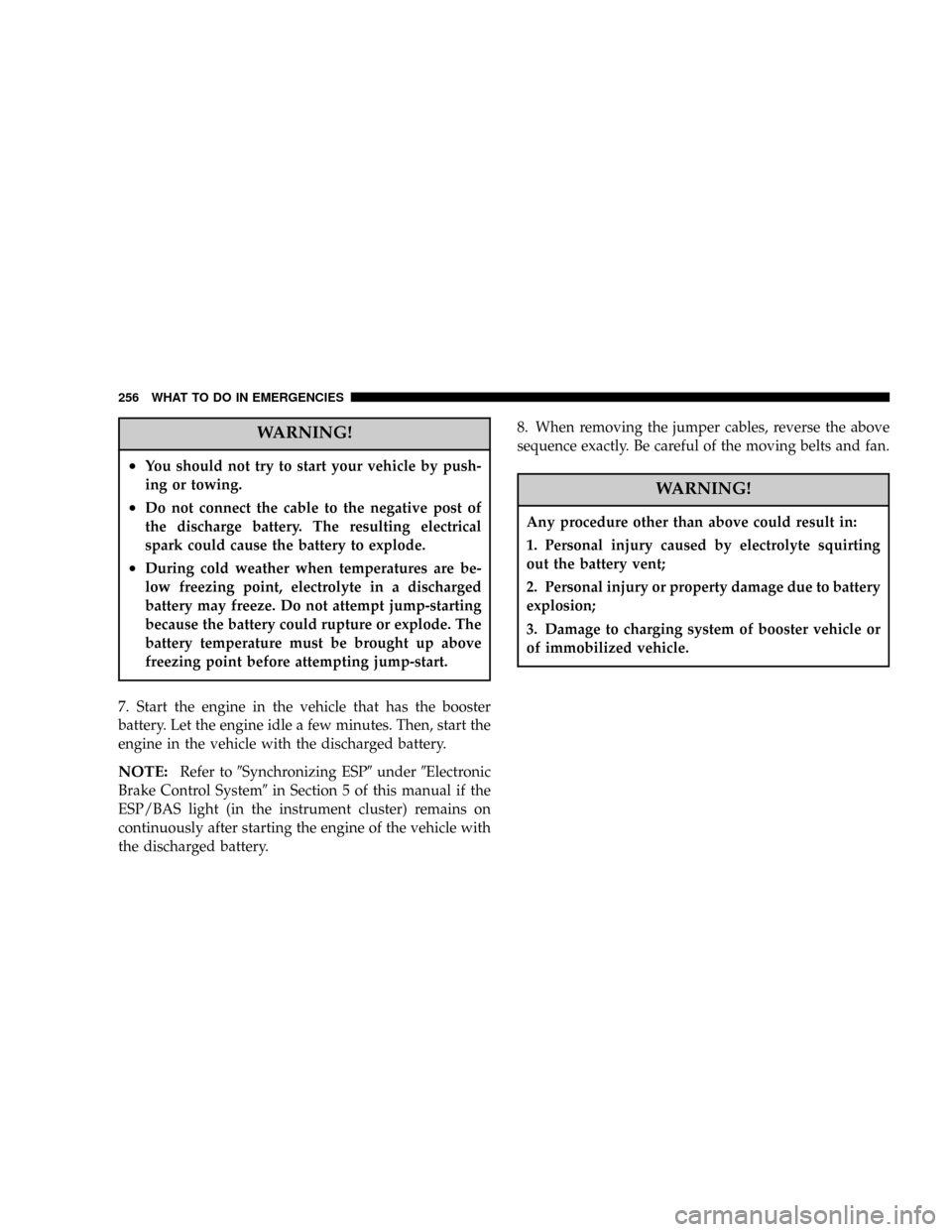
WARNING!
²You should not try to start your vehicle by push-
ing or towing.
²Do not connect the cable to the negative post of
the discharge battery. The resulting electrical
spark could cause the battery to explode.
²During cold weather when temperatures are be-
low freezing point, electrolyte in a discharged
battery may freeze. Do not attempt jump-starting
because the battery could rupture or explode. The
battery temperature must be brought up above
freezing point before attempting jump-start.
7. Start the engine in the vehicle that has the booster
battery. Let the engine idle a few minutes. Then, start the
engine in the vehicle with the discharged battery.
NOTE:Refer to9Synchronizing ESP9under9Electronic
Brake Control System9in Section 5 of this manual if the
ESP/BAS light (in the instrument cluster) remains on
continuously after starting the engine of the vehicle with
the discharged battery.8. When removing the jumper cables, reverse the above
sequence exactly. Be careful of the moving belts and fan.
WARNING!
Any procedure other than above could result in:
1. Personal injury caused by electrolyte squirting
out the battery vent;
2. Personal injury or property damage due to battery
explosion;
3. Damage to charging system of booster vehicle or
of immobilized vehicle.
256 WHAT TO DO IN EMERGENCIES
Page 261 of 350

MAINTAINING YOUR VEHICLE
CONTENTS
m6.1L Engine Compartment...............263
mOnboard Diagnostic System Ð OBD II......264
NLoose Fuel Filler Cap..................264
mEmissions Inspection And Maintenance
Programs
............................265
mReplacement Parts.....................266
mDealer Service........................266
mMaintenance Procedures.................267
NEngine Oil..........................267
NEngine Oil Filter......................270
NDrive Belts Ð Check Condition And Tension . . 270
NSpark Plugs.........................270NEngine Air Cleaner Filter................271
NFuel Filter..........................271
NCatalytic Converter....................271
NMaintenance-Free Battery................273
NAir Conditioner Maintenance.............274
NA/C Air Filter Ð If Equipped............275
NPower Steering Ð Fluid Check............276
NFront & Rear Suspension Ball Joints........276
NSteering Linkage......................276
NBody Lubrication.....................276
NWindshield Wiper Blades................277
7
Page 270 of 350

Disposing of Used Engine Oil And Oil Filters
Care should be taken in disposing of used engine oil and
oil filters from your vehicle. Used oil and oil filters,
indiscriminately discarded, can present a problem to the
environment. Contact your dealer, service station, or
governmental agency for advice on how and where used
oil and oil filters can be safely discarded in your area.
Engine Oil Filter
The engine oil filter should be replaced at every engine
oil change.
Engine Oil Filter Selection
This manufacturer's engines have a full-flow type oil
filter. Use a filter of this type for replacement. The quality
of replacement filters varies considerably. Only high
quality filters should be used to assure most efficient
service. MopartEngine Oil Filters are a high quality oil
filter and are recommended.
Drive Belts Ð Check Condition and Tension
Belt tension is controlled by means of an automatic
tensioner. Therefore, no belt tension adjustments are
required. However, belt and belt tensioner conditionshould be inspected at the specified intervals and re-
placed if required. Improper belt tension can cause belt
slippage and failure. Low generator belt tension can
cause battery failure.
At the mileage indicated in the maintenance schedule,
inspect belt and belt tensioner condition. Inspect belts for
evidence of cuts, cracks, glazing, or frayed cords and
replaced if there is indication of damage, which could
result in belt failure. Also, check belt routing to make sure
there is no interference between the belts and other
engine components. See your authorized dealer for ser-
vice.
Spark Plugs
Spark plugs must fire properly to assure engine perfor-
mance and emission control. New plugs should be in-
stalled at the specified mileage. The entire set should be
replaced if there is any malfunction due to a faulty spark
plug. Malfunctioning spark plugs can damage the cata-
lytic converter. For proper type of replacement spark
plugs, refer to the ªVehicle Emission Control Informa-
tionº label in the engine compartment.
270 MAINTAINING YOUR VEHICLE
Page 274 of 350

WARNING!
²Battery fluid is a corrosive acid solution and can
burn or even blind you. Don't allow battery fluid
to contact your eyes, skin, or clothing. Don't lean
over a battery when attaching clamps. If acid
splashes in eyes or on skin, flush the area imme-
diately with large amounts of water.
²Battery gas is flammable and explosive. Keep
flame or sparks away from the battery. Don't use
a booster battery or any other booster source with
an output greater than 12 volts. Don't allow cable
clamps to touch each other.
²Battery posts, terminals, and related accessories
contain lead and lead compounds. Wash hands
after handling.
²The battery in this vehicle has a vent hose that
should not be disconnected and should only be
replaced with a battery of the same type (vented).
CAUTION!
²It is essential when replacing the cables on the
battery that the positive cable is attached to the
positive post and the negative cable is attached to
the negative post. Battery posts are marked posi-
tive (+) and negative (-) and identified on the
battery case. Cable clamps should be tight on the
terminal posts and free of corrosion.
²If a ªfast chargerº is used while battery is in
vehicle, disconnect both vehicle battery cables
before connecting the charger to battery. Do not
use a ªfast chargerº to provide starting voltage.
Air Conditioner Maintenance
For best possible performance, your air conditioner
should be checked and serviced by an Authorized Dealer
at the start of each warm season. This service should
include cleaning of the condenser fins and a performance
test. Drive belt tension should also be checked at this
time.
274 MAINTAINING YOUR VEHICLE
Page 290 of 350

WARNING!
Do not use volatile solvents for cleaning purposes.
Many are potentially flammable, and if used in
closed areas they may cause respiratory harm.
Cleaning Headlights
Your vehicle has plastic headlights that are lighter and
less susceptible to stone breakage than glass headlights.
Plastic is not as scratch resistant as glass and therefore
different lens cleaning procedures must be followed.
To minimize the possibility of scratching the lenses and
reducing light output, avoid wiping with a dry cloth. To
remove road dirt, wash with a mild soap solution fol-
lowed by rinsing.
Do not use abrasive cleaning components, solvents, steel
wool or other aggressive material to clean the lenses.
Glass Surfaces
All glass surfaces should be cleaned on a regular basis
with MopartGlass Cleaner or any commercial
household-type glass cleaner. Never use an abrasive typecleaner. Use caution when cleaning the inside rear win-
dow equipped with electric defrosters or the right rear
quarter window equipped with the radio antenna. Do
not use scrapers or other sharp instruments, which may
scratch the elements.
When cleaning the rear view mirror, spray cleaner on the
towel or rag that you are using. Do not spray cleaner
directly on the mirror.
Cleaning Plastic Instrument Cluster Lenses
The lenses in front of the instruments in this vehicle are
molded in clear plastic. When cleaning the lenses, care
must be taken to avoid scratching the plastic.
1. Clean with a wet soft rag or micro-fiber towel. A mild
soap solution may be used, but do not use high alcohol
content or abrasive cleaners. If soap is used, wipe clean
with a clean damp rag.
2. Dry with a soft tissue.
Seat Belt Maintenance
Do not bleach, dye, or clean the belts with chemical
solvents or abrasive cleaners. This will weaken the fabric.
Sun damage can also weaken the fabric.
290 MAINTAINING YOUR VEHICLE
Page 291 of 350

If the belts need cleaning, use MopartTotal Clean, a mild
soap solution, or lukewarm water. Do not remove the
belts from the vehicle to wash them.
Replace the belts if they appear frayed or worn or if the
buckles do not work properly.
Cleaning The Center Console Cup Holders
Perform the following steps to clean the center console
cup holders:
²Grab the center of the rubber portion of the cup holder
firmly and lift upward to remove.
²Soak the rubber cup holder liner in a mixture of
medium hot tap water and one teaspoon of mild liquid
dish soap. Let soak for approximately one hour.
²After one hour pull the liner from the water and dip it
back into the water about six times. This will loosen
any remaining debris.
²Rinse the liner thoroughly under warm running water.
Shake the excess water from the liner and dry the
outer surfaces with a clean soft cloth.
²Carefully tuck the front, followed by the rear, then side
edges of the cup holder into the center console.
FUSES (POWER DISTRIBUTION CENTERS)
Fuses (Front Power Distribution Center)
A power distribution center is located in the engine
compartment. This center contains fuses and relays.
Front Power Distribution Center
MAINTAINING YOUR VEHICLE 291
7
Page 315 of 350

Miles 57,000 60,000 63,000 66,000 69,000 72,000
(Kilometers) (95 000) (100 000) (105 000) (110 000) (115 000) (120 000)
Change engine oil and engine oil filter, if not
replaced at 3 months.XXXXX X
Inspect theair cleaner filterand replace if re-
quired.*X XXX X
Replace theair cleaner filter.X
Inspect the front and rear brake linings and
rotors.XX
Check and Inspect the accessory drive belt
and tensioner. Replace if required.X
Check and replace, if necessary, thePCV
valve.*³X
Change the power steering fluid X
Change the automatic transmission fluid and
filter.X
Replace the air conditioning filter. X X
Flush and replace engine coolant at 60 months
if not done at 102,000 miles.X
Rotate the tires. X X X
SCHEDULE ªBº 315
8
M
A
I
N
T
E
N
A
N
C
E
S
C
H
E
D
U
L
E
S
Page 317 of 350

Miles 93,000 96,000 99,000 102,000 105,000
(Kilometers) (155 000) (160 000) (165 000) (170 000) (175 000)
Change engine oil and engine oil filter, if not re-
placed at 3 months.XXXXX
Inspect theair cleaner filterand replace if re-
quired.*XXXX
Replace theair cleaner filter.X*
Inspect the front and rear brake linings and rotors. X
Replace thespark plugs.X
Check and Inspect the accessory drive belt and ten-
sioner. Replace if required.X
Change the rear axle fluid. X
Replace the air conditioning filter. X
Flush and replace engine coolant at 102,000 miles if
not done at 60 months.X
Rotate the tires. X X
SCHEDULE ªBº 317
8
M
A
I
N
T
E
N
A
N
C
E
S
C
H
E
D
U
L
E
S
Page 319 of 350

Miles 123,000 126,000 129,000 132,000 135,000
(Kilometers) (205 000) (210 000) (215 000) (220 000) (225 000)
Change engine oil and engine oil filter, if not re-
placed at 3 months.XXXXX
Inspect theair cleaner filterand replace if re-
quired.*XXXX
Replace theair cleaner filter.X*
Inspect the front and rear brake linings and rotors. X
Check and Inspect the accessory drive belt and ten-
sioner. Replace if required.X
Replace the air conditioning filter. X
Rotate the tires. X X
SCHEDULE ªBº 319
8
M
A
I
N
T
E
N
A
N
C
E
S
C
H
E
D
U
L
E
S