engine DODGE CHARGER SRT 2007 6.G Service Manual
[x] Cancel search | Manufacturer: DODGE, Model Year: 2007, Model line: CHARGER SRT, Model: DODGE CHARGER SRT 2007 6.GPages: 350, PDF Size: 5.51 MB
Page 238 of 350

vehicle. The manufacturer recommends the use of gaso-
lines that meet the WWFC specifications if they are
available.
Reformulated Gasoline
Many areas of the country require the use of cleaner
burning gasoline referred to as ªReformulated Gasolineº.
Reformulated gasolines contain oxygenates, and are spe-
cifically blended to reduce vehicle emissions and im-
prove air quality.
The manufacturer supports the use of reformulated gaso-
lines. Properly blended reformulated gasolines will pro-
vide excellent performance and durability of engine and
fuel system components.
Gasoline/Oxygenate Blends
Some fuel suppliers blend unleaded gasoline with oxy-
genates such as 10% ethanol, MTBE, and ETBE. Oxygen-
ates are required in some areas of the country during the
winter months to reduce carbon monoxide emissions.
Fuels blended with these oxygenates may be used in
your vehicle.
CAUTION!
DO NOT use gasolines containing Methanol or E85
Ethanol. Use of these blends may result in starting
and driveability problems and may damage critical
fuel system components.
Problems that result from using methanol/gasoline or
E85 Ethanol blends are not the responsibility of the
manufacturer. While MTBE is an oxygenate made from
Methanol, it does not have the negative effects of Metha-
nol.
MMT In Gasoline
MMT is a manganese containing metallic additive that is
blended into some gasoline to increase the octane num-
ber. Gasolines blended with MMT offer no performance
advantage beyond gasolines of the same octane number
without MMT. Gasolines blended with MMT have shown
to reduce spark plug life and reduce emission system
performance in some vehicles. The manufacturer recom-
mends using gasolines without MMT. Since the MMT
238 STARTING AND OPERATING
Page 239 of 350

content of gasoline may not be indicated on the pump,
you should ask your gasoline retailer if his/her gasoline
contains MMT.
It is even more important to look for gasolines without
MMT in Canada, because MMT can be used at levels
higher than allowed in the United States. MMT is pro-
hibited in Federal and California reformulated gasolines.
Materials Added to Fuel
All gasoline sold in the United States is required to
contain effective detergent additives. Use of additional
detergents or other additives are not needed under
normal conditions and they would result in additional
cost. Therefore, you should not have to add anything to
the fuel.
Fuel System Cautions
CAUTION!
Follow these guidelines to maintain your vehicle's
performance:
²The use of leaded gas is prohibited by Federal law.
Using leaded gasoline can impair engine performance,
or damage the emission control system.
²An out-of-tune engine, or certain fuel or ignition
malfunctions, can cause the catalytic converter to
overheat. If you notice a pungent burning odor or
some light smoke, your engine may be out-of-tune or
malfunctioning and may require immediate service.
Contact your dealer for service assistance.
²The use of fuel additives, which are now being sold as
octane enhancers, are not recommended. Most of these
products contain high concentrations of methanol.
Fuel system damage or vehicle performance problems
resulting from the use of such fuels or additives are not
the responsibility of the manufacturer.
NOTE:Intentional tampering with emissions control
systems can result in civil penalties being assessed
against you.
STARTING AND OPERATING 239
5
Page 240 of 350

Carbon Monoxide Warnings
WARNING!
Carbon monoxide (CO) in exhaust gases is deadly.
Follow the precautions below to prevent carbon
monoxide poisoning:
²Do not inhale exhaust gases. They contain carbon
monoxide, a colorless and odorless gas, which can kill.
Never run the engine in a closed area, such as a
garage, and never sit in a parked vehicle with the
engine running for an extended period. If the vehicle is
stopped in an open area with the engine running for
more than a short period, adjust the ventilation system
to force fresh, outside air into the vehicle.
²Guard against carbon monoxide with proper mainte-
nance. Have the exhaust system inspected every time
the vehicle is raised. Have any abnormal conditions
repaired promptly. Until repaired, drive with all side
windows fully open.
²Keep the trunk closed when driving your vehicle to
prevent carbon monoxide and other poisonous ex-
haust gases from entering the vehicle.
ADDING FUEL
Fuel Filler Cap (Gas Cap)
The gas cap is located behind the fuel filler door on the
left side of the vehicle. Push in on the left side (near the
edge) of the fuel filler door to access the fuel filler cap. If
the gas cap is lost or damaged, be sure the replacement
cap is for use with this vehicle.
240 STARTING AND OPERATING
Page 242 of 350

CAUTION!
²Damage to the fuel system or emission control
system could result from using an improper fuel
tank filler tube cap (gas cap).
²A poorly fitting gas cap could let impurities into
the fuel system.
²A poorly fitting gas cap may cause the Malfunc-
tion Indicator Light to turn on.
²To avoid fuel spillage and overfilling, do not ªtop
offº the fuel tank after filling. When the fuel
nozzle ªclicksº or shuts off, the fuel tank is full.
WARNING!
²Never have any smoking materials lit in or near
the vehicle when the gas cap is removed or the
tank filled.
²Never add fuel to the vehicle when the engine is
running.
²A fire may result if gasoline is pumped into a
portable container that is inside of a vehicle. You
could be burned. Always place gas containers on
the ground while filling.
NOTE:
²
Tighten the gas cap until you hear a ªclickingº sound.
This is an indication that the gas cap is tightened
properly. The Malfunction Indicator Light in the in-
strument cluster may turn on if the gas cap is not
secured properly. Make sure that the gas cap is tight-
ened each time the vehicle is refueled.
²When the fuel nozzle ªclicksº or shuts off, the fuel
tank is full.
242 STARTING AND OPERATING
Page 247 of 350

WHAT TO DO IN EMERGENCIES
CONTENTS
mHazard Warning Flasher.................248
mIf Your Engine Overheats................248
mTIREFIT Tire Repair....................249
mJump-Starting Procedures................254
mFreeing A Stuck Vehicle.................257
mTowing A Disabled Vehicle...............258NWithout The Ignition Key...............258
NTowing This Vehicle Behind Another Vehicle
(Flat Towing With All Four Wheels On The
Ground)............................258
NTowing This Vehicle Behind Another Vehicle
With A Tow Dolly.....................259
6
Page 248 of 350

HAZARD WARNING FLASHER
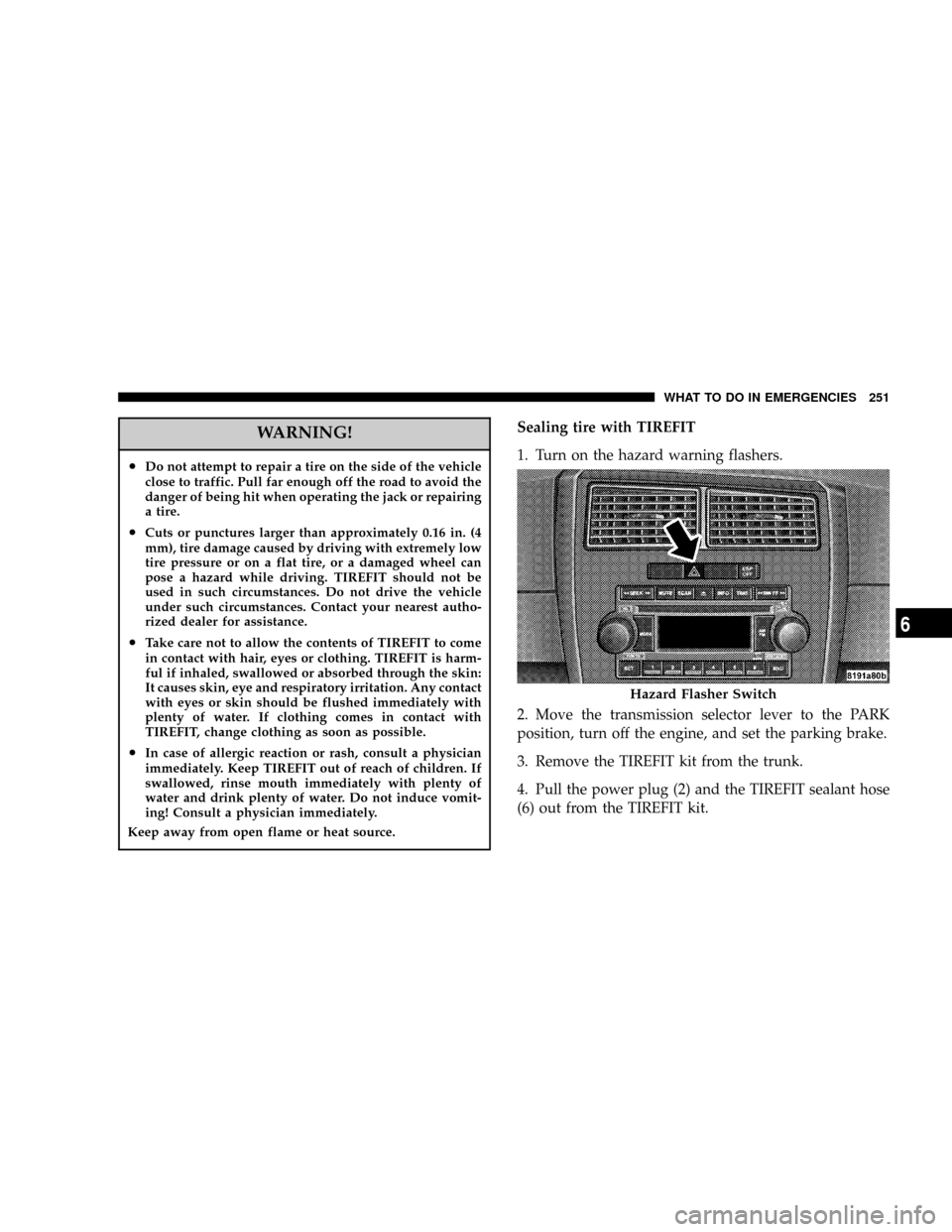
The hazard flasher switch is located in the center of the
instrument panel below the center air outlets.
To engage the Hazard Warning Flashers, depress the
switch on the instrument panel. When the Hazard Warn-
ing Switch is activated, all directional turn signals will
flash on and off to warn oncoming traffic of an emer-
gency. Push the switch a second time to turn off the
flashers.
This is an emergency warning system and it should notbe used when the vehicle is in motion. Use it when your
vehicle is disabled and it is creating a safety hazard for
other motorists.
When you must leave the vehicle to seek assistance, the
Hazard Warning Flashers will continue to operate even
though the ignition switch is OFF.
NOTE:With extended use, the Hazard Warning Flash-
ers may wear down your battery.
IF YOUR ENGINE OVERHEATS
In any of the following situations, you can reduce the
potential for overheating by taking the appropriate ac-
tion.
²On the highways Ð Slow down.
²In city traffic Ð While stopped, put transmission in
neutral, but do not increase engine idle speed.
NOTE:There are steps that you can take to slow down
an impending overheat condition. If your air conditioner
is on, turn it off. The air conditioning system adds heat to
the engine cooling system and turning off the A/C
removes this heat. You can also turn the Temperature
Hazard Flasher Switch
248 WHAT TO DO IN EMERGENCIES
Page 249 of 350

control to maximum heat, the Mode control to floor, and
the fan control to HI. This allows the heater core to act as
a supplement to the radiator and aids in removing heat
from the engine cooling system.
CAUTION!
Driving with a hot cooling system could damage
your vehicle. If temperature gauge reads 240ÉF
(116ÉC) or greater pull over and stop the vehicle. Idle
the vehicle with the air conditioner turned off until
the pointer drops back into the normal range 200±
230ÉF (93±110ÉC). If the pointer remains at 240ÉF
(116ÉC) or greater and you hear a chime, turn the
engine off immediately, and call for service.
WARNING!
A hot engine cooling system is dangerous. You or
others could be badly burned by steam or boiling
coolant. You may want to call a service center if your
vehicle overheats. If you decide to look under the
hood yourself, see Section 7, Maintenance, of this
manual. Follow the warnings under the Cooling
System Pressure Cap paragraph.
TIREFIT TIRE REPAIR
Small punctures, particularly those in the tread, can be
sealed with TIREFIT. Foreign objects (e.g., screws or
nails) should not be removed from the tire. TIREFIT can
be used in outside temperatures down to approximately
-4ÉF (-20ÉC).
WHAT TO DO IN EMERGENCIES 249
6
Page 251 of 350
WARNING!
²Do not attempt to repair a tire on the side of the vehicle
close to traffic. Pull far enough off the road to avoid the
danger of being hit when operating the jack or repairing
a tire.
²Cuts or punctures larger than approximately 0.16 in. (4
mm), tire damage caused by driving with extremely low
tire pressure or on a flat tire, or a damaged wheel can
pose a hazard while driving. TIREFIT should not be
used in such circumstances. Do not drive the vehicle
under such circumstances. Contact your nearest autho-
rized dealer for assistance.
²Take care not to allow the contents of TIREFIT to come
in contact with hair, eyes or clothing. TIREFIT is harm-
ful if inhaled, swallowed or absorbed through the skin:
It causes skin, eye and respiratory irritation. Any contact
with eyes or skin should be flushed immediately with
plenty of water. If clothing comes in contact with
TIREFIT, change clothing as soon as possible.
²In case of allergic reaction or rash, consult a physician
immediately. Keep TIREFIT out of reach of children. If
swallowed, rinse mouth immediately with plenty of
water and drink plenty of water. Do not induce vomit-
ing! Consult a physician immediately.
Keep away from open flame or heat source.
Sealing tire with TIREFIT
1. Turn on the hazard warning flashers.
2. Move the transmission selector lever to the PARK
position, turn off the engine, and set the parking brake.
3. Remove the TIREFIT kit from the trunk.
4. Pull the power plug (2) and the TIREFIT sealant hose
(6) out from the TIREFIT kit.
Hazard Flasher Switch
WHAT TO DO IN EMERGENCIES 251
6
Page 252 of 350

5. Unscrew the valve cap from the valve on the deflated
tire.
6. Screw the fitting at the end of TIREFIT sealant hose (6)
coming from the sealant bottle (5) onto the tire valve.
7. Insert the power plug (2) into the power point on the
instrument panel.
8. Leave the parking brake set and the transmission
selector lever in PARK and start the engine.
9. Press the switch (3) on the air pump to I (ON). The air
pump should start to inflate the tire and the tire sealant
(white fluid) will flow from the sealant bottle (5) through
the TIREFIT sealant hose (6) and into the tire.
10. Allow the air pump to run for five minutes and then
read the pressure gauge (4). If the tire inflates to 26 psi
(1.8 bar) or greater, proceed to Step 19 of this procedure.
If not, proceed to the following step.
11. Press the air pump switch (3) to 0 (OFF). Then,
disconnect the TIREFIT system from the tire and place it
back in the vehicle.12. Release the parking brake and drive the vehicle back
and forth approximately 30 feet (9.1 m) to distribute the
sealant more evenly within the tire.
13. Turn on the hazard warning flashers.
14. Move the transmission selector lever to the PARK
position, turn off the engine, and set the parking brake.
15. Disconnect the air pump hose (1) from the underside
of the sealant bottle (5) by flipping the hose valve open.
16. Connect the air pump hose valve to the tire valve and
flip the hose valve closed.
17. Leave the parking brake set and the transmission
selector lever in PARK and start the engine.
18. Press the switch (3) on the air pump to I (ON). The air
pump should inflate the tire to at least 26 psi (1.8 bar)
within five minutes. If the tire inflates to this level,
proceed to the following step.NOTE:If a tire pressure of
26 psi (1.8 bar) is not obtained within five minutes, the
tire is too badly damaged. Do not attempt to drive the
vehicle further. Call for assistance.
252 WHAT TO DO IN EMERGENCIES
Page 253 of 350

19. With a tire pressure of no less than 26 psi (1.8 bar)
press the air pump switch (3) to 0 (OFF) and turn off the
engine. Then, disconnect the TIREFIT system from the
tire and place it back in the vehicle.
20. Release the parking brake and drive the vehicle for
approximately 10 minutes to ensure optimum distribu-
tion of the tire sealant within the tire.
21. Turn on the hazard warning flashers.
22. Move the transmission selector lever to the PARK
position, turn off the engine, and set the parking brake.
23. Disconnect the air pump hose (1) from the underside
of the sealant bottle (5) by flipping the hose valve open.
24. Connect the air pump hose valve to the tire valve and
flip the hose valve closed.
25. Check the pressure in the tire by reading the pressure
gauge (4). If the pressure is 19 psi (1.3 bar) or greater,
proceed to the following step.NOTE:If the pressure is
less than 19 psi (1.3 bar), the tire is too badly damaged.
Do not attempt to drive the vehicle further. Call for
assistance.26. Leave the parking brake set and the transmission
selector lever in PARK and start the engine.
27. Inflate the tire to the pressure indicated on the tire
pressure label on the driver-side latch pillar by pressing
the switch (3) on the air pump to I (ON) and watching the
pressure gauge. When the tire pressure is set to the
pressure indicated on the tire pressure label, press the air
pump switch (3) to 0 (OFF) and turn off the engine.
28. Disconnect the TIREFIT system from the tire and
reinstall the valve cap.
29. Place the sealant kit back in the trunk of the vehicle.
Replace the sealant bottle at your nearest authorized
MOPARtparts dealership.
30. Have the tire inspected at the earliest opportunity at
an authorized dealer or tire service center.
NOTE:
²
If a pressure of at least 19 psi (1.3 bar) cannot be
maintained in the tire, the tire is too badly damaged.
Do not attempt to drive the vehicle further, and call for
assistance.
WHAT TO DO IN EMERGENCIES 253
6