air filter DODGE CHARGER SRT 2007 6.G Owners Manual
[x] Cancel search | Manufacturer: DODGE, Model Year: 2007, Model line: CHARGER SRT, Model: DODGE CHARGER SRT 2007 6.GPages: 350, PDF Size: 5.51 MB
Page 183 of 350

system lubrication to minimize the possibility of com-
pressor damage when the system is started again.
Window Fogging
Interior fogging on the windshield can be quickly re-
moved by turning the mode selector to Defrost. The
Defrost/Floor mode can be used to maintain a clear
windshield and provide sufficient heating. If side win-
dow fogging becomes a problem increase blower speed.
Vehicle windows tend to fog on the inside in mild but
rainy or humid weather.
NOTE:Recirculate without A/C should not be used for
long periods as fogging may occur.
Outside Air Intake
Make sure the air intake, located directly in front of the
windshield, is free of obstructions such as leaves. Leaves
collected in the air intake may reduce airflow, and if they
enter the plenum, they could plug the water drains. In
winter months, make sure the air intake is clear of ice,
slush, and snow.
A/C Air Filter Ð If Equipped
The climate control system filters outside air containing
dust, pollen and some odors. Strong odors cannot be
totally filtered out. Refer to ªMaintenance Proceduresº in
Section 7 of this manual for filter replacement instruc-
tions.
UNDERSTANDING YOUR INSTRUMENT PANEL 183
4
Page 261 of 350
MAINTAINING YOUR VEHICLE
CONTENTS
m6.1L Engine Compartment...............263
mOnboard Diagnostic System Ð OBD II......264
NLoose Fuel Filler Cap..................264
mEmissions Inspection And Maintenance
Programs
............................265
mReplacement Parts.....................266
mDealer Service........................266
mMaintenance Procedures.................267
NEngine Oil..........................267
NEngine Oil Filter......................270
NDrive Belts Ð Check Condition And Tension . . 270
NSpark Plugs.........................270NEngine Air Cleaner Filter................271
NFuel Filter..........................271
NCatalytic Converter....................271
NMaintenance-Free Battery................273
NAir Conditioner Maintenance.............274
NA/C Air Filter Ð If Equipped............275
NPower Steering Ð Fluid Check............276
NFront & Rear Suspension Ball Joints........276
NSteering Linkage......................276
NBody Lubrication.....................276
NWindshield Wiper Blades................277
7
Page 271 of 350
Engine Air Cleaner Filter
For normal driving conditions, inspect and replace the
engine air cleaner filter at the intervals shown on Sched-
ule ªA.º For vehicles driven frequently in dusty or under
severe conditions, inspect and replace the engine air
cleaner filter at the intervals shown on Schedule ªB.º
WARNING!
The air induction system (air cleaner, hoses, etc) can
provide a measure of protection in the case of engine
backfire. Do not remove the air induction system (air
cleaner, hoses, etc) unless such removal is necessary
for repair or maintenance. Make sure that no one is
near the engine compartment before starting the
vehicle with the air induction system (air cleaner,
hoses, etc) removed. Failure to do so can result in
serious personal injury.
Fuel Filter
A plugged fuel filter can cause stalling, limit the speed at
which a vehicle can be driven or cause hard starting.
Should an excessive amount of dirt accumulate in the
fuel tank, filter replacement may be necessary. See your
authorized dealer for service.
Catalytic Converter
The catalytic converter requires the use of unleaded fuel
only. Leaded gasoline will destroy the effectiveness of the
catalyst as an emission control device.
Under normal operating conditions, the catalytic con-
verter will not require maintenance. However, it is im-
portant to keep the engine properly tuned to assure
proper catalyst operation and prevent possible catalyst
damage.
MAINTAINING YOUR VEHICLE 271
7
Page 275 of 350
WARNING!
²Use only refrigerants and compressor lubricants
approved by the manufacturer for your air condi-
tioning system. Some unapproved refrigerants are
flammable and can explode, injuring you. Other
unapproved refrigerants or lubricants can cause
the system to fail, requiring costly repairs. Refer
to Section 3 of the Warranty Information book for
further warranty information.
²The air conditioning system contains refrigerant
under high pressure. To avoid risk of personal
injury or damage to the system, adding refrigerant
or any repair requiring lines to be disconnected
should be done by an experienced technician.
Refrigerant Recovery and Recycling
R-134a Air Conditioning Refrigerant is a hydrofluorocar-
bon (HFC) that is endorsed by the Environmental Pro-
tection Agency and is an ozone-saving product. How-
ever, the manufacturer recommends that air conditioning
service be performed by dealers or other service facilities
using recovery and recycling equipment.
NOTE:Use only manufacturer approved A/C System
Sealers, Stop Leak Products, Seal Conditioners, Compres-
sor Oil, and Refrigerants.
A/C Air Filter Ð If Equipped
The filter is located in the fresh air inlet under the hood,
behind a removable panel in the cowl on the passenger
side of the vehicle, next to the windshield wipers. When
installing a new filter, ensure its proper orientation. To
replace the filter, remove the access door in the cowl
screen by pressing the retaining clips. Slide the lid on the
filter adapter forward and down and remove used filter.
Install new filter with arrows pointing in the direction of
airflow, which is toward the rear of the vehicle (text and
arrows on the filter indicate this).
MAINTAINING YOUR VEHICLE 275
7
Page 276 of 350
Refer to the ªMaintenance Scheduleº in this manual for
the recommended air conditioning filter replacement
intervals.
Power Steering Ð Fluid Check
Checking the power steering fluid level at a defined
service interval is not required. The fluid should only be
checked if a leak is suspected, abnormal noises are
apparent, and/or the system is not functioning as antici-
pated. Coordinate inspection efforts through a certified
DaimlerChrysler Dealership.
WARNING!
Fluid level should be checked on a level surface and
with the engine off to prevent injury from moving
parts and to insure accurate fluid level reading. Do
not overfill. Use only manufacturer's recommended
power steering fluid.
If necessary, add fluid to restore to the proper indicated
level. With a clean cloth, wipe any spilled fluid from allsurfaces. Refer to ªFluids, Lubricants, and Genuine
Partsº in this section for the correct fluid type.
Front & Rear Suspension Ball Joints
The suspension ball joints should be inspected for exter-
nal leakage or damage when other maintenance is per-
formed.
Steering Linkage
The tie rod end ball joints should be inspected for
external leakage or damage when other maintenance is
performed.
Body Lubrication
Locks and all body pivot points, including seat tracks,
door hinges, trunk hinges, and hood hinges, should be
lubricated periodically to assure quiet, easy operation
and to protect against rust and wear. Prior to the appli-
cation of any lubricant, the parts concerned should be
wiped clean to remove dust and grit; after lubricating
excess oil and grease should be removed. Particular
attention should also be given to hood latching compo-
nents to insure proper function. When performing other
underhood services, the hood latch, release mechanism,
and safety catch should be cleaned and lubricated.
276 MAINTAINING YOUR VEHICLE
Page 287 of 350

Severe Usage (fluid and filter) Ð Refer to Maintenance
Schedule ªBº
Severe Usage is defined as:
²Police, taxi, limousine, commercial type operation, or
trailer towing where the vehicle is drivenregularlyfor
more than 45 minutes of continuous operation.
If the transmission is disassembled for any reason, the
fluid and filter should be changed.
Special Additives
Automatic Transmission Fluid (ATF) is an engineered
product and its performance may be impaired by supple-
mental additives. Therefore, do not add any fluid addi-
tives to the transmission. The only exception to this
policy is the use of special dyes to aid in detecting fluid
leaks. In addition, avoid using transmission sealers as
they may adversely affect seals.
Front And Rear Wheel Bearings
Front and rear wheel bearings are permanently sealed.
No regular maintenance is required for these compo-
nents.
Appearance Care and Protection from Corrosion
Protection of Body and Paint from Corrosion
Vehicle body care requirements vary according to geo-
graphic locations and usage. Chemicals that make roads
passable in snow and ice, and chemicals that are sprayed
on trees and road surfaces during other seasons, are
highly corrosive to the metal in your vehicle. Outside
parking, which exposes your vehicle to airborne contami-
nants, road surfaces on which the vehicle is operated,
extreme hot or cold weather and other extreme condi-
tions will have an adverse effect on paint, metal trim, and
underbody protection.
The following maintenance recommendations will enable
you to obtain maximum benefit from the corrosion
resistance built into your vehicle.
What Causes Corrosion?
Corrosion is the result of deterioration or removal of
paint and protective coatings from your vehicle.
The most common causes are:
²Road salt, dirt, and moisture accumulation.
MAINTAINING YOUR VEHICLE 287
7
Page 299 of 350

BULB REPLACEMENT
Low Beam Headlight, High Beam Headlight,
Park/Turn Light, and Front Side Marker Light
1. Open the hood.
NOTE:Removal of the air cleaner filter housing may be
necessary prior to replacing bulbs in the headlight assem-
bly on the driver side of the vehicle.
2. Twist the appropriate bulb and socket assembly
counter-clockwise, and then pull it out of the headlight
assembly.
3. Pull the bulb out of the socket assembly.
4. Push the replacement bulb into the socket assembly.
5. Reinstall the bulb and socket assembly into the head-
light assembly, and then turn it clockwise.
1 Ð High Beam Headlight Bulb
2 Ð Low Beam Headlight BulbMAINTAINING YOUR VEHICLE 2997
Page 308 of 350
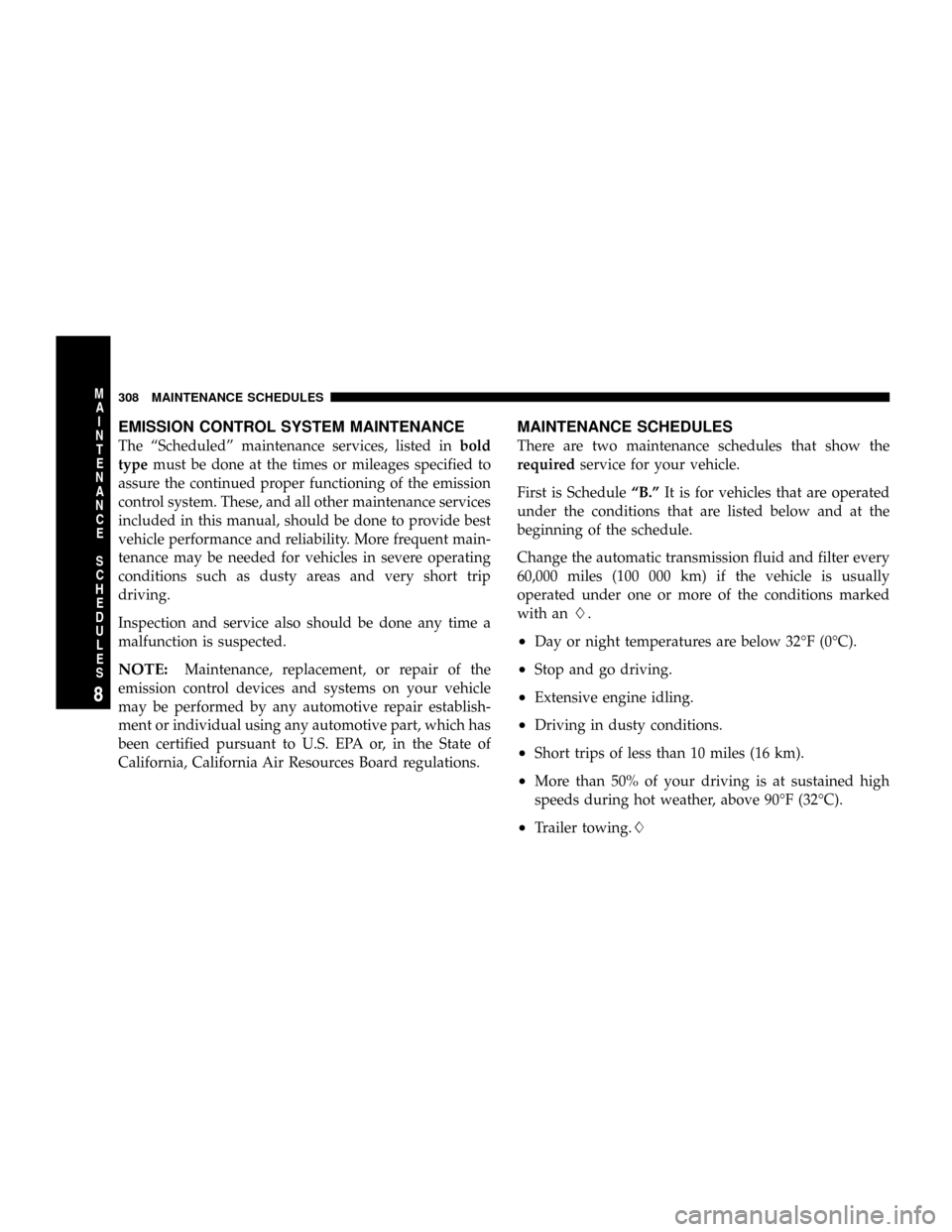
EMISSION CONTROL SYSTEM MAINTENANCE
The ªScheduledº maintenance services, listed inbold
typemust be done at the times or mileages specified to
assure the continued proper functioning of the emission
control system. These, and all other maintenance services
included in this manual, should be done to provide best
vehicle performance and reliability. More frequent main-
tenance may be needed for vehicles in severe operating
conditions such as dusty areas and very short trip
driving.
Inspection and service also should be done any time a
malfunction is suspected.
NOTE:Maintenance, replacement, or repair of the
emission control devices and systems on your vehicle
may be performed by any automotive repair establish-
ment or individual using any automotive part, which has
been certified pursuant to U.S. EPA or, in the State of
California, California Air Resources Board regulations.
MAINTENANCE SCHEDULES
There are two maintenance schedules that show the
requiredservice for your vehicle.
First is ScheduleªB.ºIt is for vehicles that are operated
under the conditions that are listed below and at the
beginning of the schedule.
Change the automatic transmission fluid and filter every
60,000 miles (100 000 km) if the vehicle is usually
operated under one or more of the conditions marked
with anL.
²Day or night temperatures are below 32ÉF (0ÉC).
²Stop and go driving.
²Extensive engine idling.
²Driving in dusty conditions.
²Short trips of less than 10 miles (16 km).
²More than 50% of your driving is at sustained high
speeds during hot weather, above 90ÉF (32ÉC).
²Trailer towing.L
308 MAINTENANCE SCHEDULES
8
M
A
I
N
T
E
N
A
N
C
E
S
C
H
E
D
U
L
E
S
Page 312 of 350
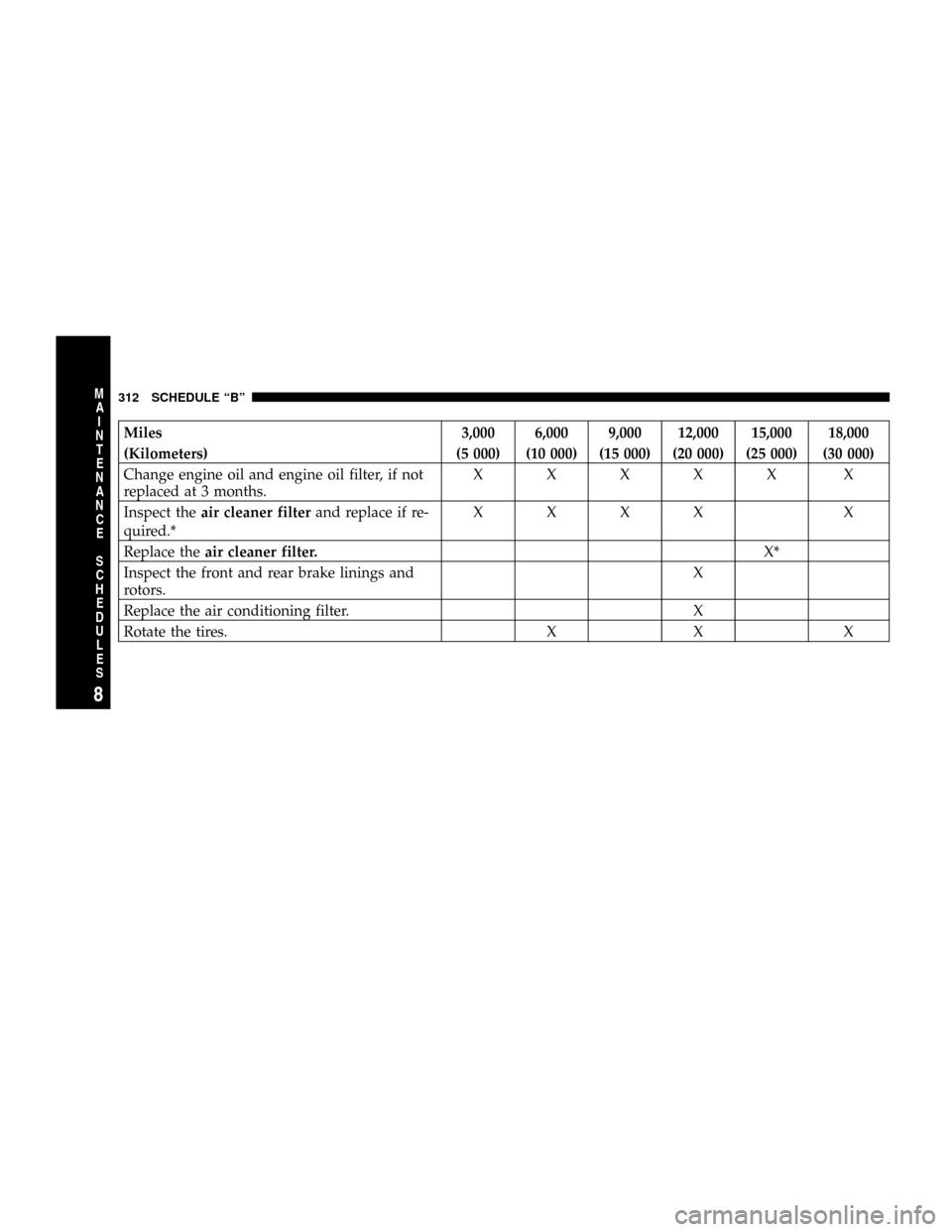
Miles 3,000 6,000 9,000 12,000 15,000 18,000
(Kilometers) (5 000) (10 000) (15 000) (20 000) (25 000) (30 000)
Change engine oil and engine oil filter, if not
replaced at 3 months.XXXXX X
Inspect theair cleaner filterand replace if re-
quired.*XXXX X
Replace theair cleaner filter.X*
Inspect the front and rear brake linings and
rotors.X
Replace the air conditioning filter. X
Rotate the tires. X X X
312 SCHEDULE ªBº
8
M
A
I
N
T
E
N
A
N
C
E
S
C
H
E
D
U
L
E
S
Page 313 of 350
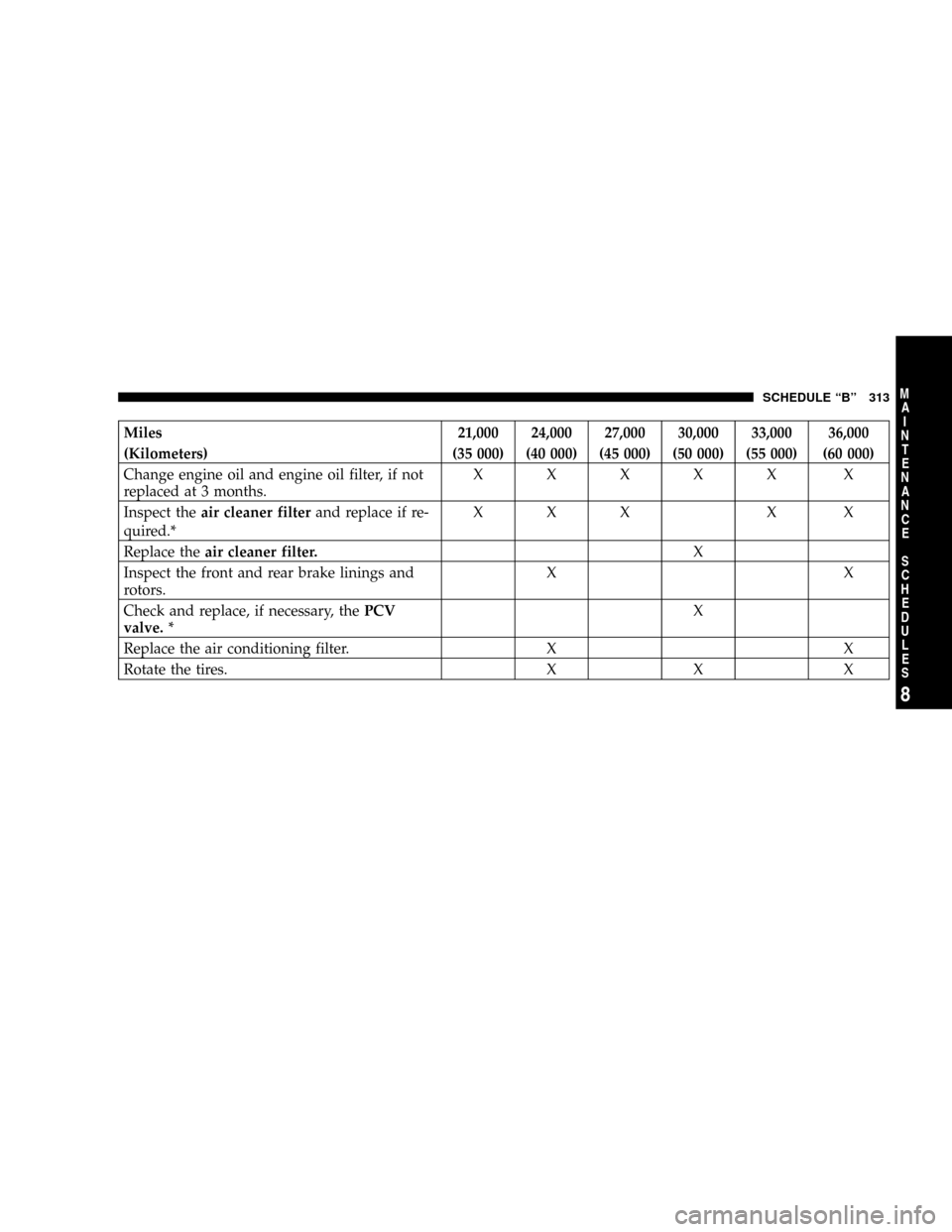
Miles 21,000 24,000 27,000 30,000 33,000 36,000
(Kilometers) (35 000) (40 000) (45 000) (50 000) (55 000) (60 000)
Change engine oil and engine oil filter, if not
replaced at 3 months.XXXXX X
Inspect theair cleaner filterand replace if re-
quired.*XXX X X
Replace theair cleaner filter.X
Inspect the front and rear brake linings and
rotors.XX
Check and replace, if necessary, thePCV
valve.*X
Replace the air conditioning filter. X X
Rotate the tires. X X X
SCHEDULE ªBº 313
8
M
A
I
N
T
E
N
A
N
C
E
S
C
H
E
D
U
L
E
S