check engine DODGE CHARGER SRT 2008 6.G Owner's Manual
[x] Cancel search | Manufacturer: DODGE, Model Year: 2008, Model line: CHARGER SRT, Model: DODGE CHARGER SRT 2008 6.GPages: 442, PDF Size: 5.32 MB
Page 364 of 442
filter. Install the new filter with arrows pointing in the
direction of airflow, which is toward the rear of the
vehicle (text and arrows on the filter indicate this).
Refer to the Maintenance Schedule in Section 8 for the
recommended air conditioning filter replacement inter-
vals.
Power Steering — Fluid Check
Checking the power steering fluid level at a defined
service interval is not required. The fluid should only be
checked if a leak is suspected, abnormal noises are
apparent, and/or the system is not functioning as antici-
pated. Coordinate inspection efforts through an autho-
rized dealer. No chemical flushes should be used in any
power steering system; only the approved lubricant may
be used.
WARNING!
Fluid level should be checked on a level surface and
with the engine OFF to prevent injury from moving
parts and to ensure accurate fluid level reading. Do
not overfill. Use only manufacturer’s recommended
power steering fluid.
If necessary, add fluid to restore to the proper indicated
level. With a clean cloth, wipe any spilled fluid from all
surfaces. Refer to “Fluids, Lubricants, and Genuine
Parts” in this section for the correct fluid type.
Front and Rear Suspension Ball Joints
The suspension ball joints should be inspected for exter-
nal leakage or damage when other maintenance is per-
formed.
362 MAINTAINING YOUR VEHICLE
Page 366 of 442
Windshield Washers
The windshield washer fluid reservoir is located in the
front of the engine compartment. Be sure to check the
fluid level in the reservoir at regular intervals. Fill the
reservoir with windshield washer solvent (not radiator
antifreeze) and operate the system for a few seconds to
flush out the residual water.
When refilling the washer fluid reservoir, apply some
washer fluid to a cloth or towel and wipe the wiper
blades clean. This will help blade performance.
To prevent freeze-up of your windshield washer system
in cold weather, select a solution or mixture that meets or
exceeds the temperature range of your climate. This
rating information can be found on most washer fluid
containers.
The fluid reservoir will hold nearly 1 gal (4 l) of washer
fluid when the message “Low Washer Fluid” appears in
the Electronic Vehicle Information Center (EVIC).WARNING!
Commercially available windshield washer solvents
are flammable. They could ignite and burn you. Care
must be exercised when filling or working around
the washer solution.
Exhaust System
The best protection against carbon monoxide entry into
the vehicle body is a properly maintained engine exhaust
system.
Whenever a change is noticed in the sound of the exhaust
system, when exhaust fumes can be detected inside the
vehicle, or when the underside or rear of the vehicle is
damaged, have a competent mechanic inspect the com-
plete exhaust system and adjacent body areas for broken,
damaged, deteriorated, or mispositioned parts. Open
seams or loose connections could permit exhaust fumes
364 MAINTAINING YOUR VEHICLE
Page 368 of 442
Coolant Checks
Check engine coolant (antifreeze) protection every 12
months (before the onset of freezing weather, where
applicable). If coolant is dirty or rusty in appearance, the
system should be drained, flushed and refilled with fresh
coolant. Check the front of the A/C condenser for any
accumulation of bugs, leaves, etc. If dirty, clean by gently
spraying water from a garden hose vertically down the
face of the condenser.
Check the coolant recovery bottle tubing for brittle rub-
ber, cracking, tears, cuts, and tightness of the connection
at the bottle and radiator. Inspect the entire system for
leaks.
With the engine at normal operating temperature (but
not running), check the cooling system pressure cap for
proper vacuum sealing by draining a small amount of
coolant from the radiator drain cock. If the cap is sealing
properly, the engine coolant (antifreeze) will begin todrain from the coolant recovery bottle. DO NOT RE-
MOVE THE COOLANT PRESSURE CAP WHEN THE
COOLING SYSTEM IS HOT.
Cooling System — Drain, Flush, and Refill
The system should be drained, flushed, and refilled at the
intervals shown in the Maintenance Schedule in Section
8.
If the solution is dirty or contains a considerable amount
of sediment, clean and flush with a reliable cooling
system cleaner. Follow with a thorough rinsing to remove
all deposits and chemicals. Properly dispose of old
antifreeze solution.
Selection of Coolant
Use only the manufacturer’s recommended coolant. Re-
fer to “Fluids, Lubricants, and Genuine Parts” in this
section for the correct coolant type.
366 MAINTAINING YOUR VEHICLE
Page 371 of 442
Disposal of Used Coolant
Used ethylene glycol-based engine coolant is a regulated
substance requiring proper disposal. Check with your
local authorities to determine the disposal rules for your
community. To prevent ingestion by animals or children,
do not store ethylene glycol-based engine coolant in open
containers or allow it to remain in puddles on the
ground. If ingested by a child, contact a physician
immediately. Clean up any ground spills immediately.
Coolant Level
The coolant bottle provides a quick visual method for
determining that the coolant level is adequate. With the
engine OFF and cold, the level of the coolant in the bottle
should be between the ranges indicated on the bottle.
The radiator normally remains completely full, so there is
no need to remove the radiator cap unless checking for
coolant freeze point or replacing coolant. Advise yourservice attendant of this. As long as the engine operating
temperature is satisfactory, the coolant bottle need only
be checked once a month.
When additional coolant is needed to maintain the
proper level, it should be added to the coolant bottle. Do
not overfill.
Points to Remember
NOTE:When the vehicle is stopped after a few miles
(kilometers) of operation, you may observe vapor coming
from the front of the engine compartment. This is nor-
mally a result of moisture from rain, snow, or high
humidity accumulating on the radiator and being vapor-
ized when the thermostat opens, allowing hot coolant to
enter the radiator.
If an examination of your engine compartment shows no
evidence of radiator or hose leaks, the vehicle may be
safely driven. The vapor will soon dissipate.
MAINTAINING YOUR VEHICLE 369
7
Page 372 of 442
•Do not overfill the coolant recovery bottle.
•Check coolant freeze point in the radiator and in the
coolant recovery bottle. If antifreeze needs to be
added, contents of coolant recovery bottle must also be
protected against freezing.
•If frequent coolant additions are required, or if the
level in the coolant recovery bottle does not drop when
the engine cools, the cooling system should be pres-
sure tested for leaks.
•Maintain coolant concentration at 50% HOAT engine
coolant (minimum) and distilled water for proper
corrosion protection of your engine, which contains
aluminum components.
•Make sure that the radiator and coolant recovery
bottle overflow hoses are not kinked or obstructed.
•Keep the front of the radiator clean. If your vehicle is
equipped with air conditioning, keep the front of the
condenser clean, also.
•Do not change the thermostat for Summer or Winter
operation. If replacement is ever necessary, install
ONLY the correct type thermostat. Other designs may
result in unsatisfactory coolant performance, poor gas
mileage, and increased emissions.
Hoses and Vacuum/Vapor Harnesses
Inspect surfaces of hoses and nylon tubing for evidence
of heat and mechanical damage. Hard or soft spots,
brittle rubber, cracking, tears, cuts, abrasions, and exces-
sive swelling indicate deterioration of the rubber.
Pay particular attention to those hoses nearest to high
heat sources such as the exhaust manifold. Inspect hose
routing to be sure hoses do not come in contact with any
heat source or moving component, which may cause heat
damage or mechanical wear.
370 MAINTAINING YOUR VEHICLE
Page 375 of 442
Master Cylinder - Brake Fluid Level Check
Check the fluid level in the master cylinder immediately
if the brake system warning light indicates system fail-
ure.
Check the fluid level in the master cylinder when per-
forming underhood services.
Clean the top of the master cylinder area before removing
the cap. Add fluid to bring the level up to the top of the
“FULL” mark on the side of the master cylinder reservoir.
Overfilling of fluid is not recommended because it may
cause leaking in the system.
Add enough fluid to bring the level up to the require-
ments described on the brake fluid reservoir. With disc
brakes, fluid level can be expected to fall as the brake
pads wear. However, low fluid level may be caused by a
leak and a checkup may be needed.Use only manufacturer’s recommended brake fluid. Re-
fer to “Fluids, Lubricants, and Genuine Parts” in this
section for the correct fluid type.
WARNING!
•Overfilling the brake fluid reservoir can result in
spilling brake fluid on hot engine parts and the
brake fluid catching fire.
•Use of a brake fluid that may have a lower initial
boiling point, or is unidentified as to specification,
may result in sudden brake failure during hard
prolonged braking. You could have an accident.
Use only brake fluid that has been in a tightly closed
container to avoid contamination from foreign matter or
moisture.
MAINTAINING YOUR VEHICLE 373
7
Page 403 of 442
At Each Stop for Fuel
•Check the engine oil level. Refer to “Engine Oil” under
“Maintenance Procedures” in Section 7.
•Check the windshield washer solvent and add if
required.
Once a Month
•Check tire pressure and look for unusual wear or
damage.
•Inspect the battery, and clean and tighten the terminals
as required.
•Check the fluid levels of coolant reservoir and brake
master cylinder, and add as needed.
•Check all lights and other electrical items for correct
operation.
At Each Oil Change
•Change the engine oil filter.
•Inspect the brake hoses and lines.
CAUTION!
Failure to perform the required maintenance items
may result in damage to the vehicle.
MAINTENANCE SCHEDULES 401
8
M
A
I
N
T
E
N
A
N
C
E
S
C
H
E
D
U
L
E
S
Page 422 of 442
Brake System........................281,371
Anti-Lock (ABS)....................281,285
Fluid Check.......................373,397
Hoses.............................. 372
Master Cylinder....................... 373
Parking............................. 279
Warning Light.....................169,281
Brakes.............................281,371
Brake/Transmission Interlock............... 268
Break-In Recommendations, New Vehicle........ 72
Brightness, Interior Lights.................. 131
Bulb Replacement.....................388,389
Bulbs,Light .......................... 76,388
Calibration, Compass..................... 184
Capacities, Fluid........................ 395
Caps, Filler
Fuel................................ 324
Oil (Engine).......................... 354Radiator (Coolant Pressure)............... 368
Car Washes............................ 376
Carbon Monoxide Warning............... 74,324
Cargo (Vehicle Loading)................... 327
Catalytic Converter...................... 357
CD (Compact Disc) Player...............194,213
Cellular Phone..................... 85,213,214
Certification Label....................... 327
Chains, Tire............................ 307
Chart, Tire Sizing........................ 293
Check Engine Light (Malfunction Indicator
Light) ................................ 350
Checking Your Vehicle For Safety............. 73
Checks, Safety........................... 73
Child Restraint.................. 63,64,65,68,70
Child Restraint Tether Anchors............. 67,68
Child Safety Locks........................ 30
Clean Air Gasoline....................... 321
420 INDEX
Page 425 of 442
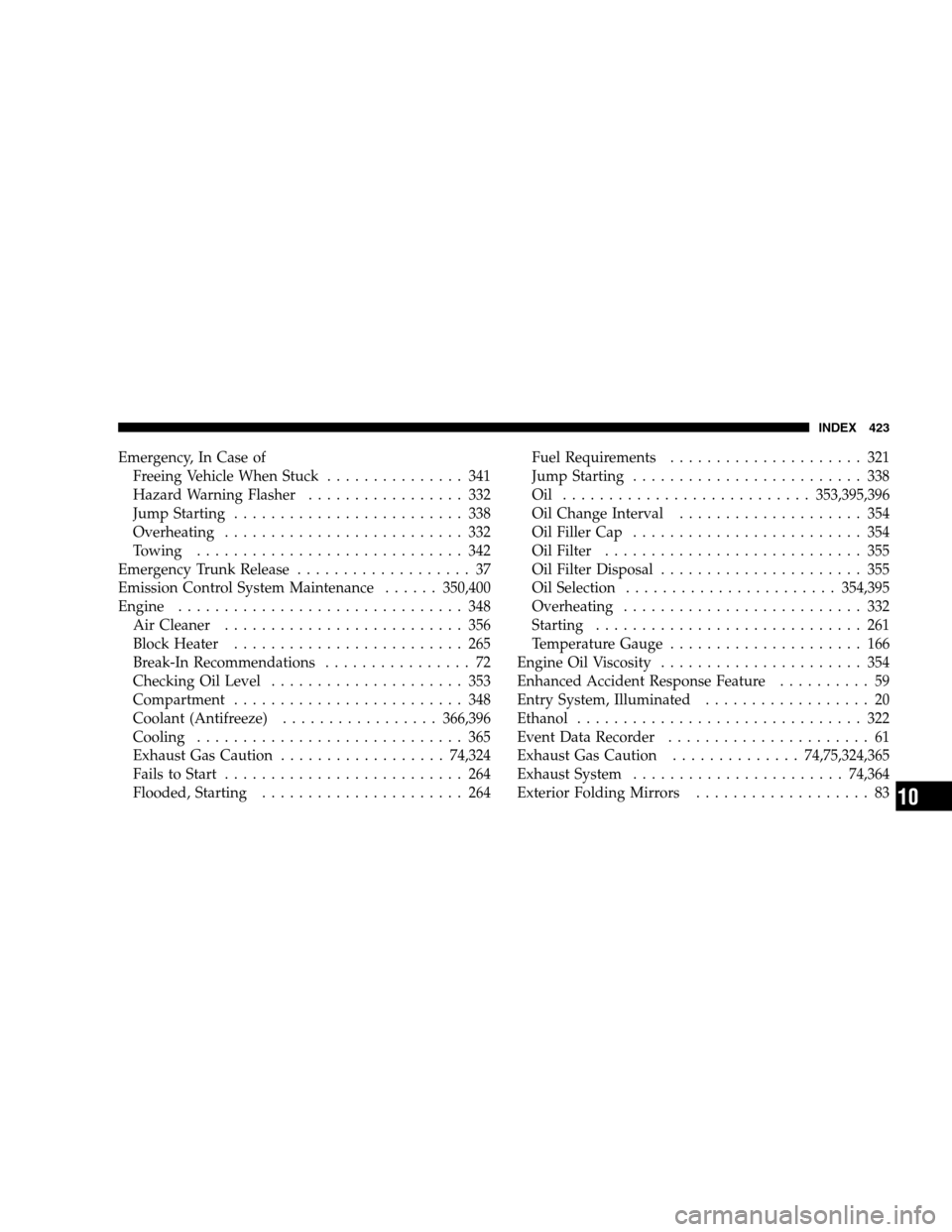
Emergency, In Case of
Freeing Vehicle When Stuck............... 341
Hazard Warning Flasher................. 332
Jump Starting......................... 338
Overheating.......................... 332
Towing ............................. 342
Emergency Trunk Release................... 37
Emission Control System Maintenance......350,400
Engine............................... 348
Air Cleaner.......................... 356
Block Heater......................... 265
Break-In Recommendations................ 72
Checking Oil Level..................... 353
Compartment......................... 348
Coolant (Antifreeze).................366,396
Cooling ............................. 365
Exhaust Gas Caution.................. 74,324
Fails to Start.......................... 264
Flooded, Starting...................... 264Fuel Requirements..................... 321
Jump Starting......................... 338
Oil ...........................353,395,396
Oil Change Interval.................... 354
Oil Filler Cap......................... 354
OilFilter ............................ 355
Oil Filter Disposal...................... 355
Oil Selection.......................354,395
Overheating.......................... 332
Starting............................. 261
Temperature Gauge..................... 166
Engine Oil Viscosity...................... 354
Enhanced Accident Response Feature.......... 59
Entry System, Illuminated.................. 20
Ethanol............................... 322
Event Data Recorder...................... 61
Exhaust Gas Caution.............. 74,75,324,365
Exhaust System....................... 74,364
ExteriorFoldingMirrors ................... 83
INDEX 423
10
Page 426 of 442
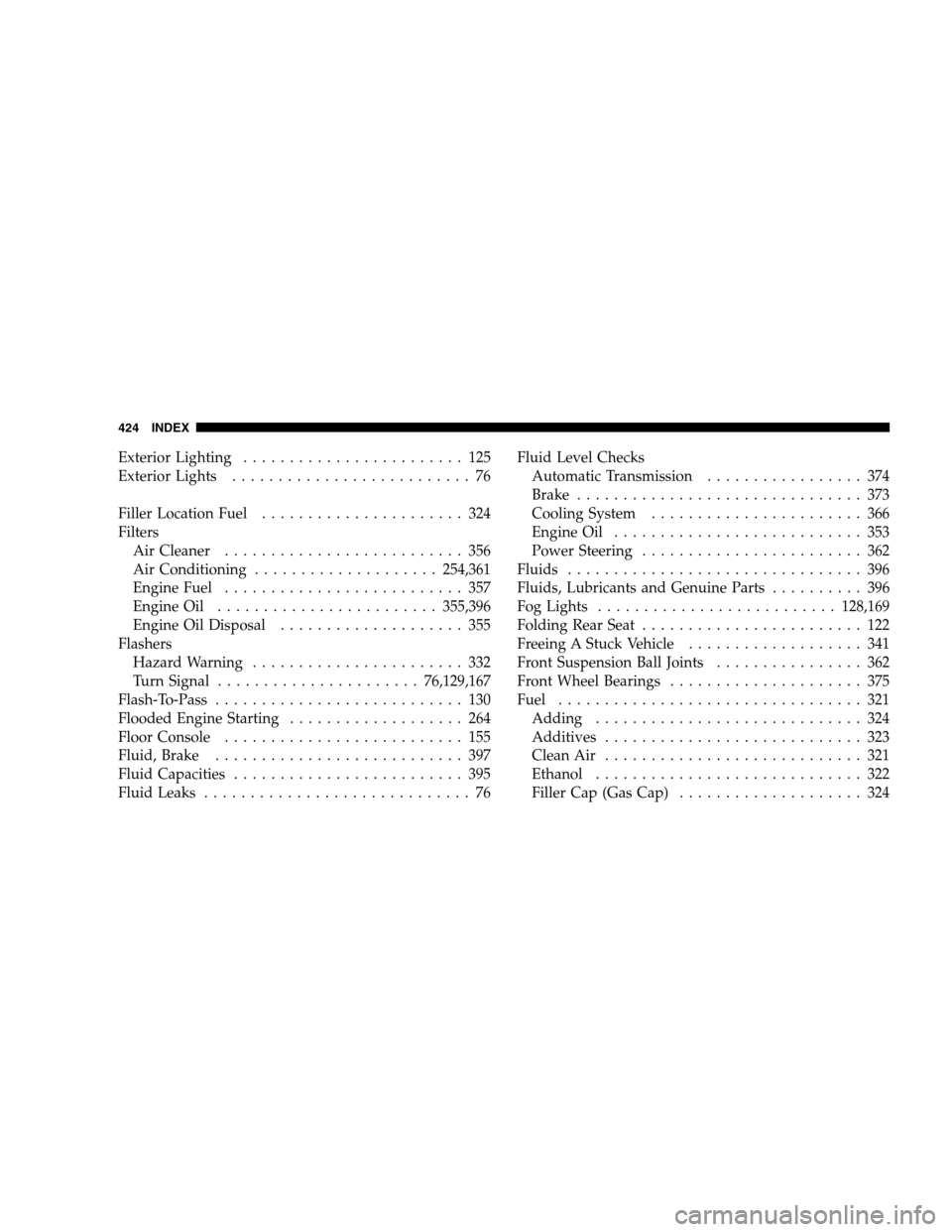
Exterior Lighting........................ 125
Exterior Lights.......................... 76
Filler Location Fuel...................... 324
Filters
Air Cleaner.......................... 356
Air Conditioning....................254,361
Engine Fuel.......................... 357
Engine Oil........................355,396
Engine Oil Disposal.................... 355
Flashers
Hazard Warning....................... 332
Turn Signal...................... 76,129,167
Flash-To-Pass........................... 130
Flooded Engine Starting................... 264
Floor Console.......................... 155
Fluid, Brake........................... 397
Fluid Capacities......................... 395
Fluid Leaks............................. 76Fluid Level Checks
Automatic Transmission................. 374
Brake............................... 373
Cooling System....................... 366
Engine Oil........................... 353
Power Steering........................ 362
Fluids ................................ 396
Fluids, Lubricants and Genuine Parts.......... 396
Fog Lights..........................128,169
Folding Rear Seat........................ 122
Freeing A Stuck Vehicle................... 341
Front Suspension Ball Joints................ 362
Front Wheel Bearings..................... 375
Fuel................................. 321
Adding............................. 324
Additives............................ 323
CleanAir ............................ 321
Ethanol............................. 322
Filler Cap (Gas Cap).................... 324
424 INDEX