heating DODGE CHARGER SRT 2012 7.G User Guide
[x] Cancel search | Manufacturer: DODGE, Model Year: 2012, Model line: CHARGER SRT, Model: DODGE CHARGER SRT 2012 7.GPages: 546, PDF Size: 17.96 MB
Page 341 of 546
Operating Tips
NOTE:Refer to the chart at the end of this section for
suggested control settings for various weather condi-
tions.
Summer Operation
The engine cooling system in air-conditioned vehicles
must be protected with a high-quality antifreeze coolant
to provide proper corrosion protection and to protect
against engine overheating. A solution of 50% ethylene
glycol antifreeze coolant and 50% water is recommended.
Refer to “Maintenance Procedures” in “Maintaining Your
Vehicle” for proper coolant selection.
Winter Operation
Use of the air Recirculation mode during Winter months
is not recommended because it may cause window
fogging.
Vacation Storage
Any time you store your vehicle or keep it out of service
(i.e., vacation) for two weeks or more, run the air
conditioning system at idle for about five minutes in the
fresh air and high blower setting. This will ensure
adequate system lubrication to minimize the possibility
of compressor damage when the system is started again.
4
UNDERSTANDING YOUR INSTRUMENT PANEL 339
PAGE POSITION:339JOB:@zeta.tweddle.com/chry_pdm/CLS_chrysler/GRP_owners/JOB_918945-en-dsr-12D482-126-AA_DSR/DIV_og pubnum: 12D482-126-AB_DSR Operating Tips
NOTE:Refer to the chart at the end of this section for
suggested control settings for various weather condi-
tions.
Summer Operation
The engine cooling system in air-conditioned vehicles
must be protected with a high-quality antifreeze coolant
to provide proper corrosion protection and to protect
against engine overheating. A solution of 50% ethylene
glycol antifreeze coolant and 50% water is recommended.
Refer to “Maintenance Procedures” in “Maintaining Your
Vehicle” for proper coolant selection.
Winter Operation
Use of the air Recirculation mode during Winter months
is not recommended because it may cause window
fogging.
Vacation Storage
Any time you store your vehicle or keep it out of service
(i.e., vacation) for two weeks or more, run the air
conditioning system at idle for about five minutes in the
fresh air and high blower setting. This will ensure
adequate system lubrication to minimize the possibility
of compressor damage when the system is started again.
4
UNDERSTANDING YOUR INSTRUMENT PANEL 339
PAGE POSITION:339JOB:@zeta.tweddle.com/chry_pdm/CLS_chrysler/GRP_owners/JOB_918945-en-dsr-12D482-126-AA_DSR/DIV_og pubnum: 12D482-126-AB_DSR
Page 342 of 546
Window Fogging
Interior fogging on the windshield can be quickly re-
moved by turning the mode selector to Defrost. The
Defrost/Floor mode can be used to maintain a clear
windshield and provide sufficient heating. If side win-
dow fogging becomes a problem increase blower speed.
Vehicle windows tend to fog on the inside in mild but
rainy or humid weather.
NOTE:
•Recirculate without A/C should not be used for long
periods, as fogging may occur.
•Automatic Temperature Controls (ATC) will automati-
cally adjust the climate control settings to reduce or
eliminate window fogging on the front windshield.
Outside Air Intake
Make sure the air intake, located directly in front of the
windshield, is free of obstructions such as leaves. Leaves
collected in the air intake may reduce airflow, and if they
enter the plenum, they could plug the water drains. In
Winter months, make sure the air intake is clear of ice,
slush, and snow.
A/C Air Filter
The climate control system filters outside air containing
dust, pollen and some odors. Strong odors cannot be
totally filtered out. Refer to “Maintenance Procedures” in
“Maintaining Your Vehicle” for filter replacement
instructions.
340 UNDERSTANDING YOUR INSTRUMENT PANEL
PAGE POSITION:340JOB:@zeta.tweddle.com/chry_pdm/CLS_chrysler/GRP_owners/JOB_918945-en-dsr-12D482-126-AA_DSR/DIV_og pubnum: 12D482-126-AB_DSR Window Fogging
Interior fogging on the windshield can be quickly re-
moved by turning the mode selector to Defrost. The
Defrost/Floor mode can be used to maintain a clear
windshield and provide sufficient heating. If side win-
dow fogging becomes a problem increase blower speed.
Vehicle windows tend to fog on the inside in mild but
rainy or humid weather.
NOTE:
•Recirculate without A/C should not be used for long
periods, as fogging may occur.
•Automatic Temperature Controls (ATC) will automati-
cally adjust the climate control settings to reduce or
eliminate window fogging on the front windshield.
Outside Air Intake
Make sure the air intake, located directly in front of the
windshield, is free of obstructions such as leaves. Leaves
collected in the air intake may reduce airflow, and if they
enter the plenum, they could plug the water drains. In
Winter months, make sure the air intake is clear of ice,
slush, and snow.
A/C Air Filter
The climate control system filters outside air containing
dust, pollen and some odors. Strong odors cannot be
totally filtered out. Refer to “Maintenance Procedures” in
“Maintaining Your Vehicle” for filter replacement
instructions.
340 UNDERSTANDING YOUR INSTRUMENT PANEL
PAGE POSITION:340JOB:@zeta.tweddle.com/chry_pdm/CLS_chrysler/GRP_owners/JOB_918945-en-dsr-12D482-126-AA_DSR/DIV_og pubnum: 12D482-126-AB_DSR
Page 393 of 546
WARNING!
Overloading of your tires is dangerous. Overloading
can cause tire failure, affect vehicle handling, and
increase your stopping distance. Use tires of the
recommended load capacity for your vehicle. Never
overload them.
TIRES — GENERAL INFORMATION
Tire Pressure
Proper tire inflation pressure is essential to the safe and
satisfactory operation of your vehicle. Three primary
areas are affected by improper tire pressure:
Safety
WARNING!
•Improperly inflated tires are dangerous and can
cause collisions.
•Under-inflation increases tire flexing and can re-
sult in tire over-heating and failure.
•Over-inflation reduces a tire’s ability to cushion
shock. Objects on the road and chuckholes can
cause damage that result in tire failure.
•Over-inflated or under-inflated tires can affect
vehicle handling and can fail suddenly, resulting
in loss of vehicle control.
•Unequal tire pressures can cause steering prob-
lems. You could lose control of your vehicle.
(Continued)
5
STARTING AND OPERATING 391
PAGE POSITION:391JOB:@zeta.tweddle.com/chry_pdm/CLS_chrysler/GRP_owners/JOB_918945-en-dsr-12D482-126-AA_DSR/DIV_og pubnum: 12D482-126-AB_DSR WARNING!
Overloading of your tires is dangerous. Overloading
can cause tire failure, affect vehicle handling, and
increase your stopping distance. Use tires of the
recommended load capacity for your vehicle. Never
overload them.
TIRES — GENERAL INFORMATION
Tire Pressure
Proper tire inflation pressure is essential to the safe and
satisfactory operation of your vehicle. Three primary
areas are affected by improper tire pressure:
Safety
WARNING!
•Improperly inflated tires are dangerous and can
cause collisions.
•Under-inflation increases tire flexing and can re-
sult in tire over-heating and failure.
•Over-inflation reduces a tire’s ability to cushion
shock. Objects on the road and chuckholes can
cause damage that result in tire failure.
•Over-inflated or under-inflated tires can affect
vehicle handling and can fail suddenly, resulting
in loss of vehicle control.
•Unequal tire pressures can cause steering prob-
lems. You could lose control of your vehicle.
(Continued)
5
STARTING AND OPERATING 391
PAGE POSITION:391JOB:@zeta.tweddle.com/chry_pdm/CLS_chrysler/GRP_owners/JOB_918945-en-dsr-12D482-126-AA_DSR/DIV_og pubnum: 12D482-126-AB_DSR
Page 424 of 546
HAZARD WARNING FLASHERS
The Hazard Warning flasher switch is located in the
switch bank near the top center of the instrument panel.
Press the switch to turn on the Hazard Warning
flasher. When the switch is activated, all directional
turn signals will flash on and off to warn oncoming
traffic of an emergency. Press the switch a second time to
turn off the Hazard Warning flashers.
This is an emergency warning system and it should not
be used when the vehicle is in motion. Use it when your
vehicle is disabled and it is creating a safety hazard for
other motorists.
When you must leave the vehicle to seek assistance, the
Hazard Warning flashers will continue to operate even
though the ignition is placed in the OFF position.
NOTE:With extended use the Hazard Warning flashers
may wear down your battery.
IF YOUR ENGINE OVERHEATS
In any of the following situations, you can reduce the
potential for overheating by taking the appropriate ac-
tion.
•On the highways — slow down.
•In city traffic — while stopped, place the transmission
in NEUTRAL, but do not increase the engine idle speed.
NOTE:There are steps that you can take to slow down
an impending overheat condition:
•If your air conditioner (A/C) is on, turn it off. The A/C
system adds heat to the engine cooling system and
turning the A/C off can help remove this heat.
•You can also turn the temperature control to maximum
heat, the mode control to floor and the blower control
to high. This allows the heater core to act as a
supplement to the radiator and aids in removing heat
from the engine cooling system.
422 WHAT TO DO IN EMERGENCIES
PAGE POSITION:422JOB:@zeta.tweddle.com/chry_pdm/CLS_chrysler/GRP_owners/JOB_918945-en-dsr-12D482-126-AA_DSR/DIV_og pubnum: 12D482-126-AB_DSR HAZARD WARNING FLASHERS
The Hazard Warning flasher switch is located in the
switch bank near the top center of the instrument panel.
Press the switch to turn on the Hazard Warning
flasher. When the switch is activated, all directional
turn signals will flash on and off to warn oncoming
traffic of an emergency. Press the switch a second time to
turn off the Hazard Warning flashers.
This is an emergency warning system and it should not
be used when the vehicle is in motion. Use it when your
vehicle is disabled and it is creating a safety hazard for
other motorists.
When you must leave the vehicle to seek assistance, the
Hazard Warning flashers will continue to operate even
though the ignition is placed in the OFF position.
NOTE:With extended use the Hazard Warning flashers
may wear down your battery.
IF YOUR ENGINE OVERHEATS
In any of the following situations, you can reduce the
potential for overheating by taking the appropriate ac-
tion.
•On the highways — slow down.
•In city traffic — while stopped, place the transmission
in NEUTRAL, but do not increase the engine idle speed.
NOTE:There are steps that you can take to slow down
an impending overheat condition:
•If your air conditioner (A/C) is on, turn it off. The A/C
system adds heat to the engine cooling system and
turning the A/C off can help remove this heat.
•You can also turn the temperature control to maximum
heat, the mode control to floor and the blower control
to high. This allows the heater core to act as a
supplement to the radiator and aids in removing heat
from the engine cooling system.
422 WHAT TO DO IN EMERGENCIES
PAGE POSITION:422JOB:@zeta.tweddle.com/chry_pdm/CLS_chrysler/GRP_owners/JOB_918945-en-dsr-12D482-126-AA_DSR/DIV_og pubnum: 12D482-126-AB_DSR
Page 439 of 546
8. Disconnect the opposite end of the positive(+)jumper
cable from the positive(+)post of the booster battery.
9. Disconnect the positive(+)end of the jumper cable
from the remote positive(+)post of the discharged
vehicle.
If frequent jump-starting is required to start your vehicle
you should have the battery and charging system in-
spected at your authorized dealer.
CAUTION!
Accessories that can be plugged into the vehicle
power outlets draw power from the vehicle’s battery,
even when not in use (i.e., cellular phones, etc.).
Eventually, if plugged in long enough, the vehicle’s
battery will discharge sufficiently to degrade battery
life and/or prevent the engine from starting.
FREEING A STUCK VEHICLE
If your vehicle becomes stuck in mud, sand, or snow, it
can often be moved by a rocking motion. Turn your
steering wheel right and left to clear the area around the
front wheels. Then shift back and forth between DRIVE
and REVERSE. Using minimal accelerator pedal pressure
to maintain the rocking motion, without spinning the
wheels, is most effective.
CAUTION!
Racing the engine or spinning the wheels may lead to
transmission overheating and failure. Allow the en-
gine to idle with the shift lever in NEUTRAL for at
least one minute after every five rocking-motion
cycles. This will minimize overheating and reduce
the risk of transmission failure during prolonged
efforts to free a stuck vehicle.6
WHAT TO DO IN EMERGENCIES 437
PAGE POSITION:437JOB:@zeta.tweddle.com/chry_pdm/CLS_chrysler/GRP_owners/JOB_918945-en-dsr-12D482-126-AA_DSR/DIV_og pubnum: 12D482-126-AB_DSR 8. Disconnect the opposite end of the positive(+)jumper
cable from the positive(+)post of the booster battery.
9. Disconnect the positive(+)end of the jumper cable
from the remote positive(+)post of the discharged
vehicle.
If frequent jump-starting is required to start your vehicle
you should have the battery and charging system in-
spected at your authorized dealer.
CAUTION!
Accessories that can be plugged into the vehicle
power outlets draw power from the vehicle’s battery,
even when not in use (i.e., cellular phones, etc.).
Eventually, if plugged in long enough, the vehicle’s
battery will discharge sufficiently to degrade battery
life and/or prevent the engine from starting.
FREEING A STUCK VEHICLE
If your vehicle becomes stuck in mud, sand, or snow, it
can often be moved by a rocking motion. Turn your
steering wheel right and left to clear the area around the
front wheels. Then shift back and forth between DRIVE
and REVERSE. Using minimal accelerator pedal pressure
to maintain the rocking motion, without spinning the
wheels, is most effective.
CAUTION!
Racing the engine or spinning the wheels may lead to
transmission overheating and failure. Allow the en-
gine to idle with the shift lever in NEUTRAL for at
least one minute after every five rocking-motion
cycles. This will minimize overheating and reduce
the risk of transmission failure during prolonged
efforts to free a stuck vehicle.6
WHAT TO DO IN EMERGENCIES 437
PAGE POSITION:437JOB:@zeta.tweddle.com/chry_pdm/CLS_chrysler/GRP_owners/JOB_918945-en-dsr-12D482-126-AA_DSR/DIV_og pubnum: 12D482-126-AB_DSR
Page 440 of 546
NOTE:Turn off the Electronic Stability Program (ESP)
— if equipped, or Traction Control System (TCS) — if
equipped before rocking the vehicle. Refer to “Electronic
Brake Control” in “Starting And Operating” for further
information.
CAUTION!
•When “rocking” a stuck vehicle by moving be-
tween DRIVE and REVERSE, do not spin the
wheels faster than 15 mph (24 km/h), or drivetrain
damage may result.
•Revving the engine or spinning the wheels too fast
may lead to transmission overheating and failure.
It can also damage the tires. Do not spin the
wheels above 30 mph (48 km/h) while in gear (no
transmission shifting occurring).
WARNING!
Fast spinning tires can be dangerous. Forces gener-
ated by excessive wheel speeds may cause damage, or
even failure, of the axle and tires. A tire could
explode and injure someone. Do not spin your vehi-
cle’s wheels faster than 30 mph (48 km/h) or for
longer than 30 seconds continuously without stop-
ping when you are stuck and do not let anyone near
a spinning wheel, no matter what the speed.
SHIFT LEVER OVERRIDE
If a malfunction occurs and the shift lever cannot be
moved out of the PARK position, you can use the
following procedure to temporarily move the shift lever:
1. Firmly set the parking brake.
2. Remove the rubber tray from the storage bin located to
the right of the shift lever. The override access port is near
the bottom of the bin to the right of the shift lever gate.
438 WHAT TO DO IN EMERGENCIES
PAGE POSITION:438JOB:@zeta.tweddle.com/chry_pdm/CLS_chrysler/GRP_owners/JOB_918945-en-dsr-12D482-126-AA_DSR/DIV_og pubnum: 12D482-126-AB_DSR NOTE:Turn off the Electronic Stability Program (ESP)
— if equipped, or Traction Control System (TCS) — if
equipped before rocking the vehicle. Refer to “Electronic
Brake Control” in “Starting And Operating” for further
information.
CAUTION!
•When “rocking” a stuck vehicle by moving be-
tween DRIVE and REVERSE, do not spin the
wheels faster than 15 mph (24 km/h), or drivetrain
damage may result.
•Revving the engine or spinning the wheels too fast
may lead to transmission overheating and failure.
It can also damage the tires. Do not spin the
wheels above 30 mph (48 km/h) while in gear (no
transmission shifting occurring).
WARNING!
Fast spinning tires can be dangerous. Forces gener-
ated by excessive wheel speeds may cause damage, or
even failure, of the axle and tires. A tire could
explode and injure someone. Do not spin your vehi-
cle’s wheels faster than 30 mph (48 km/h) or for
longer than 30 seconds continuously without stop-
ping when you are stuck and do not let anyone near
a spinning wheel, no matter what the speed.
SHIFT LEVER OVERRIDE
If a malfunction occurs and the shift lever cannot be
moved out of the PARK position, you can use the
following procedure to temporarily move the shift lever:
1. Firmly set the parking brake.
2. Remove the rubber tray from the storage bin located to
the right of the shift lever. The override access port is near
the bottom of the bin to the right of the shift lever gate.
438 WHAT TO DO IN EMERGENCIES
PAGE POSITION:438JOB:@zeta.tweddle.com/chry_pdm/CLS_chrysler/GRP_owners/JOB_918945-en-dsr-12D482-126-AA_DSR/DIV_og pubnum: 12D482-126-AB_DSR
Page 463 of 546
Under normal operating conditions, the catalytic con-
verter will not require maintenance. However, it is im-
portant to keep the engine properly tuned to assure
proper catalyst operation and prevent possible catalyst
damage.
NOTE:Intentional tampering with emissions control
systems can result in civil penalties being assessed
against you.
In unusual situations involving grossly malfunctioning
engine operation, a scorching odor may suggest severe
and abnormal catalyst overheating. If this occurs, stop
the vehicle, turn off the engine and allow it to cool.
Service, including a tune-up to manufacturer’s specifica-
tions, should be obtained immediately.To minimize the possibility of catalytic converter dam-
age:
•Do not shut off the engine or interrupt the ignition,
when the transmission is in gear and the vehicle is in
motion.
•Do not try to start the engine by pushing or towing the
vehicle.
•Do not idle the engine with any spark plug wires
disconnected or removed, such as when diagnostic
testing, or for prolonged periods during very rough
idle or malfunctioning operating conditions.
7
MAINTAINING YOUR VEHICLE 461
PAGE POSITION:461JOB:@zeta.tweddle.com/chry_pdm/CLS_chrysler/GRP_owners/JOB_918945-en-dsr-12D482-126-AA_DSR/DIV_og pubnum: 12D482-126-AB_DSR Under normal operating conditions, the catalytic con-
verter will not require maintenance. However, it is im-
portant to keep the engine properly tuned to assure
proper catalyst operation and prevent possible catalyst
damage.
NOTE:Intentional tampering with emissions control
systems can result in civil penalties being assessed
against you.
In unusual situations involving grossly malfunctioning
engine operation, a scorching odor may suggest severe
and abnormal catalyst overheating. If this occurs, stop
the vehicle, turn off the engine and allow it to cool.
Service, including a tune-up to manufacturer’s specifica-
tions, should be obtained immediately.To minimize the possibility of catalytic converter dam-
age:
•Do not shut off the engine or interrupt the ignition,
when the transmission is in gear and the vehicle is in
motion.
•Do not try to start the engine by pushing or towing the
vehicle.
•Do not idle the engine with any spark plug wires
disconnected or removed, such as when diagnostic
testing, or for prolonged periods during very rough
idle or malfunctioning operating conditions.
7
MAINTAINING YOUR VEHICLE 461
PAGE POSITION:461JOB:@zeta.tweddle.com/chry_pdm/CLS_chrysler/GRP_owners/JOB_918945-en-dsr-12D482-126-AA_DSR/DIV_og pubnum: 12D482-126-AB_DSR
Page 528 of 546

Door Locks, Automatic.................... 30
Door Opener, Garage..................... 242
Driving
On Slippery Surfaces.................. 363
Through Flowing, Rising, or Shallow
Standing Water...................... 364
Driving to Achieve Maximum Fuel Economy.... 290
Electric Rear Window Defrost............... 265
Electric Remote Mirrors.................... 97
Electrical Power Outlets................... 254
Electronic Brake Control System............. 373
Anti-Lock Brake System................ 373
Brake Assist System................... 374
Traction Control System................ 373
Electronic Power Distribution Center (Fuses).... 477
Electronic Speed Control (Cruise Control)....204,207
Electronic Stability Control (ESC)............. 375Electronic Vehicle Information
Center (EVIC).......................239,281
Emergency Deck Lid Release................ 41
Emergency Trunk Release................... 41
Emergency, In Case of
Freeing Vehicle When Stuck............. 437
Hazard Warning Flasher............... 422
Jump Starting....................... 433
Overheating........................ 422
Towing............................ 440
Emission Control System Maintenance......... 446
Engine............................... 445
Air Cleaner......................... 452
Block Heater........................ 351
Break-In Recommendations.............. 81
Checking Oil Level................... 449
Compartment....................... 445
Coolant (Antifreeze)................462,491
Cooling........................... 462
526 INDEX
PAGE POSITION:526JOB:@zeta.tweddle.com/chry_pdm/CLS_chrysler/GRP_owners/JOB_918945-en-dsr-12D482-126-AA_DSR/DIV_og pubnum: 12D482-126-AB_DSR Door Locks, Automatic.................... 30
Door Opener, Garage..................... 242
Driving
On Slippery Surfaces.................. 363
Through Flowing, Rising, or Shallow
Standing Water...................... 364
Driving to Achieve Maximum Fuel Economy.... 290
Electric Rear Window Defrost............... 265
Electric Remote Mirrors.................... 97
Electrical Power Outlets................... 254
Electronic Brake Control System............. 373
Anti-Lock Brake System................ 373
Brake Assist System................... 374
Traction Control System................ 373
Electronic Power Distribution Center (Fuses).... 477
Electronic Speed Control (Cruise Control)....204,207
Electronic Stability Control (ESC)............. 375Electronic Vehicle Information
Center (EVIC).......................239,281
Emergency Deck Lid Release................ 41
Emergency Trunk Release................... 41
Emergency, In Case of
Freeing Vehicle When Stuck............. 437
Hazard Warning Flasher............... 422
Jump Starting....................... 433
Overheating........................ 422
Towing............................ 440
Emission Control System Maintenance......... 446
Engine............................... 445
Air Cleaner......................... 452
Block Heater........................ 351
Break-In Recommendations.............. 81
Checking Oil Level................... 449
Compartment....................... 445
Coolant (Antifreeze)................462,491
Cooling........................... 462
526 INDEX
PAGE POSITION:526JOB:@zeta.tweddle.com/chry_pdm/CLS_chrysler/GRP_owners/JOB_918945-en-dsr-12D482-126-AA_DSR/DIV_og pubnum: 12D482-126-AB_DSR
Page 529 of 546
Exhaust Gas Caution................83,414
Fails to Start........................ 350
Flooded, Starting..................... 350
Fuel Requirements.................... 410
Jump Starting....................... 433
Oil .........................449,490,491
Oil Change Interval................289,450
Oil Filler Cap....................... 451
Oil Filter........................... 451
Oil Filter Disposal.................... 451
Oil Selection.....................450,490
Oil Synthetic........................ 451
Overheating........................ 422
Starting........................... 347
Temperature Gauge................... 279
Engine Oil Viscosity...................... 451
Enhanced Accident Response Feature.......... 66
Entry System, Illuminated.................. 20
Ethanol............................... 411Event Data Recorder...................... 69
Exhaust Gas Caution...................83,414
Exhaust System.......................83,459
Exterior Folding Mirrors................... 96
Exterior Lighting........................ 185
Exterior Lights.......................... 86
Filler Location Fuel...................... 275
Filters
Air Cleaner......................... 452
Air Conditioning..................340,455
Engine Oil.......................451,491
Engine Oil Disposal................... 451
Flash-To-Pass........................... 190
Flashers
Hazard Warning..................... 422
Turn Signal....................86,189,271
Flooded Engine Starting................... 350
Floor Console.......................... 262
10
INDEX 527
PAGE POSITION:527JOB:@zeta.tweddle.com/chry_pdm/CLS_chrysler/GRP_owners/JOB_918945-en-dsr-12D482-126-AA_DSR/DIV_og pubnum: 12D482-126-AB_DSR Exhaust Gas Caution................83,414
Fails to Start........................ 350
Flooded, Starting..................... 350
Fuel Requirements.................... 410
Jump Starting....................... 433
Oil .........................449,490,491
Oil Change Interval................289,450
Oil Filler Cap....................... 451
Oil Filter........................... 451
Oil Filter Disposal.................... 451
Oil Selection.....................450,490
Oil Synthetic........................ 451
Overheating........................ 422
Starting........................... 347
Temperature Gauge................... 279
Engine Oil Viscosity...................... 451
Enhanced Accident Response Feature.......... 66
Entry System, Illuminated.................. 20
Ethanol............................... 411Event Data Recorder...................... 69
Exhaust Gas Caution...................83,414
Exhaust System.......................83,459
Exterior Folding Mirrors................... 96
Exterior Lighting........................ 185
Exterior Lights.......................... 86
Filler Location Fuel...................... 275
Filters
Air Cleaner......................... 452
Air Conditioning..................340,455
Engine Oil.......................451,491
Engine Oil Disposal................... 451
Flash-To-Pass........................... 190
Flashers
Hazard Warning..................... 422
Turn Signal....................86,189,271
Flooded Engine Starting................... 350
Floor Console.......................... 262
10
INDEX 527
PAGE POSITION:527JOB:@zeta.tweddle.com/chry_pdm/CLS_chrysler/GRP_owners/JOB_918945-en-dsr-12D482-126-AA_DSR/DIV_og pubnum: 12D482-126-AB_DSR
Page 536 of 546
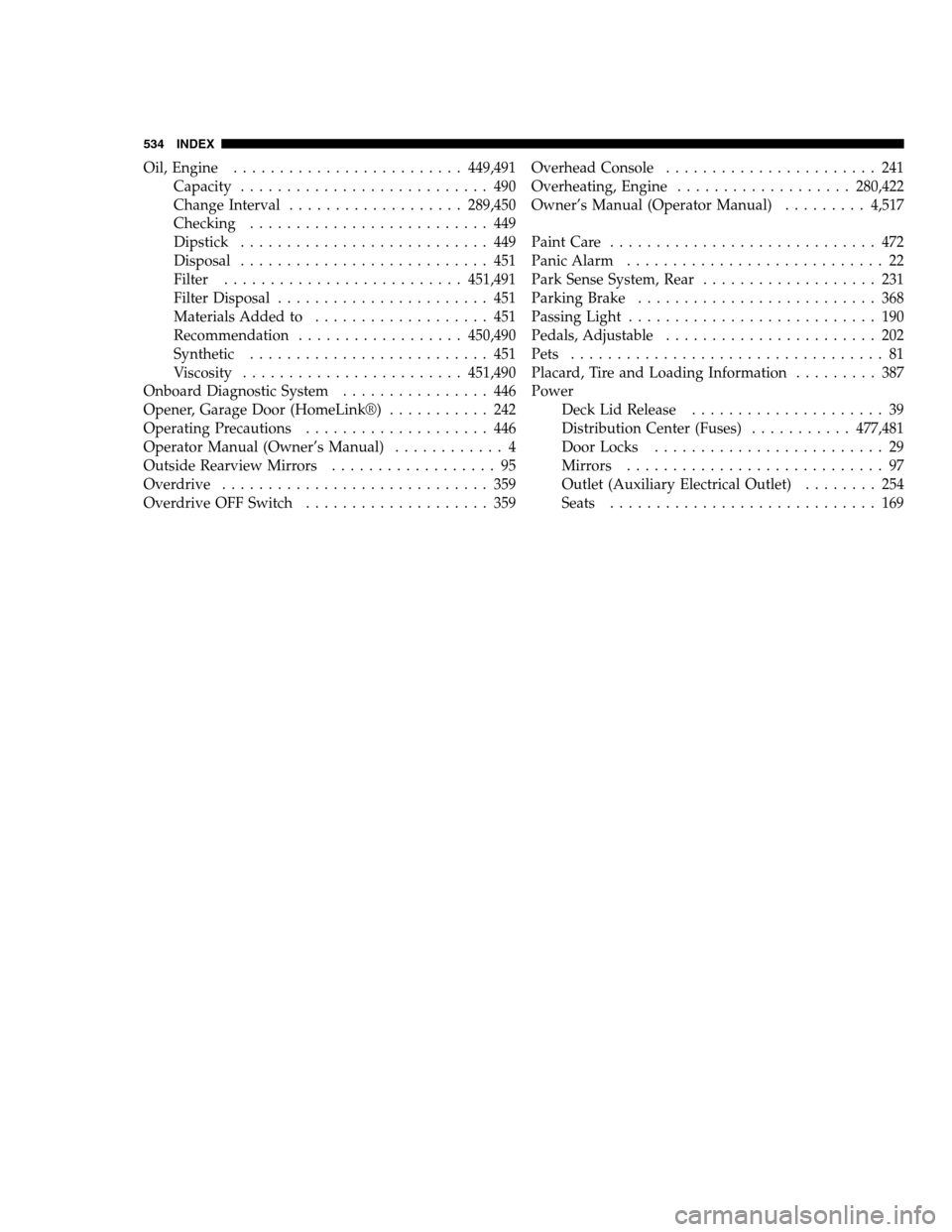
Oil, Engine.........................449,491
Capacity........................... 490
Change Interval...................289,450
Checking.......................... 449
Dipstick........................... 449
Disposal........................... 451
Filter..........................451,491
Filter Disposal....................... 451
Materials Added to................... 451
Recommendation..................450,490
Synthetic.......................... 451
Viscosity........................451,490
Onboard Diagnostic System................ 446
Opener, Garage Door (HomeLink®)........... 242
Operating Precautions.................... 446
Operator Manual (Owner’s Manual)............ 4
Outside Rearview Mirrors.................. 95
Overdrive............................. 359
Overdrive OFF Switch.................... 359Overhead Console....................... 241
Overheating, Engine...................280,422
Owner’s Manual (Operator Manual).........4,517
Paint Care............................. 472
Panic Alarm............................ 22
Park Sense System, Rear................... 231
Parking Brake.......................... 368
Passing Light........................... 190
Pedals, Adjustable....................... 202
Pets.................................. 81
Placard, Tire and Loading Information......... 387
Power
Deck Lid Release..................... 39
Distribution Center (Fuses)...........477,481
Door Locks......................... 29
Mirrors............................ 97
Outlet (Auxiliary Electrical Outlet)........ 254
Seats............................. 169
534 INDEX
PAGE POSITION:534JOB:@zeta.tweddle.com/chry_pdm/CLS_chrysler/GRP_owners/JOB_918945-en-dsr-12D482-126-AA_DSR/DIV_og pubnum: 12D482-126-AB_DSR Oil, Engine.........................449,491
Capacity........................... 490
Change Interval...................289,450
Checking.......................... 449
Dipstick........................... 449
Disposal........................... 451
Filter..........................451,491
Filter Disposal....................... 451
Materials Added to................... 451
Recommendation..................450,490
Synthetic.......................... 451
Viscosity........................451,490
Onboard Diagnostic System................ 446
Opener, Garage Door (HomeLink®)........... 242
Operating Precautions.................... 446
Operator Manual (Owner’s Manual)............ 4
Outside Rearview Mirrors.................. 95
Overdrive............................. 359
Overdrive OFF Switch.................... 359Overhead Console....................... 241
Overheating, Engine...................280,422
Owner’s Manual (Operator Manual).........4,517
Paint Care............................. 472
Panic Alarm............................ 22
Park Sense System, Rear................... 231
Parking Brake.......................... 368
Passing Light........................... 190
Pedals, Adjustable....................... 202
Pets.................................. 81
Placard, Tire and Loading Information......... 387
Power
Deck Lid Release..................... 39
Distribution Center (Fuses)...........477,481
Door Locks......................... 29
Mirrors............................ 97
Outlet (Auxiliary Electrical Outlet)........ 254
Seats............................. 169
534 INDEX
PAGE POSITION:534JOB:@zeta.tweddle.com/chry_pdm/CLS_chrysler/GRP_owners/JOB_918945-en-dsr-12D482-126-AA_DSR/DIV_og pubnum: 12D482-126-AB_DSR