coolant level DODGE CHARGER SRT 2016 7.G Owners Manual
[x] Cancel search | Manufacturer: DODGE, Model Year: 2016, Model line: CHARGER SRT, Model: DODGE CHARGER SRT 2016 7.GPages: 634, PDF Size: 4.6 MB
Page 254 of 634
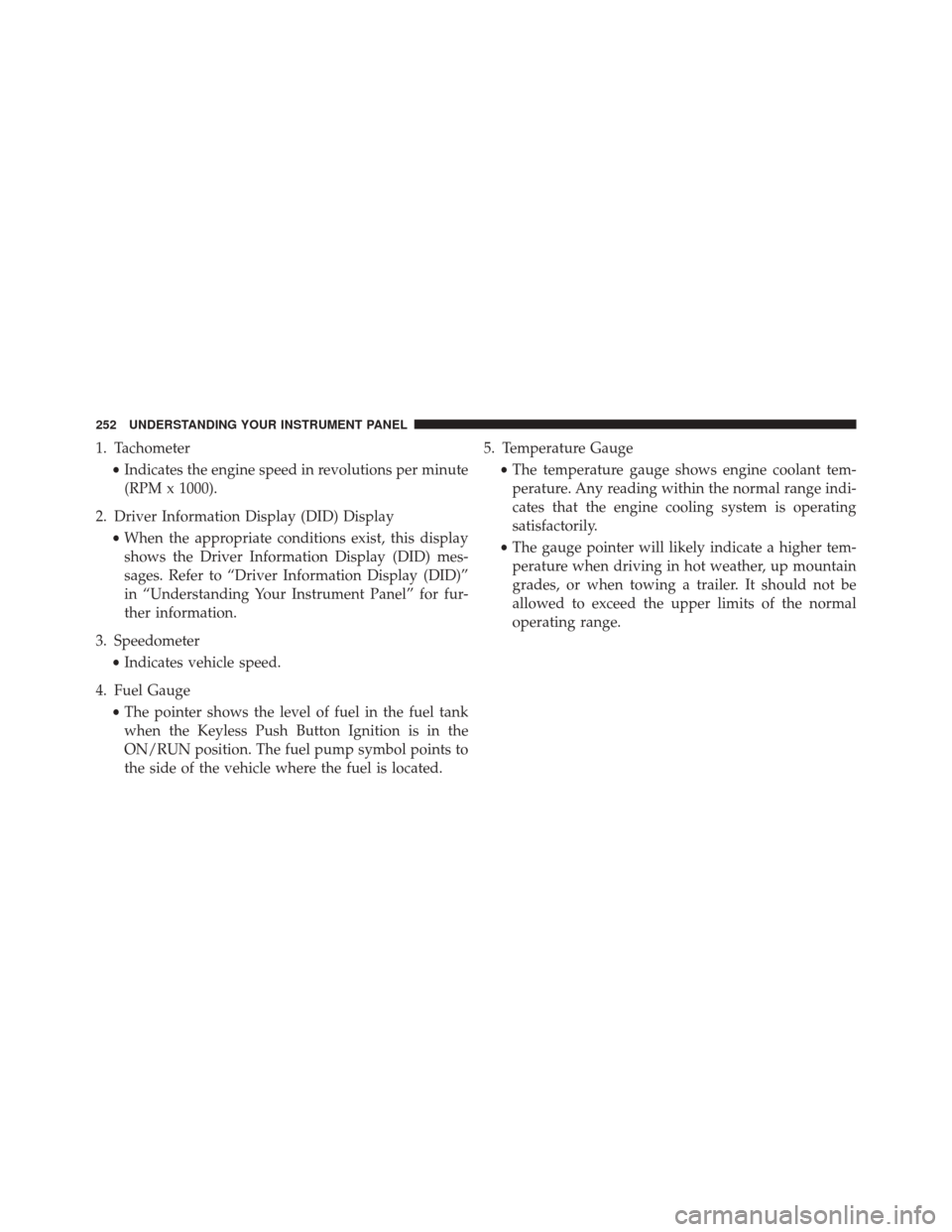
1. Tachometer•Indicates the engine speed in revolutions per minute
(RPM x 1000).
2. Driver Information Display (DID) Display •When the appropriate conditions exist, this display
shows the Driver Information Display (DID) mes-
sages. Refer to “Driver Information Display (DID)”
in “Understanding Your Instrument Panel” for fur-
ther information.
3. Speedometer •Indicates vehicle speed.
4. Fuel Gauge •The pointer shows the level of fuel in the fuel tank
when the Keyless Push Button Ignition is in the
ON/RUN position. The fuel pump symbol points to
the side of the vehicle where the fuel is located. 5. Temperature Gauge
•The temperature gauge shows engine coolant tem-
perature. Any reading within the normal range indi-
cates that the engine cooling system is operating
satisfactorily.
• The gauge pointer will likely indicate a higher tem-
perature when driving in hot weather, up mountain
grades, or when towing a trailer. It should not be
allowed to exceed the upper limits of the normal
operating range.
252 UNDERSTANDING YOUR INSTRUMENT PANEL
Page 257 of 634
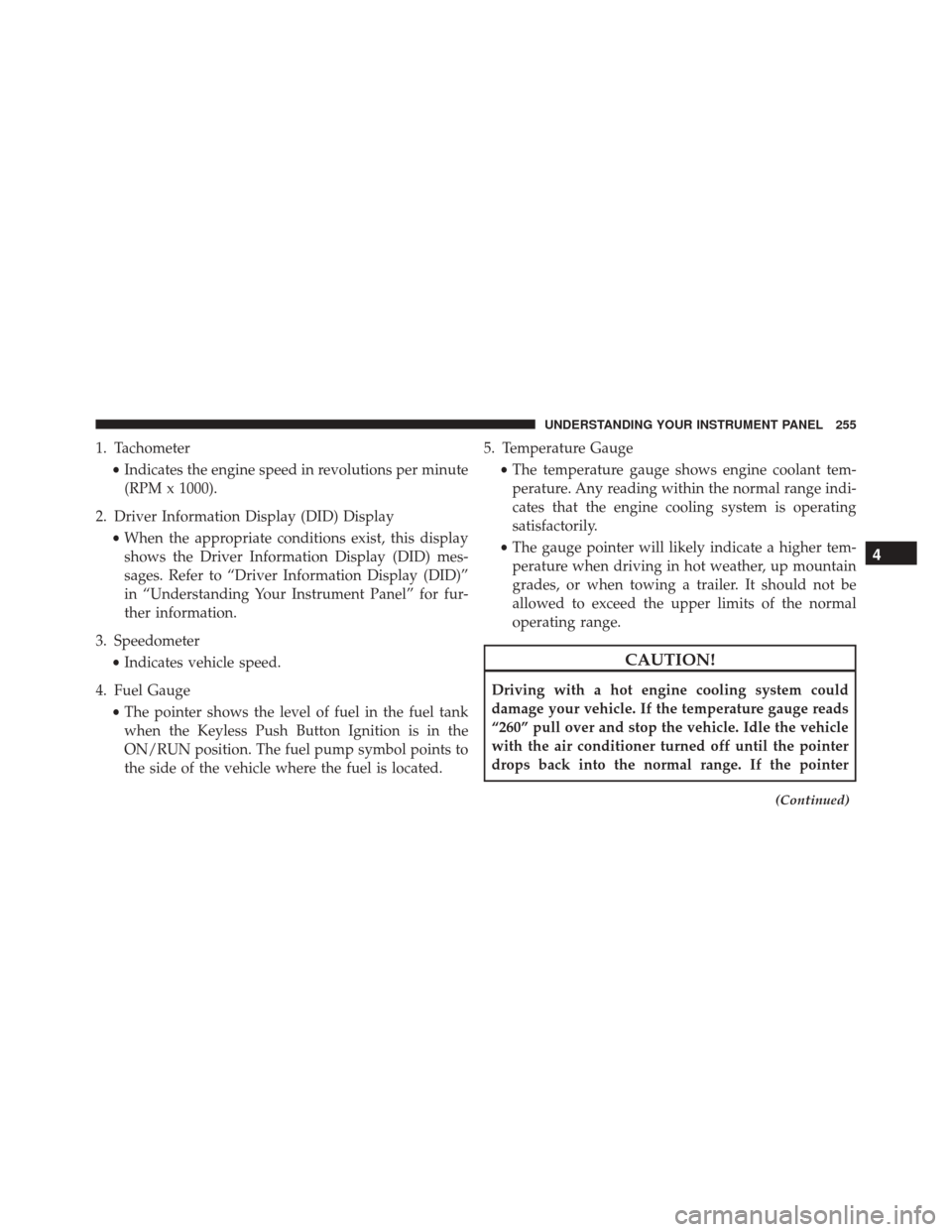
1. Tachometer•Indicates the engine speed in revolutions per minute
(RPM x 1000).
2. Driver Information Display (DID) Display •When the appropriate conditions exist, this display
shows the Driver Information Display (DID) mes-
sages. Refer to “Driver Information Display (DID)”
in “Understanding Your Instrument Panel” for fur-
ther information.
3. Speedometer •Indicates vehicle speed.
4. Fuel Gauge •The pointer shows the level of fuel in the fuel tank
when the Keyless Push Button Ignition is in the
ON/RUN position. The fuel pump symbol points to
the side of the vehicle where the fuel is located. 5. Temperature Gauge
•The temperature gauge shows engine coolant tem-
perature. Any reading within the normal range indi-
cates that the engine cooling system is operating
satisfactorily.
• The gauge pointer will likely indicate a higher tem-
perature when driving in hot weather, up mountain
grades, or when towing a trailer. It should not be
allowed to exceed the upper limits of the normal
operating range.
CAUTION!
Driving with a hot engine cooling system could
damage your vehicle. If the temperature gauge reads
“260” pull over and stop the vehicle. Idle the vehicle
with the air conditioner turned off until the pointer
drops back into the normal range. If the pointer
(Continued)
4
UNDERSTANDING YOUR INSTRUMENT PANEL 255
Page 549 of 634
•Mix a minimum solution of 50% OAT engine coolant
that meets the requirements of FCA Material Standard
MS.90032 and distilled water. Use higher concentra-
tions (not to exceed 70%) if temperatures below 34°F
(37°C) are anticipated. Please contact your authorized
dealer for assistance.
• Use only high purity water such as distilled or deion-
ized water when mixing the water/engine coolant
(antifreeze) solution. The use of lower quality water
will reduce the amount of corrosion protection in the
engine cooling system.
NOTE:
• It is the owner’s responsibility to maintain the proper
level of protection against freezing according to the
temperatures occurring in the area where the vehicle is
operated. •
Some vehicles require special tools to add coolant
properly. Failure to fill these systems properly could
lead to severe internal engine damage. If any coolant is
needed to be added to the system, please contact your
local authorized dealer.
• Mixing engine coolant (antifreeze) types is not recom-
mended and can result in cooling system damage. If
HOAT and OAT coolant are mixed in an emergency,
have a authorized dealer drain, flush, and refill with
OAT coolant (conforming to MS.90032) as soon as
possible.
Cooling System Pressure Caps
The cap must be fully tightened to prevent loss of engine
coolant (antifreeze), and to ensure that engine coolant
(antifreeze) will return to the radiator from the coolant
recovery tank.
7
MAINTAINING YOUR VEHICLE 547
Page 550 of 634
The cap should be inspected and cleaned if there is any
accumulation of foreign material on the sealing surfaces.
NOTE:Be sure you do not mix the engine coolant system
pressure cap with the intercooler system pressure cap
these caps are not interchangeable.
WARNING!
• Do not open hot engine cooling system. Never add
engine coolant (antifreeze) when the engine is
overheated. Do not loosen or remove the cap to cool
an overheated engine. Heat causes pressure to
build up in the cooling system. To prevent scalding
or injury, do not remove the pressure cap while the
system is hot or under pressure.
• Do not use a pressure cap other than the one
specified for your vehicle. Personal injury or en-
gine damage may result.
Disposal Of Used Engine Coolant
Used ethylene glycol-based engine coolant (antifreeze) is
a regulated substance requiring proper disposal. Check
with your local authorities to determine the disposal
rules for your community. To prevent ingestion by ani-
mals or children, do not store ethylene glycol-based
engine coolant in open containers or allow it to remain in
puddles on the ground. If ingested by a child or pet, seek
emergency assistance immediately. Clean up any ground
spills immediately.
Coolant Level
The coolant bottle provides a quick visual method for
determining that the coolant level is adequate. With the
engine OFF and cold, the level of the engine coolant
(antifreeze) in the bottle should be between the ranges
indicated on the bottle.
The radiator normally remains completely full, so there is
no need to remove the radiator/coolant pressure cap
548 MAINTAINING YOUR VEHICLE
Page 551 of 634
unless checking for engine coolant (antifreeze) freeze
point or replacing coolant. Advise your service attendant
of this. As long as the engine operating temperature is
satisfactory, the coolant bottle need only be checked once
a month.
When additional engine coolant (antifreeze) is needed to
maintain the proper level, only OAT coolant that meets
the requirements of FCA Material Standard MS.90032
should be added to the coolant bottle. Do not overfill.
Points To Remember
NOTE:When the vehicle is stopped after a few miles/
kilometers of operation, you may observe vapor coming
from the front of the engine compartment. This is nor-
mally a result of moisture from rain, snow, or high
humidity accumulating on the radiator and being vapor-
ized when the thermostat opens, allowing hot engine
coolant (antifreeze) to enter the radiator. If an examination of your engine compartment shows no
evidence of radiator or hose leaks, the vehicle may be
safely driven. The vapor will soon dissipate.
•
Do not overfill the coolant expansion bottle.
• Check the coolant freeze point in the radiator and in
the coolant expansion bottle. If engine coolant (anti-
freeze) needs to be added, the contents of the coolant
expansion bottle must also be protected against freez-
ing.
• If frequent engine coolant (antifreeze) additions are
required, the cooling system should be pressure tested
for leaks.
• Maintain engine coolant (antifreeze) concentration at a
minimum of 50% OAT coolant (conforming to
MS.90032) and distilled water for proper corrosion
protection of your engine which contains aluminum
components.7
MAINTAINING YOUR VEHICLE 549
Page 552 of 634
•Make sure that the coolant expansion bottle overflow
hoses are not kinked or obstructed.
• Keep the front of the radiator clean. If your vehicle is
equipped with air conditioning, keep the front of the
condenser clean.
• Do not change the thermostat for Summer or Winter
operation. If replacement is ever necessary, install
ONLY the correct type thermostat. Other designs may
result in unsatisfactory engine coolant (antifreeze)
performance, poor gas mileage, and increased emis-
sions.
Brake System
In order to assure brake system performance, all brake
system components should be inspected periodically.
Refer to the “Maintenance Schedule” for the proper
maintenance intervals.
WARNING!
Riding the brakes can lead to brake failure and
possibly a collision. Driving with your foot resting or
riding on the brake pedal can result in abnormally
high brake temperatures, excessive lining wear, and
possible brake damage. You would not have your full
braking capacity in an emergency.
Master Cylinder — Brake Fluid Level Check
Check the fluid level in the master cylinder immediately
if the brake system warning light indicates system fail-
ure.
Check the fluid level in the master cylinder when per-
forming underhood services.
Clean the top of the master cylinder area before removing
the cap. Add fluid to bring the level up to the top of the
“FULL” mark on the side of the master cylinder reservoir.
550 MAINTAINING YOUR VEHICLE
Page 583 of 634
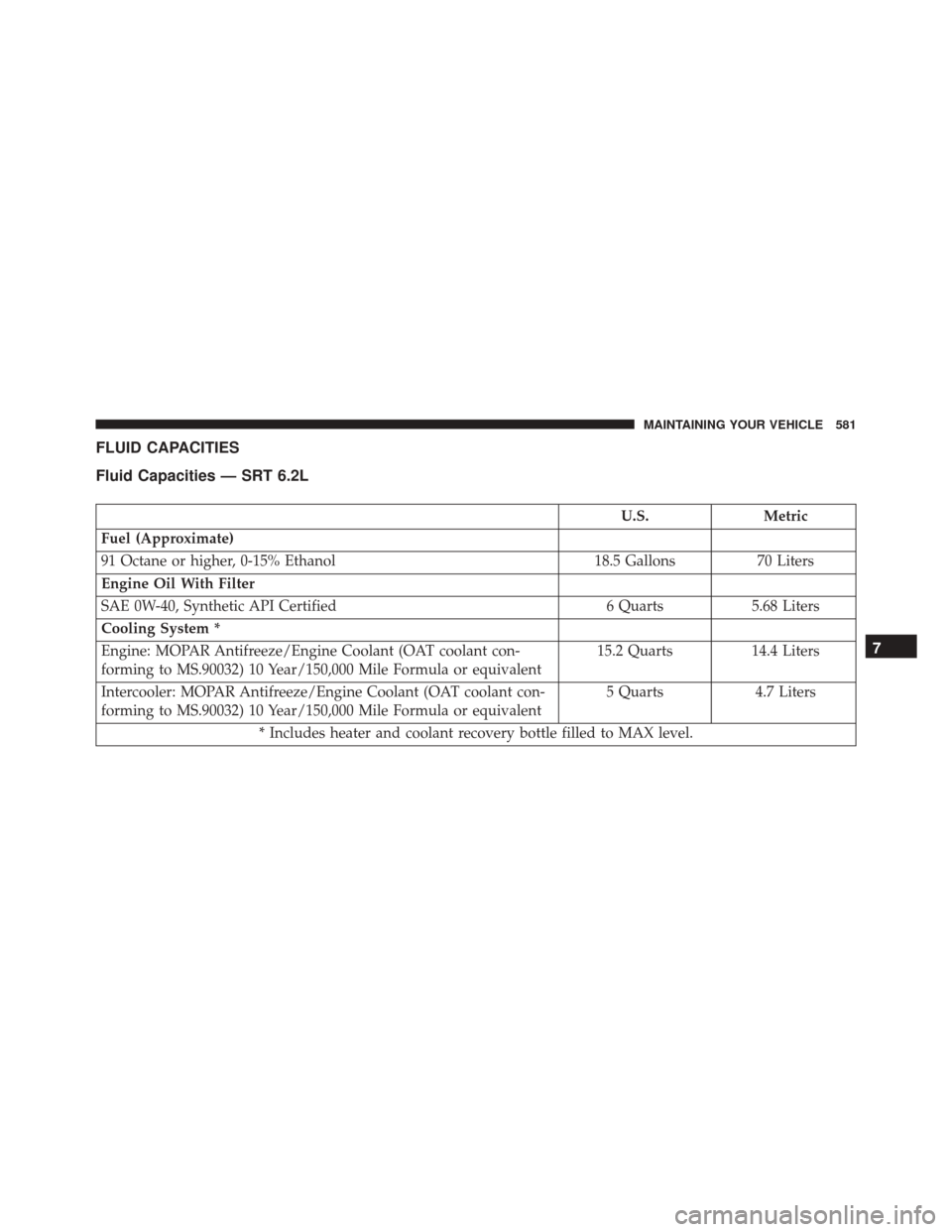
FLUID CAPACITIES
Fluid Capacities — SRT 6.2L
U.S.Metric
Fuel (Approximate)
91 Octane or higher, 0-15% Ethanol 18.5 Gallons70 Liters
Engine Oil With Filter
SAE 0W-40, Synthetic API Certified 6 Quarts5.68 Liters
Cooling System *
Engine: MOPAR Antifreeze/Engine Coolant (OAT coolant con-
forming to MS.90032) 10 Year/150,000 Mile Formula or equivalent 15.2 Quarts
14.4 Liters
Intercooler: MOPAR Antifreeze/Engine Coolant (OAT coolant con-
forming to MS.90032) 10 Year/150,000 Mile Formula or equivalent 5 Quarts
4.7 Liters
* Includes heater and coolant recovery bottle filled to MAX level.
7
MAINTAINING YOUR VEHICLE 581
Page 584 of 634
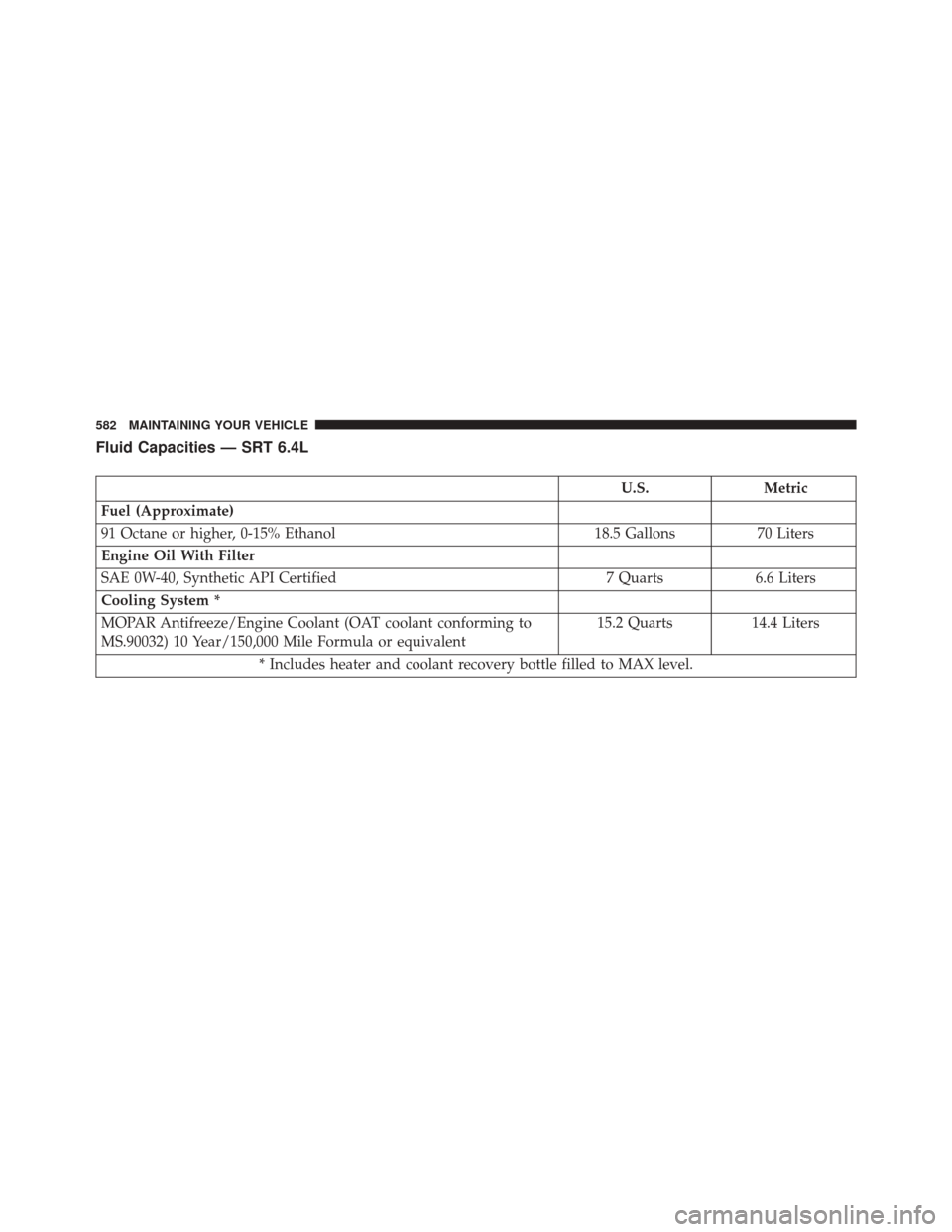
Fluid Capacities — SRT 6.4L
U.S.Metric
Fuel (Approximate)
91 Octane or higher, 0-15% Ethanol 18.5 Gallons70 Liters
Engine Oil With Filter
SAE 0W-40, Synthetic API Certified 7 Quarts6.6 Liters
Cooling System *
MOPAR Antifreeze/Engine Coolant (OAT coolant conforming to
MS.90032) 10 Year/150,000 Mile Formula or equivalent 15.2 Quarts
14.4 Liters
* Includes heater and coolant recovery bottle filled to MAX level.
582 MAINTAINING YOUR VEHICLE
Page 591 of 634
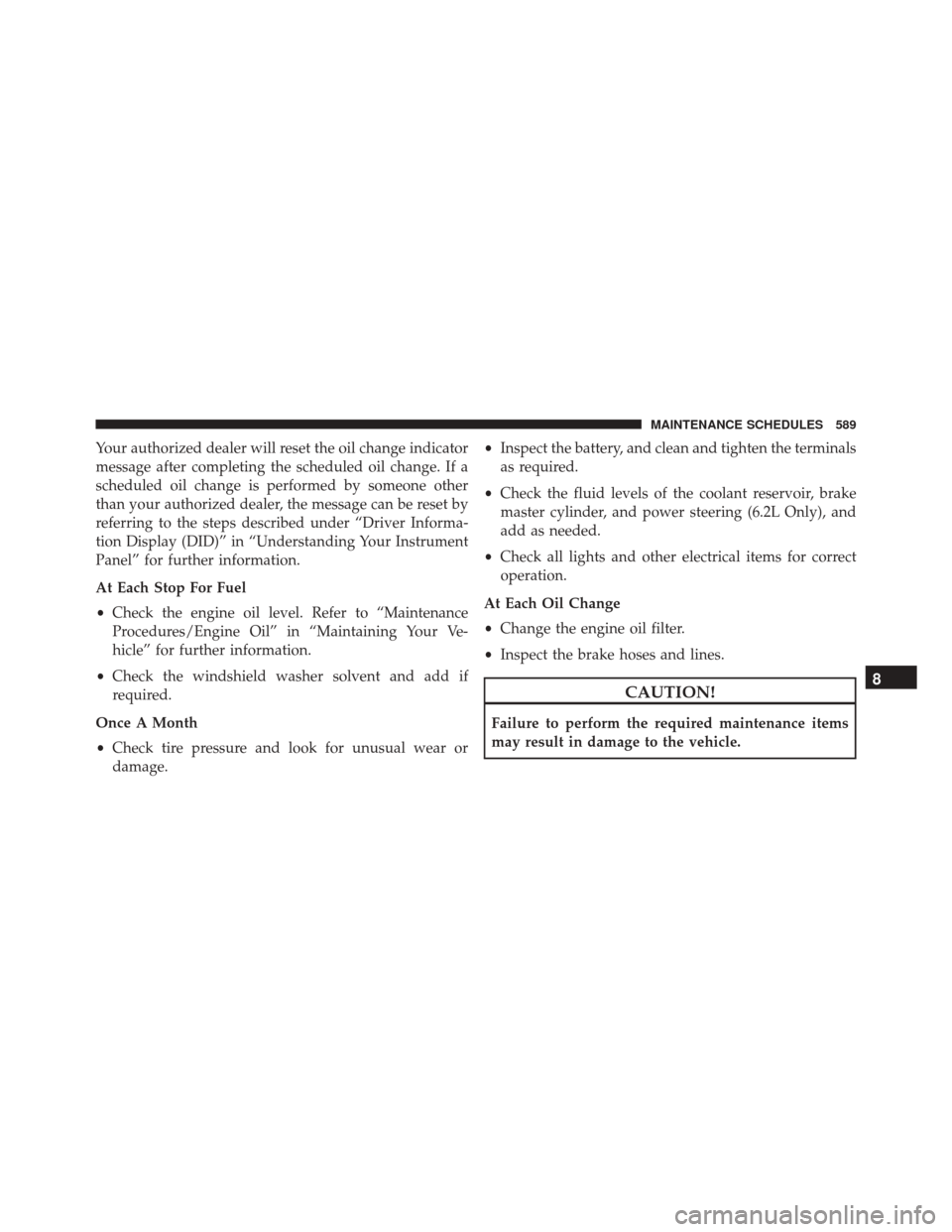
Your authorized dealer will reset the oil change indicator
message after completing the scheduled oil change. If a
scheduled oil change is performed by someone other
than your authorized dealer, the message can be reset by
referring to the steps described under “Driver Informa-
tion Display (DID)” in “Understanding Your Instrument
Panel” for further information.
At Each Stop For Fuel
•Check the engine oil level. Refer to “Maintenance
Procedures/Engine Oil” in “Maintaining Your Ve-
hicle” for further information.
• Check the windshield washer solvent and add if
required.
Once A Month
• Check tire pressure and look for unusual wear or
damage. •
Inspect the battery, and clean and tighten the terminals
as required.
• Check the fluid levels of the coolant reservoir, brake
master cylinder, and power steering (6.2L Only), and
add as needed.
• Check all lights and other electrical items for correct
operation.
At Each Oil Change
• Change the engine oil filter.
• Inspect the brake hoses and lines.
CAUTION!
Failure to perform the required maintenance items
may result in damage to the vehicle.
8
MAINTENANCE SCHEDULES 589
Page 613 of 634
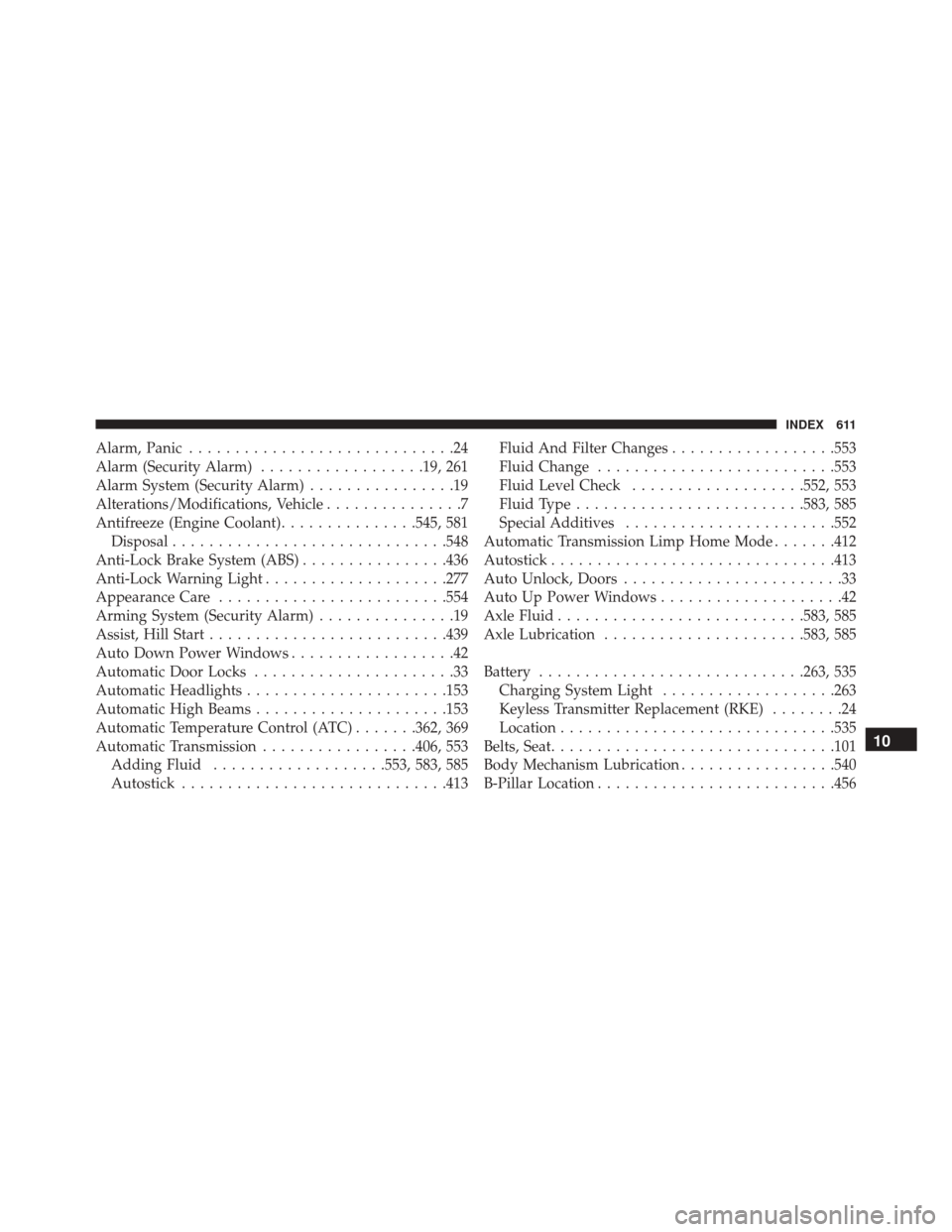
Alarm, Panic.............................24
Alarm (Security Alarm) ..................19, 261
Alarm System (Security Alarm) ................19
Alterations/Modifications, Vehicle ...............7
Antifreeze (Engine Coolant) ...............545, 581
Disposal ............................. .548
Anti-Lock Brake System (ABS) ................436
Anti-Lock Warning Light ....................277
Appearance Care ........................ .554
Arming System (Security Alarm) ...............19
Assist, Hill Start ......................... .439
Auto Down Power Windows ..................42
Automatic Door Locks ......................33
Automatic Headlights ..................... .153
Automatic High Beams .....................153
Automatic Temperature Control (ATC) .......362, 369
Automatic Transmission .................406, 553
Adding Fluid ...................553, 583, 585
Autostick ............................ .413Fluid And Filter Changes
..................553
Fluid Change ......................... .553
Fluid Level Check ...................552, 553
Fluid Type ........................ .583, 585
Special Additives ...................... .552
Automatic Transmission Limp Home Mode .......412
Autostick .............................. .413
Auto Unlock, Doors ........................33
Auto Up Power Windows ....................42
Axle Fluid .......................... .583, 585
Axle Lubrication ..................... .583, 585
Battery ............................ .263, 535
Charging System Light ...................263
Keyless Transmitter Replacement (RKE) ........24
Location ............................. .535
Belts, Seat .............................. .101
Body Mechanism Lubrication .................540
B-Pillar Location ......................... .456
10
INDEX 611