brakes DODGE CHARGER SRT 2018 Owner's Manual
[x] Cancel search | Manufacturer: DODGE, Model Year: 2018, Model line: CHARGER SRT, Model: DODGE CHARGER SRT 2018Pages: 490, PDF Size: 5.08 MB
Page 346 of 490
Overfilling of fluid is not recommended because it may
cause leaking in the system.
Add enough fluid to bring the level up to the requirements
described on the brake fluid reservoir. With disc brakes,
fluid level can be expected to fall as the brake pads wear.
However, low fluid level may be caused by a leak and a
checkup may be needed.
Use only brake fluid that has been recommended by the
manufacturer, and has been kept in a tightly closed container
to avoid contamination from foreign matter or moisture.
Refer to “Fluids And Lubricants” in “Technical Specifica-
tions” for further information.
WARNING!
•Use only manufacturer’s recommended brake fluid.
Refer to “Fluids And Lubricants” in “Technical
Specifications” for further information. Using the
wrong type of brake fluid can severely damage your
brake system and/or impair its performance. The
proper type of brake fluid for your vehicle is also
identified on the original factory installed hydraulic
master cylinder reservoir.
(Continued)
WARNING! (Continued)
•To avoid contamination from foreign matter or mois-
ture, use only new brake fluid or fluid that has been
in a tightly closed container. Keep the master cylin-
der reservoir cap secured at all times. Brake fluid in
a open container absorbs moisture from the air
resulting in a lower boiling point. This may cause it
to boil unexpectedly during hard or prolonged brak-
ing, resulting in sudden brake failure. This could
result in a collision.
• Overfilling the brake fluid reservoir can result in
spilling brake fluid on hot engine parts, causing the
brake fluid to catch fire. Brake fluid can also damage
painted and vinyl surfaces, care should be taken to
avoid its contact with these surfaces.
• Do not allow petroleum based fluid to contaminate
the brake fluid. Brake seal components could be
damaged, causing partial or complete brake failure.
This could result in a collision.
344 SERVICING AND MAINTENANCE
Page 368 of 490
and to prevent corrosion. Wash wheels with the same soap
solution recommended for the body of the vehicle and
remember to always wash when the surfaces are not hot to
the touch.
Your wheels are susceptible to deterioration caused by salt,
sodium chloride, magnesium chloride, calcium chloride,
etc., and other road chemicals used to melt ice or control
dust on dirt roads. Use a soft cloth or sponge and mild soap
to wipe away promptly. Do not use harsh chemicals or a
stiff brush. They can damage the wheel’s protective coating
that helps keep them from corroding and tarnishing.
CAUTION!
Avoid products or automatic car washes that use acidic
solutions or strong alkaline additives or harsh brushes.
Many aftermarket wheel cleaners and automatic car
washes may damage the wheel’s protective finish.
Such damage is not covered by the New Vehicle
Limited Warranty. Only car wash soap, Mopar Wheel
Cleaner or equivalent is recommended.When cleaning extremely dirty wheels including excessive
brake dust, care must be taken in the selection of tire and
wheel cleaning chemicals and equipment to prevent dam-
age to the wheels. Mopar Wheel Treatment or Mopar
Chrome Cleaner or their equivalent is recommended or
select a non-abrasive, non-acidic cleaner for aluminum or
chrome wheels.
CAUTION!
Do not use scouring pads, steel wool, a bristle brush,
metal polishes or oven cleaner. These products may
damage the wheel’s protective finish. Such damage is
not covered by the New Vehicle Limited Warranty.
Only car wash soap, Mopar Wheel Cleaner or equiva-
lent is recommended.
NOTE: If you intend parking or storing your vehicle for an
extended period after cleaning the wheels with wheel
cleaner, drive your vehicle and apply the brakes to remove
the water droplets from the brake components. This activ-
ity will remove the red rust on the brake rotors and prevent
vehicle vibration when braking.
366 SERVICING AND MAINTENANCE
Page 379 of 490
BRAKE SYSTEM
Your vehicle is equipped with dual hydraulic brake sys-
tems. If either of the two hydraulic systems loses normal
capability, the remaining system will still function. There
will be some loss of overall braking effectiveness. This may
be evident by increased pedal travel during application,
greater pedal force required to slow or stop, and potential
activation of the Brake Warning Light.
In the event power assist is lost for any reason (for
example, repeated brake applications with the engine
OFF), the brakes will still function. The effort required to
brake the vehicle will be much greater than that required
with the power system operating.
NOTE:Your vehicle is equipped with a high performance
braking system. The brake pads are a semi-metallic com-
pound, which offer superior fade resistance for consistent
operation. A compromise to using this type of brake pad is
that the brakes may produce more brake dust and may
squeal slightly under certain weather and operating con-
ditions (i.e., during light brake applications). These are
considered normal conditions.
WHEEL AND TIRE TORQUE SPECIFICATIONS
Proper lug nut/bolt torque is very important to ensure that
the wheel is properly mounted to the vehicle. Any time a
wheel has been removed and reinstalled on the vehicle, the
lug nuts/bolts should be torqued using a properly cali-
brated torque wrench using a high quality six sided (hex)
deep wall socket.
Torque Specifications
Lug Nut/Bolt Torque **Lug Nut/Bolt
Size Lug Nut/Bolt
Socket Size
111 Ft-Lbs (150 N·m) M14 x 1.50 22 mm
**Use only your authorized dealer recommended lug nuts/
bolts and clean or remove any dirt or oil before tightening.
9
TECHNICAL SPECIFICATIONS 377
Page 474 of 490
About Your Brakes........................ .377
Adaptive Cruise Control (ACC) (Cruise Control) . . . .238
Adding Engine Coolant (Antifreeze) .............340
Adding Fuel ............................. .271
Adding Washing Fluid .......................327
Additives, Fuel ............................380
Adjust Forward ................................43
Rearward ...............................43
AirBag ................................ .176
Advance Front Air Bag ....................176
Air Bag Operation ........................177
Air Bag Warning Light .....................174
Driver Knee Air Bag ..................... .178
Enhanced Accident Response .............184, 318
Event Data Recorder (EDR) .................318
FrontAirBag .......................... .176
If Deployment Occurs .....................183
Knee Impact Bolsters ..................... .178
Maintaining Your Air Bag System .............185
Maintenance ............................185
Redundant Air Bag Warning Light ............175
Side Air Bags .......................... .178
Transporting Pets ........................203
Air Bag Light .......................120, 174, 204 Air Cleaner, Engine (Engine Air Cleaner Filter)
......331
Air Conditioner Maintenance ..................332
Air Conditioner Refrigerant ................332, 333
Air Conditioner System ..................... .332
Air Conditioning ............................72
Air Conditioning Filter ....................79, 333
Air Conditioning, Operating Tips ................78
Air Filter ............................... .331
Air Pressure Tires................................. .357
Alarm Arm The System .......................33, 35
Panic ..................................20
Rearm The System ........................35
Security Alarm....................... .33,124
Alarm
System
Security Alarm ...........................33
Alterations/Modifications, Vehicle ................5
Android Auto ............................ .461
Antifreeze (Engine Coolant) ................339, 384
Disposal ...............................342
Anti-Lock Brake System (ABS) .................136
Anti-Lock Warning Light .....................127
Apple CarPlay ............................462
472 INDEX
Page 483 of 490
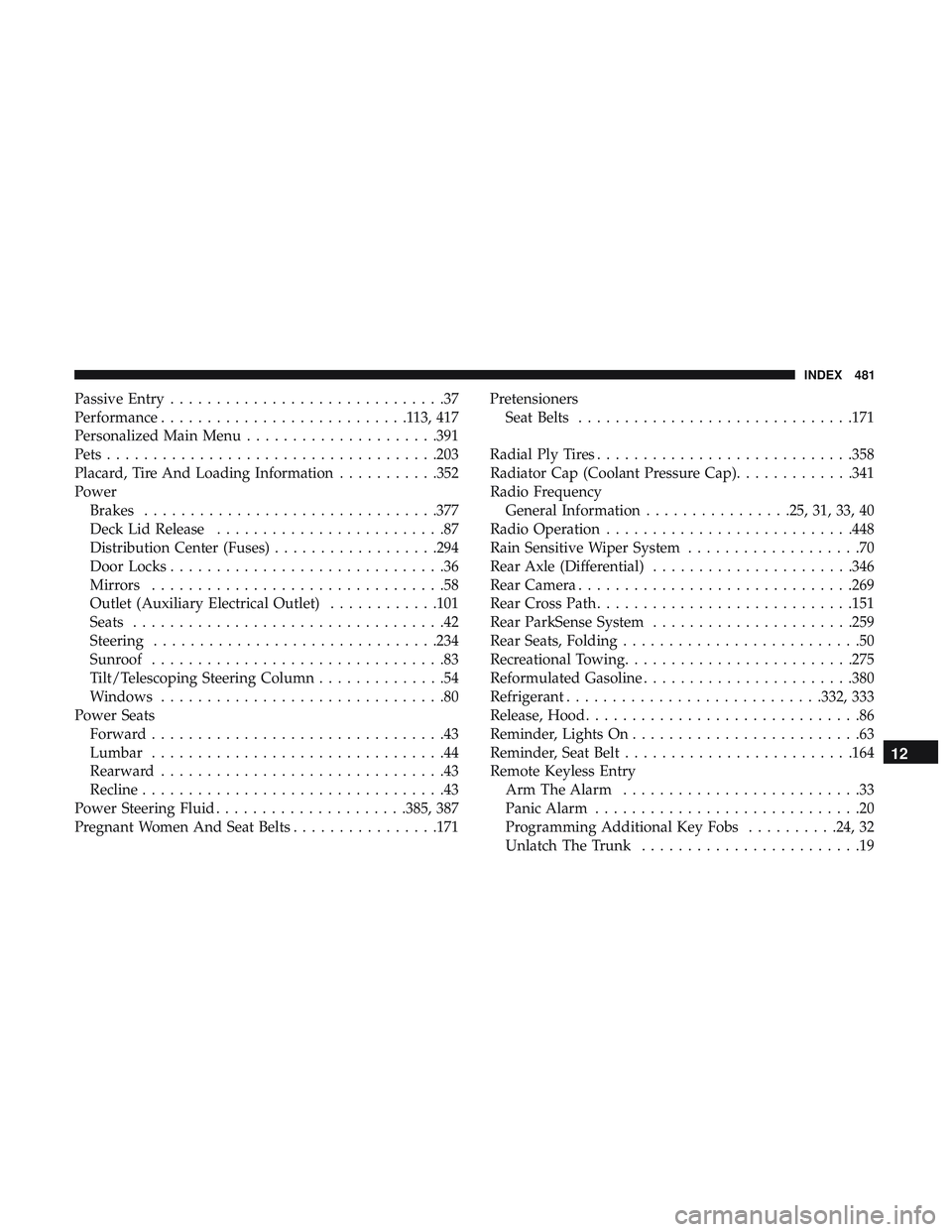
Passive Entry..............................37
Performance ...........................113,417
Personalized Main Menu .....................391
Pets ................................... .203
Placard, Tire And Loading Information ...........352
Power Brakes ............................... .377
Deck Lid Release .........................87
Distribution Center (Fuses) ..................294
Door Locks ..............................36
Mirrors ................................58
Outlet (Auxiliary Electrical Outlet) ............101
Seats ..................................42
Steering ...............................234
Sunroof ................................83
Tilt/Telescoping Steering Column ..............54
Windows ...............................80
Power Seats Forward ................................43
Lumbar ................................44
Rearward ...............................43
Recline .................................43
Power Steering Fluid .....................385, 387
Pregnant Women And Seat Belts ................171Pretensioners
Seat Belts ............................. .171
Radial Ply Tires ............................358
Radiator Cap (Coolant Pressure Cap) .............341
Radio Frequency General Information ................25, 31, 33, 40
Radio Operation .......................... .448
Rain Sensitive Wiper System ...................70
Rear Axle (Differential) ..................... .346
Rear Camera ............................. .269
Rear Cross Path ............................151
Rear ParkSense System ..................... .259
Rear Seats, Folding ..........................50
Recreational Towing ........................ .275
Reformulated Gasoline .......................380
Refrigerant ............................332, 333
Release, Hood ..............................86
Reminder, Lights On .........................63
Reminder, Seat Belt ........................ .164
Remote Keyless
Entry
Arm The Alarm ..........................33
Panic Alarm .............................20
Programming Additional Key Fobs ..........24, 32
Unlatch The Trunk ........................1912
INDEX 481