belt DODGE DAKOTA 2004 3.G Owner's Manual
[x] Cancel search | Manufacturer: DODGE, Model Year: 2004, Model line: DAKOTA, Model: DODGE DAKOTA 2004 3.GPages: 300, PDF Size: 5.23 MB
Page 45 of 300
Installing the Child Restraint System
WARNING!
Do not install child restraint systems equipped with
LATCH attachments in the center position of a Quad
Cab model rear seat. The LATCH anchorages in this
seat are designed for the two outboard seating posi-
tions only. A child may be placed in the rear center
seating position of a Quad Cab model using the seat
belt and child tether anchorage. Failure to follow this
may result in serious or fatal injury.
We urge that you carefully follow the directions of the
manufacturer when installing your child restraint. Many,
but not all, restraint systems will be equipped with
separate straps on each side, with each having a hook or
connector and a means for adjusting the tension in the
strap. Forward-facing toddler restraints and some
rearward-facing infant restraints will also be equipped
with a tether strap, a hook and means for adjusting the
tension in the strap.In general, you will first loosen the adjusters on the lower
straps and tether straps so that you can more easily attach
the hook or connector to the lower anchorages and tether
anchorages. Then tighten all three straps as you push the
child restraint rearward and downward into the seat.
Not all child restraint systems will be installed as we
have described here. Again, carefully follow the instruc-
tions that come with the child restraint system.
WARNING!
Improper installation of a child restraint to the
LATCH anchorages can lead to failure of an infant or
child restraint. The child could be badly injured or
killed. Follow the manufacturers directions exactly
when installing an infant or child restraint.
THINGS TO KNOW BEFORE STARTING YOUR VEHICLE 45
2
Page 46 of 300
Child Restraint Tether Anchor
Regular Cab models have two tether anchorages, one
behind each passenger seating position (front center and
right seat positions). Club Cab and Quad Cab models
have three anchorages, one behind each of the rear seat
positions (rear left, center, and right seat positions).
WARNING!
With a child restraint installed in the rear driver or
passenger side locations, use care when adjusting
the front seat(s) rearward, to avoid the front seat
back coming in contact with the belted child directly
behind the seat. The child could be injured.
WARNING!
Improper installation can lead to failure of an infant
or child restraint. It could come loose in a collision.
The child could be seriously injured or killed. Make
sure the child restraint tether strap is always routed
through the proper anchor strap inner loop.
Tether Straps at the Front Passenger's Seat (Regular
Cab With All Seats)
1. Route the child restraint tether strap up and over the
passenger seat back.
2. Thread the tether strap through the anchor strap inner
loop (loop with metal ring), located directly behind the
passenger's seat.
3. Route the tether strap across to the anchor strap
installed in the center, and attach the tether strap hook to
the anchor strap metal ring.
46 THINGS TO KNOW BEFORE STARTING YOUR VEHICLE
Page 52 of 300
WARNING!
An incorrectly anchored tether strap could lead to
seat failure and injury to the child. In a collision, the
seat could come loose and allow the child to crash
into the inside of the vehicle or other passengers, or
even be thrown from the vehicle. Use only the
anchor positions directly behind the child restraint
to secure a child restraint top tether strap. See your
dealer for help if necessary.
Children Too Large for Booster Seats
Children who are large enough to wear the shoulder belt
comfortably, and whose legs are long enough to bend
over the front of the seat when their back is against the
seat back should use the lap/shoulder belt in a rear seat.
²Make sure that the child is upright in the seat.
²The lap portion should be low on the hips and as snug
as possible.
²Check belt fit periodically. A child's squirming or
slouching can move the belt out of position.If the shoulder belt contacts the face or neck, move the
child closer to the center of the vehicle. If this doesn't
help, move the child to the center rear seating position
and use the lap belt. Never allow a child to put the
shoulder belt under an arm or behind their back.
ENGINE BREAK-IN RECOMMENDATIONS
A long break-in period is not required for the engine in
your new vehicle. Drive moderately during the first 300
miles (500 km). After the initial 60 miles (100 km), speeds
up to 50 or 55 mph (80 or 90 km/h) are desirable. While
cruising, brief full-throttle acceleration, within the limits
of local traffic laws, contributes to a good break-in.
Avoid wide open throttle acceleration in low gear.
The engine oil installed in the engine at the factory is a
high-quality, energy-conserving type lubricant. Oil
changes should be consistent with anticipated climate
conditions under which vehicle operations will occur.
The recommended viscosity and quality grades are
shown in Section 7.
NON-DETERGENT OR STRAIGHT MINERAL OILS
MUST NEVER BE USED.
52 THINGS TO KNOW BEFORE STARTING YOUR VEHICLE
Page 54 of 300

Safety Checks You Should Make Inside The
Vehicle
Seat Belts
Inspect the belt system periodically, checking for cuts,
frays and loose parts. Damaged parts must be replaced
immediately. Do not disassemble or modify the system.
Seat belt assemblies must be replaced after an accident if
they have been damaged (bent retractor, torn webbing,
etc.). If there is any question regarding belt or retractor
condition, replace the belt.
Defrosters
Check operation by selecting the defrost mode and place
the blower control on high speed. You can feel the air
directed against the windshield.
Safety Checks You Should Make Outside The
Vehicle:
Tires
Examine tires for tread wear or uneven wear patterns.
Check for stones, nails, glass or other objects lodged in
the tread.
Inspect for tread cuts or sidewall cracks. Check wheel
nuts for tightness and tires for proper pressure.
Lights
Have someone observe the operation of exterior lights as
you turn them on. Check turn signal and high beam
indicator lights on the instrument panel.
Door Latches
Check for positive closing, latching and locking.
Fluid Leaks
Check the area under vehicle after overnight parking for
fuel, water, oil, or other fluid leaks. Also, if gasoline
fumes are detected, the cause should be located and
corrected.
54 THINGS TO KNOW BEFORE STARTING YOUR VEHICLE
Page 62 of 300
WARNING!
Adjusting a seat while the vehicle is moving is
dangerous. The sudden movement of the seat could
cause you to lose control. The seat belt might not be
properly adjusted and you could be injured. Adjust
any seat only while the vehicle is parked.
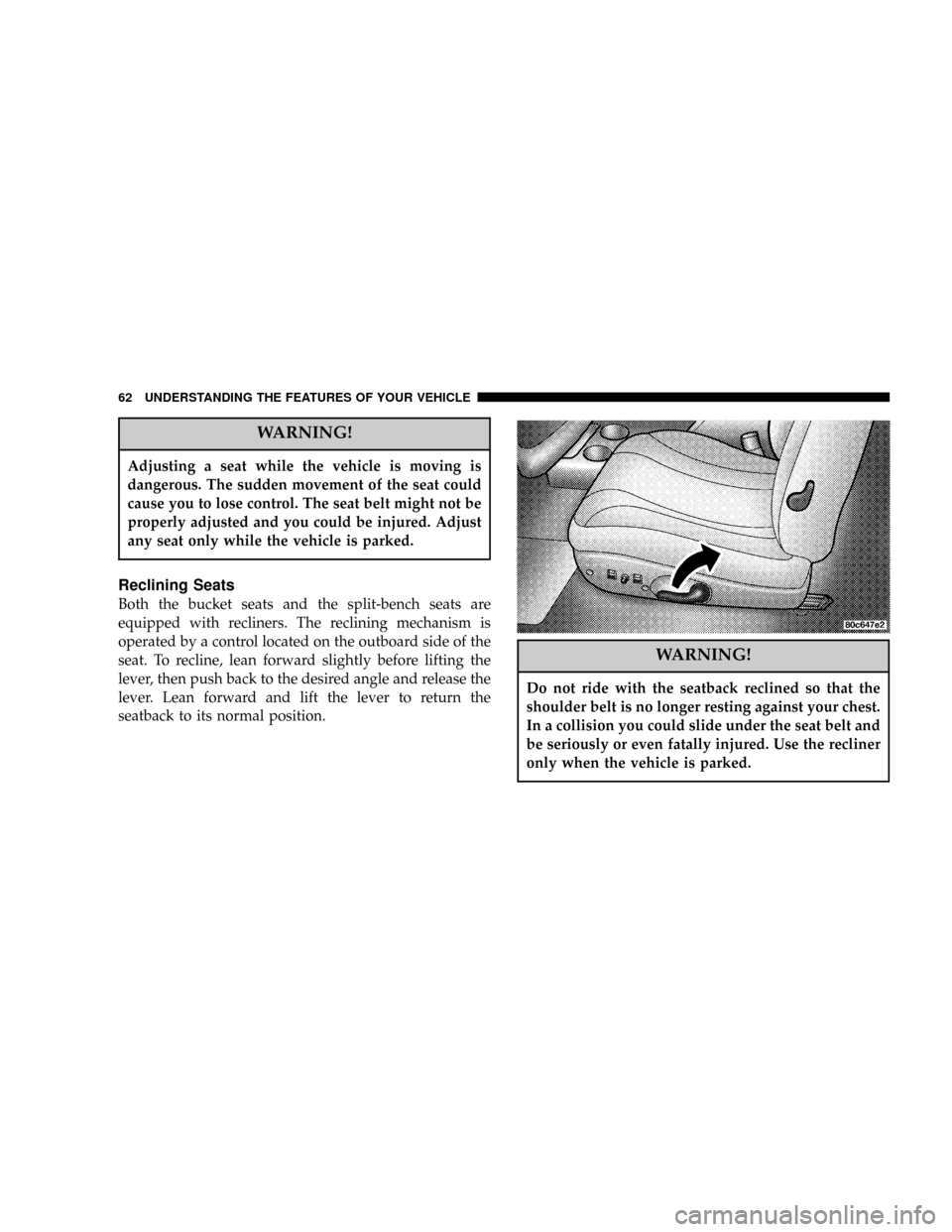
Reclining Seats
Both the bucket seats and the split-bench seats are
equipped with recliners. The reclining mechanism is
operated by a control located on the outboard side of the
seat. To recline, lean forward slightly before lifting the
lever, then push back to the desired angle and release the
lever. Lean forward and lift the lever to return the
seatback to its normal position.
WARNING!
Do not ride with the seatback reclined so that the
shoulder belt is no longer resting against your chest.
In a collision you could slide under the seat belt and
be seriously or even fatally injured. Use the recliner
only when the vehicle is parked.
62 UNDERSTANDING THE FEATURES OF YOUR VEHICLE
Page 64 of 300

Seatback ReleasesÐBucket And Split Bench
Both seats have a position latch release. To release the
seatback if you are on the outside of the vehicle, lift up on
the recliner lever located on the outboard side of the seat.
From the rear seat, lift the lever located on the rear of the
seatback.
Club Cab Easy Entry System
To allow easier access to the rear seat, the front passenger
seat will move to its full forward position when the
seatback is folded down. To fold the seatback forward if
you are on the outside of the vehicle, lift up on therecliner lever located on the outboard side of the seat.
From the rear seat, pull the cloth pull-tab located on the
rear or the seat cushion rearward until the latch releases,
and then push the seat forward. The seat will lock in
place when the back is returned to an upright position
and will need to be reset. However, the seat may be slid
rearward before returning the seatback to the upright
position to minimize the amount of readjustment re-
quired.
NOTE:Power seats are available with the Club or Quad
Cab models only.
CAUTION!
When operating the folding front seat, use care in
repositioning seat to its normal position. This will
prevent shoulder belt harness from being caught
behind seat or tangled in the seatback latching
mechanism.
64 UNDERSTANDING THE FEATURES OF YOUR VEHICLE
Page 65 of 300
WARNING!
It is extremely dangerous to ride in a cargo area,
inside or outside of a vehicle. In a collision, people
riding in these areas are more likely to be seriously
injured or killed.
Do not allow people to ride in any area of your
vehicle that is not equipped with seats and seat belts.
Be sure everyone in your vehicle is in a seat and
using a seat belt properly.
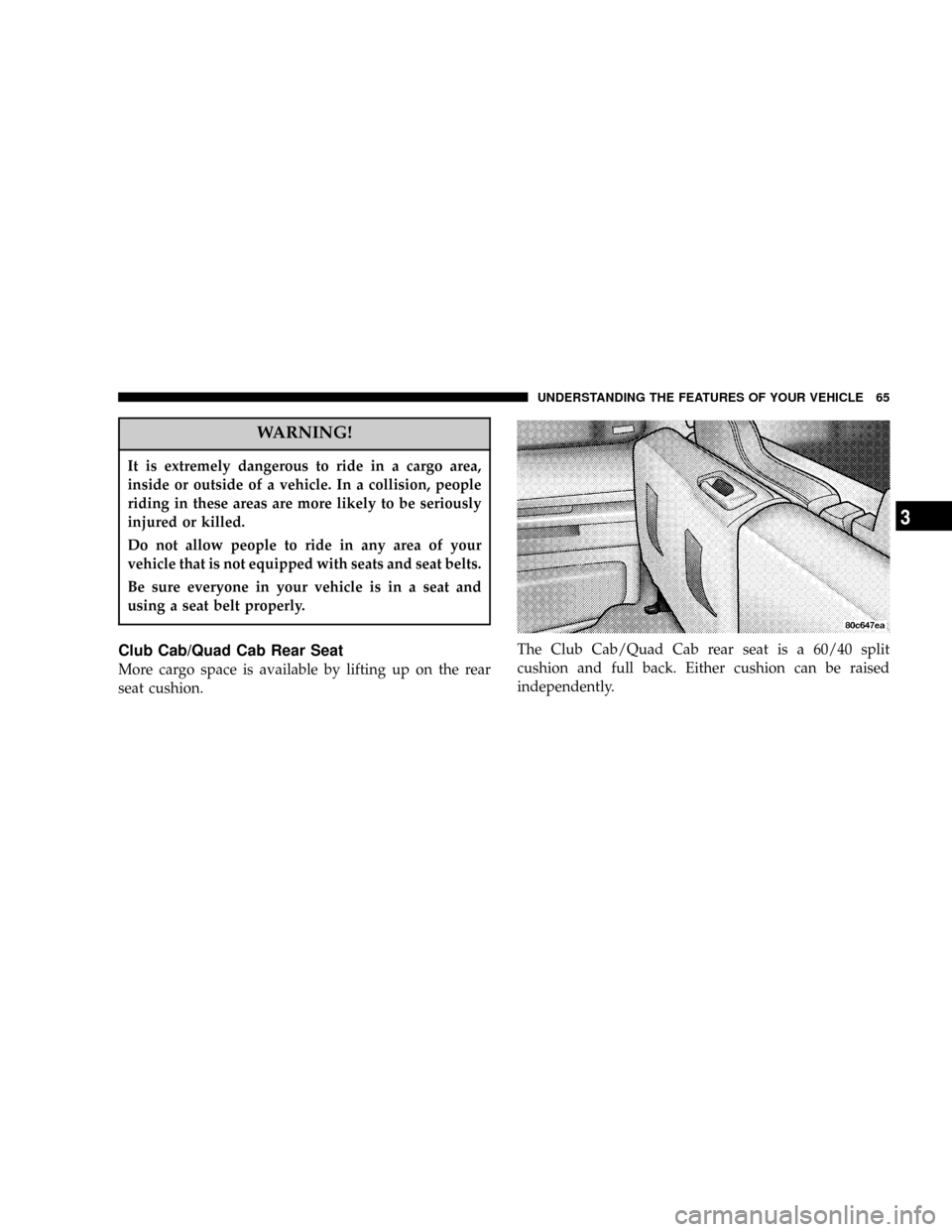
Club Cab/Quad Cab Rear Seat
More cargo space is available by lifting up on the rear
seat cushion.The Club Cab/Quad Cab rear seat is a 60/40 split
cushion and full back. Either cushion can be raised
independently.
UNDERSTANDING THE FEATURES OF YOUR VEHICLE 65
3
Page 101 of 300

12. Seat Belt Reminder Light
This light comes on for several seconds after the
ignition is turned ON as a reminder to ªbuckle
up.º This light will remain on as long as the seat
belt remains unbuckled. If this light flashes, it indi-
cates a fault in the airbag system. Have the system
checked by an authorized dealer.
13. Low Washer Fluid Indicator
This light comes on when the washer fluid level falls
below approximately 1/4 full. The light will remain on
until fluid is added and ignition switch is cycled.
14. Brake System Warning Light
This light will light when the ignition key is turned to the
ON position and will remain on for a few seconds. If the
light stays on, it may be an indication that the parking
brake has not been released, or there is a low brake fluid
level. If the light remains on when the parking brake has
been disengaged, and the fluid level is at the full mark on
the master cylinder reservoir, it indicates a possible brake
hydraulic system malfunction. In this case, the light will
remain on until the cause is corrected. If the parking
brake is applied, the light will flash when the gearposition is out of park for automatic transmissions, or the
engine RPM is greater than 0 for manual transmissions.
If brake failure is indicated, immediate repair is neces-
sary.Operating the vehicle in this condition is danger-
ous!
15. SERVICE 4WD Indicator
This light monitors the electric shift 4WD
system. This light will come on when the
ignition key is turned to the ON position and
will stay on for 2 seconds. If the light stays
on or comes on during driving, it means that the 4WD
system is not functioning properly and that service is
required.
16. Check Gages
This light illuminates when the Voltmeter, En-
gine Oil Pressure or Engine Coolant Tempera-
ture gages indicate a reading either too high or too
low. Examine the gages carefully, and follow the
instructions above for each indicated problem.
NOTE:
When the ignition switch is turned to OFF, the
Fuel Gage, Voltmeter, Oil Pressure and Engine Coolant
INSTRUMENT PANEL AND CONTROLS 101
4
Page 195 of 300
See your dealer or a reputable installer of aftermarket
equipment for further information on the installation of
these supports.
WARNING!
It is extremely dangerous to ride in a cargo area,
inside or outside of a vehicle. In a collision, people
riding in these areas are more likely to be seriously
injured or killed.
Do not allow people to ride in any area of your
vehicle that is not equipped with seats and seat belts.
Be sure every one in your vehicle is in a seat and
using a seat belt properly
TRAILER TOWING
To maintain warranty coverage, follow the requirements
and recommendations in this manual concerning ve-
hicles used for trailer towing.
Definitions
The following trailer towing related terminology defini-
tions will assist in understanding the subsequent sec-
tions:
GROSS COMBINATION WEIGHT RATING (GCWR)
is the total permissible weight of your vehicle and trailer
when weighed in combination. (Note that GCWR ratings
include a 68 kg (150 lb.) allowance for the presence of a
driver.) Tongue Weight (of a trailer) is the weight placed
on a vehicle's trailer hitch by the trailer.
GROSS TRAILER WEIGHT (GTW)is the weight of the
trailer plus the weight of all cargo, consumables and
equipment (permanent or temporary) loaded in or on the
trailer in its9loaded and ready for operation9condition.
TRAILER SWAY CONTROLis a telescoping link that
can be installed between the hitch receiver and the trailer
STARTING AND OPERATING 195
5
Page 217 of 300
WARNING!
Do not connect the cable to the negative post of the
discharge battery. The resulting electrical spark
could cause the battery to explode.
During cold weather when temperatures are below
freezing point, electrolyte in a discharged battery
may freeze. Do not attempt jump starting because
the battery could rupture or explode. The battery
temperature must be brought up above freezing
point before attempting jump start.
6. Start the engine in the vehicle which has the booster
battery, let the engine idle a few minutes, then start the
engine in the vehicle with the discharged battery.
7. When removing the jumper cables, reverse the above
sequence exactly. Be careful of the moving belts and fan.
WARNING!
Any procedure other than above could result in:
1. Personal injury caused by electrolyte squirting
out the battery vent;
2. Personal injury or property damage due to battery
explosion;
3. Damage to charging system of booster vehicle or
of immobilized vehicle.
TOWING A DISABLED VEHICLE
Proper towing or lifting equipment is required to prevent
damage to your vehicle. Use of safety chains is recom-
mended.Attach towing device to main structural mem-
bers of the vehicle Ð not to bumpers or associated
brackets. State and local laws applying to vehicles
under tow must be observed.
WHAT TO DO IN EMERGENCIES 217
6