warning light DODGE DAKOTA 2004 3.G Owner's Manual
[x] Cancel search | Manufacturer: DODGE, Model Year: 2004, Model line: DAKOTA, Model: DODGE DAKOTA 2004 3.GPages: 300, PDF Size: 5.23 MB
Page 165 of 300

During severe braking conditions, particularly with
changing road surfaces, such as ice to concrete, a slight
drop or minor pulsation may be felt in the brake pedal.
WARNING!
Both Anti-Lock Brake Systems contain sophisticated
electronic equipment. It may be susceptible to inter-
ference caused by improperly installed or high out-
put radio transmitting equipment. This interference
can cause possible loss of anti-lock braking capabil-
ity. Installation of such equipment should be done
by qualified professionals.
Four-Wheel Anti-Lock Brake System Ð If
Equipped
This Anti-Lock Brake System is designed to aid the driver
in maintaining vehicle control under adverse braking
conditions. The system operates with a separate com-
puter to modulate hydraulic pressure to prevent wheel
lock-up and help avoid skidding on slippery surfaces.The system's pump motor runs during an ABS stop to
provide regulated hydraulic pressure. The pump motor
makes a low humming noise during operation, which is
normal.
The Anti-Lock Brake System includes an amber ABS
warning light. When the light is illuminated, the Anti-
Lock Brake System is not functioning. The system reverts
to standard non-anti-lock brakes. Turning the ignition
OFF and ON again may reset the Anti-Lock Brake System
if the fault detected was only momentary.
WARNING!
Pumping of the Anti-Lock Brakes will diminish
their effectiveness and may lead to an accident.
Pumping makes the stopping distance longer. Just
press firmly on your brake pedal when you need to
slow down or stop.
STARTING AND OPERATING 165
5
Page 187 of 300
WARNING!
²Remove the fuel tank filler tube cap (gas cap)
slowly to prevent fuel spray from the filler neck
which may cause injury.
²The volatility of some gasolines may cause a
buildup of pressure in the fuel tank that may
increase while you drive. This pressure can result
in a spray of gasoline and/or vapors when the cap
is removed from a hot vehicle. Removing the cap
slowly allows the pressure to vent and prevents
fuel spray.
²Never allow any lit smoking materials near the
vehicles while removing the cap or filling the
tank.
²Never add fuel to the vehicle when the engine is
running.
Fuel Tank Filler Tube
NOTE:
On some models, the fuel tank filler tube has a
restricting door about 2 inches (50 mm) down from the
opening. If fuel is poured from a portable container, the
container should have a flexible nozzle long enough to
force open the restricting door.
CAUTION!
To avoid fuel spillage and overfilling, do not ªtop
offº the fuel tank after filling.
NOTE:When the fuel nozzle ªclicksº or shuts off, the
fuel tank is full.
NOTE:Tighten the gas cap until you hear a ªclickingº
sound. This is an indication that the gas cap is properly
tightened.
The Check Engine light will come on if the gas cap is
not properly secured. Make sure that the gas cap is
tightened each time the vehicle is refueled.
STARTING AND OPERATING 187
5
Page 188 of 300
WARNING!
A fire may result if gasoline is pumped into a
portable container that is inside of a vehicle. You
could be burned. Always place gas containers on the
ground while filling.
Fuel System Cautions
CAUTION!
Follow these guidelines to maintain your vehicle's
performance:
²The use of leaded gas is prohibited by Federal law.
Using leaded gasoline can impair engine performance,
damage the emission control system, and could result
in loss of warranty coverage.
²An out-of-tune engine, or certain fuel or ignition
malfunctions, can cause the catalytic converter to
overheat. If you notice a pungent burning odor orsome light smoke, your engine may be out of tune or
malfunctioning and may require immediate service.
Contact your dealer for service assistance.
²When pulling a heavy load or driving a fully loaded
vehicle when the humidity is low and the temperature
is high, use a premium unleaded fuel to help prevent
spark knock. If spark knock persists, lighten the load,
or engine piston damage may result.
²The use of fuel additives which are now being sold as
octane enhancers is not recommended. Most of these
products contain high concentrations of methanol.
Fuel system damage or vehicle performance problems
resulting from the use of such fuels or additives is not
the responsibility of the manufacturer and may not be
covered under the New Vehicle Warranty.
NOTE:Intentional tampering with emissions control
systems can result in civil penalties being assessed
against you.
188 STARTING AND OPERATING
Page 200 of 300
of the trailer lights and assure their proper functioning, a
heavy duty turn signal flasher can be installed as a
separate equipment item by your dealer.
WARNING!
The direct connection of hydraulic brake lines from
vehicle brake system to trailer system is not accept-
able. The extra load may cause brake failure and you
may be injured.
Heavy trailer towing also may require breakaway electric
trailer brakes, anti-sway devices or equalizing hitches for
safe operation. Such devices are commonly required by
state law.
For all trailer tow or heavy-duty applications it is
strongly recommended that the factory fill rear axle
lubricant be replaced with an SAE 75W-140 synthetic
gear lubricant. MopartSynthetic Gear Lubricant is of
this type.
Trailer Tow Wiring
The Trailer Tow Package includes a wiring harness
located at the rear underbody of the vehicle.
NOTE:Connect trailer lighting and brakes using fac-
tory harnesses only. Do not cut or splice wiring to the
brake circuits.
The electrical connections are all complete to the vehicle
but you must mate the harness to a trailer connector.
Refer to the following table for wire color and function.
Wire Color Function
Black Ground Wire
Blue Trailer Brake
Black/Orange Tail & Running Lamps
Red/Tan Battery
Dk. Green/Red Lt. Stop & Turn Signal
Brown/Red Rt. Stop & Turn Signal
Violet/Black Backup Lamps
200 STARTING AND OPERATING
Page 205 of 300

NOTE:The ignition key must be ON for a shift to take
place and for the position indicator lights to be operable.
If the key is not ON, the shift will not take place and no
position indicator lights will be on or flashing.
NOTE:Flashing neutral (N) position indicator light
indicates that shift requirements have not been met.
WARNING!
You or others could be injured if you leave the
vehicle unattended with the transfer case in the
Neutral (N) position without first fully engaging the
parking brake. The transfer case Neutral (N) position
disengages both the front and rear driveshafts from
the powertrain and will allow the vehicle to move
despite the transmission position. The parking
brake should always be applied when the driver is
not in the vehicle.
CAUTION!
²Do not use a bumper mounted clamp-on tow bar
on your vehicle. The bumper face bar will be
damaged.
²Do not disconnect the rear driveshaft because
fluid will leak from the transfer case and damage
internal parts.
STARTING AND OPERATING 205
5
Page 213 of 300
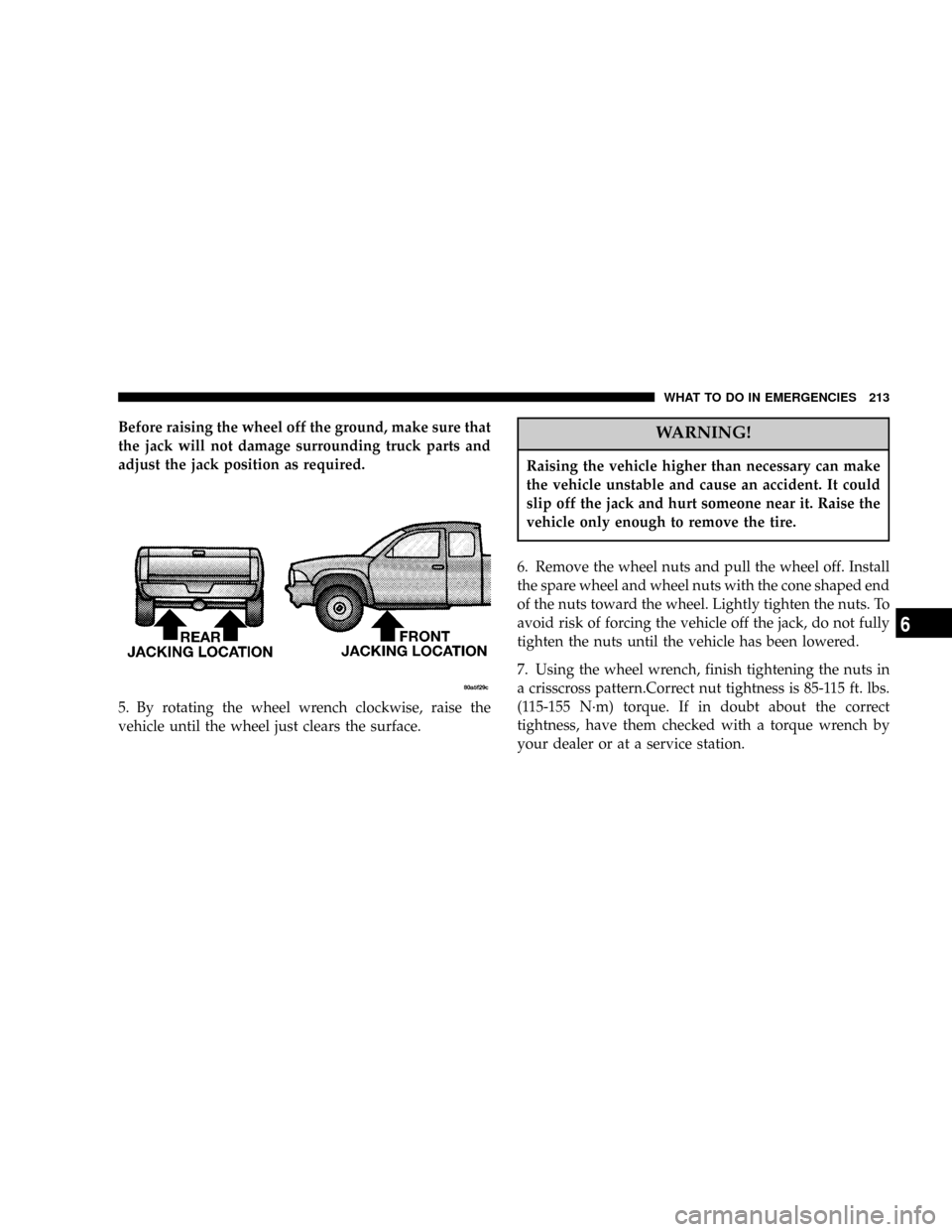
Before raising the wheel off the ground, make sure that
the jack will not damage surrounding truck parts and
adjust the jack position as required.
5. By rotating the wheel wrench clockwise, raise the
vehicle until the wheel just clears the surface.WARNING!
Raising the vehicle higher than necessary can make
the vehicle unstable and cause an accident. It could
slip off the jack and hurt someone near it. Raise the
vehicle only enough to remove the tire.
6. Remove the wheel nuts and pull the wheel off. Install
the spare wheel and wheel nuts with the cone shaped end
of the nuts toward the wheel. Lightly tighten the nuts. To
avoid risk of forcing the vehicle off the jack, do not fully
tighten the nuts until the vehicle has been lowered.
7. Using the wheel wrench, finish tightening the nuts in
a crisscross pattern.Correct nut tightness is 85-115 ft. lbs.
(115-155 N´m) torque. If in doubt about the correct
tightness, have them checked with a torque wrench by
your dealer or at a service station.
WHAT TO DO IN EMERGENCIES 213
6
Page 243 of 300

Brake System
Power Disc Brakes (Front)
Disc brakes do not require adjustment; however, several
hard stops during the break-in period are recommended
to seat the linings and wear off any foreign material.
Self-Adjusting Rear Brakes
To maintain the correct adjustment, you need only drive
your vehicle in reverse and apply the brakes. If further
adjustment is needed, drive forward about 20 feet (6
meters) before you repeat the reverse application. To
avoid poor braking, brake pull, or damage to brake
drums, the brake linings should be inspected as specified
in the Maintenance Schedule.
Brake Master Cylinders
The fluid level in the master cylinders should be checked
whenever the vehicle is serviced, or immediately if the
brake system warning light is on. If necessary, add fluid
to bring level to the full mark on the side of the reservoir
of the brake master cylinder. Be sure to clean the top of
the master cylinder area before removing the cap. With
disc brakes, fluid level can be expected to fall as the brakepads wear. Brake fluid level should be checked when
pads are replaced. If the brake fluid level is abnormally
low, check system for leaks.
Refer to Recommended Fluids, Lubricants and Genuine
Parts for correct fluid type.
MAINTAINING YOUR VEHICLE 243
7
Page 254 of 300

NOTE:If you are leaving your vehicle dormant for
longer than 21 days, you may want to take steps to
protect your battery. You may do this by disconnecting
the battery or by disconnecting the ignition-off draw
(I.O.D.) fuse in cavity #12. The I.O.D. cavity includes a
snap-in retainer that allows the fuse to be disconnected,
without removing it from the fuse block. Pressing the
I.O.D. fuse back into the cavity reconnects it.
VEHICLE STORAGE
If you are storing your vehicle for more than 21 days, we
recommend that you take the following steps to mini-
mize the drain on your vehicle's battery:
²Disconnect the Ignition-Off Draw fuse (I.O.D.) fuse
located in cavity #12 of the fuse block. The I.O.D.
cavity includes a snap-in retainer that allows the fuse
to be disconnected, without removing it from the fuse
block.
²The transfer case should be placed in the 4HI mode
and kept in this position to minimize the battery drain.
²As an alternative to the above steps you may discon-
nect the negative cable from the battery.
REPLACEMENT LIGHT BULBS
LIGHT BULBS Ð Inside Bulb No.
A/C Control............................. 74
Ash Tray.............................. 161
Brake System Warning Indicator.............. 194
Dome Light............................ 579
EGR Reminder.......................... 194
Glove Box.............................. 194
Heater Control.......................... 158
High Beam Indicator...................... 194
Instrument Cluster........................ 194
Low Fuel Indicator....................... 194
Low Washer Fluid Indicator................. 194
Oil Indicator............................ 194
Overhead Console........................ 578
Seat Belt Indicator........................ 194
Switched Dome.......................... 578
Temperature Indicator..................... 194
Turn Signals............................ 194
Underhood Light......................... 561
4x4 Shift Indicator........................ 161
254 MAINTAINING YOUR VEHICLE
Page 288 of 300

Adding Engine Coolant (Antifreeze)......... 239
Adding Fuel........................186,208
Air Conditioner Maintenance.............. 233
Air Conditioning....................... 134
Air Conditioning, Operating Tips........135,137
Air Conditioning Refrigerant.............. 234
Air Conditioning System................. 134
Air Pressure, Tires...................176,182
Airbag...........................31,34,102
Airbag Light........................... 38
Airbag On/Off Switch.................... 34
Alarm.............................21,102
Alarm, Panic........................... 19
Alignment and Balance.................. 181
Alterations/Modifications, Vehicle............ 5
Antifreeze (Engine Coolant)............238,258
Anti-Lock Brake System...............164,165
Anti-Lock Warning Light................. 102
Anti-Theft System....................21,102
Appearance Care....................... 249
Automatic Dimming Mirror................ 59
Automatic Transmission............144,146,245
Adding Fluid........................ 246Fluid and Filter Changes................ 247
Fluid Level Check..................... 245
Fluid Type.......................247,260
Gear Ranges......................... 147
Overdrive........................... 148
Shifting............................ 146
Special Additives..................... 247
Torque Converter..................... 149
Axle Fluid............................ 260
Axle Lubrication....................... 248
Backfire, Engine........................ 190
Ball Joints............................ 235
Battery............................... 232
Charging........................... 215
Emergency Starting.................... 215
Gas Caution......................... 215
Keyless Transmitter Replacement.......... 21
Saving Feature........................ 68
Belts, Drive........................... 230
Belts, Seat............................. 25
Body Mechanism Lubrication.............. 235
B-Pillar Location....................... 172
288 INDEX
Page 289 of 300

Brake Fluid........................... 260
Brake System.......................164,243
Anti-Lock........................164,165
Disc Brakes.......................... 243
Fluid Check......................... 243
Hoses.............................. 244
Master Cylinder...................... 243
Parking............................ 163
Self-Adjusting Rear.................... 243
Warning Light....................... 101
Brake/Transmission Interlock.............. 146
Break-In Recommendations, New Vehicle...... 52
Bulb Replacement...................... 255
Bulbs, Light........................... 254
Camper............................... 90
Capacities, Fluid....................... 258
Capacity, Cargo Weight.................. 191
Caps, Filler
Fuel............................... 186
Power Steering....................... 234
Car Washes........................... 250
Carbon Monoxide Warning.............91,189Cargo ............................... 191
Cargo Area Features..................... 194
Cargo Light.........................70,102
Cassette Tape and Player Maintenance....... 131
Cassette Tape Player...............106,119,121
Catalytic Converter..................189,231
CD Changer..................... 113,117,122
CD Player................. 110,114,116,124,126
Cellular Phone......................... 132
Center High Mounted Stop Light........... 257
Center Lap Belts........................ 30
Center Seat Storage Compartment........... 89
Certification Label...................... 191
Changing A Flat Tire.................... 209
Charging............................. 215
Chart, Tire Sizing....................... 169
Child Restraint.....................38,39,52
Child Restraint Tether Anchors...........42,46
Child Safety Locks....................... 16
Child Seat............................. 45
Climate Control........................ 133
Clock................................ 105
Club Cab............................24,64
INDEX 289
10