tow DODGE DAKOTA 2004 3.G Owner's Guide
[x] Cancel search | Manufacturer: DODGE, Model Year: 2004, Model line: DAKOTA, Model: DODGE DAKOTA 2004 3.GPages: 300, PDF Size: 5.23 MB
Page 198 of 300

to 65% of the weight in the front of the trailer. This places
10% to 15% of the GTW on the tow hitch of your vehicle.
Trailer sway control and equalizing hitch are required for
tongue weights above 350 lbs. (159 kg).
Trailer TowingÐHitches:
With a Class I Hitch, your vehicle can be equipped to tow
trailers with a Gross Trailer Weight (GTW) of 2,000 lbs.
(907 kg) maximum. Vehicles equipped with a rear step
bumper are rated for a Class I Hitch.With a Class II Hitch, your vehicle can be equipped to
tow trailers with a Gross Trailer Weight (GTW) of 3,500
lbs. (1,587 kg) maximum. Tongue weight must be equal to
at least 10% of GTW, but no more that 15% of GTW.
With a Class III Hitch, your vehicle can be equipped to
tow trailers with a Gross Trailer Weight (GTW) of 5,000
lbs. (2,268 kg) maximum. Tongue weight must be equal to
at least 10% of GTW, but no more that 15% of GTW.
With a Class IV Hitch, you can tow a trailer with a Gross
Trailer Weight of up to 6,700 lbs. (3039 kg.) depending on
your vehicle equipment. The Trailer Tow Package in-
cludes the platform hitch receiver, and a 7 lead wiring
harness mounted on the hitch.
NOTE:When towing a trailer, the following require-
ments must be adhered to:
²GCWR must not be exceeded
²Total weight must be distributed between the tow
vehicle and the trailer such that the following four
(4) ratings are not exceeded:
1.GVWR
198 STARTING AND OPERATING
Page 199 of 300
![DODGE DAKOTA 2004 3.G Owners Guide 2.GTW
3.Tongue weight rating for the trailer hitch uti-
lized (This requirement may limit the ability to
always achieve the 10% to 15% range of tongue
weight [15% to 25% for a(5th Wheel(style trailer]](/img/12/5586/w960_5586-198.png "DODGE DAKOTA 2004 3.G Owners Guide 2.GTW
3.Tongue weight rating for the trailer hitch uti-
lized (This requirement may limit the ability to
always achieve the 10% to 15% range of tongue
weight [15% to 25% for a(5th Wheel(style trailer]")
2.GTW
3.Tongue weight rating for the trailer hitch uti-
lized (This requirement may limit the ability to
always achieve the 10% to 15% range of tongue
weight [15% to 25% for a(5th Wheel(style trailer]
as a percentage of total trailer weight.)
4.GAWR ratings
NOTE:
Towing a trailer equipped with more than the
standard lighting (turn, tail, stop and backup lights) may
cause an abnormally high electrical current draw through
the headlight switch, causing the switch to fail. To
prevent a recurring switch failure install a trailer tow
wiring harness overlay kit with relay to bypass headlight
switch (available from your dealer).
Trailer Towing Information (Maximum Trailer
Weight Ratings)
(Trailer Towing Guide(
NOTE:
For trailer towing information (maximum
trailer weight ratings) refer to the following website
address:http:// www.dodge.com/towing.
In Canada, refer to the following website address:
http:// www.dodge.ca.
Trailer Towing Requirements
All Dodge Dakota trucks are intended to tow trailers up
to 2,000 lbs. without added equipment or alterations to
standard equipment. Your vehicle may be factory
equipped for safe towing of trailers weighing over 2,000
lbs. with the Trailer Tow Package. The electrical part of
this package includes an instruction sheet, a 7/4 pin
adaptor, a wiring pigtail for an aftermarket electric trailer
brake controller, and three relays that must be installed
into the power distribution center. These items are stored
in the glove box. Also included in the Trailer Tow
Package are two fuses and a relay that are located on the
driver's side of the engine compartment on a harness
near the Power Distribution Center. This relay and the
fuses power up the trailer towing option. See your Dodge
dealer for further information.
If you regularly pull a trailer, regardless of the trailer size,
stop and turn signals on the trailer are recommended for
motoring safety. To handle the additional electrical load
STARTING AND OPERATING 199
5
Page 200 of 300
of the trailer lights and assure their proper functioning, a
heavy duty turn signal flasher can be installed as a
separate equipment item by your dealer.
WARNING!
The direct connection of hydraulic brake lines from
vehicle brake system to trailer system is not accept-
able. The extra load may cause brake failure and you
may be injured.
Heavy trailer towing also may require breakaway electric
trailer brakes, anti-sway devices or equalizing hitches for
safe operation. Such devices are commonly required by
state law.
For all trailer tow or heavy-duty applications it is
strongly recommended that the factory fill rear axle
lubricant be replaced with an SAE 75W-140 synthetic
gear lubricant. MopartSynthetic Gear Lubricant is of
this type.
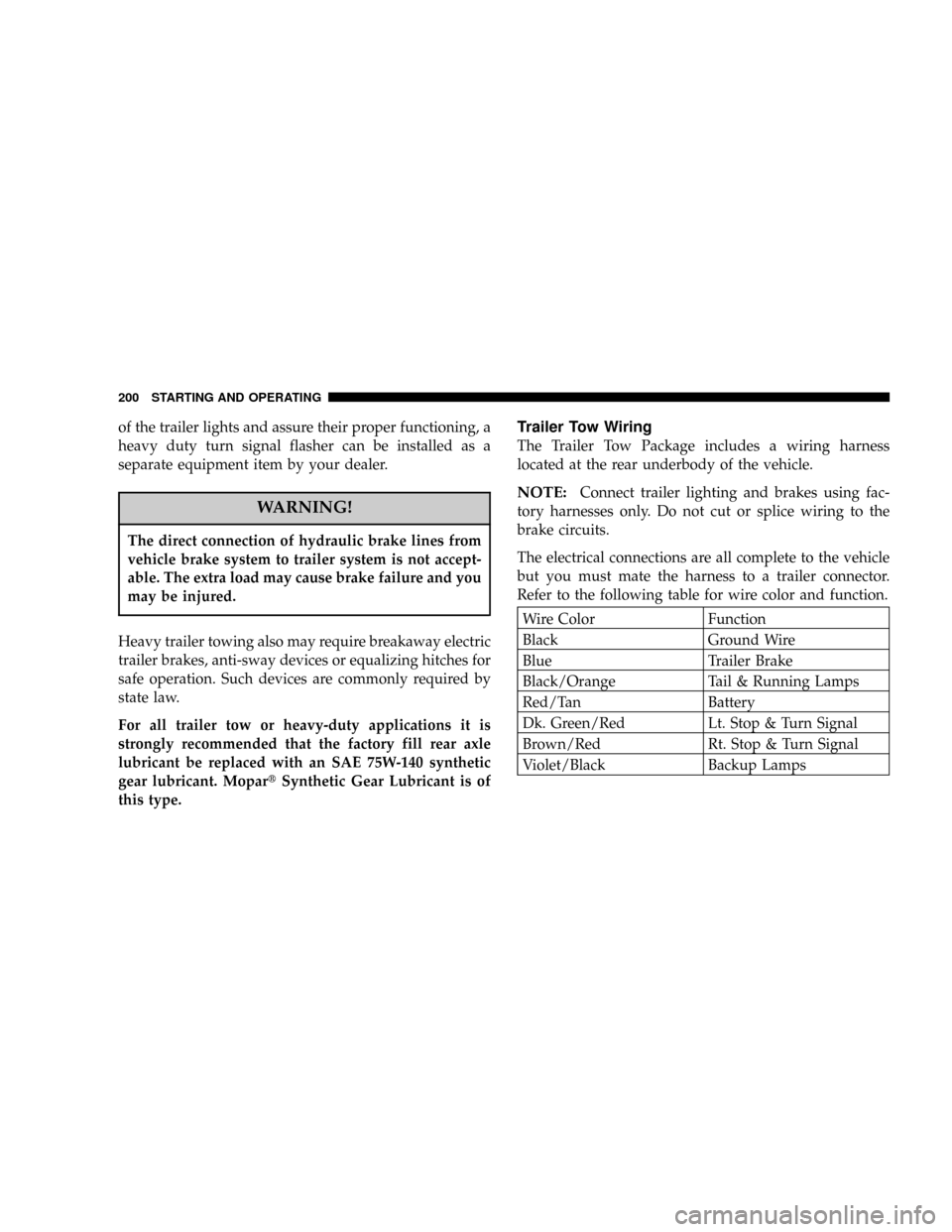
Trailer Tow Wiring
The Trailer Tow Package includes a wiring harness
located at the rear underbody of the vehicle.
NOTE:Connect trailer lighting and brakes using fac-
tory harnesses only. Do not cut or splice wiring to the
brake circuits.
The electrical connections are all complete to the vehicle
but you must mate the harness to a trailer connector.
Refer to the following table for wire color and function.
Wire Color Function
Black Ground Wire
Blue Trailer Brake
Black/Orange Tail & Running Lamps
Red/Tan Battery
Dk. Green/Red Lt. Stop & Turn Signal
Brown/Red Rt. Stop & Turn Signal
Violet/Black Backup Lamps
200 STARTING AND OPERATING
Page 201 of 300

Cooling System TipsÐTrailer Towing
To reduce potential for engine and transmission over-
heating, take the following actions:
²City DrivingÐWhen stopped for short periods of
time, put transmission in neutral and increase engine
idle speed.
²Highway DrivingÐReduce your speed.
²Air ConditioningÐTurn off temporarily.
See Cooling System Operating information in the Main-
tenance section of this manual for more information.
To reduce potential for automatic transmission overheat-
ing, turn the Overdrive OFF when driving in hilly areas
or shift the transmission to Drive position 2 on more
severe grades. Move the shift lever to the next lower
position to eliminate excessive transmission shifting. This
action will also reduce the possibility of transmission
overheating and provide better engine braking.
NOTE:If your vehicle has an automatic transmission
and you tow a trailer frequently follow Maintenance
Schedule ªBº.
SNOWPLOW
Dodge Dakota Models
NOTE:
Do not use Dodge Dakota Models for snow-
plow applications.
WARNING!
Snowplows, winches, and other aftermarket equip-
ment should not be added to the front end or your
vehicle. The airbag crash sensors may be affected by
the change in the front end structure. The airbags
could deploy unexpectedly or could fail to deploy
during a collision resulting in serious injury or
death.
CAUTION!
Using this vehicle for snowplow applications can
cause damage to the vehicle.
STARTING AND OPERATING 201
5
Page 202 of 300

RECREATIONAL TOWING (BEHIND
MOTORHOME, ETC.) OF 4X4 VEHICLES
CAUTION!
Internal damage to the transfer case will occur if a
front or rear wheel lift is used when recreational
towing.
NOTE:Both the NV233 and NV244 transfer cases must
be shifted into Neutral (N) for recreational towing. The
Neutral (N) selection button is located on the lower left
hand corner of the 4WD Control Switch. Shifts into and
out of transfer case Neutral (N) can take place with the
selector switch in any mode position. Automatic Trans-
missions must be placed in P (Park) position for recre-
ational towing. Manual Transmissions must be placed in
gear (for example, 4th gear) for recreational towing.
Recreational Towing Procedure
Use the following procedure to prepare your vehicle for
recreational towing.
CAUTION!
It is necessary to follow these steps to be certain that
the transfer case is fully in Neutral (N) before
recreational towing to prevent damage to internal
parts.
1. Bring vehicle to a complete stop.
2. Shut engine OFF.
3. Place ignition key in the ON position.
4. Depress brake pedal.
5. Shift automatic transmission to Neutral (N) or depress
clutch on manual transmission.
202 STARTING AND OPERATING
Page 203 of 300

6. Using the point of a ballpoint pen or similar object,
depress the recessed transfer case Neutral (N) button for
4 seconds.
7. After shift is completed and the Neutral (N) light
comes on release Neutral (N) button.
8. Start engine.
9. Shift automatic transmission into Reverse (R).
10. Release brake pedal for five seconds and ensure that
there is no vehicle movement.
11. Repeat steps 9 and 10 with the transmission in Drive
(D).
12. Shut engine OFF and place ignition key to the
unlocked OFF position.
13. Shift automatic transmission into Park (P). Shift
Manual transmissions into 4th gear.
14. Attach vehicle to tow vehicle with tow bar.NOTE:Items 1 through 5 are requirements that must be
met prior to depressing the Neutral (N) selection button,
and must continue to be met until the 4 seconds elaspes
and the shift has been completed. If any of these require-
ments (with the exception of 3 - Key ON) are not met
prior to depressing the Neutral (N) button or are no
longer met during the 4 second timer, then the Neutral
(N) indicator light will flash continuously until all re-
quirements are met or until the Neutral (N) button is
released.
NOTE:The ignition key must be ON for a shift to take
place and for the position indicator lights to be operable.
If the key in not ON, the shift will not take place and no
position indicator lights will be on or flashing.
NOTE:Flashing neutral (N) position indicator light
indicates that shift requirements have not been met.
STARTING AND OPERATING 203
5
Page 205 of 300

NOTE:The ignition key must be ON for a shift to take
place and for the position indicator lights to be operable.
If the key is not ON, the shift will not take place and no
position indicator lights will be on or flashing.
NOTE:Flashing neutral (N) position indicator light
indicates that shift requirements have not been met.
WARNING!
You or others could be injured if you leave the
vehicle unattended with the transfer case in the
Neutral (N) position without first fully engaging the
parking brake. The transfer case Neutral (N) position
disengages both the front and rear driveshafts from
the powertrain and will allow the vehicle to move
despite the transmission position. The parking
brake should always be applied when the driver is
not in the vehicle.
CAUTION!
²Do not use a bumper mounted clamp-on tow bar
on your vehicle. The bumper face bar will be
damaged.
²Do not disconnect the rear driveshaft because
fluid will leak from the transfer case and damage
internal parts.
STARTING AND OPERATING 205
5
Page 207 of 300

WHAT TO DO IN EMERGENCIES
CONTENTS
mHazard Warning Flasher.................208
mAdding Fuel..........................208
mChanging A Flat Tire...................209
NJack Location........................209
NJack Removal And Stowage..............210
NRemoving The Spare Tire................210NTire Changing Procedure................211
mJump Starting.........................215
mTowing A Disabled Vehicle...............217
NFour-Wheel Drive Vehicles...............218
NTwo-Wheel Drive Vehicles...............218
6
Page 209 of 300
WARNING!
Remove the gas cap slowly to prevent fuel spray
from the filler neck which may cause injury.
The volatility of present gasolines may cause a build
up of pressure in the fuel tank that may increase
while you drive. This pressure can result in a spray
of gasoline and/or vapors when you remove the cap
from a hot vehicle. Removing the cap slowly allows
the pressure to vent and prevents fuel spray.
Never allow any lit smoking materials near the
vehicles while removing the cap or filling the tank.
Never add fuel to the vehicle when the engine is
running.
CHANGING A FLAT TIRE
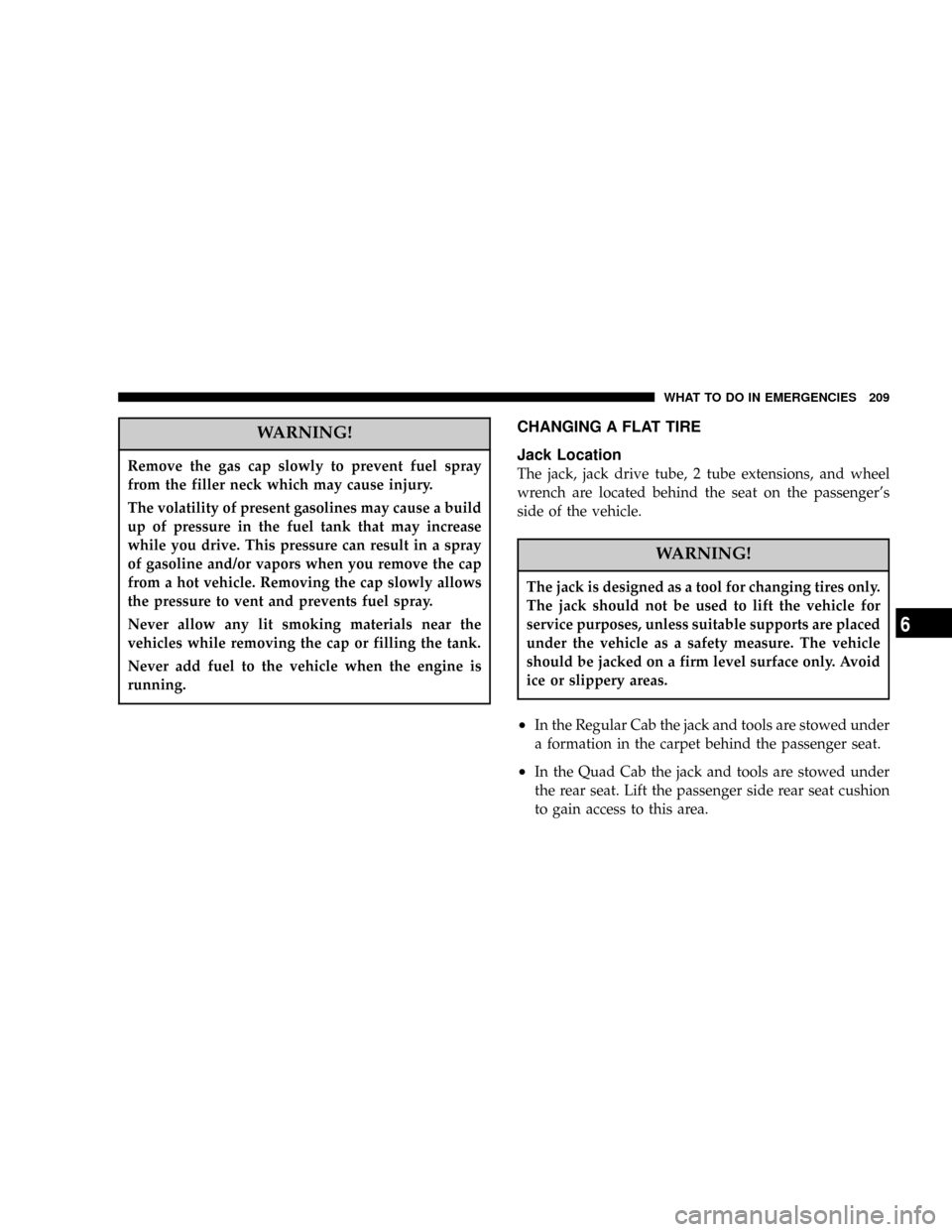
Jack Location
The jack, jack drive tube, 2 tube extensions, and wheel
wrench are located behind the seat on the passenger's
side of the vehicle.
WARNING!
The jack is designed as a tool for changing tires only.
The jack should not be used to lift the vehicle for
service purposes, unless suitable supports are placed
under the vehicle as a safety measure. The vehicle
should be jacked on a firm level surface only. Avoid
ice or slippery areas.
²In the Regular Cab the jack and tools are stowed under
a formation in the carpet behind the passenger seat.
²In the Quad Cab the jack and tools are stowed under
the rear seat. Lift the passenger side rear seat cushion
to gain access to this area.
WHAT TO DO IN EMERGENCIES 209
6
Page 210 of 300

²In the Club Cab the jack and tools are stowed in a floor
compartment located under the rear seat on the pas-
senger's side of the vehicle. The seat cushion can be
lifted to a vertical position to allow access to this
compartment.
Jack Removal and Stowage
a. Quad Cab models have a Hoop±Style stowage follow
the instructions below:
²For jack removal, turn the screw counterclockwise
to remove the jack from beneath the retaining hoop.
²For jack stowage, place the jack beneath the retain-
ing hoop and turn the jack screw clockwise until the
jack is firmly secured within the retaining hoop.
Refer to the graphic below. The seat has been
removed for clarity.
Removing The Spare Tire
Remove the spare tire before attempting to jack the truck.
Attach the wheel wrench to the jack extension tube. Insert
the tube through the access hole in the rear bumper and
into the winch mechanism tube. Rotate the wheel wrench
Quad Cab Jack Stowage
210 WHAT TO DO IN EMERGENCIES