warning DODGE DAKOTA 2004 3.G Repair Manual
[x] Cancel search | Manufacturer: DODGE, Model Year: 2004, Model line: DAKOTA, Model: DODGE DAKOTA 2004 3.GPages: 300, PDF Size: 5.23 MB
Page 181 of 300
WARNING!
²Do not use a tire, wheel size or rating other than
that specified for your vehicle. Some combina-
tions of unapproved tires and wheels may change
suspension dimensions and performance charac-
teristics, resulting in changes to steering, han-
dling, and braking of your vehicle. This can cause
unpredictable handling and stress to steering and
suspension components. You could lose control
and have an accident resulting in serious injury or
death. Use only the tire and wheel sizes with load
ratings approved for your vehicle.
²Never use a tire with a smaller load index or
capacity, other than what was originally equipped
on your vehicle. Using a tire with a smaller load
index could result in tire overloading and failure.
You could lose control and have an accident.
²Failure to equip your vehicle with tires having
adequate speed capability can result in sudden
tire failure and loss of vehicle control.
CAUTION!
Replacing original tires with tires of a different size
may result in false speedometer and odometer read-
ings.
Alignment And Balance
Poor suspension alignment may result in:
²Fast tire wear.
²Uneven tire wear, such as feathering and one-sided
wear.
²Vehicle pull to right or left.
Tires may also cause the vehicle to pull to the left or right.
Alignment will not correct this condition. See your dealer
for proper diagnosis.
Improper alignment will not cause vehicle vibration.
Vibration may be a result of tire and wheel out-of-
balance. Proper balancing will reduce vibration and
avoid tire cupping and spotty wear.
STARTING AND OPERATING 181
5
Page 187 of 300
WARNING!
²Remove the fuel tank filler tube cap (gas cap)
slowly to prevent fuel spray from the filler neck
which may cause injury.
²The volatility of some gasolines may cause a
buildup of pressure in the fuel tank that may
increase while you drive. This pressure can result
in a spray of gasoline and/or vapors when the cap
is removed from a hot vehicle. Removing the cap
slowly allows the pressure to vent and prevents
fuel spray.
²Never allow any lit smoking materials near the
vehicles while removing the cap or filling the
tank.
²Never add fuel to the vehicle when the engine is
running.
Fuel Tank Filler Tube
NOTE:
On some models, the fuel tank filler tube has a
restricting door about 2 inches (50 mm) down from the
opening. If fuel is poured from a portable container, the
container should have a flexible nozzle long enough to
force open the restricting door.
CAUTION!
To avoid fuel spillage and overfilling, do not ªtop
offº the fuel tank after filling.
NOTE:When the fuel nozzle ªclicksº or shuts off, the
fuel tank is full.
NOTE:Tighten the gas cap until you hear a ªclickingº
sound. This is an indication that the gas cap is properly
tightened.
The Check Engine light will come on if the gas cap is
not properly secured. Make sure that the gas cap is
tightened each time the vehicle is refueled.
STARTING AND OPERATING 187
5
Page 188 of 300
WARNING!
A fire may result if gasoline is pumped into a
portable container that is inside of a vehicle. You
could be burned. Always place gas containers on the
ground while filling.
Fuel System Cautions
CAUTION!
Follow these guidelines to maintain your vehicle's
performance:
²The use of leaded gas is prohibited by Federal law.
Using leaded gasoline can impair engine performance,
damage the emission control system, and could result
in loss of warranty coverage.
²An out-of-tune engine, or certain fuel or ignition
malfunctions, can cause the catalytic converter to
overheat. If you notice a pungent burning odor orsome light smoke, your engine may be out of tune or
malfunctioning and may require immediate service.
Contact your dealer for service assistance.
²When pulling a heavy load or driving a fully loaded
vehicle when the humidity is low and the temperature
is high, use a premium unleaded fuel to help prevent
spark knock. If spark knock persists, lighten the load,
or engine piston damage may result.
²The use of fuel additives which are now being sold as
octane enhancers is not recommended. Most of these
products contain high concentrations of methanol.
Fuel system damage or vehicle performance problems
resulting from the use of such fuels or additives is not
the responsibility of the manufacturer and may not be
covered under the New Vehicle Warranty.
NOTE:Intentional tampering with emissions control
systems can result in civil penalties being assessed
against you.
188 STARTING AND OPERATING
Page 189 of 300
Carbon Monoxide Warnings
WARNING!
Carbon monoxide (CO) in exhaust gases is deadly.
Follow the precautions below to prevent carbon
monoxide poisoning:
²Do not inhale exhaust gases. They contain carbon
monoxide, a colorless and odorless gas which can kill.
Never run the engine in a closed area, such as a
garage, and never sit in a parked vehicle with the
engine running for an extended period. If the vehicle is
stopped in an open area with the engine running for
more than a short period, adjust the ventilation system
to force fresh, outside air into the vehicle.
²Guard against carbon monoxide with proper mainte-
nance. Have the exhaust system inspected every time
the vehicle is raised. Have any abnormal conditions
repaired promptly. Until repaired, drive with all side
windows fully open.
²Keep the liftgate closed when driving your vehicle to
prevent carbon monoxide and other poisonous ex-
haust gases from entering the vehicle.
CATALYTIC CONVERTER
The catalytic converter requires the use of unleaded fuel
only. Leaded gasoline will destroy the effectiveness of the
converter as an emission control device. Under normal
operating conditions, the catalytic converter will not
require maintenance. However, you must keep the en-
gine maintained to assure proper operation and prevent
possible damage.
NOTE:Intentional tampering with emissions control
systems result in civil penalties being assessed against
you.
STARTING AND OPERATING 189
5
Page 193 of 300
WARNING!
Do not load your vehicle any heavier than the
GVWR or the maximum front and rear GAWR. If
you do, parts on your vehicle can break, or it can
change the way your vehicle handles. This could
cause you to lose control. Also, overloading can
shorten the life of your vehicle.
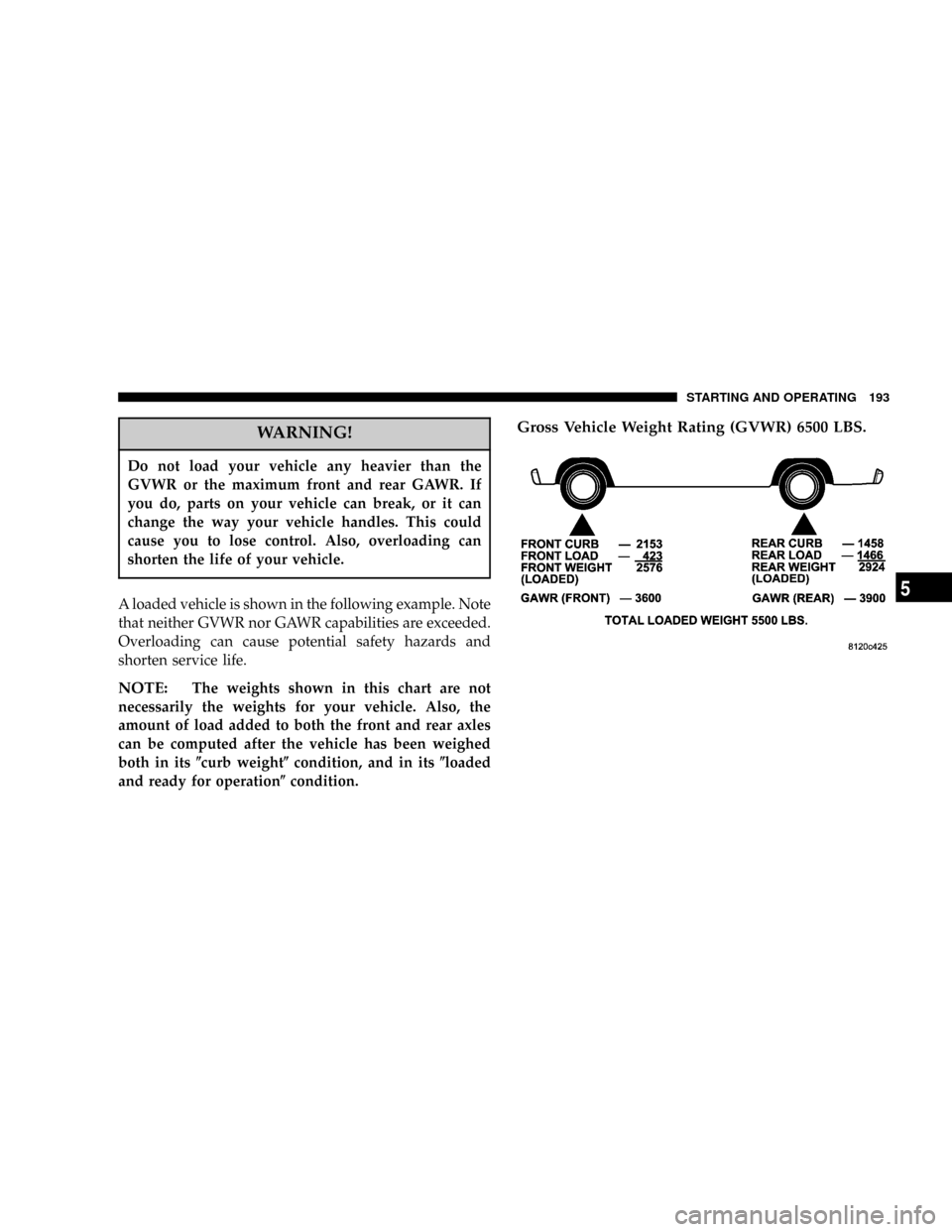
A loaded vehicle is shown in the following example. Note
that neither GVWR nor GAWR capabilities are exceeded.
Overloading can cause potential safety hazards and
shorten service life.
NOTE:The weights shown in this chart are not
necessarily the weights for your vehicle. Also, the
amount of load added to both the front and rear axles
can be computed after the vehicle has been weighed
both in its(curb weight(condition, and in its(loaded
and ready for operation(condition.
Gross Vehicle Weight Rating (GVWR) 6500 LBS.
STARTING AND OPERATING 193
5
Page 194 of 300
LOADING WIDE BUILDING MATERIALS
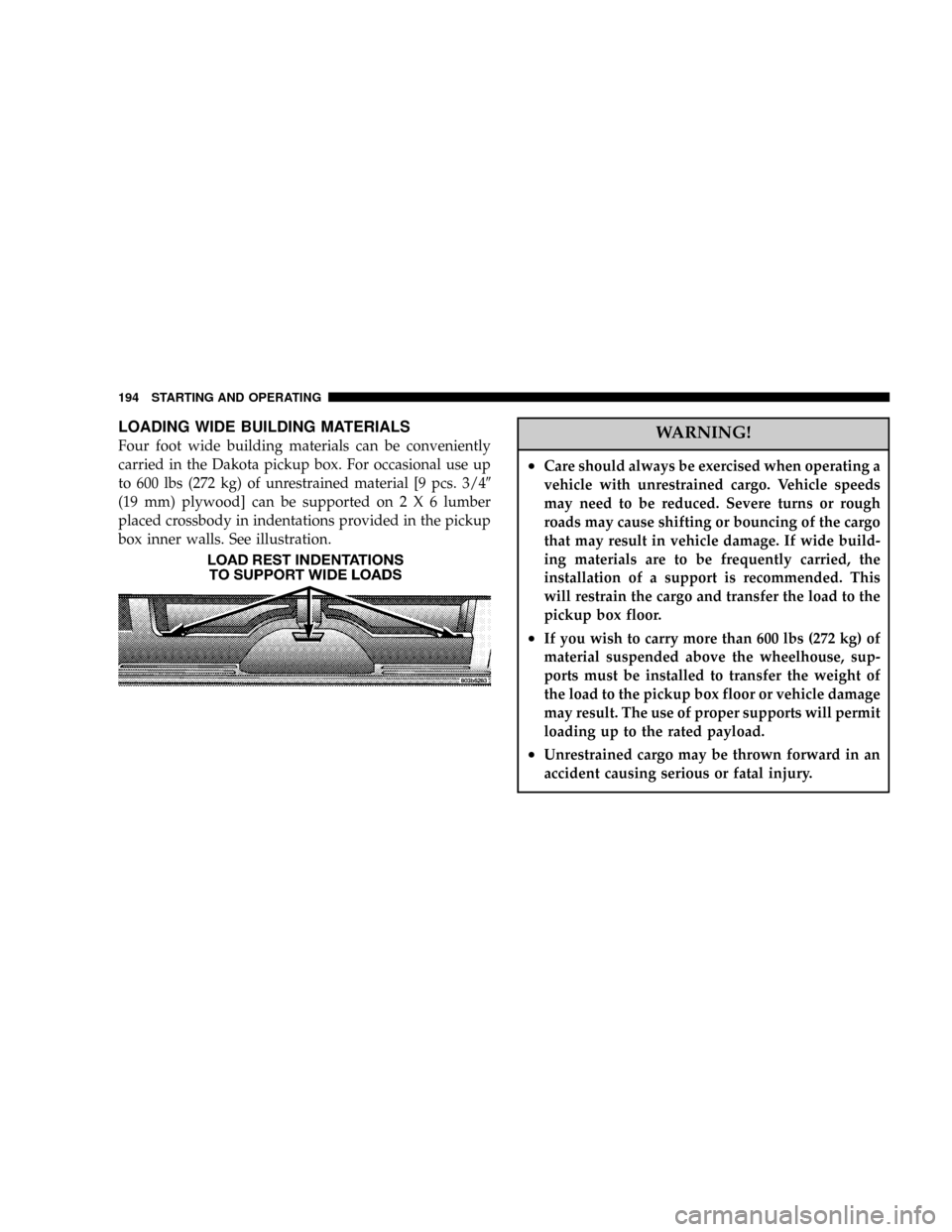
Four foot wide building materials can be conveniently
carried in the Dakota pickup box. For occasional use up
to 600 lbs (272 kg) of unrestrained material [9 pcs. 3/49
(19 mm) plywood] can be supported on2X6lumber
placed crossbody in indentations provided in the pickup
box inner walls. See illustration.WARNING!
²Care should always be exercised when operating a
vehicle with unrestrained cargo. Vehicle speeds
may need to be reduced. Severe turns or rough
roads may cause shifting or bouncing of the cargo
that may result in vehicle damage. If wide build-
ing materials are to be frequently carried, the
installation of a support is recommended. This
will restrain the cargo and transfer the load to the
pickup box floor.
²If you wish to carry more than 600 lbs (272 kg) of
material suspended above the wheelhouse, sup-
ports must be installed to transfer the weight of
the load to the pickup box floor or vehicle damage
may result. The use of proper supports will permit
loading up to the rated payload.
²Unrestrained cargo may be thrown forward in an
accident causing serious or fatal injury.
194 STARTING AND OPERATING
Page 195 of 300
See your dealer or a reputable installer of aftermarket
equipment for further information on the installation of
these supports.
WARNING!
It is extremely dangerous to ride in a cargo area,
inside or outside of a vehicle. In a collision, people
riding in these areas are more likely to be seriously
injured or killed.
Do not allow people to ride in any area of your
vehicle that is not equipped with seats and seat belts.
Be sure every one in your vehicle is in a seat and
using a seat belt properly
TRAILER TOWING
To maintain warranty coverage, follow the requirements
and recommendations in this manual concerning ve-
hicles used for trailer towing.
Definitions
The following trailer towing related terminology defini-
tions will assist in understanding the subsequent sec-
tions:
GROSS COMBINATION WEIGHT RATING (GCWR)
is the total permissible weight of your vehicle and trailer
when weighed in combination. (Note that GCWR ratings
include a 68 kg (150 lb.) allowance for the presence of a
driver.) Tongue Weight (of a trailer) is the weight placed
on a vehicle's trailer hitch by the trailer.
GROSS TRAILER WEIGHT (GTW)is the weight of the
trailer plus the weight of all cargo, consumables and
equipment (permanent or temporary) loaded in or on the
trailer in its9loaded and ready for operation9condition.
TRAILER SWAY CONTROLis a telescoping link that
can be installed between the hitch receiver and the trailer
STARTING AND OPERATING 195
5
Page 196 of 300

tongue that typically provides adjustable friction associ-
ated with the telescoping motion to dampen any un-
wanted trailer swaying motions while traveling.
CAUTION!
²During the first 500 miles (805 km) your new
vehicle is driven, do not tow a trailer. Doing so
may damage your vehicle.
²When first towing a trailer, limit your speed to 50
mph (80 km/h) during the first 500 miles (805 km)
of towing.
Consider the following items when computing the
weight on the rear axle:
²the tongue weight of the trailer
²the weight of any other type of cargo or equipment put
in or on your vehicle
NOTE:Remember that everything put into or on the
trailer adds to the load on your vehicle. Also, additional
factory-installed options, or dealer-installed options,
must be considered as part of the total load on your
vehicle. Refer to the Certification label located at the
driver's door for the Gross Vehicle Weight Rating.
Perform maintenance services as prescribed in the Main-
tenance Schedules section. When your vehicle is used for
trailer towing, never exceed the gross axle weight rating
(GAWR) and GVWR.
WARNING!
Improper towing can lead to an injury accident.
Follow these guidelines to make your trailer towing
as safe as possible:
²Be sure the trailer is loaded heavier in front, with 60%
to 65% of the weight located ahead of the trailer's
axles(s) sufficiently to place result in tongue weights of
between 10% and 15% of the GTW loaded trailer
weight on the tow hitch of your vehicle. (For a95th
196 STARTING AND OPERATING
Page 200 of 300
of the trailer lights and assure their proper functioning, a
heavy duty turn signal flasher can be installed as a
separate equipment item by your dealer.
WARNING!
The direct connection of hydraulic brake lines from
vehicle brake system to trailer system is not accept-
able. The extra load may cause brake failure and you
may be injured.
Heavy trailer towing also may require breakaway electric
trailer brakes, anti-sway devices or equalizing hitches for
safe operation. Such devices are commonly required by
state law.
For all trailer tow or heavy-duty applications it is
strongly recommended that the factory fill rear axle
lubricant be replaced with an SAE 75W-140 synthetic
gear lubricant. MopartSynthetic Gear Lubricant is of
this type.
Trailer Tow Wiring
The Trailer Tow Package includes a wiring harness
located at the rear underbody of the vehicle.
NOTE:Connect trailer lighting and brakes using fac-
tory harnesses only. Do not cut or splice wiring to the
brake circuits.
The electrical connections are all complete to the vehicle
but you must mate the harness to a trailer connector.
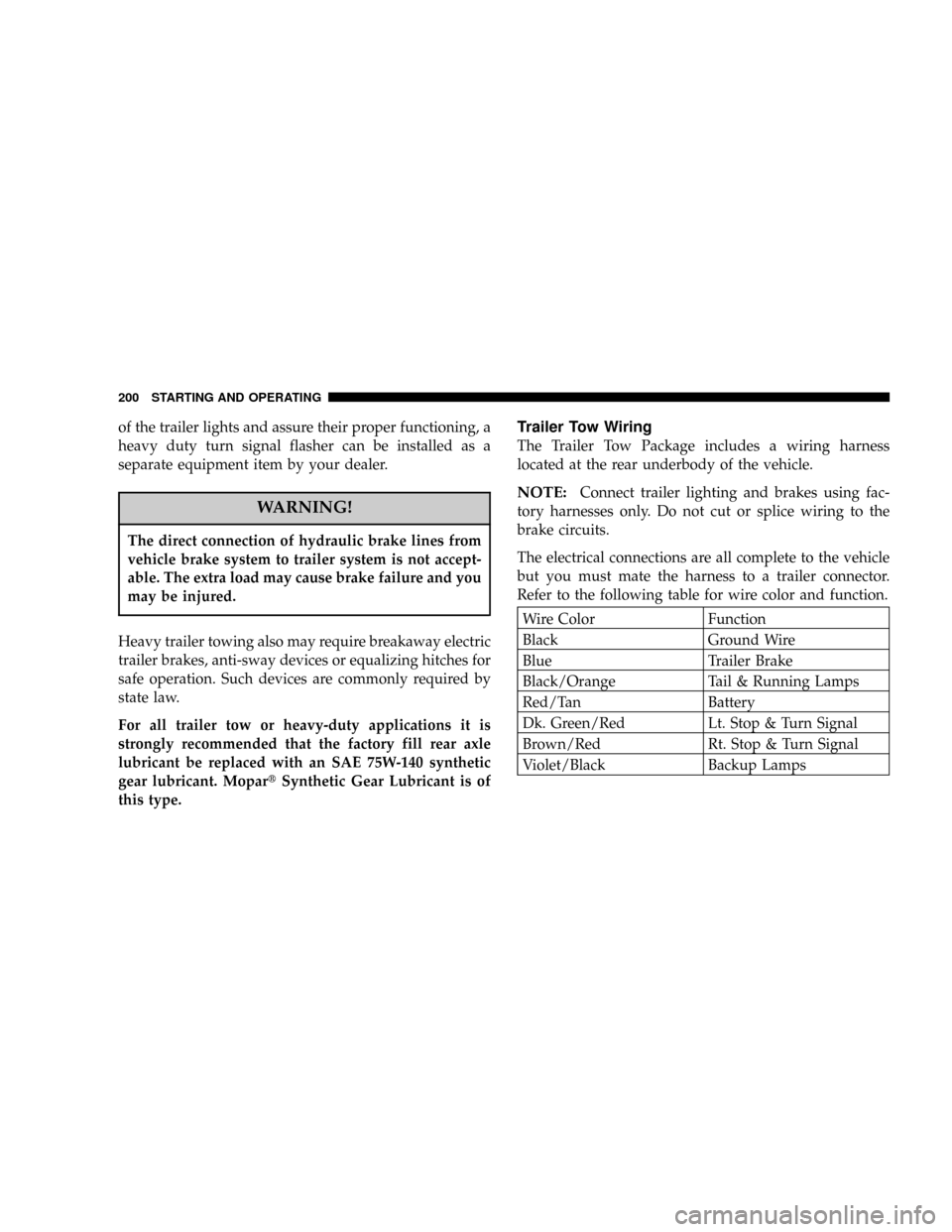
Refer to the following table for wire color and function.
Wire Color Function
Black Ground Wire
Blue Trailer Brake
Black/Orange Tail & Running Lamps
Red/Tan Battery
Dk. Green/Red Lt. Stop & Turn Signal
Brown/Red Rt. Stop & Turn Signal
Violet/Black Backup Lamps
200 STARTING AND OPERATING
Page 201 of 300
Cooling System TipsÐTrailer Towing
To reduce potential for engine and transmission over-
heating, take the following actions:
²City DrivingÐWhen stopped for short periods of
time, put transmission in neutral and increase engine
idle speed.
²Highway DrivingÐReduce your speed.
²Air ConditioningÐTurn off temporarily.
See Cooling System Operating information in the Main-
tenance section of this manual for more information.
To reduce potential for automatic transmission overheat-
ing, turn the Overdrive OFF when driving in hilly areas
or shift the transmission to Drive position 2 on more
severe grades. Move the shift lever to the next lower
position to eliminate excessive transmission shifting. This
action will also reduce the possibility of transmission
overheating and provide better engine braking.
NOTE:If your vehicle has an automatic transmission
and you tow a trailer frequently follow Maintenance
Schedule ªBº.
SNOWPLOW
Dodge Dakota Models
NOTE:
Do not use Dodge Dakota Models for snow-
plow applications.
WARNING!
Snowplows, winches, and other aftermarket equip-
ment should not be added to the front end or your
vehicle. The airbag crash sensors may be affected by
the change in the front end structure. The airbags
could deploy unexpectedly or could fail to deploy
during a collision resulting in serious injury or
death.
CAUTION!
Using this vehicle for snowplow applications can
cause damage to the vehicle.
STARTING AND OPERATING 201
5