lock DODGE DAKOTA 2008 3.G Owners Manual
[x] Cancel search | Manufacturer: DODGE, Model Year: 2008, Model line: DAKOTA, Model: DODGE DAKOTA 2008 3.GPages: 426, PDF Size: 6.39 MB
Page 307 of 426

11. Repeat steps 9 and 10 with the transmission in Drive
(D).
12. Shut engine OFF and place ignition key to the
unlocked OFF position.
13. Shift automatic transmission into Park (P). Shift
Manual transmissions into 4th gear.
14. Attach vehicle to tow vehicle with tow bar.
15. Disconnect the negative battery cable.
NOTE:Items 1 through 5 are requirements that must be
met prior to depressing the Neutral (N) selection button,
and must continue to be met until the 4 seconds elapse
and the shift has been completed. If any of these require-
ments (with the exception of 3 - Key ON) are not met
prior to depressing the Neutral (N) button or are no
longer met during the 4 second timer, then the Neutral(N) indicator light will flash continuously until all re-
quirements are met or until the Neutral (N) button is
released.
NOTE:The ignition key must be ON for a shift to take
place and for the position indicator lights to be operable.
If the key in not ON, the shift will not take place and no
position indicator lights will be on or flashing.
NOTE:Flashing neutral (N) position indicator light
indicates that shift requirements have not been met.
CAUTION!
Damage to the transmission may occur if the trans-
mission is shifted into Park (P) with the transfer case
in Neutral (N) and the engine RUNNING. With the
transfer case in Neutral (N), ensure that the engine is
OFF prior to shifting the transmission into Park (P).
STARTING AND OPERATING 307
5
Page 312 of 426

HAZARD WARNING FLASHER
The flasher switch is on the top of the steering column,
just behind the steering wheel. Press the flasher switch
and all front and rear directional signals will flash
intermittently.
Press the switch a second time to turn off the emergency
flashers.This is an emergency warning system and should not be
used when the vehicle is in motion. Use it when your
vehicle is disabled and is creating a safety hazard for
other motorists.
If it is necessary to leave the vehicle to go for service, the
flasher system will continue to operate with the ignition
key removed and the vehicle locked.
ADDING FUEL
If using a portable fuel container, it should have a flexible
nozzle long enough to reach past the restriction in the
fuel filler tube.
312 WHAT TO DO IN EMERGENCIES
Page 315 of 426
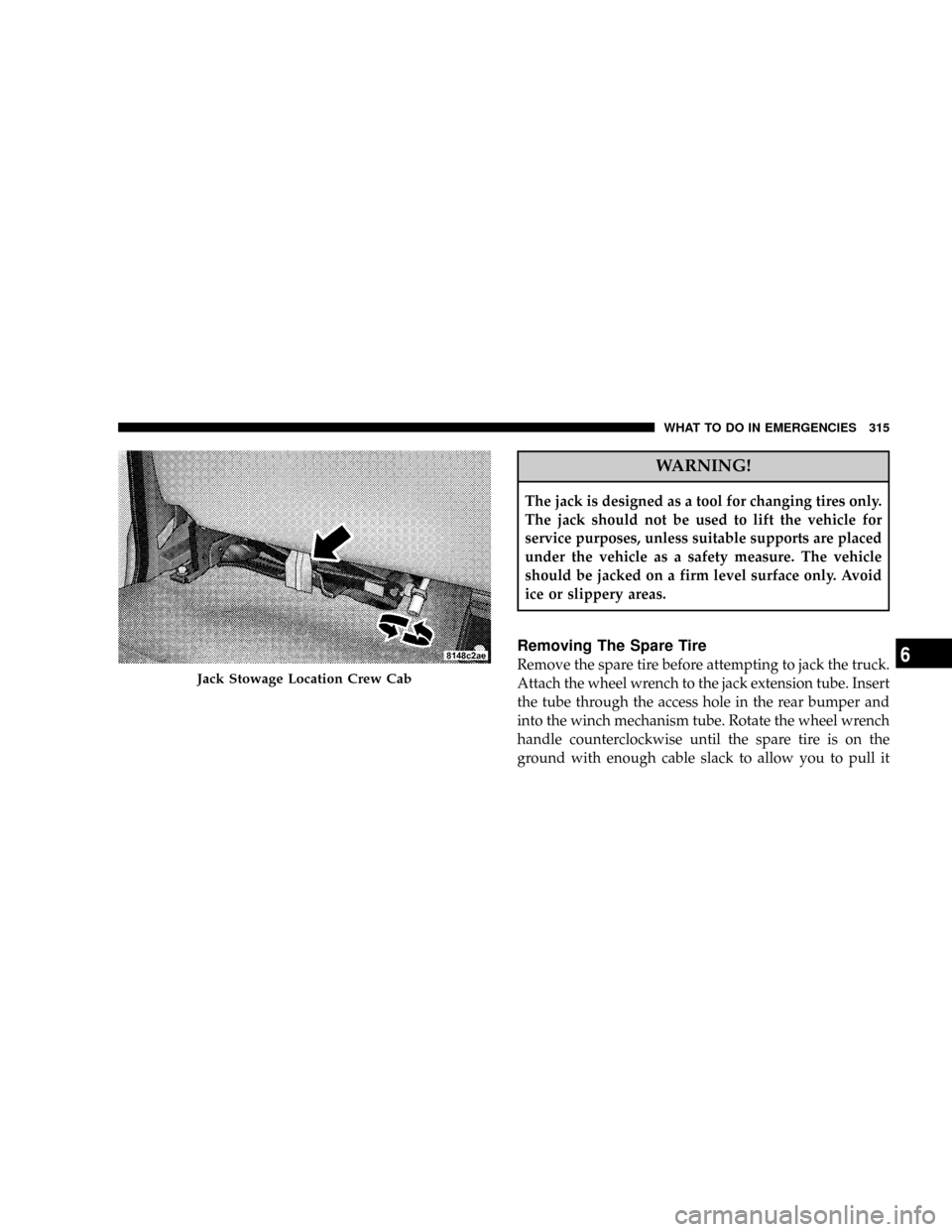
WARNING!
The jack is designed as a tool for changing tires only.
The jack should not be used to lift the vehicle for
service purposes, unless suitable supports are placed
under the vehicle as a safety measure. The vehicle
should be jacked on a firm level surface only. Avoid
ice or slippery areas.
Removing The Spare Tire
Remove the spare tire before attempting to jack the truck.
Attach the wheel wrench to the jack extension tube. Insert
the tube through the access hole in the rear bumper and
into the winch mechanism tube. Rotate the wheel wrench
handle counterclockwise until the spare tire is on the
ground with enough cable slack to allow you to pull itJack Stowage Location Crew Cab
WHAT TO DO IN EMERGENCIES 315
6
Page 316 of 426

out from under the vehicle. When the spare is clear, tilt
the retainer at the end of the cable and pull it through the
center of the wheel.
Steps for Removing the Spare Tire
²Remove the jack from the stowage compartment using
the supplied finger assist tool.
²Remove the finger assist tool from jack and set aside
until jack is stowed.
²Assemble the jack tools.
²Locate the tire carrier access hole on the rear bumper.
²Place assembled jack tool extension rod into the access
hole in the direction of the arrow on the bumper trim.
²Rotate the tool counterclockwise to release and lower
the spare tire to the ground so that it can be pulled
from under the vehicle.
²Rotate clockwise to stow the spare tire.
Inserting Lug Wrench and Extension
316 WHAT TO DO IN EMERGENCIES
Page 319 of 426

²Block both the front and rear
of the wheel diagonally oppo-
site the jacking position. For
example, if the right front
wheel is being changed, block
the left rear wheel.
²Passengers should not remain in the vehicle when the
vehicle is being jacked.
Instructions
1. Lower and remove the spare wheel, jack, and tools
from stowage.
2. Using the wheel wrench, loosen, but do not remove,
the wheel nuts by turning them counterclockwise one
turn while the wheel is still on the ground.
3. When changing a front wheel, place the jack under the
frame rail behind the wheel. Locate the jack as far
forward as possible on the straight part of the frame priorto inboard transition, as shown. Operate the jack using
the jack drive tube and the wheel wrench - the tube
extension, may be used but is not required.
When changing a rear wheel, assemble the jack drive
tube to the jack and connect the drive tube to the
extension tube. Place the jack under the axle in the
Positioning of the Jack Front Wheels
WHAT TO DO IN EMERGENCIES 319
6
Page 320 of 426

positions shown with the drive tubes extending to the
rear. Connect the jack tube extension and wheel wrench.
NOTE: Before raising the wheel off the ground, make
sure that the jack will not damage surrounding truck
parts and adjust the jack position as required.
4. By rotating the wheel wrench clockwise, raise the
vehicle until the wheel just clears the surface.
Left Rear Jacking Location
Right Rear Jacking Location
320 WHAT TO DO IN EMERGENCIES
Page 322 of 426

WARNING!
Carefully follow these tire changing warnings to help
prevent personal injury or damage to your vehicle:
²Always park on a firm, level surface as far from the
edge of the roadway as possible before raising the
vehicle.
²Block the wheel diagonally opposite the wheel to be
raised.
²Apply the parking brake firmly before jacking.
²Never start the engine with the vehicle on a jack.
²Do not let anyone sit in the vehicle when it is on a jack.
²Do not get under the vehicle when it is on a jack.
²Only use the jack in the positions indicated.
²If working on or near a roadway, be extremely careful of
motor traffic.
²To assure that spare tires, flat or inflated are securely
stowed, spares must be stowed with the value stem
facing the ground.
To Stow The Flat Or Spare
Turn the wheel so that the valve stem is down. Slide the
wheel retainer through the center of the wheel and
position it properly across the wheel opening.
For convenience in checking the spare tire inflation, stow
with the valve stem toward the rear of the vehicle.
Rotate the winch mechanism until the wheel is drawn
into place against the underside of the vehicle. Continue
to rotate until you feel the winch mechanism slip or click
3 times. It cannot be overtightened. Push against the tire
several times to be sure it is firmly in place.
To Stow the Flat or Spare: Wheel retainer does not fit
through the center of the aluminum wheel. The tire must
be stored in a safe manner in the bed of the truck.
322 WHAT TO DO IN EMERGENCIES
Page 348 of 426

Front Suspension Ball Joints
The ball joints and seals should be inspected whenever
the vehicle is serviced for other reasons. Damaged seals
should be replaced to prevent leakage or contamination
of the grease.
Drive Shaft Constant Velocity Joints
All four wheel drive models are equipped with four
constant velocity joints. Periodic lubrication of these
joints is not required. However, the joint boot should be
inspected for external leakage or damage periodically. If
external leakage or damage is evident, the joint boot and
grease should be replaced immediately. Continued op-
eration could result in failure of the joint due to water
and dirt contamination of the grease. This would require
complete replacement of the joint assembly. Refer to the
Service Manual for the detailed replacement procedure.
Body Lubrication
Locks and all body pivot points, including such items as
seat tracks, doors and hood hinges, should be lubricated
periodically to assure quiet, easy operation and to protect
against rust and wear. Prior to the application of any
lubricant, the parts concerned should be wiped clean to
remove dust and grit; after lubricating excess oil and
grease should be removed. Particular attention should
also be given to hood latching components to insure
proper function. When performing other underhood ser-
vices, the hood latch, release mechanism and safety catch
should be cleaned and lubricated.
The external lock cylinders should be lubricated twice a
year, preferably in the fall and spring. Apply a small
amount of a high quality lubricant such as MopartLock
Cylinder Lubricant directly into the lock cylinder.
348 MAINTAINING YOUR VEHICLE
Page 369 of 426
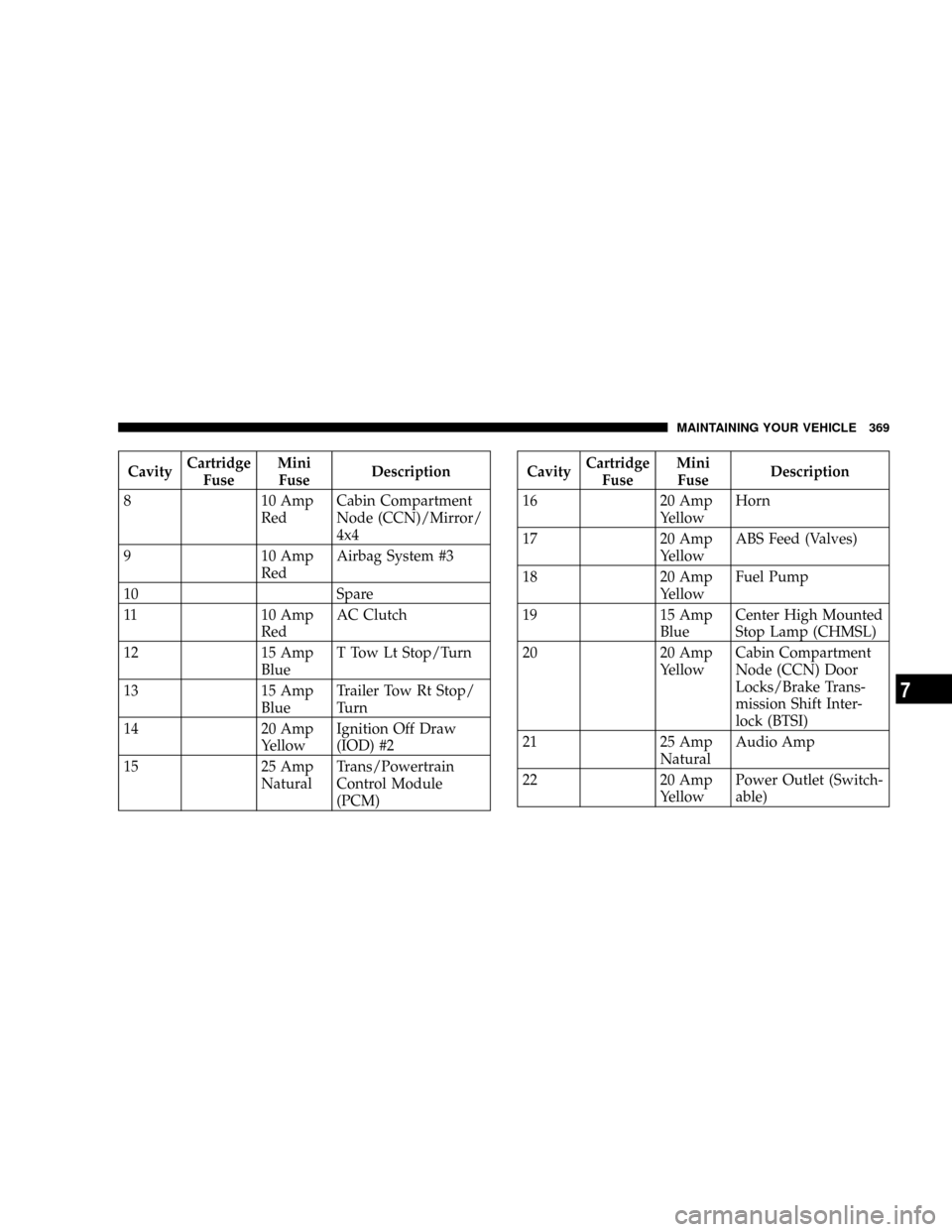
CavityCartridge
FuseMini
FuseDescription
8 10 Amp
RedCabin Compartment
Node (CCN)/Mirror/
4x4
9 10 Amp
RedAirbag System #3
10 Spare
11 10 Amp
RedAC Clutch
12 15 Amp
BlueT Tow Lt Stop/Turn
13 15 Amp
BlueTrailer Tow Rt Stop/
Turn
14 20 Amp
YellowIgnition Off Draw
(IOD) #2
15 25 Amp
NaturalTrans/Powertrain
Control Module
(PCM)CavityCartridge
FuseMini
FuseDescription
16 20 Amp
YellowHorn
17 20 Amp
YellowABS Feed (Valves)
18 20 Amp
YellowFuel Pump
19 15 Amp
BlueCenter High Mounted
Stop Lamp (CHMSL)
20 20 Amp
YellowCabin Compartment
Node (CCN) Door
Locks/Brake Trans-
mission Shift Inter-
lock (BTSI)
21 25 Amp
NaturalAudio Amp
22 20 Amp
YellowPower Outlet (Switch-
able)
MAINTAINING YOUR VEHICLE 369
7
Page 371 of 426
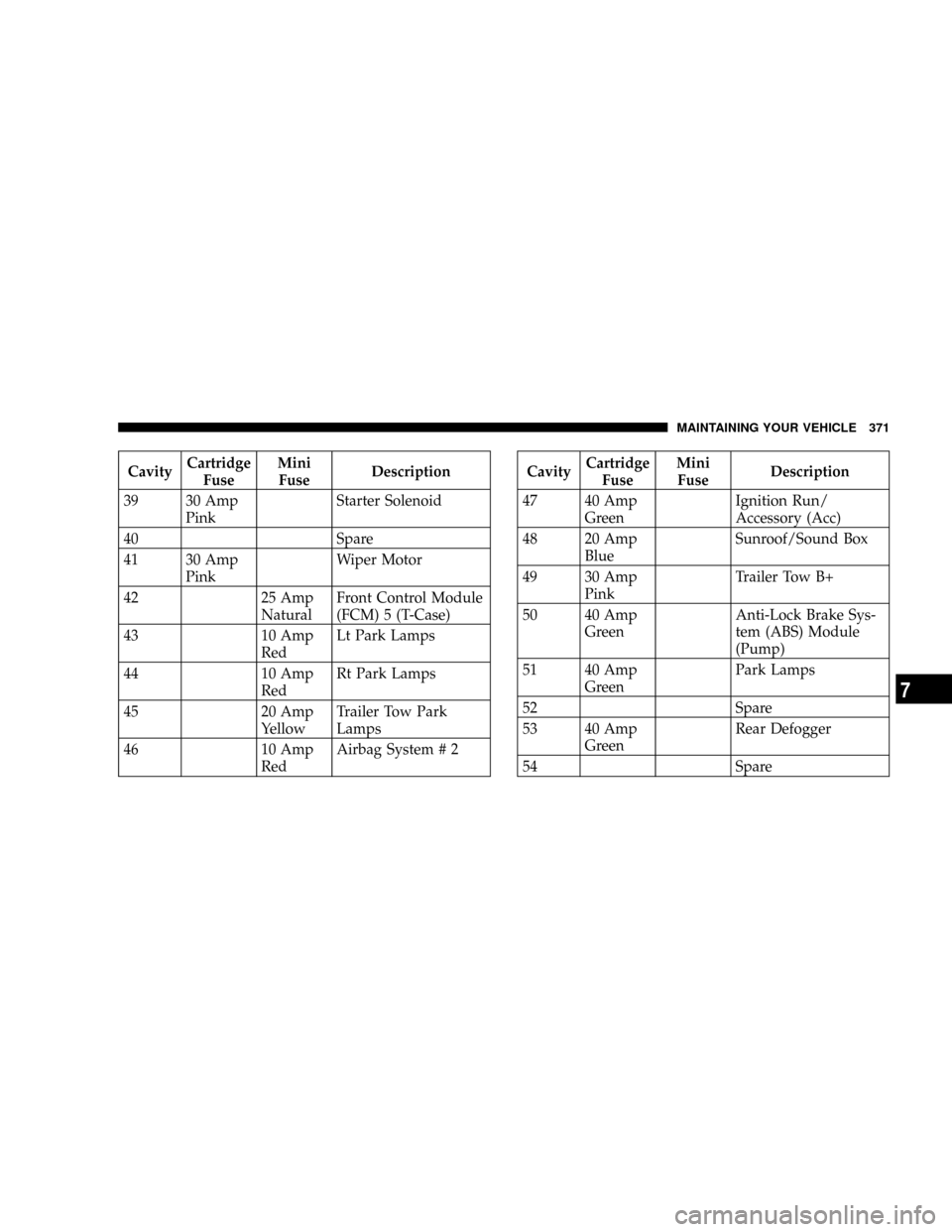
CavityCartridge
FuseMini
FuseDescription
39 30 Amp
PinkStarter Solenoid
40 Spare
41 30 Amp
PinkWiper Motor
42 25 Amp
NaturalFront Control Module
(FCM) 5 (T-Case)
43 10 Amp
RedLt Park Lamps
44 10 Amp
RedRt Park Lamps
45 20 Amp
YellowTrailer Tow Park
Lamps
46 10 Amp
RedAirbag System # 2CavityCartridge
FuseMini
FuseDescription
47 40 Amp
GreenIgnition Run/
Accessory (Acc)
48 20 Amp
BlueSunroof/Sound Box
49 30 Amp
PinkTrailer Tow B+
50 40 Amp
GreenAnti-Lock Brake Sys-
tem (ABS) Module
(Pump)
51 40 Amp
GreenPark Lamps
52 Spare
53 40 Amp
GreenRear Defogger
54 Spare
MAINTAINING YOUR VEHICLE 371
7