warning DODGE DAKOTA 2008 3.G Owner's Manual
[x] Cancel search | Manufacturer: DODGE, Model Year: 2008, Model line: DAKOTA, Model: DODGE DAKOTA 2008 3.GPages: 426, PDF Size: 6.39 MB
Page 52 of 426
irritation continues, see your doctor. If these particles
settle on your clothing, follow the garment manufac-
turer's instructions for cleaning.
²It is not advisable to drive your vehicle after the
airbags have deployed. If you are involved in another
collision, the airbags will not be in place to protect you.
WARNING!
Deployed airbags and seat belt pretensioners cannot
protect you in another collision. Have the airbags,
and both front seat belt retractor assemblies (w/
pretensioners), replaced by an authorized dealer as
soon as possible.
Maintaining Your Airbag System
WARNING!
²Modifications to any part of the airbag system
could cause it to fail when you need it. You could
be injured if the airbag system is not there to
protect you. Do not modify the components or
wiring, including adding any kind of badges or
stickers to the steering wheel hub trim cover or the
upper right side of the instrument panel. Do not
modify the front bumper, vehicle body structure,
or add aftermarket side steps or running boards.
²You need proper knee impact protection in a
collision. Do not mount or locate any aftermarket
equipment on or behind the knee bolsters.
²It is dangerous to try to repair any part of the
airbag system yourself. Be sure to tell anyone who
works on your vehicle that it has an airbag system.
52 THINGS TO KNOW BEFORE STARTING YOUR VEHICLE
Page 55 of 426

2. Used in defense of litigation involving a
DaimlerChrysler Corporation product
3. Requested by police under a legal warrant
4. Otherwise required by law
Data Parameters that May Be Recorded:
²Diagnostic trouble code(s) and warning lamp status
for electronically-controlled safety systems, including
the airbag system
²9Time9of airbag deployment (in terms of ignition
cycles and vehicle mileage)
²Airbag deployment level (if applicable)
²Impact acceleration and angle
²Seatbelt status
²Brake status (service and parking brakes)
²Accelerator status (including vehicle speed)
²Engine control status (including engine speed)
²Transmission gear selection
²Cruise control status
²Traction/stability control status
²Tire pressure monitoring system status (if equipped)
Child Restraint
Everyone in your vehicle needs to be buckled up all the
time - babies and children, too. Every state in the United
States and all Canadian provinces require that small
children ride in proper restraint systems. This is the law,
and you can be prosecuted for ignoring it. Children 12
years and under should ride properly buckled up in a
rear seat, if available. According to crash statistics, chil-
dren are safer when properly restrained in the rear seats
rather than in the front.
THINGS TO KNOW BEFORE STARTING YOUR VEHICLE 55
2
Page 58 of 426
WARNING!
²Improper installation can lead to failure of an
infant or child restraint. It could come loose in a
collision. The child could be badly injured or
killed. Follow the manufacturer's directions ex-
actly when installing an infant or child restraint.
²A rearward facing infant restraint should only be
used in a rear seat of a vehicle that does not have
an airbag off switch. A rearward facing infant
restraint in the front seat may be struck by a
deploying passenger airbag which may cause se-
vere or fatal to the infant.
Here are some tips for getting the most out of your child
restraint:
²Before buying any restraint system, make sure that it
has a label certifying that it meets all applicable SafetyStandards. The manufacturer recommends that you
try a child restraint in the vehicle seats where you will
use it before you buy it.
²The restraint must be appropriate for your child's
weight and height. Check the label on the restraint for
weight and height limits.
²Carefully follow the instructions that come with the
restraint. If you install the restraint improperly, it may
not work when you need it.
²The Extended Cab first and Club/Crew Cab second
row outside seating positions have cinching latch
plates. These are designed to keep the lap portion tight
around the child restraint so that it is not necessary to
use a locking clip. If the seat belt has a cinching latch
plate, pulling up on the shoulder portion of the
lap/shoulder belt will tighten the belt. The cinching
latch plate will keep the belt tight, however, any seat
58 THINGS TO KNOW BEFORE STARTING YOUR VEHICLE
Page 62 of 426

over the top of the anchorage bars, pushing aside the seat
cover material. Then attach the tether strap to the anchor-
age located on the back of the seat, being careful to route
the tether strap to provide the most direct path between
the anchor and the child restraint. If your vehicle is
equipped with adjustable rear head restraints, raise the
head restraint and, route the tether strap under the head
restraint and between the two posts. Finally, tighten all
three straps as you push the child restraint rearward and
downward into the seat, removing slack in the straps
according to the child restraint manufacturer's instruc-
tions.
NOTE:When using the LATCH attaching system to
install a child restraint, please ensure that all seat belts
not being used for occupant restraints are stowed and out
of reach of children. It is recommended that before
installing the child restraint, buckle the seat belt so the
seat belt is tucked behind the child restraint and out of
reach. If the buckled seat belt interferes with the childrestraint installation, instead of tucking the seat belt
behind the child restraint, route the seat belt through the
child restraint belt path and then buckle it. This should
stow the seat belt out of the reach of an inquisitive child.
Remind all children in the vehicle that the seat belts are
not toys and should not be played with, and never leave
your child unattended in the vehicle.
WARNING!
Improper installation of a child restraint to the
LATCH anchorages can lead to failure of an infant or
child restraint. The child could be badly injured or
killed. Follow the manufacturer's directions exactly
when installing an infant or child restraint.
62 THINGS TO KNOW BEFORE STARTING YOUR VEHICLE
Page 64 of 426
Child Restraint Tether Anchor
The Extended Cab model has one routing strap
located behind the passenger side rear out-
board seating position. The tether anchor itself
is located in the center of vehicle, in between
the two seating positions. The front outboard passenger
seating position is also equipped with a child tether
anchorage, located at the base of the front seat back.
When there is a rear seat delete option, the tether
anchorage located on the cab back panel is designed to be
used for the front seat center seating position. The Crew
Cab model has three anchorages located behind each of
the rear seating positions (rear left, rear center, and rear
right).WARNING!
With a child restraint installed in the rear passenger
side locations, use care when adjusting the front
seat(s) rearward, to avoid the front seat back coming
in contact with the belted child directly behind the
seat. The child could be injured.
WARNING!
Improper installation can lead to failure of an infant
or child restraint. It could come loose in a collision.
The child could be seriously injured or killed. Make
sure the child restraint tether strap is always routed
through the proper anchor strap inner loop.
64 THINGS TO KNOW BEFORE STARTING YOUR VEHICLE
Page 68 of 426
WARNING!
An incorrectly anchored tether strap could lead to
seat failure and injury to the child. In a collision, the
seat could come loose and allow the child to crash
into the inside of the vehicle or other passengers, or
even be thrown from the vehicle. Use only the anchor
positions directly behind the child restraint to secure
a child restraint top tether strap. See your dealer for
help if necessary.
Transporting Pets
Airbags deploying in the front seat could harm your pet.
An unrestrained pet will be thrown about and possibly
injured, or injure a passenger during panic braking or in
a collision. Pets should be restrained in the rear seat in
pet harnesses or pet carriers that are secured by seat belts.
ENGINE BREAK-IN RECOMMENDATIONS
A long break-in period is not required for the engine in
your new vehicle. Drive moderately during the first 300
miles (500 km). After the initial 60 miles (100 km), speeds
up to 50 or 55 mph (80 or 90 km/h) are desirable. While
cruising, brief full-throttle acceleration, within the limits
of local traffic laws, contributes to a good break-in.
Avoid wide open throttle acceleration in low gear.
The engine oil installed in the engine at the factory is a
high-quality, energy-conserving type lubricant. Oil
changes should be consistent with anticipated climate
conditions under which vehicle operations will occur.
The recommended viscosity and quality grades are
shown in Section 7.
NON-DETERGENT OR STRAIGHT MINERAL OILS
MUST NEVER BE USED.
68 THINGS TO KNOW BEFORE STARTING YOUR VEHICLE
Page 69 of 426
A new engine may consume some oil during its first few
thousand miles of operation. This is a normal part of the
break-in and is not an indication of difficulty.
SAFETY TIPS
Exhaust System
WARNING!
Exhaust gases contain carbon monoxide, an ex-
tremely toxic gas that by itself is colorless and
odorless. To avoid inhaling these gases, the following
precautions should be observed:
²Do not run the engine in a closed garage or in confined
areas any longer than needed to move your vehicle in
or out of the area.
²It may be necessary to sit in a parked vehicle with the
engine running for more than a short period. If so,
adjust your climate control system to force outside air
into the vehicle. Set the blower at high speed and the
controls in any position except OFF or RECIRC.
²The best protection against carbon monoxide entry
into the vehicle body is a properly maintained engine
exhaust system.
Be aware of changes in the sound of the exhaust system;
exhaust fumes detected inside the vehicle; or damage to
the underside or rear of the vehicle. Have a competent
mechanic inspect the complete exhaust system and adja-
cent body areas for broken, damaged, deteriorated or
mispositioned parts. Open seams or loose connections
could permit exhaust fumes to seep into the passenger
compartment. In addition, inspect the exhaust system
each time the vehicle is raised for lubrication or oil
change. Replace or adjust as required.
THINGS TO KNOW BEFORE STARTING YOUR VEHICLE 69
2
Page 76 of 426

NGeneral Information...................138
mElectrical Power Outlets..................138
NElectrical Outlet Use With Engine Off
(Battery Fed Configuration)..............139
mFloor Console Ð If Equipped..............140
NFloor Console Features.................140
mCenter Storage Compartment Ð If Equipped . . . 141
mCup Holders..........................141
mRear Storage ± If Equipped................142
NRear Convenience Storage Crates..........142
NPlastic Grocery Bag Retainers.............144
mRear Window Features...................145NRear Window Defroster ± If Equipped.......145
NSliding Rear Window ± If Equipped........146
mTailgate..............................146
NTailgate Removal.....................146
NTwo Position Tailgate / Upper
Load Platform.......................147
mRear Cargo Area Utility Rails..............149
mSlide-In Campers.......................151
NCamper Applications...................151
NGeneral Information...................151
NCarbon Monoxide Warning Vehicles Equipped
With A Cap Or Slide-In Campers..........151
76 UNDERSTANDING THE FEATURES OF YOUR VEHICLE
Page 79 of 426
WARNING!
Vehicles and other objects seen in the right side
convex mirror will look smaller and farther away
than they really are. Relying too much on your right
side mirror could cause you to collide with another
vehicle or other object. Use your inside mirror when
judging the size or distance of a vehicle seen in the
right side mirror.
HANDS±FREE COMMUNICATION (UConnectT)Ð
IF EQUIPPED
NOTE: The sales code RER radio contains an inte-
grated Hands-Free Communication (UConnectt) sys-
tem. Refer to your ªNavigation User's Manualº for
UConnecttsystem operating instructions for this radio.UConnecttis a voice-activated, hands-free, in- vehicle
communications system. UConnecttallows you to dial a
phone number with your cellular phone using simple
voice commands (e.g.,9Callº{ªMikeº{ºWork9or9Dialº
{ª248-555-12129). Your cellular phone's audio is trans-
mitted through your vehicle's audio system; the system
will automatically mute your radio when using the
UConnecttsystem.
NOTE:The UConnecttsystem use requires a cellular
phone equipped with the Bluetooth9Hands-Free Profile,9
version 0.96 or higher. See UConnecttwebsite for sup-
ported phones.
NOTE:For UConnecttcustomer support, visit the
following web sites:
²www.chrysler.com/uconnect
²www.dodge.com/uconnect
²www.jeep.com/uconnect
UNDERSTANDING THE FEATURES OF YOUR VEHICLE 79
3
Page 106 of 426
WARNING!
Adjusting a seat while the vehicle is moving is
dangerous. The sudden movement of the seat could
cause you to lose control. The seat belt might not be
properly adjusted and you could be injured. Adjust
any seat only while the vehicle is parked.
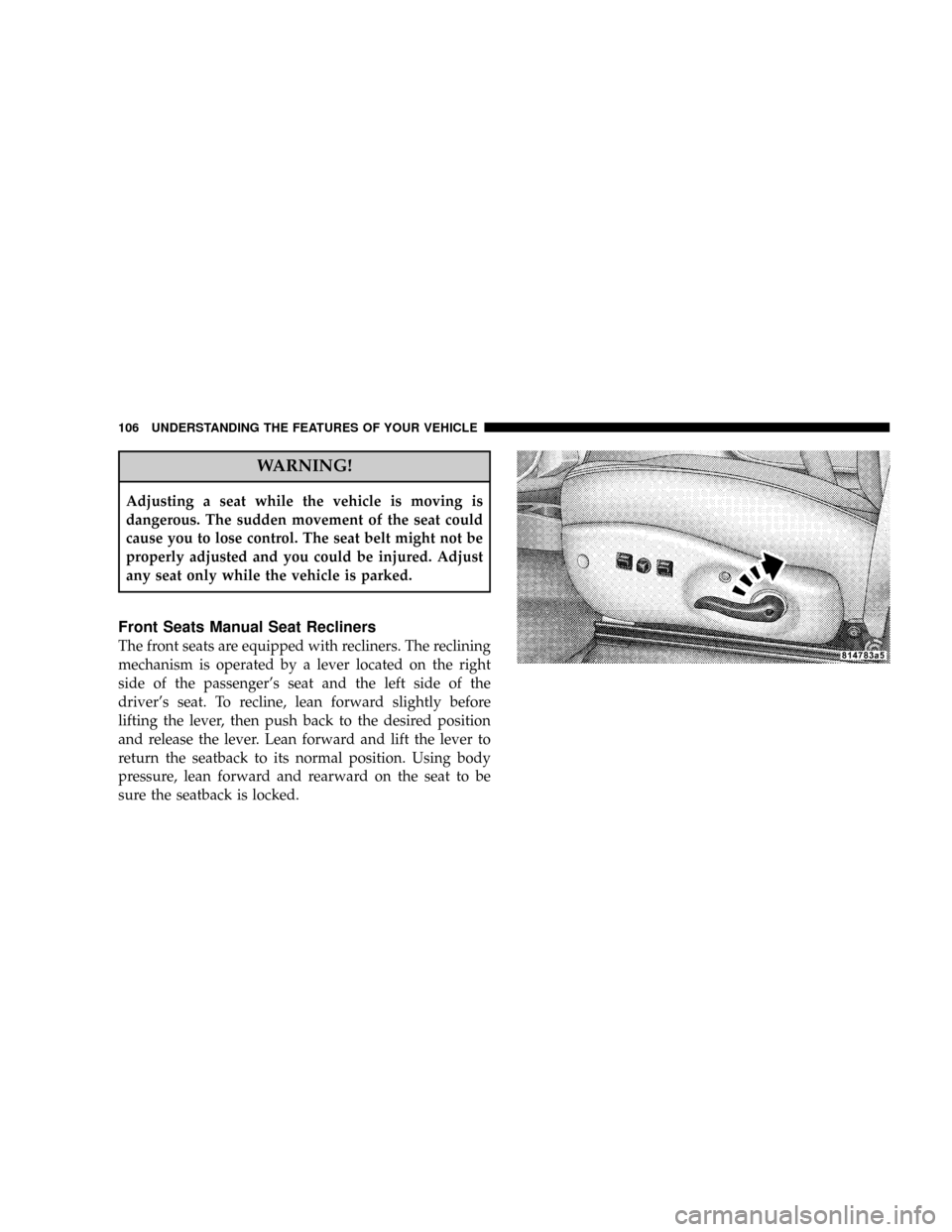
Front Seats Manual Seat Recliners
The front seats are equipped with recliners. The reclining
mechanism is operated by a lever located on the right
side of the passenger's seat and the left side of the
driver's seat. To recline, lean forward slightly before
lifting the lever, then push back to the desired position
and release the lever. Lean forward and lift the lever to
return the seatback to its normal position. Using body
pressure, lean forward and rearward on the seat to be
sure the seatback is locked.
106 UNDERSTANDING THE FEATURES OF YOUR VEHICLE