engine DODGE DAKOTA 2008 3.G Repair Manual
[x] Cancel search | Manufacturer: DODGE, Model Year: 2008, Model line: DAKOTA, Model: DODGE DAKOTA 2008 3.GPages: 426, PDF Size: 6.39 MB
Page 244 of 426

3. While still rolling, rotate the transfer case control
switch to the desired position.
4. After the position indicator light has stopped flashing,
shift the transmission back into gear.
Alternate Procedure
1. Bring the vehicle to complete stop.
2. With the key ON and the engine either OFF or
RUNNING, shift the transmission into NEUTRAL.
3. Rotate the transfer case control switch to the desired
position.
4. After the position indicator light has stopped flashing,
shift the transmission back into gear.
NOTE:The ignition key must be ON for a shift to take
place and for the position indicator lights to be operable.
If the key is not ON then the shift will not take place and
no position indicator lights will be on or flashing.NOTE:If any of the requirements to select a new
transfer case position have not been met, the transfer case
will not shift. The indicator light will flash and the
current transfer case position will be maintained. To retry
the selection, turn the control knob back to the current
position, wait five (5) seconds, and retry the shift.
LIMITED-SLIP REAR AXLE DIFFERENTIAL Ð IF
EQUIPPED
The limited-slip differential provides additional traction
on snow, ice, mud, sand and gravel. It improves traction
when there is a difference between the characteristics of
the surface under the right and left rear wheels. During
normal driving and cornering, the limited-slip unit is
similar to a conventional differential. But on a slippery
surface, the differential delivers more of the driving effort
to the wheel having the better traction.
244 STARTING AND OPERATING
Page 245 of 426

WARNING!
On vehicles equipped with a limited-slip differen-
tial, never run the engine with one rear wheel off the
ground. The vehicle may drive through the rear
wheel remaining on the ground and cause you to lose
control of the vehicle.
Care should be taken to avoid sudden accelerations when
both rear wheels are on a slippery surface. This could cause
both rear wheels to spin, and allow the vehicle to slide
sideways on the crowned surface of a road or in a turn.
DRIVING ON SLIPPERY SURFACES
When driving on wet or slushy roads, it is possible for a
wedge of water to build up between the tire and road
surface. This is known as hydroplaning and may cause
partial or complete loss of vehicle control and stopping
ability. To reduce this possibility, the following precau-
tions should be observed:1. Slow down during rainstorms or when roads are
slushy.
2. Slow down if road has standing water or puddles.
3. Replace tires when tread wear indicators first become
visible.
4. Keep tires properly inflated.
5. Maintain sufficient distance between your vehicle and
the car in front to avoid a collision in a sudden stop.
DRIVING THROUGH WATER
Driving through water more than a few inches deep will
require extra caution to ensure safety and prevent dam-
age to your vehicle.
STARTING AND OPERATING 245
5
Page 246 of 426
Flowing/Rising Water
WARNING!
Do not drive on or cross a road or a path where water
is flowing and/or rising (as in storm run-off). Flow-
ing water can wear away the road or path's surface
and cause your vehicle to sink into deeper water.
Furthermore, flowing and/or rising water can carry
your vehicle away swiftly. Failure to follow this
warning may result in injuries that are serious or
fatal to you, your passengers, and others around you.
Shallow Standing Water
Although your vehicle is capable of driving through
shallow standing water, consider the following before
doing so:
CAUTION!
²Always check the depth of the standing water before
driving through it. Never drive through standing water that
is deeper than the bottom of the tire rims mounted on the
vehicle.
²Determine the condition of the road or the path that is
under water and if there are any obstacles in the way before
driving through the standing water.
²Do not exceed 5 mph (8 km/h) when driving through
standing water. This will minimize wave effects.
²Driving through standing water may cause damage to your
vehicle's drivetrain components. Always inspect your ve-
hicle's fluids (i.e. engine oil, transmission, axle, etc.) for
signs of contamination (i.e. fluid that is milky or foamy in
appearance) after driving through standing water. Do not
continue to operate the vehicle if any fluid appears con-
taminated, as this may result in further damage. Such
damage is not covered by the new vehicle limited warranty.
²Getting water inside your vehicle's engine can cause it to
lockup and stall out and cause serious internal damage to
the engine. Such damage is not covered by the new vehicle
limited warranty.
246 STARTING AND OPERATING
Page 247 of 426
WARNING!
²Driving through standing water limits your vehi-
cle's traction capabilities. Do not exceed 5 mph (8
km/h) when driving through standing water.
²Driving through standing water limits your vehi-
cle's braking capabilities, which increases stop-
ping distances. Therefore, after driving through
standing water, drive slowly and lightly press on
the brake pedal several times to dry the brakes.
²Getting water inside your vehicle's engine can
cause it to lockup and stall out and leave you
stranded.
²Failure to follow these warnings may result in
injuries that are serious or fatal to you, your
passengers, and others around you.
PARKING BRAKE
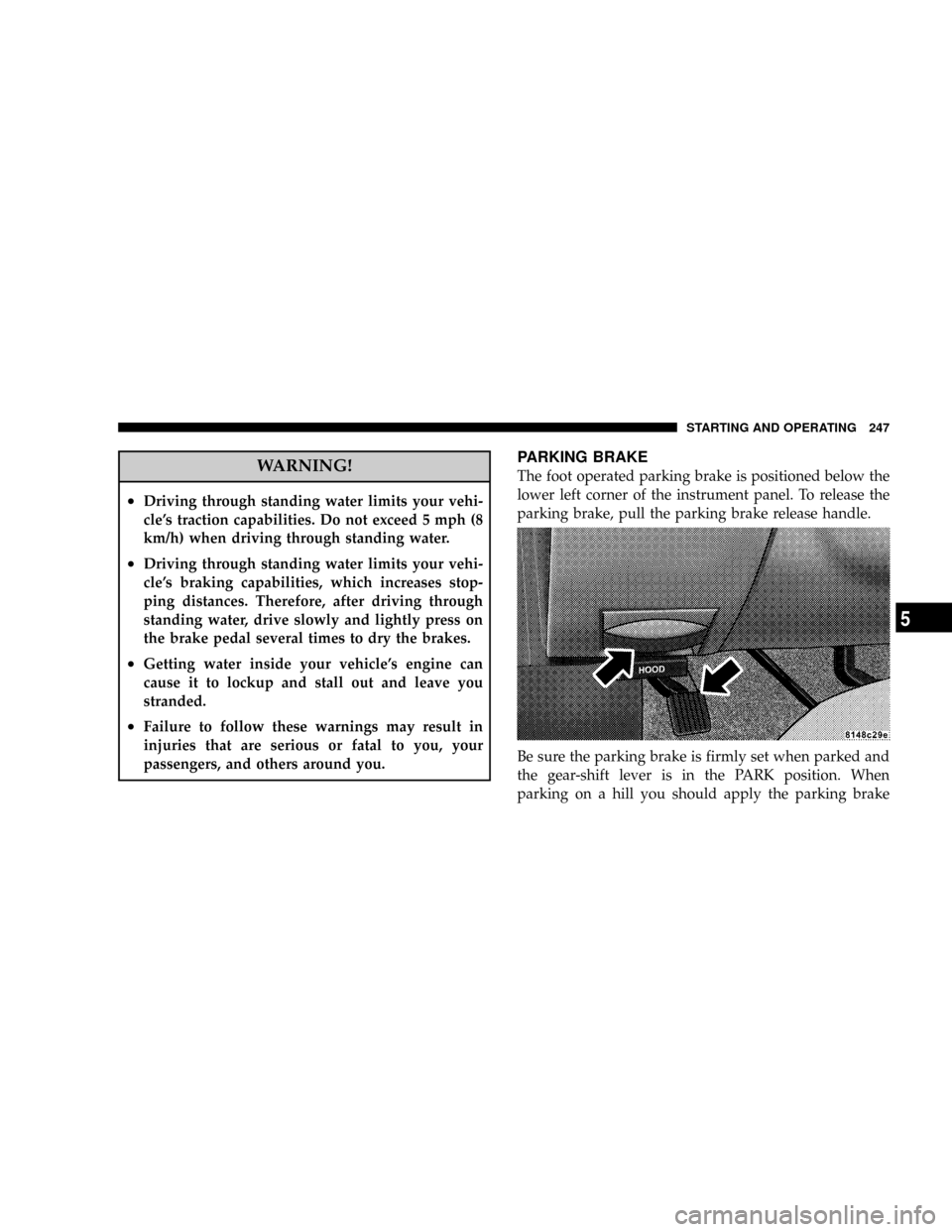
The foot operated parking brake is positioned below the
lower left corner of the instrument panel. To release the
parking brake, pull the parking brake release handle.
Be sure the parking brake is firmly set when parked and
the gear-shift lever is in the PARK position. When
parking on a hill you should apply the parking brake
STARTING AND OPERATING 247
5
Page 249 of 426

BRAKE SYSTEM
In the event power assist is lost for any reason (for
example, repeated brake applications with the engine
off), the brakes will still function. The effort required to
brake the vehicle will be significantly more than that
required with the power system operating.
If either the front or rear hydraulic system loses normal
capability, the remaining system will still function with
some loss of braking effectiveness. This will be evident by
increased pedal travel during application, greater pedal
force required to slow or stop, and activation of the Brake
Warning light and the ABS light during brake use.
Rear Wheel Anti-Lock Brake System ± If
Equipped
This Anti-Lock Brake System provides increased vehicle
stability and brake performance under most braking
conditions. The system automatically controls the opera-
tion of the rear brakes to prevent rear wheel lockup.The system remains operational in the four-wheel drive
mode. The level of performance is reduced when the
front brakes are locked up. This will cause the rear brakes
to lock-up through the drivetrain, which may reduce the
effectiveness of the anti-lock system.
During severe braking conditions, particularly with
changing road surfaces, such as ice to concrete, a slight
drop or minor pulsation may be felt in the brake pedal.
WARNING!
Both Anti-Lock Brake Systems contain sophisticated
electronic equipment. It may be susceptible to inter-
ference caused by improperly installed or high out-
put radio transmitting equipment. This interference
can cause possible loss of anti-lock braking capabil-
ity. Installation of such equipment should be done by
qualified professionals.
STARTING AND OPERATING 249
5
Page 265 of 426

Compact Spare Tire Ð If Equipped
The compact spare is for temporary emergency use with
radial tires. It is engineered to be used on your style
vehicle only. Since this tire has limited tread life, the
original tire should be repaired (or replaced) and rein-
stalled at the first opportunity.
WARNING!
Temporary use spare tires are for emergency use only.
With these tires, do not drive more than 50 mph (80
km/h). Temporary-use spare tires have limited tread
life. When the tread is worn to the tread wear
indicators, the temporary use spare tire needs to be
replaced. Be sure to follow the warnings, which
apply to your spare. Failure to do so could result in
spare tire failure and loss of vehicle control.Do not install a wheel cover or attempt to mount a
conventional tire on the compact spare wheel, since the
wheel is designed specifically for the compact spare.
Do not install more than one compact spare tire/wheel
on the vehicle at any given time.
CAUTION!
Because of the reduced ground clearance, do not take
your vehicle through an automatic car wash with the
compact spare installed. Damage to the vehicle may
result.
Limited Use Spare Ð If Equipped
The limited use spare tire is for temporary emergency use
on your vehicle. This tire is identified by a limited use
spare tire warning label located on the limited use spare
tire and wheel assembly. This tire may look like the
STARTING AND OPERATING 265
5
Page 278 of 426

General Information
This device complies with part 15 of the FCC rules and
RSS 210 of Industry Canada. Operation is subject to the
following conditions:
²This device may not cause harmful interference.
²This device must accept any interference received,
including interference that may cause undesired op-
eration.
The tire pressure sensors are covered under one of the
following licenses:
United States.....................KR5S120123
Canada........................2671-S120123
FUEL REQUIREMENTS
All engines (except 5.7L engines) are de-
signed to meet all emissions regulations
and provide excellent fuel economy and
performance when using high quality un-
leaded ªregularº gasoline having an oc-
tane rating of 87. The use of premium
gasoline is not recommended. Under normal conditions,
the use of premium gasoline will not provide a benefit
over high quality regular gasolines, and in some circum-
stances may result in poorer performance.
The 4.7 HO engine is designed to meet all
emissions regulations and provide satisfac-
tory fuel economy and performance when
using high quality unleaded gasoline hav-
ing an octane range of 87 to 91. The manu-
facturer recommends the use of 91 octane
for optimum performance.
278 STARTING AND OPERATING
Page 279 of 426

Light spark knock at low engine speeds is not harmful to
your engine. However, continued heavy spark knock at
high speeds can cause damage and immediate service is
required. Poor quality gasoline can cause problems such
as hard starting, stalling, and hesitations. If you experi-
ence these symptoms, try another brand of gasoline
before considering service for the vehicle.
Over 40 auto manufacturer's world wide have issued and
endorsed consistent gasoline specifications (the World-
wide Fuel Charter, WWFC) which define fuel properties
necessary to deliver enhanced emissions, performance,
and durability for your vehicle. The manufacturer recom-
mends the use of gasoline that meets the WWFC speci-
fications if they are available.
Reformulated Gasoline
Many areas of the country require the use of cleaner
burning gasoline referred to as ªReformulated Gasoline.º
Reformulated gasolines contain oxygenates, and are spe-
cifically blended to reduce vehicle emissions and im-
prove air quality.We strongly support the use of reformulated gasolines.
Properly blended reformulated gasolines will provide
excellent performance and durability for the engine and
fuel system components.
Gasoline/Oxygenate Blends
Some fuel suppliers blend unleaded gasoline with oxy-
genates such as 10% ethanol, MTBE and ETBE. Oxygen-
ates are required in some areas of the country during the
winter months to reduce carbon monoxide emissions.
Fuels blended with these oxygenates may be used in
your vehicle.
CAUTION!
DO NOT use gasoline containing Methanol or E85
Ethanol. Use of these blends may result in starting
and driveability problems and may damage critical
fuel system components.
STARTING AND OPERATING 279
5
Page 280 of 426

NOTE: 4.7L Engine Ð If Equipped, is now rated for
E85 Ethanol use. Only vehicles with the E-85 fuel filler
door label can operate on E-85. For more information,
refer to ªFlexible Fuelº in this section.
Problems that result from using methanol/gasoline or
E85 Ethanol blends are not the responsibility of the
manufacturer. While MTBE is an oxygenate made from
Methanol, it does not have the negative effects of Metha-
nol.
MMT In Gasoline
MMT is a manganese containing metallic additive that is
blended into some gasoline to increase octane. Gasoline
blended with MMT provides no performance advantage
beyond gasoline of the same octane number without
MMT. Gasoline blended with MMT reduces spark plug
life and reduces emission system performance in somevehicles. The manufacturer recommends that gasoline
without MMT be used in your vehicle. The MMT content
of gasoline may not be indicated on the gasoline pump,
therefore, you should ask your gasoline retailer whether
or not his/her gasoline contains MMT. It is even more
important to look for gasolines without MMT in Canada,
because MMT can be used at levels higher than those
allowed in the United States. MMT is prohibited in
Federal and California reformulated gasoline.
Materials Added To Fuel
All gasolines sold in the United States are required to
contain effective detergent additives. Use of additional
detergents or other additives is not needed under normal
conditions and would result in unnecessary cost. There-
fore, you should not have to add anything to the fuel.
280 STARTING AND OPERATING
Page 281 of 426
Fuel System Cautions
CAUTION!
Follow these guidelines to maintain your vehicle's performance:
²The use of leaded gas is prohibited by Federal law. Using
leaded gasoline can impair engine performance, damage the
emission control system.
²An out-of-tune engine, or certain fuel or ignition malfunc-
tions, can cause the catalytic converter to overheat. If you
notice a pungent burning odor or some light smoke, your
engine may be out of tune or malfunctioning and may require
immediate service. Contact your dealer for service assistance.
²When pulling a heavy load or driving a fully loaded vehicle
when the humidity is low and the temperature is high, use a
premium unleaded fuel to help prevent spark knock. If spark
knock persists, lighten the load, or engine piston damage may
result.
²The use of fuel additives which are now being sold as octane
enhancers is not recommended. Many of these products con-
tain high concentrations of methanol. Fuel system damage or
vehicle performance problems resulting from the use of such
fuels or additives is not the responsibility of the manufacturer.
NOTE:Intentional tampering with emissions control sys-
tems can result in civil penalties being assessed against you.
Carbon Monoxide Warnings
WARNING!
Carbon monoxide (CO) in exhaust gases is deadly. Follow the
precautions below to prevent carbon monoxide poisoning:
²Do not inhale exhaust gases. They contain carbon monoxide, a
colorless and odorless gas which can kill. Never run the
engine in a closed area, such as a garage, and never sit in a
parked vehicle with the engine running for an extended
period. If the vehicle is stopped in an open area with the
engine running for more than a short period, adjust the
ventilation system to force fresh, outside air into the vehicle.
²Guard against carbon monoxide with proper maintenance.
Have the exhaust system inspected every time the vehicle is
raised. Have any abnormal conditions repaired promptly.
Until repaired, drive with all side windows fully open.
²Keep the liftgate closed when driving your vehicle to prevent
carbon monoxide and other poisonous exhaust gases from
entering the vehicle.
STARTING AND OPERATING 281
5