light DODGE DAKOTA 2009 3.G User Guide
[x] Cancel search | Manufacturer: DODGE, Model Year: 2009, Model line: DAKOTA, Model: DODGE DAKOTA 2009 3.GPages: 449, PDF Size: 10.96 MB
Page 46 of 449
Seat Belt Pretensioners
The seat belts for front outboard seating positions are
equipped with pretensioning devices that are designed to
remove any slack from the seat belt system in the event of
a collision. These devices improve the performance of the
seat belt by assuring that the belt is tight about the
occupant early in a collision. Pretensioners work for all
size occupants, including those in child restraints.
NOTE:These devices are not a substitute for proper seat
belt placement by the occupant. The seat belt still must be
worn snugly and positioned properly.
The pretensioners are triggered by the Occupant Re-
straint Controller (ORC). Like the airbags, the pretension-
ers are single-use items. After a collision that is severe
enough to deploy the airbags and pretensioners, both
must be replaced.
Enhanced Driver Seat Belt Reminder System
(BeltAlertT)
If the driver's seat belt has not been buckled within
60 seconds of starting the vehicle, and if the vehicle speed
is greater than 5 mph (8 km/h), the Enhanced Warning
System (BeltAlertt) will alert the driver to buckle their
seat belt. The driver should also instruct all other occu-
pants to buckle their seat belts. If the driver unbuckles the
seat belt while the vehicle is in motion, an immediate
chime will be heard and, BeltAlerttwill continue to
chime and flash the Seat Belt Warning Light for 96 sec-
onds or until the driver's seat belt is buckled. BeltAlertt
will be reactivated if the driver's seat belt is unbuckled
for more than 10 seconds, and the vehicle speed is greater
than 5 mph (8 km/h).
BeltAlerttcan be enabled or disabled by your authorized
dealer, or by following these steps:
44 THINGS TO KNOW BEFORE STARTING YOUR VEHICLE
Page 47 of 449
NOTE:The following steps must occur within the first
60 seconds of the ignition switch being turned to the ON
or START position. Chrylser LLC does not recommend
deactivating BeltAlertt.
1. Turn the ignition switch to the OFF position and
buckle the driver's seat belt.
2. Turn the ignition switch to the ON position and wait
for the Seat Belt Warning Light to turn off.
3. Within 60 seconds of starting the vehicle, unbuckle
and then re-buckle the driver's seat belt at least three
times within 10 seconds, ending with the seat belt
buckled.
4. Turn off the engine. A single chime will sound to
signify that you have successfully completed the
programming.
BeltAlerttcan be reactivated by repeating this procedure.NOTE:Although the BeltAlertthas been deactivated,
the Seat Belt Warning Light will continue to illuminate
while the driver's seat belt remains unbuckled.
Seat Belts And Pregnant Women
We recommend that pregnant women use seat belts
throughout their pregnancies. Keeping the mother safe is
the best way to keep the baby safe.
Pregnant women should wear the lap part of the belt
across the thighs and as snug against the hips as possible.
Keep the belt low so that it does not come across the
abdomen. That way the strong bones of the hips will take
the force if there is a collision.
Seat Belt Extender
If a seat belt is too short, even when fully extended, your
authorized dealer can provide you with a seat belt
extender. This extender should be used only if the
existing belt is not long enough. When it is not required,
remove the extender and store it.
THINGS TO KNOW BEFORE STARTING YOUR VEHICLE 45
2
Page 52 of 449
WARNING! (Continued)
²If the vehicle has window bags, they also need
room to inflate. Do not lean against the door or
window. Sit upright in the center of the seat.
Airbag System Components
The airbag system consists of the following:
²Occupant Restraint Controller
²Side Remote Acceleration Sensors ± if equipped
²Airbag Warning Light
²Driver Airbag
²Passenger Airbag
²Window Bags above side windows ± if equipped
²Steering Wheel and Column
²Instrument Panel
²Interconnecting Wiring
²Knee Impact Bolsters
²Front Acceleration Sensors
²Driver and Front Passenger Seat Belt Pretensioners
How the Airbag System Works
²
TheOccupant Restraint Controller (ORC)determines
if a frontal collision is severe enough to require the
airbags to inflate. The front airbag inflators are de-
signed to provide different rates of airbag inflation
from direction provided by the ORC. The ORC will not
detect rollover.
The ORC also monitors the readiness of the electronic
parts of the system whenever the ignition switch is in
the START or RUN position. These include all of the
items listed above, except the steering wheel and
column, and knee bolsters. If the key is in the OFF
50 THINGS TO KNOW BEFORE STARTING YOUR VEHICLE
Page 53 of 449
position, in the ACC position, or not in the ignition,
the airbags are not on and will not inflate.
During a moderate-to-severe rear impact, the ORC may
only deploy the seat belt pretensioners.
²Also, the ORC turns on the AIRBAG warn-
ing light in the instrument cluster for six to
eight seconds for a self-check when the
ignition is first turned on. After the self-
check, the AIRBAG warning light will turn off. If the
ORC detects a malfunction in any part of the system, it
turns on the AIRBAG warning light either momen-
tarily or continuously. A single chime will sound if the
light comes on again after initial start up.
WARNING!
Ignoring the AIRBAG warning light in your instru-
ment panel could mean you won't have the airbags to
protect you in a collision. If the light does not come
on, stays on after you start the vehicle, or if it comes
on as you drive, have the airbag system checked right
away.
NOTE:Children 12 years and younger should always
ride buckled up in a rear seat, in an appropriate child
restraint.
²TheDriver and Passenger Airbag/Inflator Unitsare
located in the center of the steering wheel and the right
side of the instrument panel. When the ORC detects a
collision requiring the airbags, it signals the inflator
units. A large quantity of nontoxic gas is generated to
inflate the front airbags. Different airbag inflation rates
THINGS TO KNOW BEFORE STARTING YOUR VEHICLE 51
2
Page 57 of 449
WARNING! (Continued)
²It is dangerous to try to repair any part of the airbag
system yourself. Be sure to tell anyone who works
on your vehicle that it has an airbag system.
NOTE:Perchlorate Material ± special handling may apply.
See www.dtsc.ca.gov/hazardouswaste/perchlorate.
Enhanced Accident Response System
If the airbags deploy after an impact and the electrical
system remains functional, vehicles equipped with
power door locks will unlock automatically. In addition,
approximately five seconds after the vehicle has stopped
moving, the interior lights will light until the ignition
switch is turned off.
Airbag Warning Light
You will want to have the airbags ready to
inflate for your protection in an impact. While
the airbag system is designed to be mainte-
nance free, if any of the following occurs, have
an authorized dealer service the system promptly:
²The Airbag Warning Light does not come on or flickers
during the six to eight seconds when the ignition
switch is first turned on.
²The light remains on or flickers after the six to eight
second interval.
²The light flickers or comes on and remains on while
driving.
NOTE:If the speedometer, tachometer or any engine
related gauges are not working, the Occupant Restraint
Controller (ORC) may also be disabled. The airbags may
not be ready to inflate for your protection. Promptly
THINGS TO KNOW BEFORE STARTING YOUR VEHICLE 55
2
Page 74 of 449
compartment. In addition, inspect the exhaust system
each time the vehicle is raised for lubrication or oil
change. Replace or adjust as required.
Safety Checks You Should Make Inside The
Vehicle
Heater Defroster Ducts
Inspect the heater defroster ducts for proper operation.
Check for proper airflow through all defroster ducts. If
there is any question regarding the operation of your
heater defroster ducts, have the system checked by an
authorized dealer
Seat Belts
Inspect the seat belt system periodically, checking for
cuts, frays and loose parts. Damaged parts must be
replaced immediately. Do not disassemble or modify the
system.Seat belt assemblies must be replaced after an accident if
they have been damaged (bent retractor, torn webbing,
etc.) or if the front airbags have deployed. If there is any
question regarding seat belt or retractor condition, re-
place the seat belt.
Airbag Warning Light
The airbag warning light should come on, and remain on,
for six to eight seconds as a bulb check when the ignition
switch is first turned ON. If the light is not lit during
starting, see your authorized dealer. If the light stays on,
flickers or comes on while driving, have the system
checked by an authorized dealer. If there is a problem
with the airbag warning light, the seat belt light will
flash.
72 THINGS TO KNOW BEFORE STARTING YOUR VEHICLE
Page 75 of 449
Safety Checks You Should Make Outside The
Vehicle
Tires
Examine tires for tread wear or uneven wear patterns.
Check for stones, nails, glass or other objects lodged in
the tread.
Inspect for tread cuts or sidewall cracks. Check wheel
nuts for tightness and tires for proper pressure.
Lights
Check the operation of all exterior lights. Check turn
signal and high beam indicator lights on the instrument
panel.
Door Latches
Check for positive closing, latching and locking.
Fluid Leaks
Check area under vehicle after overnight parking for fuel,
water, oil, or other fluid leaks. Also, if fuel fumes are
detected the cause should be located and corrected.
THINGS TO KNOW BEFORE STARTING YOUR VEHICLE 73
2
Page 78 of 449
mSeats............................... 115
NManual Seat Adjustment............... 115
NFront Seats Manual Seat Recliners......... 116
NManual Lumbar Support Adjustment Ð If
Equipped.......................... 117
NAdjustable Head Restraints Ð Front Seating
Positions........................... 118
NSix-Way Power Seat Adjuster Ð Driver's Side
Only.............................. 119
NExtended Cab/Crew CabtRear Seat....... 120
NHeated Seats Ð If Equipped............. 120
mTo Open And Close The Hood............. 121
mLights.............................. 123
NInterior Lights....................... 123NBattery Saver........................ 124
NHeadlight Delay..................... 125
N
Headlights, Parking Lights And Panel Lights... 125
NDaytime Running Lights (Canada ± Standard
And U.S. Fleet Vehicles) Ð If Equipped..... 126
NLights-On Reminder.................. 126
NFog Lights Ð If Equipped.............. 126
NCargo Light Ð If Equipped............. 126
NMultifunction Lever................... 127
mWindshield Wipers And Washers........... 129
NWindshield Wipers................... 129
NWindshield Washers................... 131
76 UNDERSTANDING THE FEATURES OF YOUR VEHICLE
Page 79 of 449
mTilt Steering Column................... 131
mElectronic Speed Control Ð If Equipped...... 132
NTo Activate......................... 133
NTo Set At A Desired Speed.............. 133
NTo Deactivate....................... 133
NTo Resume Speed.................... 133
NTo Vary The Speed Setting.............. 134
NTo Accelerate For Passing............... 134
mOverhead Console..................... 135
NCourtesy/Reading Lights............... 136
mCompass/Temperature Mini-Trip Computer . . . 136
NUS/M Button....................... 137
NReset Button........................ 137NStep Button......................... 138
NAverage Fuel Economy (AVG ECO)........ 138
NDistance To Empty (DTE)............... 138
NTrip Odometer (ODO)................. 139
NElapsed Time (ET).................... 139
NC/T Button......................... 139
NGlobal Reset........................ 140
NCompass/Temperature Display........... 140
NAutomatic Compass Calibration.......... 140
NManual Compass Calibration............ 141
NTo Put Into a Calibration Mode........... 141
NOutside Temperature.................. 142
UNDERSTANDING THE FEATURES OF YOUR VEHICLE 77
3
Page 82 of 449
MIRRORS
Inside Day/Night Mirror
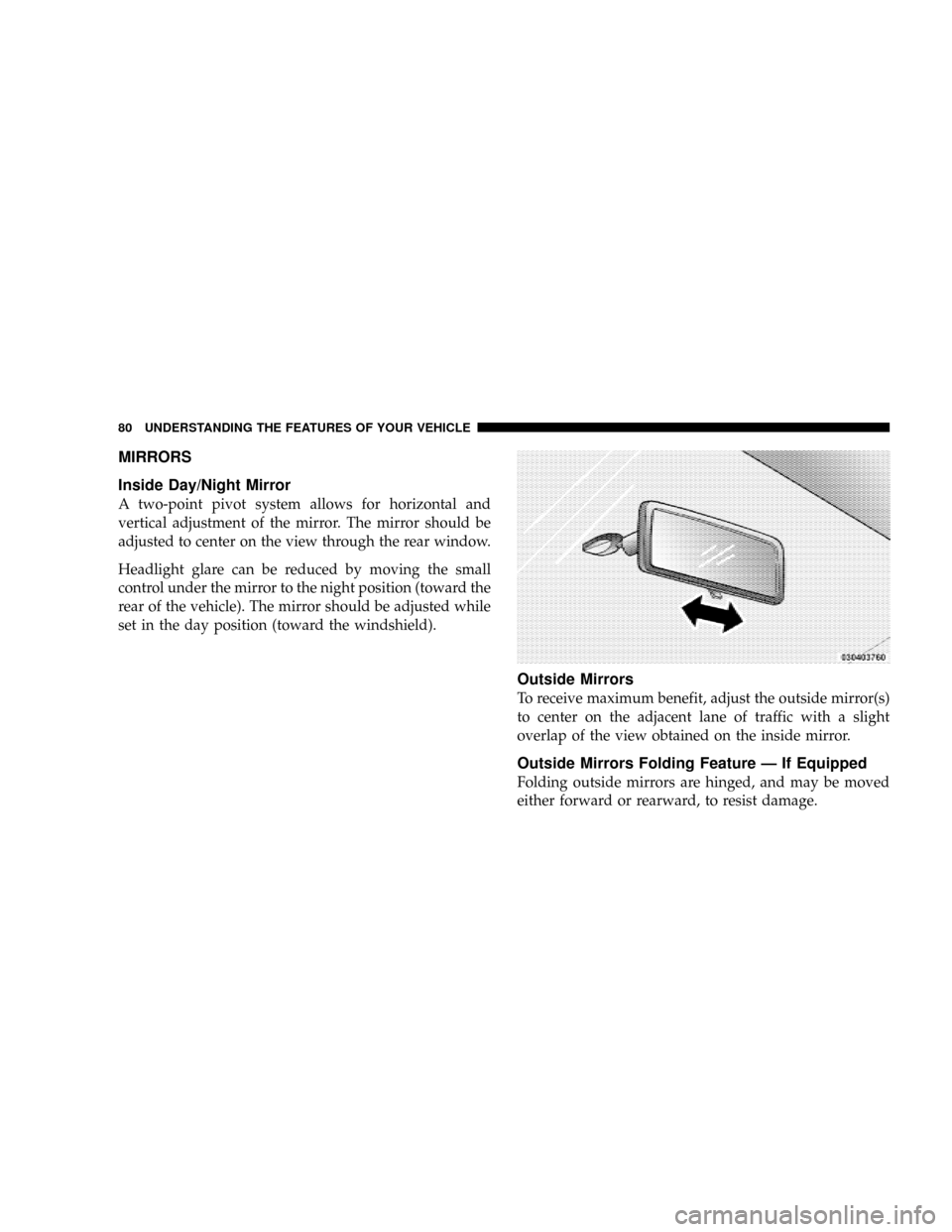
A two-point pivot system allows for horizontal and
vertical adjustment of the mirror. The mirror should be
adjusted to center on the view through the rear window.
Headlight glare can be reduced by moving the small
control under the mirror to the night position (toward the
rear of the vehicle). The mirror should be adjusted while
set in the day position (toward the windshield).
Outside Mirrors
To receive maximum benefit, adjust the outside mirror(s)
to center on the adjacent lane of traffic with a slight
overlap of the view obtained on the inside mirror.
Outside Mirrors Folding Feature Ð If Equipped
Folding outside mirrors are hinged, and may be moved
either forward or rearward, to resist damage.
80 UNDERSTANDING THE FEATURES OF YOUR VEHICLE