ECU DODGE DAKOTA 2009 3.G Owner's Manual
[x] Cancel search | Manufacturer: DODGE, Model Year: 2009, Model line: DAKOTA, Model: DODGE DAKOTA 2009 3.GPages: 449, PDF Size: 10.96 MB
Page 163 of 449
To return the tailgate to the full-open position:
1. Lift up on the tailgate.
2. Remove both cables from between the cable guides
and the tailgate bumpers, and lower the tailgate.
CAUTION!
²Care should always be exercised when operating a
vehicle with cargo. Vehicle speeds may need to be
reduced. Severe turns or rough roads may cause
shifting or bouncing of the cargo that may result in
vehicle damage.
²Ensure the load is securely tied down and is
properly identified according to local laws if it
extends beyond the tail lights.
(Continued)
CAUTION! (Continued)
²Loading should not exceed 400 lbs (181 kg) of
material suspended above the wheelhouse and
partially open tailgate or vehicle damage may
result.
UNDERSTANDING THE FEATURES OF YOUR VEHICLE 161
3
Page 172 of 449
WARNING!
A hot engine cooling system is dangerous. You or
others could be badly burned by steam or boiling
coolant. You may want to call a service center if your
vehicle overheats. If you decide to look under the
hood yourself, see Section 7 of this manual. Follow
the warnings under the Cooling System Pressure Cap
paragraph.
8. Speedometer
The speedometer shows the vehicle's speed.
9. Charging System Light
This light shows the status of the electrical charg-
ing system. The light should come on when the
ignition switch is first turned ON and remain on briefly
as a bulb check. If the light stays on or comes on while
driving, turn off some of the vehicle's non-essential
electrical devices or increase engine speed (if at idle). Ifthe charging system light remains on, it means that the
vehicle is experiencing a problem with the charging
system. Obtain SERVICE IMMEDIATELY. See an autho-
rized dealer.
10. Vehicle Security Light
The vehicle security light will flash rapidly for approxi-
mately 15 seconds when the vehicle security alarm is
arming. The light will flash at a slower speed continu-
ously after the alarm is set. The security light will also
come on for about three seconds when the ignition is first
turned ON.
11. Anti-Lock Brake System (ABS)
This light monitors the Anti-Lock Brake System
(ABS). The light will illuminate when the igni-
tion switch is turned to the ON position and
may stay on for as long as four seconds.
If the ABS light remains on or turns on while driving, it
indicates that the Anti-Lock portion of the brake system
170 UNDERSTANDING YOUR INSTRUMENT PANEL
Page 260 of 449
roads. This feature provides the safety, security, and
convenience of operating in all-wheel drive at all times
regardless of road conditions.
When additional traction is required, the 4WD LOCK
and 4WD LOW positions can be used to lock the front
and rear driveshafts together, through the transfer case
inter-axle differential, and force the front and rear wheels
to rotate at the same speed. This is accomplished by
rotating the 4WD Control Switch to these positions. The
4WD LOCK and 4WD LOW positions are intended for
loose, slippery road surfaces only. Driving in the 4WD
LOCK and 4WD LOW positions on dry, hard-surfaced
roads may cause increased tire wear and damage to the
driveline components.
The transfer case NEUTRAL position is selected by
depressing the recessed button located on the lower left
hand corner of the 4WD Control Switch.NOTE:The transfer case NEUTRAL position is to be
used for recreational towing only. Refer to ªRecreational
Towingº in Section 5 for specific procedures on shifting
into and out of NEUTRAL.
Transfer Case Position Indicator Lights
Transfer case position indicator lights are located on the
instrument cluster. If there are no indicator lights on or
flashing, the transfer case position is 4-wheel drive
(4WD) and indicates the current and desired transfer case
selection (4WD,4WD LOCK).
The ªSVC 4WDº warning light monitors the electric shift
4WD system. If this light remains on after engine start up
or illuminates during driving, it means that the 4WD
system is not functioning properly and that service is
required. See your authorized dealer for service.
258 STARTING AND OPERATING
Page 312 of 449
should then be determined separately to be sure that the
load is properly distributed over front and rear axle.
Weighing the vehicle may show that the GAWR of either
the front or rear axles has been exceeded but the total
load is within the specified GVWR. If so, weight must be
shifted from front to rear or rear to front as appropriate
until the specified weight limitations are met.
Store heavier items down low and be sure that the weight
is distributed equally. Stow all loose items securely before
driving.
Improper weight distribution can have an adverse effect
on the way your vehicle steers and handles and the way
the brakes operate.WARNING!
Do not load your vehicle any heavier than the GVWR
or the maximum front and rear GAWR. If you do,
parts on your vehicle can break, or it can change the
way your vehicle handles. This could cause you to
lose control. Also, overloading can shorten the life of
your vehicle.
TRAILER TOWING
In this section you will find safety tips and information
on limits to the type of towing you can reasonably do
with your vehicle. Before towing a trailer carefully re-
view this information to tow your load as efficiently and
safely as possible.
To maintain warranty coverage, follow the requirements
and recommendations in this manual concerning ve-
hicles used for trailer towing.
310 STARTING AND OPERATING
Page 320 of 449
WARNING! (Continued)
Make certain that the load is secured in the trailer
and will not shift during travel. When trailering
cargo that is not fully secured, dynamic load shifts
can occur that may be difficult for the driver to
control. You could lose control of your vehicle and
have an accident.
²When hauling cargo or towing a trailer, do not over-
load your vehicle or trailer. Overloading can cause a
loss of control, poor performance or damage to brakes,
axle, engine, transmission, steering, suspension, chas-
sis structure or tires.
²Safety chains must always be used between your
vehicle and trailer. Always connect the chains to the
frame or hook retainers of the vehicle hitch. Cross the
chains under the trailer tongue and allow enough
slack for turning corners.
²Vehicles with trailers should not be parked on a grade.
When parking, apply the parking brake on the tow
vehicle. Put the tow vehicle automatic transmission in
PARK. With a manual transmission, shift the transmis-
sion into REVERSE. For four-wheel drive vehicles,
make sure the transfer case is not in NEUTRAL.
Always, block or9chock9the trailer wheels.
²GCWR must not be exceeded.
²Total weight must be distributed between the tow
vehicle and the trailer so that the following four
ratings are not exceeded:
1. GVWR
2. GTW
3. GAWR
318 STARTING AND OPERATING
Page 335 of 449
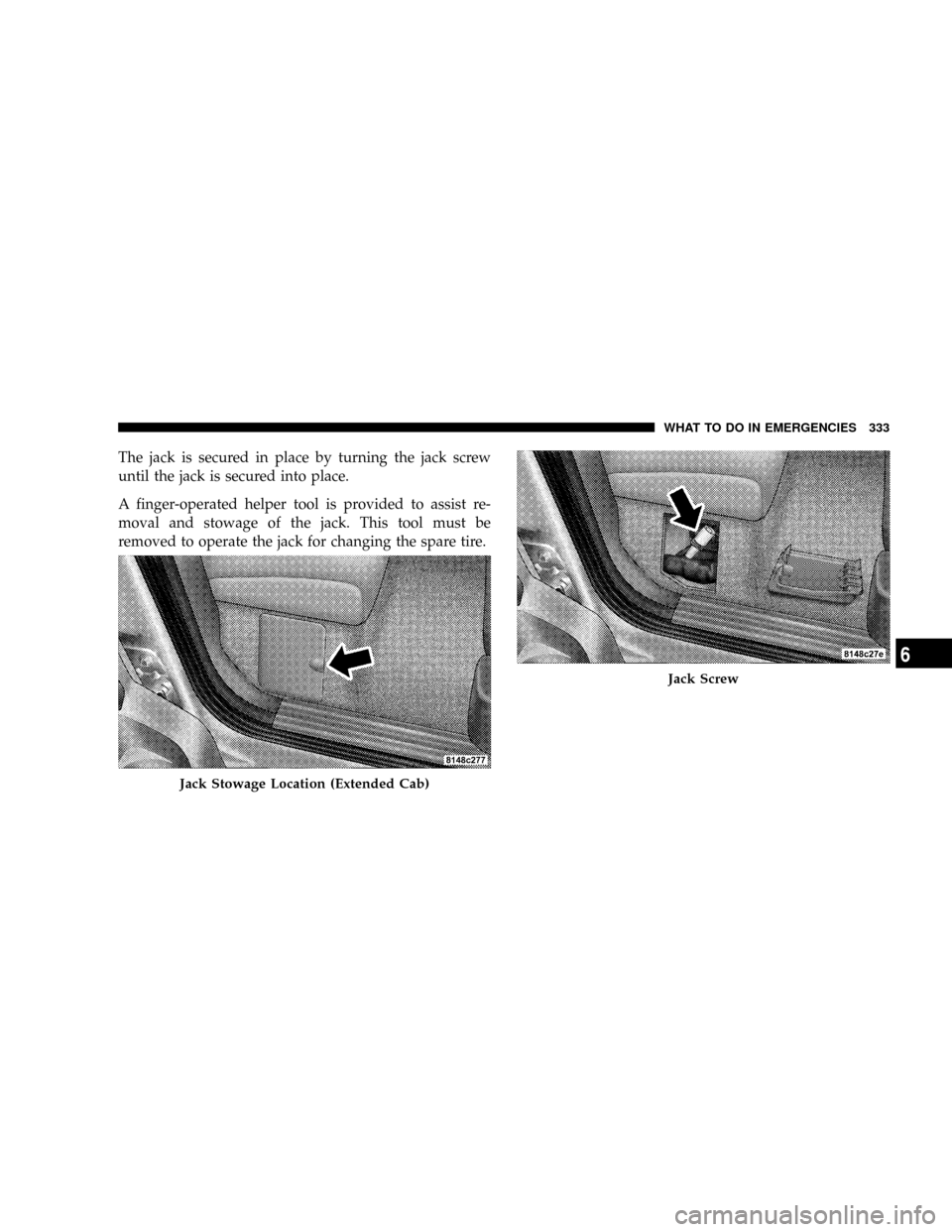
The jack is secured in place by turning the jack screw
until the jack is secured into place.
A finger-operated helper tool is provided to assist re-
moval and stowage of the jack. This tool must be
removed to operate the jack for changing the spare tire.
Jack Stowage Location (Extended Cab)
Jack Screw
WHAT TO DO IN EMERGENCIES 333
6
Page 341 of 449
WARNING! (Continued)
²If working on or near a roadway, be extremely
careful of motor traffic.
²To assure that spare tires, flat or inflated are
securely stowed, spares must be stowed with the
valve stem facing the ground.
²Turn on the Hazard warning flasher.
1. Lower and remove the spare wheel, jack, and tools
from stowage.2. Using the wheel wrench, loosen, but do not remove,
the wheel nuts by turning them counterclockwise one
turn while the wheel is still on the ground.
3. When changing a front wheel, place the jack under the
frame rail behind the wheel. Locate the jack as far
forward as possible on the straight part of the frame prior
to inboard transition, as shown. Operate the jack using
the jack drive tube and the wheel wrench - the tube
extension, may be used but is not required.
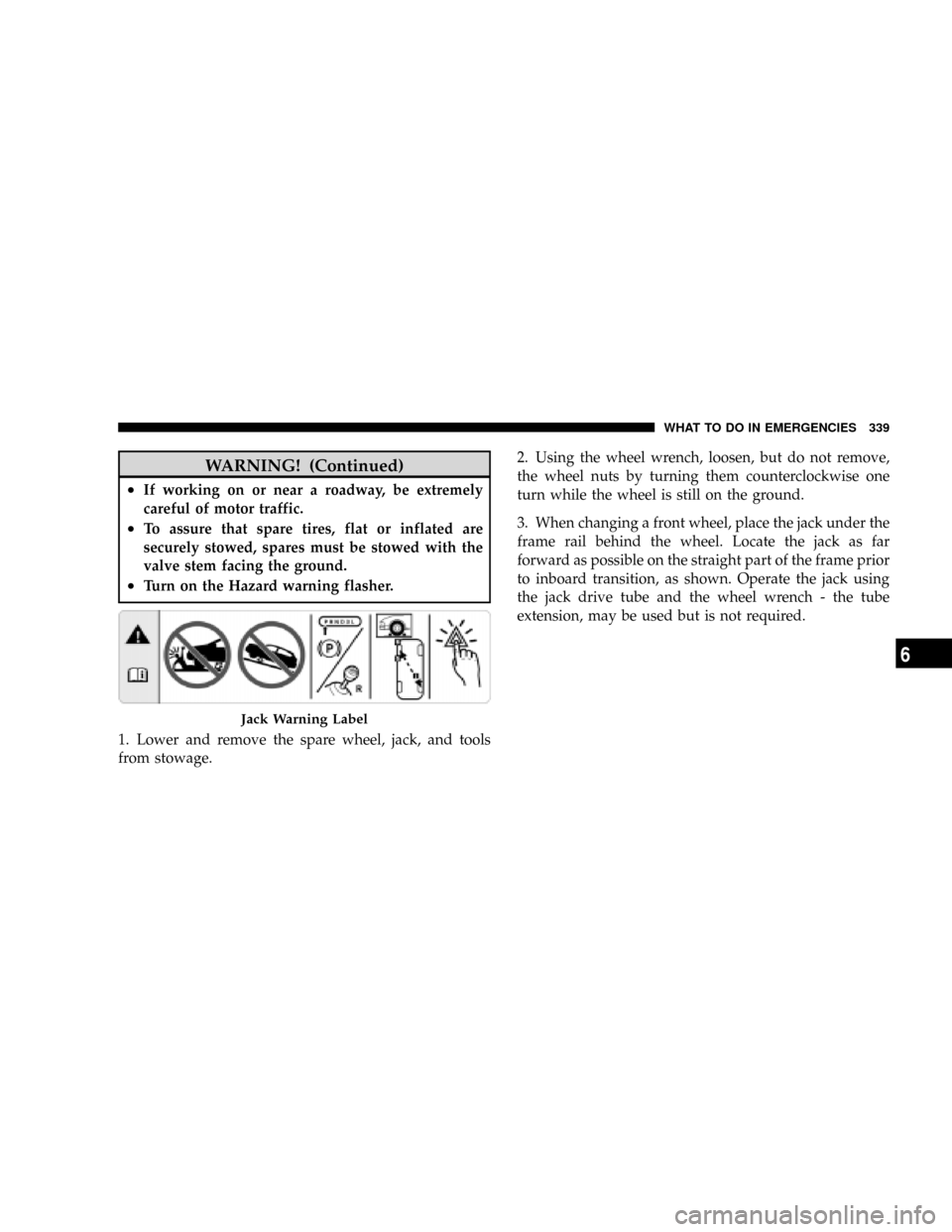
Jack Warning Label
WHAT TO DO IN EMERGENCIES 339
6
Page 344 of 449
WARNING!
A loose tire or jack thrown forward in a collision or
hard stop could injure someone in the vehicle. Al-
ways stow the jack, tools and the extra tire and wheel
in the places provided.
8. Lower the jack to its fully closed position. Stow the
replaced tire, jack, and tools as previously described.
9. Adjust the tire pressure when possible.
NOTE:Do not oil wheel studs. For chrome wheels, do
not substitute with chrome plated wheel nuts.
WARNING!
Carefully follow these tire changing warnings to
help prevent personal injury or damage to your
vehicle:
(Continued)
WARNING! (Continued)
²Always park on a firm, level surface as far from
the edge of the roadway as possible before raising
the vehicle.
²Block the wheel diagonally opposite the wheel to
be raised.
²Apply the parking brake firmly before jacking.
²Never start the engine with the vehicle on a jack.
²Do not let anyone sit in the vehicle when it is on a
jack.
²Do not get under the vehicle when it is on a jack.
²Only use the jack in the positions indicated.
²If working on or near a roadway, be extremely
careful of motor traffic.
²To assure that spare tires, flat or inflated, are
securely stowed, spares must be stowed with the
valve stem facing the ground.
342 WHAT TO DO IN EMERGENCIES
Page 430 of 449
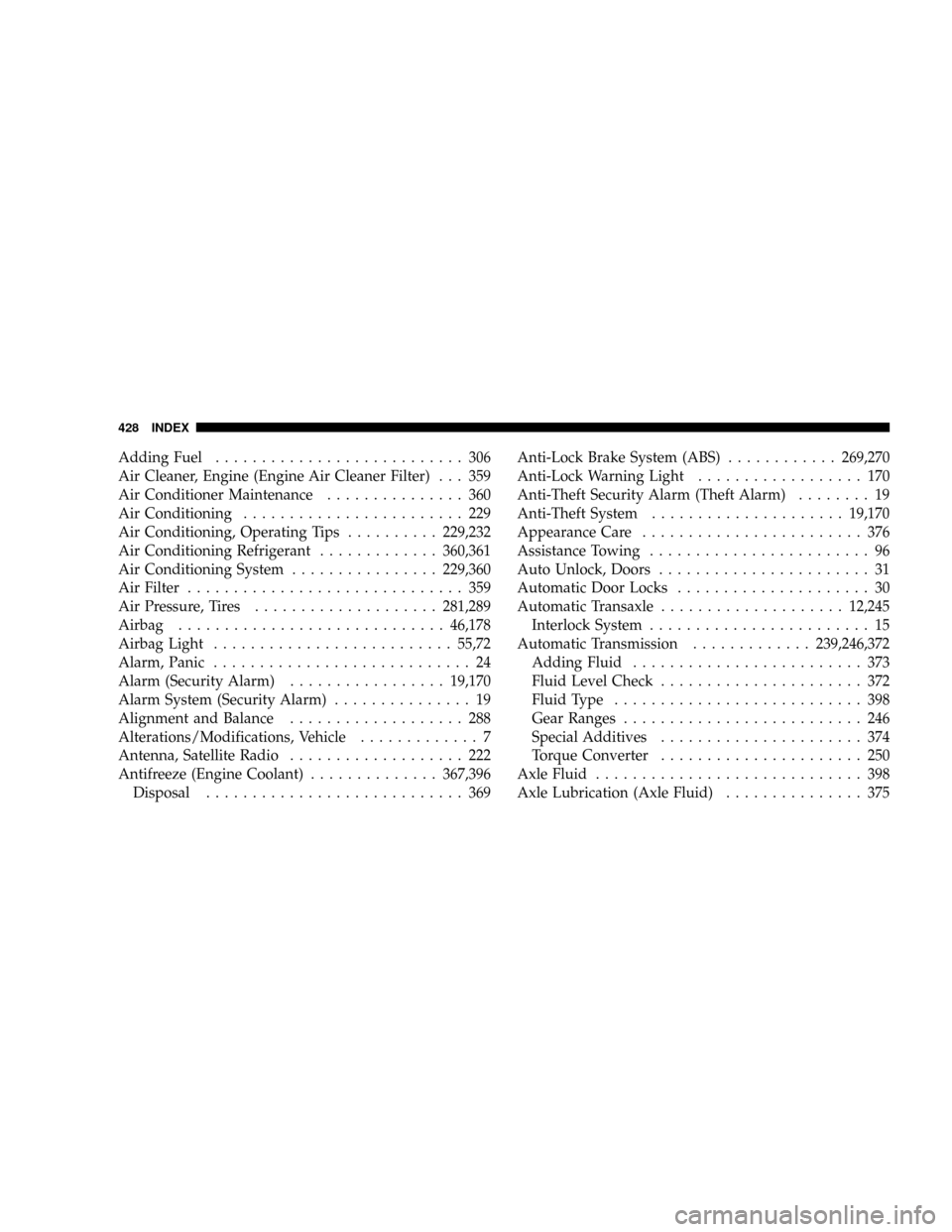
Adding Fuel........................... 306
Air Cleaner, Engine (Engine Air Cleaner Filter) . . . 359
Air Conditioner Maintenance............... 360
Air Conditioning........................ 229
Air Conditioning, Operating Tips..........229,232
Air Conditioning Refrigerant.............360,361
Air Conditioning System................229,360
Air Filter.............................. 359
Air Pressure, Tires....................281,289
Airbag.............................46,178
Airbag Light..........................55,72
Alarm, Panic............................ 24
Alarm (Security Alarm).................19,170
Alarm System (Security Alarm)............... 19
Alignment and Balance................... 288
Alterations/Modifications, Vehicle............. 7
Antenna, Satellite Radio................... 222
Antifreeze (Engine Coolant)..............367,396
Disposal............................ 369Anti-Lock Brake System (ABS)............269,270
Anti-Lock Warning Light.................. 170
Anti-Theft Security Alarm (Theft Alarm)........ 19
Anti-Theft System.....................19,170
Appearance Care........................ 376
Assistance Towing........................ 96
Auto Unlock, Doors....................... 31
Automatic Door Locks..................... 30
Automatic Transaxle....................12,245
Interlock System........................ 15
Automatic Transmission.............239,246,372
Adding Fluid......................... 373
Fluid Level Check...................... 372
Fluid Type........................... 398
Gear Ranges.......................... 246
Special Additives...................... 374
Torque Converter...................... 250
Axle Fluid............................. 398
Axle Lubrication (Axle Fluid)............... 375
428 INDEX
Page 442 of 449
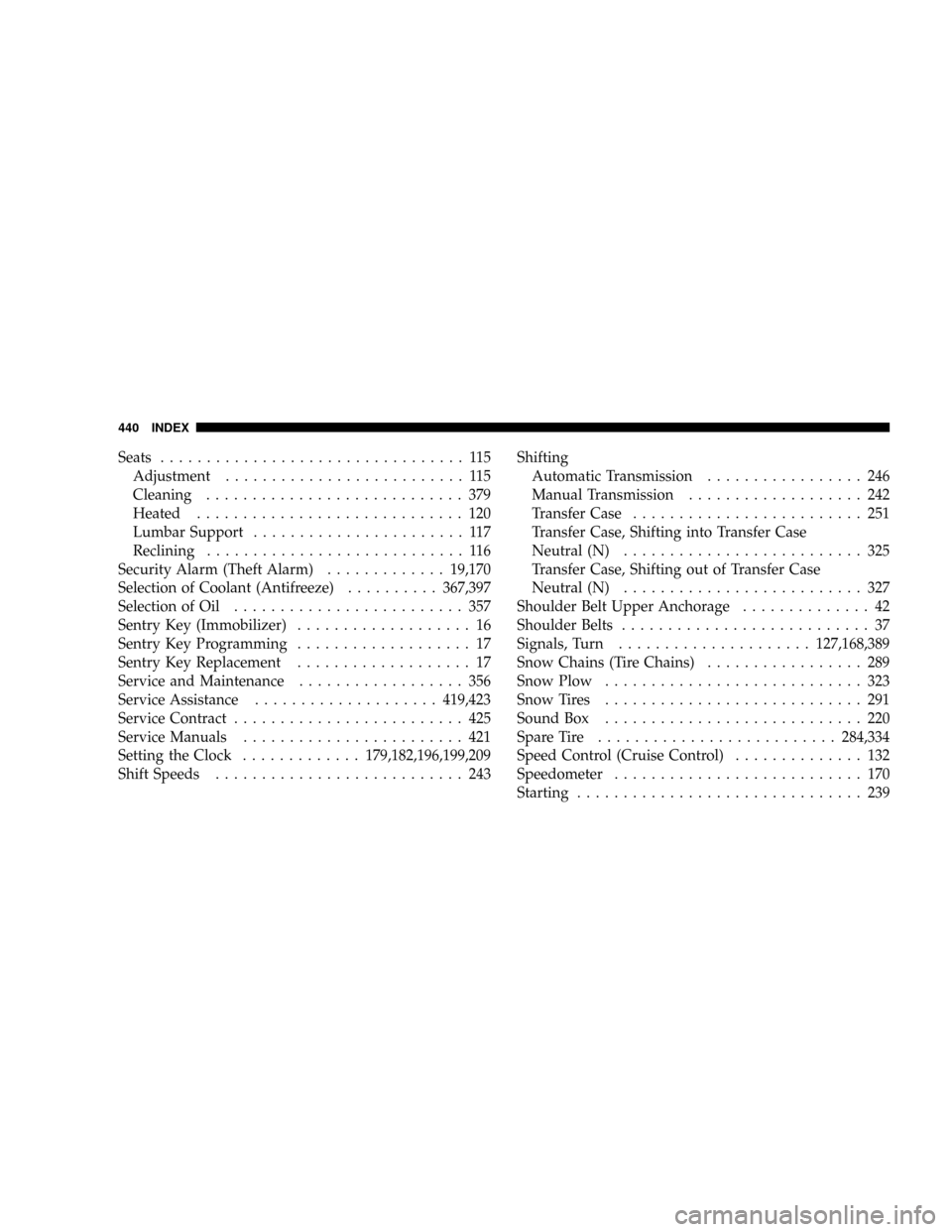
Seats................................. 115
Adjustment.......................... 115
Cleaning............................ 379
Heated............................. 120
Lumbar Support....................... 117
Reclining............................ 116
Security Alarm (Theft Alarm).............19,170
Selection of Coolant (Antifreeze)..........367,397
Selection of Oil......................... 357
Sentry Key (Immobilizer)................... 16
Sentry Key Programming................... 17
Sentry Key Replacement................... 17
Service and Maintenance.................. 356
Service Assistance....................419,423
Service Contract......................... 425
Service Manuals........................ 421
Setting the Clock.............179,182,196,199,209
Shift Speeds........................... 243Shifting
Automatic Transmission................. 246
Manual Transmission................... 242
Transfer Case......................... 251
Transfer Case, Shifting into Transfer Case
Neutral (N).......................... 325
Transfer Case, Shifting out of Transfer Case
Neutral (N).......................... 327
Shoulder Belt Upper Anchorage.............. 42
Shoulder Belts........................... 37
Signals, Turn.....................127,168,389
Snow Chains (Tire Chains)................. 289
Snow Plow............................ 323
Snow Tires............................ 291
Sound Box............................ 220
Spare Tire..........................284,334
Speed Control (Cruise Control).............. 132
Speedometer........................... 170
Starting............................... 239
440 INDEX