tires DODGE DAKOTA 2009 3.G Owner's Guide
[x] Cancel search | Manufacturer: DODGE, Model Year: 2009, Model line: DAKOTA, Model: DODGE DAKOTA 2009 3.GPages: 449, PDF Size: 10.96 MB
Page 311 of 449
Gross Axle Weight Rating (GAWR)
The GAWR is the maximum permissible load on the front
and rear axles. The load must be distributed in the cargo
area so that the GAWR of each axle is not exceeded.
Each axle GAWR is determined by the component in the
system with the lowest load carrying capacity (axle,
springs, tires, or wheels).
Heavier axles or suspension components sometimes
specified by purchasers for increased durability do not
necessarily increase the vehicle's GVWR.
Tire Size
This is the minimum allowable tire size for your vehicle.
Replacement tires must be equal to the load capacity of
this tire size.
Rim Size
This is the rim size that is appropriate for the tire size
listed.
Inflation Pressure (Cold)
This is the cold tire inflation pressure for your vehicle for
all loading conditions up to full GAWR.
Curb Weight
The curb weight of a vehicle is defined as the total weight
of the vehicle with all fluids, including vehicle fuel, at full
capacity conditions, and with no occupants or cargo
loaded into the vehicle. The front and rear curb weight
values are determined by weighing your vehicle on a
commercial scale before any occupants or cargo are
added.
Loading
The actual total weight and the weight of the front and
rear of your vehicle at the ground can best be determined
by weighing it when it is loaded and ready for operation.
The entire vehicle should first be weighed on a commer-
cial scale to ensure that the GVWR has not been ex-
ceeded. The weight on the front and rear of the vehicle
STARTING AND OPERATING 309
5
Page 320 of 449
WARNING! (Continued)
Make certain that the load is secured in the trailer
and will not shift during travel. When trailering
cargo that is not fully secured, dynamic load shifts
can occur that may be difficult for the driver to
control. You could lose control of your vehicle and
have an accident.
²When hauling cargo or towing a trailer, do not over-
load your vehicle or trailer. Overloading can cause a
loss of control, poor performance or damage to brakes,
axle, engine, transmission, steering, suspension, chas-
sis structure or tires.
²Safety chains must always be used between your
vehicle and trailer. Always connect the chains to the
frame or hook retainers of the vehicle hitch. Cross the
chains under the trailer tongue and allow enough
slack for turning corners.
²Vehicles with trailers should not be parked on a grade.
When parking, apply the parking brake on the tow
vehicle. Put the tow vehicle automatic transmission in
PARK. With a manual transmission, shift the transmis-
sion into REVERSE. For four-wheel drive vehicles,
make sure the transfer case is not in NEUTRAL.
Always, block or9chock9the trailer wheels.
²GCWR must not be exceeded.
²Total weight must be distributed between the tow
vehicle and the trailer so that the following four
ratings are not exceeded:
1. GVWR
2. GTW
3. GAWR
318 STARTING AND OPERATING
Page 321 of 449
4. Tongue weight rating for the trailer hitch utilized
(This requirement may limit the ability to always
achieve the 10% to 15% range of tongue weight as a
percentage of total trailer weight.)
Towing Requirements Ð Tires
þ
Do not attempt to tow a trailer while using a compact
spare tire.
þProper tire inflation pressures are essential to the safe
and satisfactory operation of your vehicle. For proper
tire inflation procedures, refer to ªTire Pressuresº
under ºTires±General Informationº in Section 5.
þAlso, check the trailer tires for proper tire inflation
pressures before trailer usage.
þCheck for signs of tire wear or visible tire damage
before towing a trailer. For the proper inspection
procedure, refer to ªTread Wear Indicatorsº under
ºTires±General Informationº in Section 5.
þWhen replacing tires, refer to ªReplacement Tiresº
under ªTires±General Informationº in Section 5. Re-
placing tires with a higher load carrying capacity will
not increase the vehicle's GVWR and GAWR limits.
Towing Requirements Ð Trailer Brakes
þ
Donotinterconnect the hydraulic brake system or
vacuum system of your vehicle with that of the trailer.
This could cause inadequate braking and possible
personal injury.
þAn electronically actuated trailer brake controller is
required when towing a trailer with electronically
actuated brakes. When towing a trailer equipped with
a hydraulic surge actuated brake system, an electronic
brake controller is not required.
þTrailer brakes are recommended for trailers over
1,000 lbs (454 kg) and required for trailers in excess of
2,000 lbs (907 kg).
STARTING AND OPERATING 319
5
Page 336 of 449
WARNING!
The jack is designed as a tool for changing tires only.
The jack should not be used to lift the vehicle for
service purposes, unless suitable supports are placed
under the vehicle as a safety measure. The vehicle
should be jacked on a firm level surface only. Avoid
icy or slippery areas.
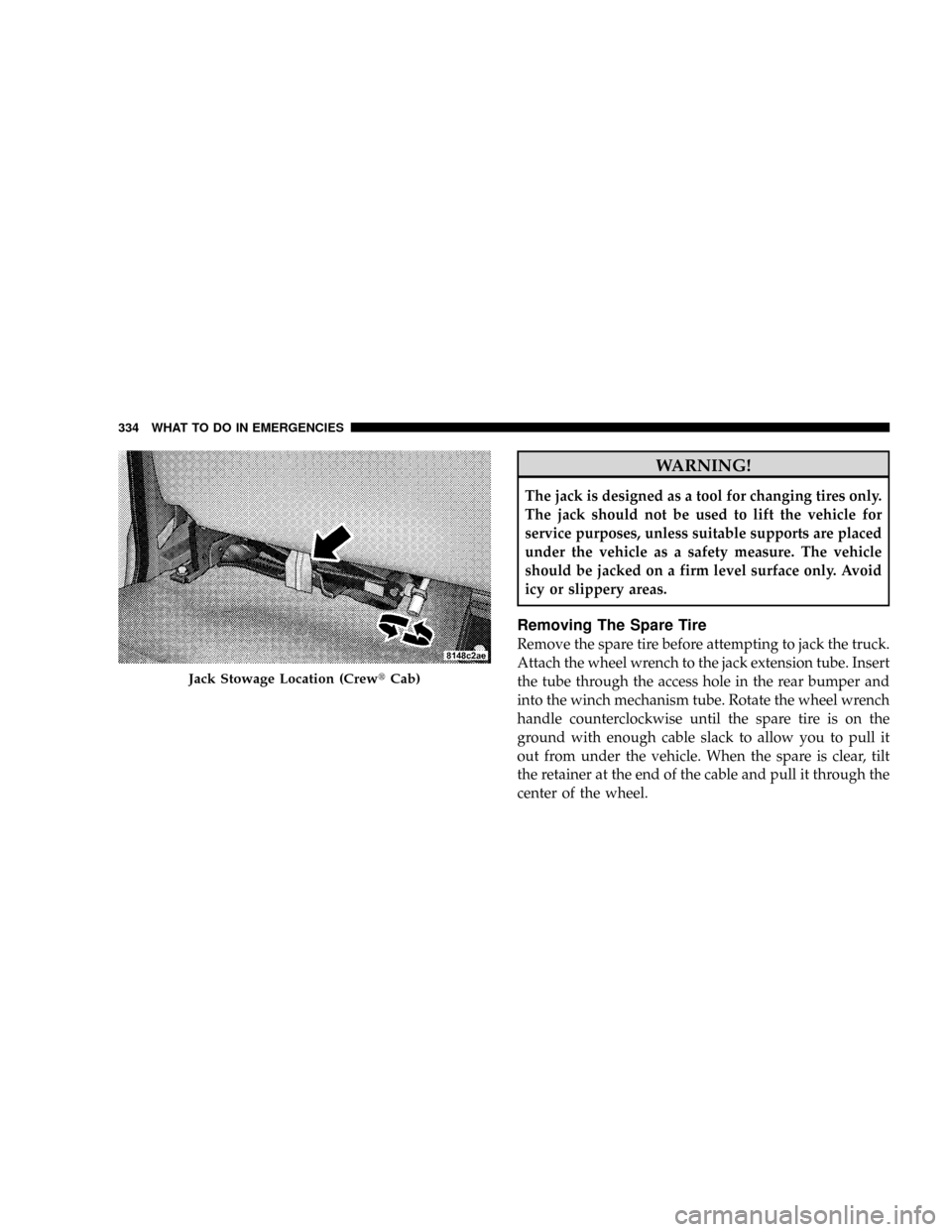
Removing The Spare Tire
Remove the spare tire before attempting to jack the truck.
Attach the wheel wrench to the jack extension tube. Insert
the tube through the access hole in the rear bumper and
into the winch mechanism tube. Rotate the wheel wrench
handle counterclockwise until the spare tire is on the
ground with enough cable slack to allow you to pull it
out from under the vehicle. When the spare is clear, tilt
the retainer at the end of the cable and pull it through the
center of the wheel.
Jack Stowage Location (CrewtCab)
334 WHAT TO DO IN EMERGENCIES
Page 339 of 449
Tire Changing Procedure
WARNING!
Getting under a jacked-up vehicle is dangerous. The
vehicle could slip off the jack and fall on you. You
could be crushed. Never get any part of your body
under a vehicle that is on a jack. Never start or run
the engine while the vehicle is on a jack. If you need
to get under a raised vehicle, take it to a service center
where it can be raised on a lift.
Do not raise this vehicle using a bumper jack. The scissor
jack is designed as a tool for changing tires on this vehicle
only. It is not recommended that the jack be used for
service purposes or to lift more than one wheel at a time.
Preparations
1. Park the vehicle on a firm level surface. Avoid icy or
slippery areas.
WARNING!
Do not attempt to change a tire on the side of the
vehicle close to moving traffic. Pull far enough off
the road to avoid the danger of being hit when
operating the jack or changing the wheel.
2. Set the parking brake.
3. Place the shift lever in PARK (automatic transmission).
On 4-Wheel Drive vehicles, shift the transfer case to the
4L position.
4. Turn the ignition OFF.
5. Turn on the Hazard Warning Flasher.
WHAT TO DO IN EMERGENCIES 337
6
Page 341 of 449
WARNING! (Continued)
²If working on or near a roadway, be extremely
careful of motor traffic.
²To assure that spare tires, flat or inflated are
securely stowed, spares must be stowed with the
valve stem facing the ground.
²Turn on the Hazard warning flasher.
1. Lower and remove the spare wheel, jack, and tools
from stowage.2. Using the wheel wrench, loosen, but do not remove,
the wheel nuts by turning them counterclockwise one
turn while the wheel is still on the ground.
3. When changing a front wheel, place the jack under the
frame rail behind the wheel. Locate the jack as far
forward as possible on the straight part of the frame prior
to inboard transition, as shown. Operate the jack using
the jack drive tube and the wheel wrench - the tube
extension, may be used but is not required.
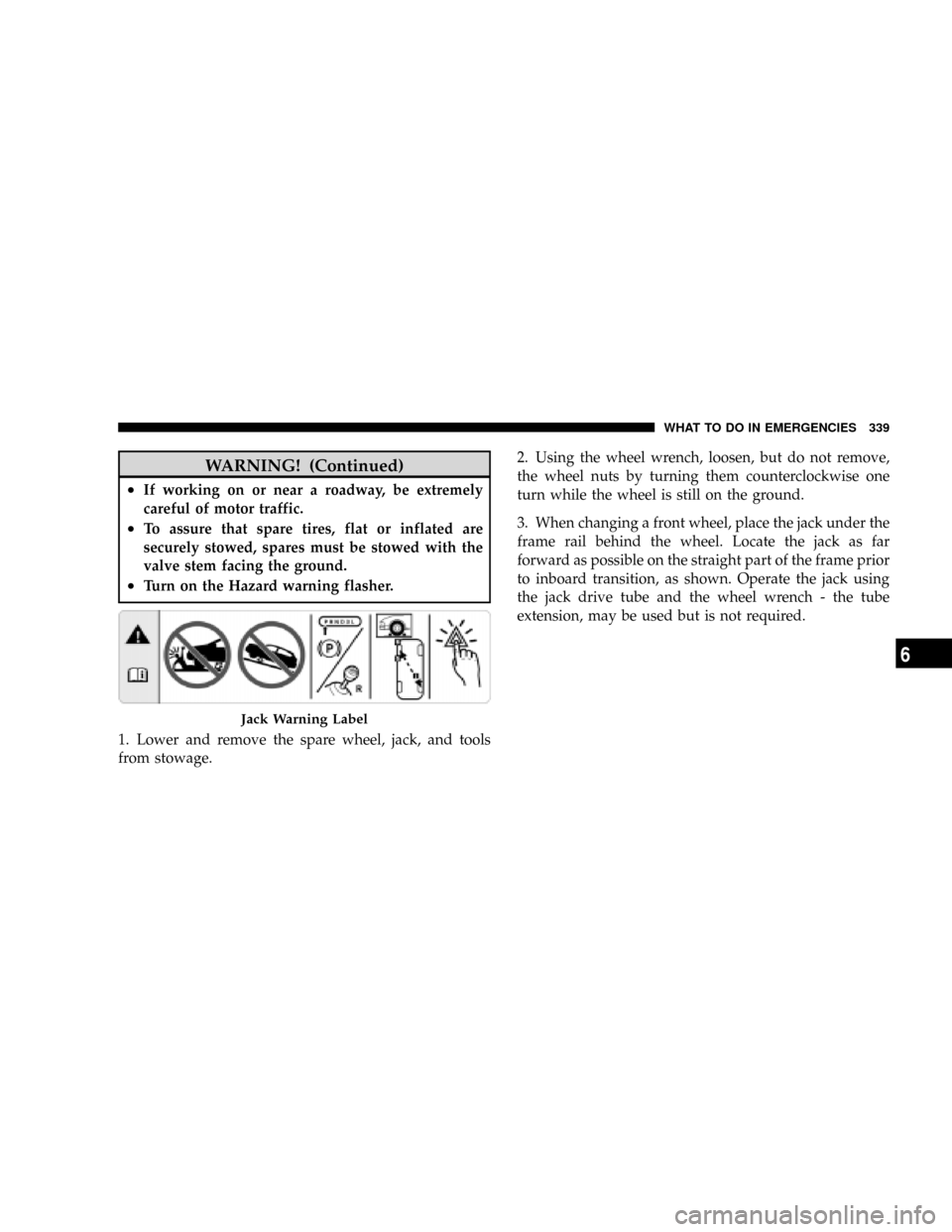
Jack Warning Label
WHAT TO DO IN EMERGENCIES 339
6
Page 344 of 449
WARNING!
A loose tire or jack thrown forward in a collision or
hard stop could injure someone in the vehicle. Al-
ways stow the jack, tools and the extra tire and wheel
in the places provided.
8. Lower the jack to its fully closed position. Stow the
replaced tire, jack, and tools as previously described.
9. Adjust the tire pressure when possible.
NOTE:Do not oil wheel studs. For chrome wheels, do
not substitute with chrome plated wheel nuts.
WARNING!
Carefully follow these tire changing warnings to
help prevent personal injury or damage to your
vehicle:
(Continued)
WARNING! (Continued)
²Always park on a firm, level surface as far from
the edge of the roadway as possible before raising
the vehicle.
²Block the wheel diagonally opposite the wheel to
be raised.
²Apply the parking brake firmly before jacking.
²Never start the engine with the vehicle on a jack.
²Do not let anyone sit in the vehicle when it is on a
jack.
²Do not get under the vehicle when it is on a jack.
²Only use the jack in the positions indicated.
²If working on or near a roadway, be extremely
careful of motor traffic.
²To assure that spare tires, flat or inflated, are
securely stowed, spares must be stowed with the
valve stem facing the ground.
342 WHAT TO DO IN EMERGENCIES
Page 405 of 449
6,000 Miles (10,000 km) or
6 Months Maintenance Service
Schedule
oChange the engine oil and engine oil
filter.
oRotate tires.
Odometer Reading Date
Repair Order # Dealer Code
Signature Authorized Chrysler Dealer
12,000 Miles (20,000 km) or 12 Months Maintenance Service
Schedule
oChange the engine oil and engine oil filter.
oRotate tires.
oIf using your vehicle for any of the following: Dusty or off-road conditions. Inspect the
engine air cleaner filter, replace if necessary.
oInspect the brake linings, replace if necessary.
oInspect the CV joints. Perform the first inspection at 12,000 miles (20 000 km) or
12 months.
oInspect the exhaust system. Perform the first inspection at 12,000 miles (20 000 km) or
12 months.
Odometer Reading Date
Repair Order # Dealer Code
Signature Authorized Chrysler Dealer
MAINTENANCE SCHEDULES 403
8
M
A
I
N
T
E
N
A
N
C
E
S
C
H
E
D
U
L
E
S
Page 406 of 449
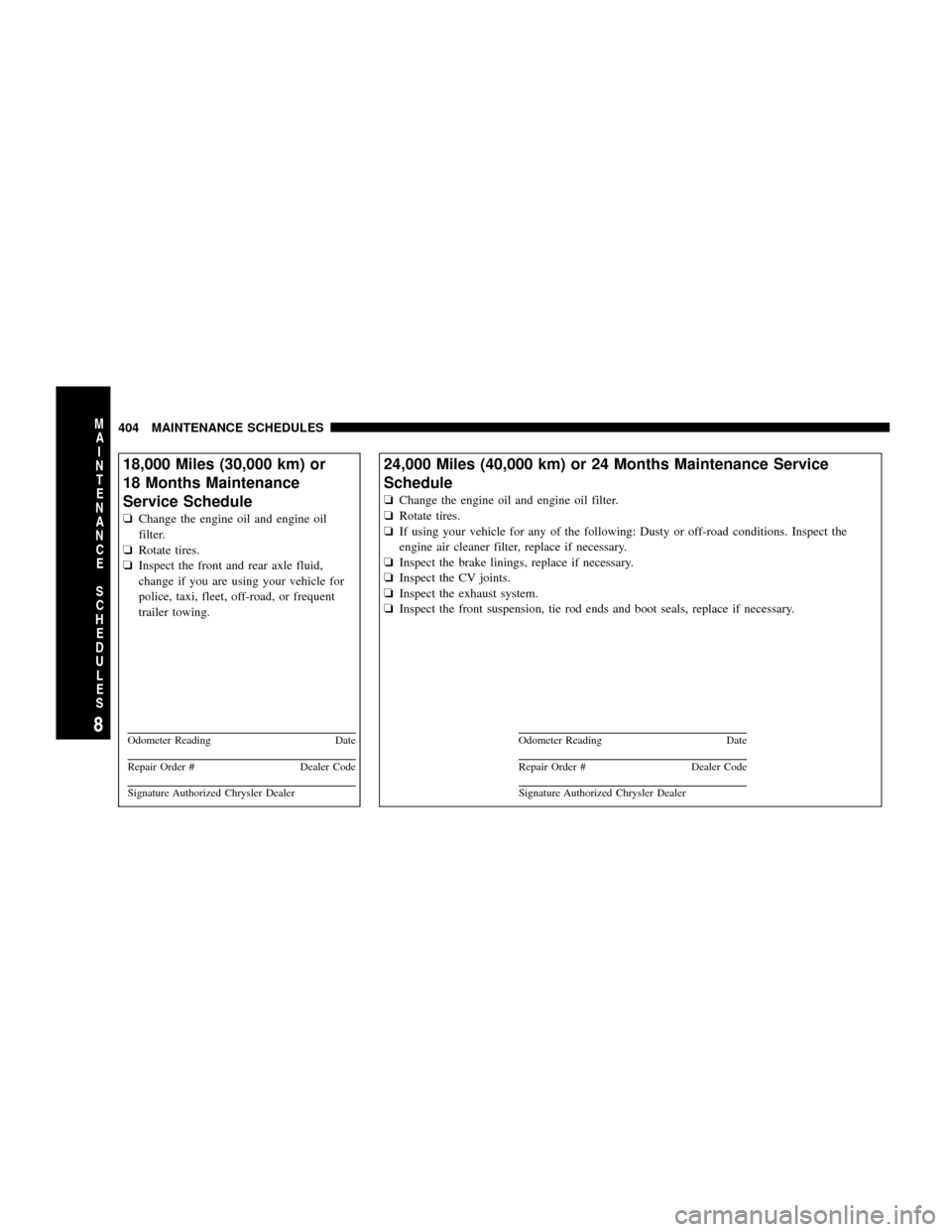
18,000 Miles (30,000 km) or
18 Months Maintenance
Service Schedule
oChange the engine oil and engine oil
filter.
oRotate tires.
oInspect the front and rear axle fluid,
change if you are using your vehicle for
police, taxi, fleet, off-road, or frequent
trailer towing.
Odometer Reading Date
Repair Order # Dealer Code
Signature Authorized Chrysler Dealer
24,000 Miles (40,000 km) or 24 Months Maintenance Service
Schedule
oChange the engine oil and engine oil filter.
oRotate tires.
oIf using your vehicle for any of the following: Dusty or off-road conditions. Inspect the
engine air cleaner filter, replace if necessary.
oInspect the brake linings, replace if necessary.
oInspect the CV joints.
oInspect the exhaust system.
oInspect the front suspension, tie rod ends and boot seals, replace if necessary.
Odometer Reading Date
Repair Order # Dealer Code
Signature Authorized Chrysler Dealer
404 MAINTENANCE SCHEDULES
8
M
A
I
N
T
E
N
A
N
C
E
S
C
H
E
D
U
L
E
S
Page 407 of 449
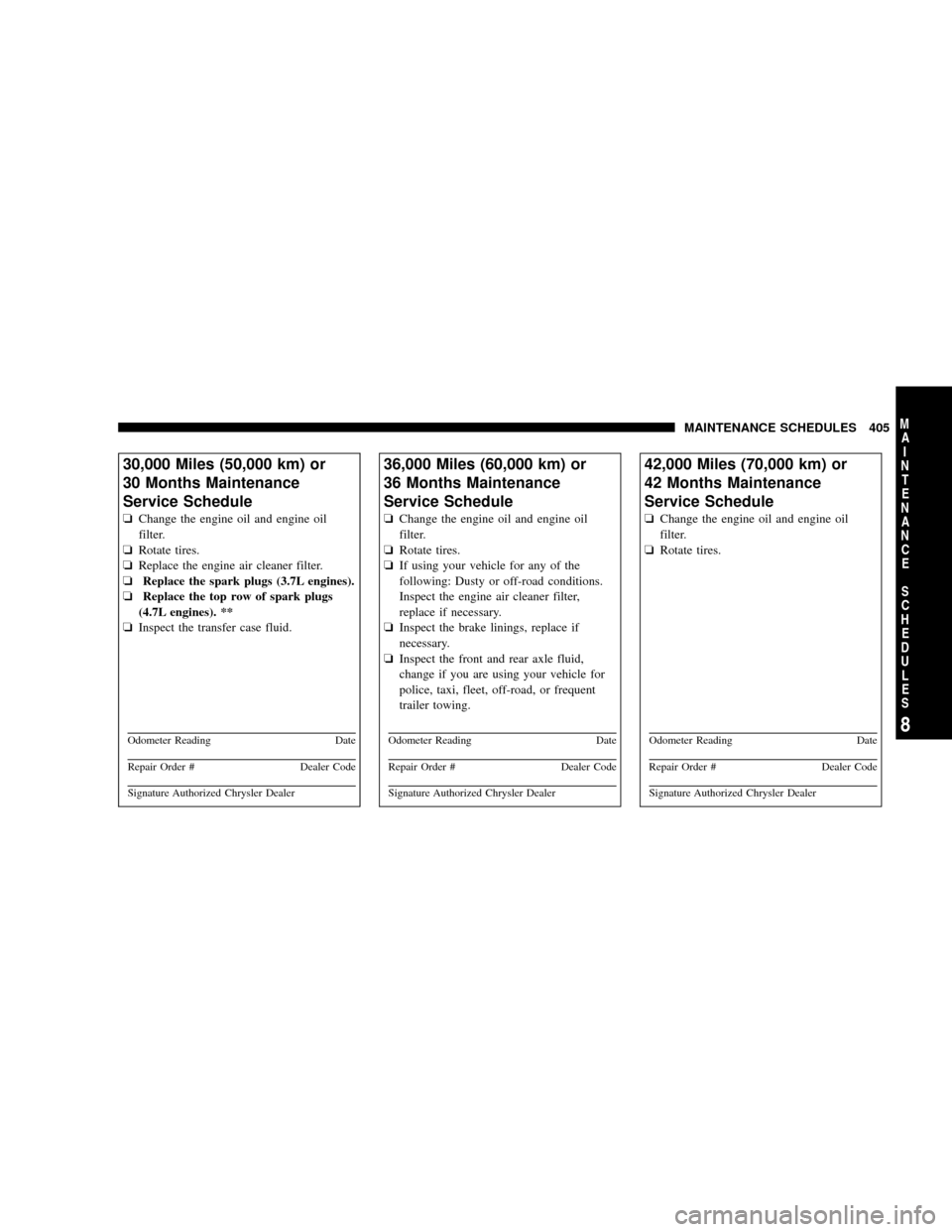
30,000 Miles (50,000 km) or
30 Months Maintenance
Service Schedule
oChange the engine oil and engine oil
filter.
oRotate tires.
oReplace the engine air cleaner filter.
oReplace the spark plugs (3.7L engines).
oReplace the top row of spark plugs
(4.7L engines). **
oInspect the transfer case fluid.
Odometer Reading Date
Repair Order # Dealer Code
Signature Authorized Chrysler Dealer
36,000 Miles (60,000 km) or
36 Months Maintenance
Service Schedule
oChange the engine oil and engine oil
filter.
oRotate tires.
oIf using your vehicle for any of the
following: Dusty or off-road conditions.
Inspect the engine air cleaner filter,
replace if necessary.
oInspect the brake linings, replace if
necessary.
oInspect the front and rear axle fluid,
change if you are using your vehicle for
police, taxi, fleet, off-road, or frequent
trailer towing.
Odometer Reading Date
Repair Order # Dealer Code
Signature Authorized Chrysler Dealer
42,000 Miles (70,000 km) or
42 Months Maintenance
Service Schedule
oChange the engine oil and engine oil
filter.
oRotate tires.
Odometer Reading Date
Repair Order # Dealer Code
Signature Authorized Chrysler Dealer
MAINTENANCE SCHEDULES 405
8
M
A
I
N
T
E
N
A
N
C
E
S
C
H
E
D
U
L
E
S