fuel cap DODGE DAKOTA 2009 3.G Owners Manual
[x] Cancel search | Manufacturer: DODGE, Model Year: 2009, Model line: DAKOTA, Model: DODGE DAKOTA 2009 3.GPages: 449, PDF Size: 10.96 MB
Page 141 of 449
point (fuel gauge pointer on the red ªEº marker), there is
reserve fuel capacity, which corresponds to approxi-
mately 8% of tank volume. This reserve capacity was put
in place to prevent the likelihood of customers running
out of fuel when operating at maximum load conditions
in areas where there aren't many gas stations.
NOTE:The Distance To Empty will remain equal to zero
until the vehicle runs out of fuel or is refueled.
Trip Odometer (ODO)
This display shows the distance traveled since the last
reset.
NOTE:The maximum value is approximately
6000 miles (9656 km).
Resetting of this screen will cause the trip odometer to
change to zero. Then the trip odometer must be reset in
order to update the trip odometer miles.
Elapsed Time (ET)
This display shows the accumulated ignition ON time
since the last reset. Resetting the Elapsed Time will cause
the display to change to zero.
C/T Button
Use the C/T (Compass/Temperature) button to select a
readout of the outside temperature and one of eight
compass headings that indicate the direction in which the
vehicle is facing.
UNDERSTANDING THE FEATURES OF YOUR VEHICLE 139
3
Page 174 of 449
CHAngE OIL and the outside temperature on vehicles
that are not equipped with the Overhead Console with
Compass/Temperature Mini-Trip Computer.
If the vehicle diagnostic system determines that the fuel
filler cap is loose, improperly installed, or damaged,
ªGASCAPº will be displayed in the instrument cluster.
Tighten the fuel filler cap properly and press the odom-
eter RESET button to turn the ªGASCAPº message off. If
the problem continues, the message will appear the next
time the vehicle is started.
Change Oil Message
Your vehicle is equipped with an engine oil change
indicator system. The ªCHAngE OILº message will flash
in the instrument cluster odometer for approximately
12 seconds after a single chime has sounded, to indicate
the next scheduled oil change interval. The engine oil
change indicator system is duty cycle based, which
means the engine oil change interval may fluctuate
dependent upon your personal driving style.Unless reset, this message will continue to display each
time you turn the ignition switch to the ON/RUN
position. To turn off the message temporarily, press and
release the Trip Odometer button on the instrument
cluster. To reset the oil change indicator system (after
performing the scheduled maintenance) refer to the fol-
lowing procedure.
1. Turn the ignition switch to the ON position(do not
start the engine).
2. Fully depress the accelerator pedal slowly three
times within 10 seconds.
3. Turn the ignition switch to the OFF/LOCK position.
NOTE:If the indicator message illuminates when you
start the vehicle, the oil change indicator system did not
reset. If necessary, repeat this procedure.
172 UNDERSTANDING YOUR INSTRUMENT PANEL
Page 240 of 449
mFlexible Fuel (4.7L Engine Only) Ð If Equipped. . 302
NE-85 General Information............... 302
NEthanol Fuel (E-85)................... 304
NFuel Requirements.................... 304
NSelection Of Engine Oil For Flexible Fuel
Vehicles (E-85) And Gasoline Vehicles...... 305
NStarting........................... 305
NCruising Range...................... 305
NReplacement Parts.................... 305
mAdding Fuel......................... 306
NFuel Filler Cap (Gas Cap)............... 306
mVehicle Loading....................... 308
NCertification Label.................... 308
NCurb Weight........................ 309NLoading........................... 309
mTrailer Towing........................ 310
NCommon Towing Definitions............ 311
NTrailer Hitch Classification.............. 315
NTrailer Towing Weights (Maximum Trailer
Weight Ratings)...................... 316
NTrailer And Tongue Weight.............. 316
NTowing Requirements................. 317
NTowing Tips........................ 322
mSnowplow........................... 323
mRecreational Towing (Behind Motorhome,
Etc.)................................ 324
N2WD Models........................ 324
N4WD Models........................ 324
238 STARTING AND OPERATING
Page 296 of 449
CAUTION!
²The TPMS has been optimized for the original
equipment tires and wheels. TPMS pressures have
been established for the tire size equipped on your
vehicle. Undesirable system operation or sensor
damage may result when using replacement
equipment that is not of the same size, type, and/or
style. Aftermarket wheels can cause sensor dam-
age. Do not use aftermarket tire sealants or balance
beads if your vehicle is equipped with a TPMS, as
damage to the sensors may result.
²After inspecting or adjusting the tire pressure
always reinstall the valve stem cap. This will
prevent moisture and dirt from entering the valve
stem, which could damage the tire pressure moni-
toring sensor.NOTE:
²The TPMS is not intended to replace normal tire care
and maintenance, or to provide warning of a tire
failure or condition.
²The TPMS should not be used as a tire pressure gauge
while adjusting your tire pressure.
²Driving on a significantly under-inflated tire causes
the tire to overheat and can lead to tire failure.
Under-inflation also reduces fuel efficiency and tire
tread life, and may affect the vehicle's handling and
stopping ability.
²The TPMS is not a substitute for proper tire mainte-
nance, and it is the driver 's responsibility to maintain
correct tire pressure using an accurate tire gauge, even
if under-inflation has not reached the level to trigger
illumination of the Tire Pressure Monitoring Telltale
Lamp.
294 STARTING AND OPERATING
Page 304 of 449
Carbon Monoxide Warnings
WARNING!
Carbon monoxide (CO) in exhaust gases is deadly.
Follow the precautions below to prevent carbon
monoxide poisoning:
²Do not inhale exhaust gases. They contain carbon
monoxide, a colorless and odorless gas, which can
kill. Never run the engine in a closed area, such as
a garage, and never sit in a parked vehicle with the
engine running for an extended period. If the
vehicle is stopped in an open area with the engine
running for more than a short period, adjust the
ventilation system to force fresh, outside air into
the vehicle.
(Continued)
WARNING! (Continued)
²Guard against carbon monoxide with proper
maintenance. Have the exhaust system inspected
every time the vehicle is raised. Have any abnor-
mal conditions repaired promptly. Until repaired,
drive with all side windows fully open.
FLEXIBLE FUEL (4.7L ENGINE ONLY) Ð IF
EQUIPPED
E-85 General Information
The information in this section is for Flexible Fuel ve-
hicles only. These vehicles can be identified by the unique
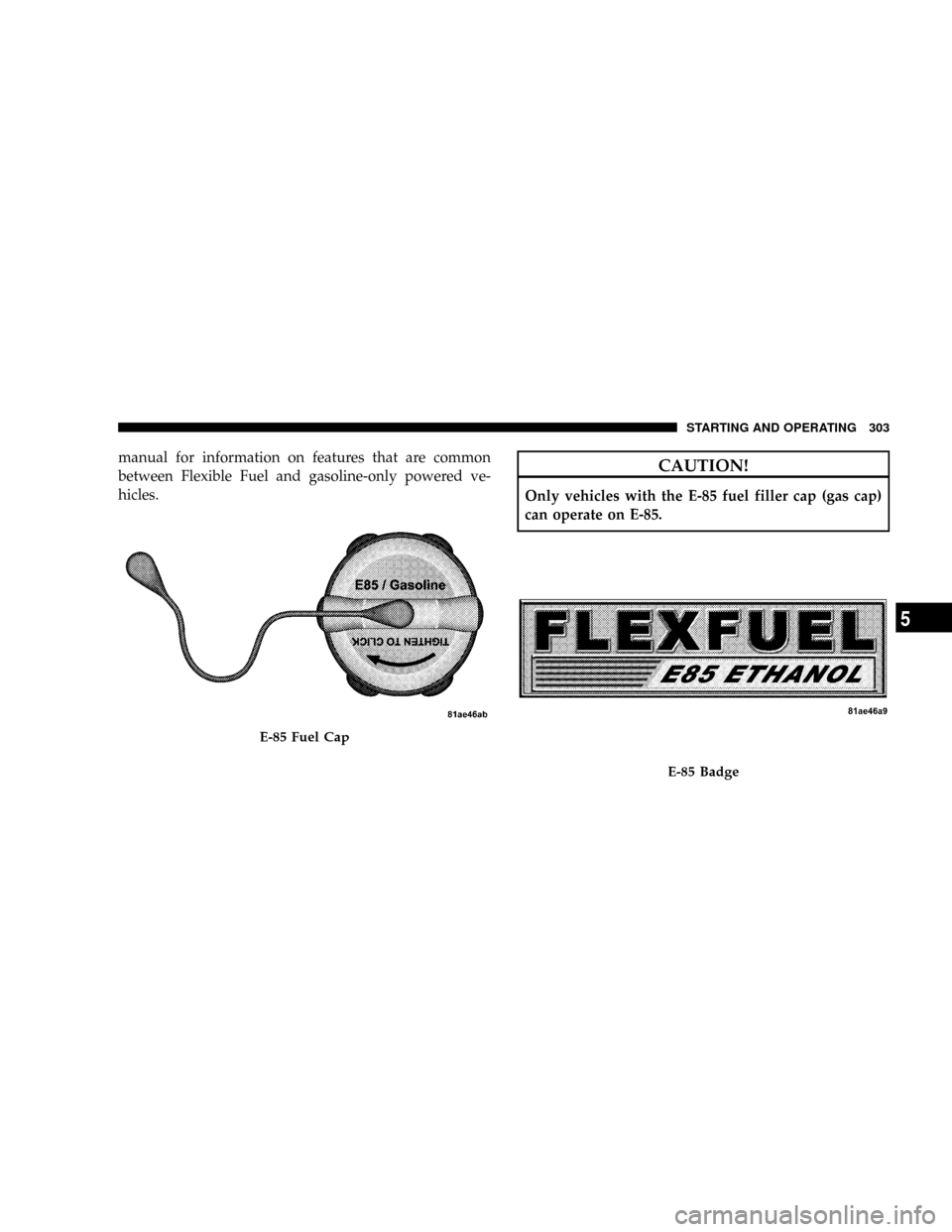
yellow fuel filler cap (gas cap) that shows E85 / Gasoline.
This section only covers those subjects that are unique to
these vehicles. Please refer to the other sections of this
302 STARTING AND OPERATING
Page 305 of 449
manual for information on features that are common
between Flexible Fuel and gasoline-only powered ve-
hicles.CAUTION!
Only vehicles with the E-85 fuel filler cap (gas cap)
can operate on E-85.
E-85 Fuel Cap
E-85 Badge
STARTING AND OPERATING 303
5
Page 306 of 449
ETHANOL FUEL (E-85)
E-85 is a mixture of approximately 85% fuel ethanol and
15% unleaded gasoline.
WARNING!
Ethanol vapors are extremely flammable and could
cause serious personal injury. Never have any smok-
ing materials lit in or near the vehicle when remov-
ing the fuel filler tube cap (gas cap) or filling the
tank. Do not use E-85 as a cleaning agent and never
use it near an open flame.
Fuel Requirements
If your vehicle is E-85 compatible, it will operate on
unleaded gasoline with an octane rating of 87, or E-85
fuel, or any mixture of these two fuels.For best results, a refueling pattern that avoids alternat-
ing between E-85 and unleaded gasoline is recom-
mended.
When you do switch fuel types it is recommended that:
²you do not add less than 5 gal (19 L) when refueling
²you drive the vehicle immediately after refueling for at
least 5 miles (8 km)
Observing these precautions will avoid possible hard
starting and/or significant deterioration in drivability
during warm up.
NOTE:Use seasonally adjusted E-85 fuel (ASTM
D5798). With non-seasonally adjusted E-85 fuel, you may
experience hard starting and rough idle following start
up even if the above recommendations are followed,
especially when the ambient temperature is below 32ÉF
(0ÉC).
304 STARTING AND OPERATING
Page 308 of 449
CAUTION!
Replacing fuel system components with non-ethanol
compatible components can damage your vehicle.
ADDING FUEL
Fuel Filler Cap (Gas Cap)
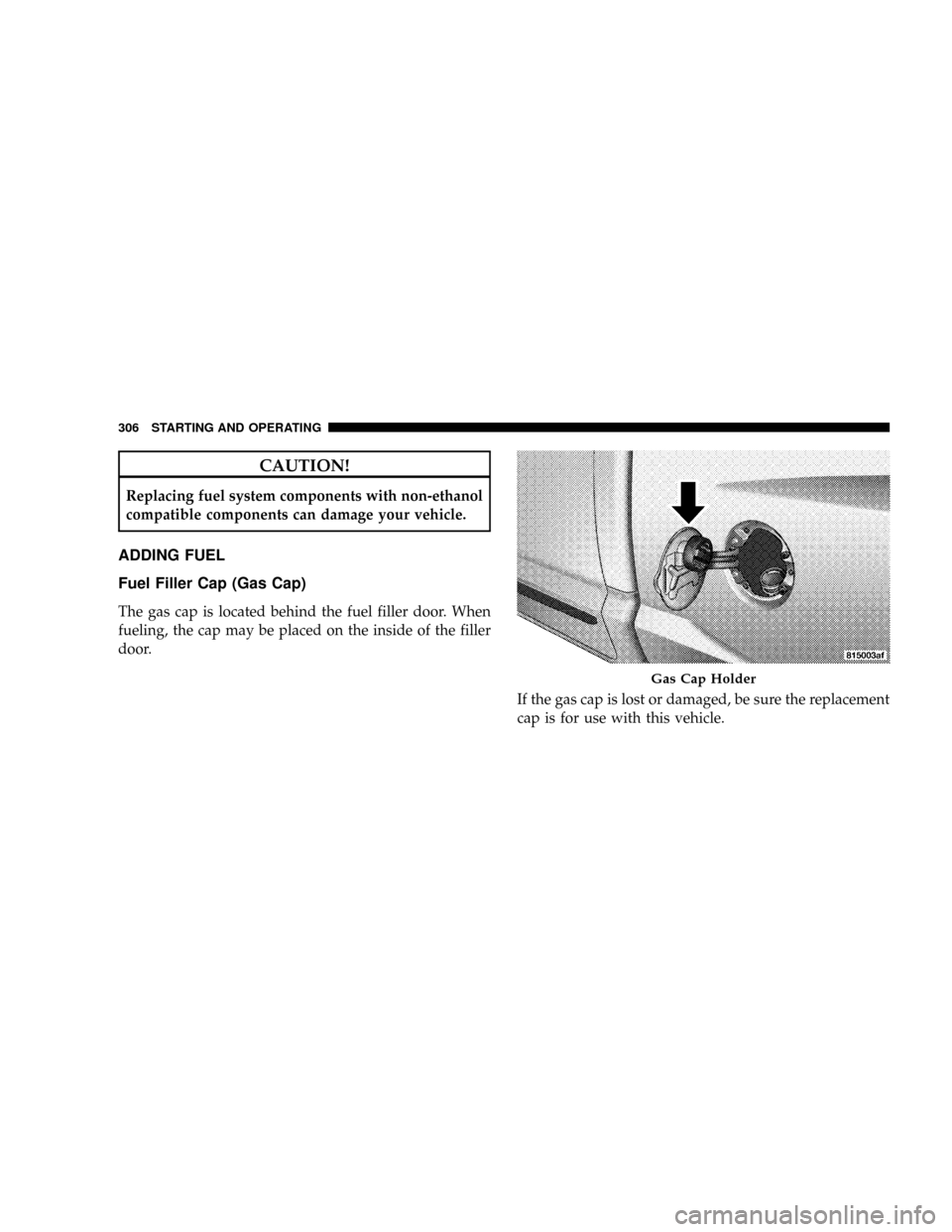
The gas cap is located behind the fuel filler door. When
fueling, the cap may be placed on the inside of the filler
door.
If the gas cap is lost or damaged, be sure the replacement
cap is for use with this vehicle.
Gas Cap Holder
306 STARTING AND OPERATING
Page 309 of 449
CAUTION!
Damage to the fuel system or emissions control
system could result from using an improper fuel tank
filler tube cap (gas cap). A poorly fitting cap could let
impurities into the fuel system.
WARNING!
²Never allow any lit smoking materials near the
vehicle while removing the cap or filling the tank.
²Never add fuel to the vehicle when the engine is
running.
NOTE:If fuel is poured from a portable container, the
container should have a flexible nozzle long enough to
extend into the fuel filler tube.
CAUTION!
To avoid fuel spillage and overfilling, do not ªtop
offº the fuel tank after filling.
NOTE:When the fuel nozzle ªclicksº or shuts off, the
fuel tank is full.
NOTE:Tighten the gas cap until you hear a ªclickingº
sound. This is an indication that the gas cap is properly
tightened. Make sure that the gas cap is tightened each
time the vehicle is refueled.
WARNING!
A fire may result if gasoline is pumped into a
portable container that is inside of a vehicle or on a
truck bed. You could be burned. Always place gas
containers on the ground while filling.
STARTING AND OPERATING 307
5
Page 311 of 449
Gross Axle Weight Rating (GAWR)
The GAWR is the maximum permissible load on the front
and rear axles. The load must be distributed in the cargo
area so that the GAWR of each axle is not exceeded.
Each axle GAWR is determined by the component in the
system with the lowest load carrying capacity (axle,
springs, tires, or wheels).
Heavier axles or suspension components sometimes
specified by purchasers for increased durability do not
necessarily increase the vehicle's GVWR.
Tire Size
This is the minimum allowable tire size for your vehicle.
Replacement tires must be equal to the load capacity of
this tire size.
Rim Size
This is the rim size that is appropriate for the tire size
listed.
Inflation Pressure (Cold)
This is the cold tire inflation pressure for your vehicle for
all loading conditions up to full GAWR.
Curb Weight
The curb weight of a vehicle is defined as the total weight
of the vehicle with all fluids, including vehicle fuel, at full
capacity conditions, and with no occupants or cargo
loaded into the vehicle. The front and rear curb weight
values are determined by weighing your vehicle on a
commercial scale before any occupants or cargo are
added.
Loading
The actual total weight and the weight of the front and
rear of your vehicle at the ground can best be determined
by weighing it when it is loaded and ready for operation.
The entire vehicle should first be weighed on a commer-
cial scale to ensure that the GVWR has not been ex-
ceeded. The weight on the front and rear of the vehicle
STARTING AND OPERATING 309
5