lock DODGE DAKOTA 2010 3.G Owners Manual
[x] Cancel search | Manufacturer: DODGE, Model Year: 2010, Model line: DAKOTA, Model: DODGE DAKOTA 2010 3.GPages: 450, PDF Size: 9.32 MB
Page 270 of 450
If necessary, add fluid to restore to the proper indicated
level. With a clean cloth, wipe any spilled fluid from all
surfaces. Refer to “Fluids, Lubricants, and Genuine
Parts” in “Maintaining Your Vehicle” for further
information.
PARKING BRAKE
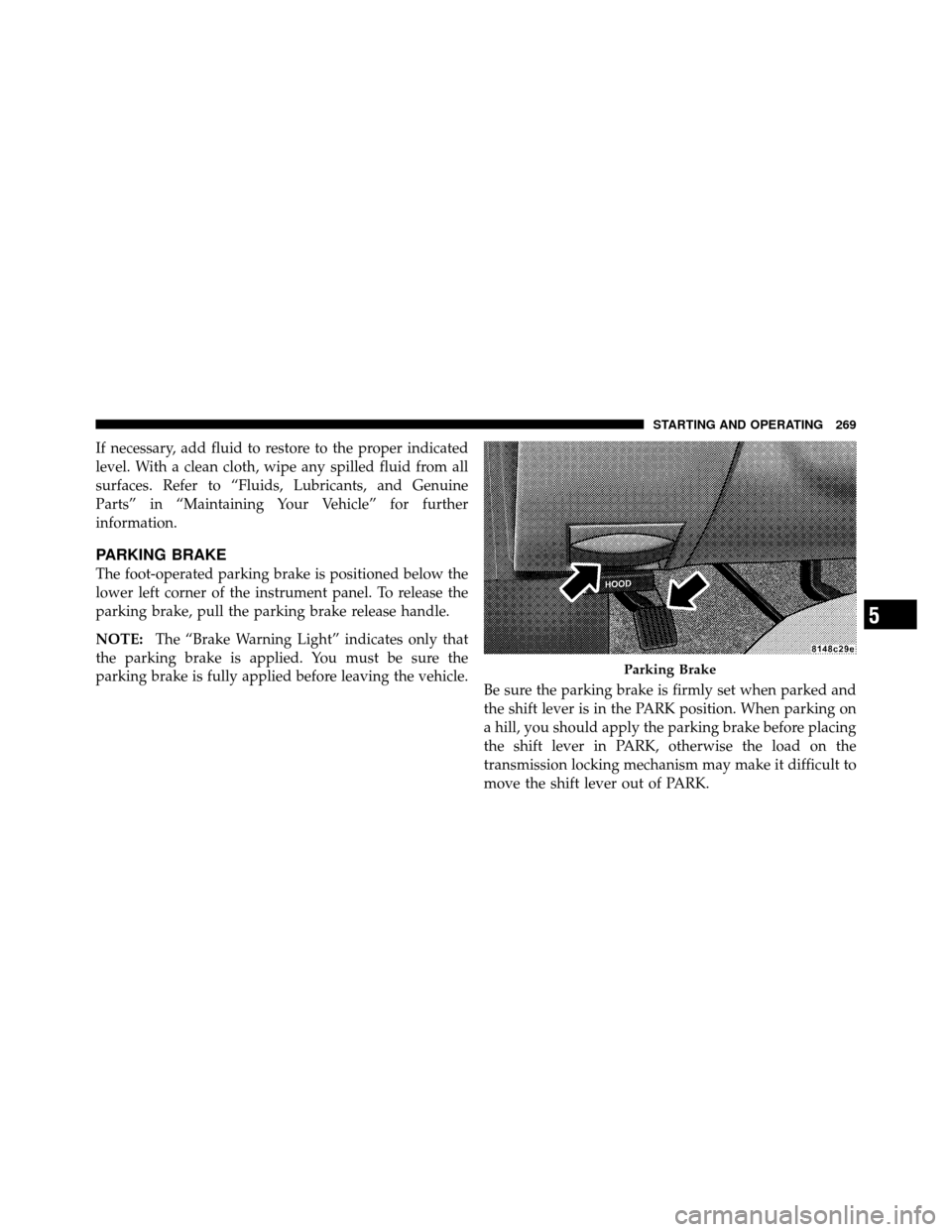
The foot-operated parking brake is positioned below the
lower left corner of the instrument panel. To release the
parking brake, pull the parking brake release handle.
NOTE:The “Brake Warning Light” indicates only that
the parking brake is applied. You must be sure the
parking brake is fully applied before leaving the vehicle. Be sure the parking brake is firmly set when parked and
the shift lever is in the PARK position. When parking on
a hill, you should apply the parking brake before placing
the shift lever in PARK, otherwise the load on the
transmission locking mechanism may make it difficult to
move the shift lever out of PARK.
Parking Brake
5
STARTING AND OPERATING 269
Page 271 of 450
WARNING!
•Always fully apply the parking brake when leav-
ing your vehicle, or it may roll and cause damage
or injury. Also, be certain to leave the transmission
in PARK. Failure to do so may cause the vehicle to
roll and cause damage or injury.
•Never leave children alone in a vehicle. Leaving
unattended children in a vehicle is dangerous for a
number of reasons. A child or others could be
seriously or fatally injured. Do not leave the key in
the ignition. A child could operate power win-
dows, other controls, or move the vehicle.
When parking on a hill, turn the front wheels toward the
curb on a downhill grade and away from the curb on an
uphill grade.
The parking brake should be applied whenever the
driver is not in the vehicle.
BRAKE SYSTEM
In the event power assist is lost for any reason (for
example, repeated brake applications with the engine
off), the brakes will still function. The effort required to
brake the vehicle will be significantly more than that
required with the power system operating.
If either the front or rear hydraulic system loses normal
capability, the remaining system will still function with
some loss of braking effectiveness. This will be evident by
increased pedal travel during application, greater pedal
force required to slow or stop, and activation of the
“Brake Warning Light” and the “ABS Warning Light”
during brake use.
Rear-Wheel Anti-Lock Brake System (ABS)
The Rear-Wheel ABS provides increased vehicle stability
and brake performance under most braking conditions.
The system automatically controls the operation of the
rear brakes to prevent rear wheel lockup.
270 STARTING AND OPERATING
Page 272 of 450
The ABS remains operational in the four-wheel drive
mode. The level of performance is reduced when the
front brakes are locked up. This will cause the rear brakes
to lock-up through the drivetrain, which may reduce the
effectiveness of the anti-lock system.
During severe braking conditions, particularly with
changing road surfaces, such as ice to concrete, a slight
drop or minor pulsation may be felt in the brake pedal.
WARNING!
Both Anti-Lock Brake Systems contain sophisticated
electronic equipment. It may be susceptible to inter-
ference caused by improperly installed or high out-
put radio transmitting equipment. This interference
can cause possible loss of anti-lock braking capabil-
ity. Installation of such equipment should be done by
qualified professionals.
Four-Wheel Anti-Lock Brake System (ABS) — If
Equipped
The Four-Wheel ABS is designed to aid the driver in
maintaining vehicle control under adverse braking con-
ditions. The system operates with a separate computer to
modulate hydraulic pressure, to prevent wheel lock-up
and help avoid skidding on slippery surfaces.
The system’s pump motor runs during an ABS stop to
provide regulated hydraulic pressure. The pump motor
makes a low humming noise during operation, which is
normal.
The ABS includes an amber “ABS Warning Light.” When
the light is illuminated, the ABS is not functioning. The
system reverts to standard non-anti-lock brakes. Turning
the ignition OFF and ON again may reset the ABS if the
fault detected was only momentary.
5
STARTING AND OPERATING 271
Page 273 of 450
WARNING!
Pumping of the Anti-Lock Brakes will diminish their
effectiveness and may lead to an accident. Pumping
makes the stopping distance longer. Just press firmly
on your brake pedal when you need to slow down or
stop.
WARNING!
•Anti-Lock Brake Systems (ABS) cannot prevent
the natural laws of physics from acting on the
vehicle, nor can it increase braking or steering
efficiency beyond that afforded by the condition
of the vehicle brakes and tires or the traction
afforded.(Continued)
WARNING! (Continued)
•The ABS cannot prevent accidents, including
those resulting from excessive speed in turns,
following another vehicle too closely, or hydro-
planing. Only a safe, attentive, and skillful driver
can prevent accidents.
•The capabilities of an ABS-equipped vehicle must
never be exploited in a reckless or dangerous
manner, which could jeopardize the user’s safety
or the safety of others.
272 STARTING AND OPERATING
Page 307 of 450
Starting
The characteristics of E85 fuel make it unsuitable for use
when ambient temperatures fall below 0°F (-18°C). In the
range of 0°F (-18°C) to 32°F (0°C), you may experience an
increase in the time it takes for your engine to start, and
a deterioration in driveability (sags and/or hesitations)
until the engine is fully warmed up.
NOTE:Use of the engine block heater (if equipped) is
beneficial for E85 startability when the ambient tempera-
ture is less than 32°F (0°C).
Cruising Range
Because E85 fuel contains less energy per gallon/liter
than gasoline, you will experience an increase in fuel
consumption. You can expect your miles per gallon
(mpg)/miles per liter and your driving range to decrease
by about 30%, compared to gasoline operation.
Replacement Parts
Many components in your Flexible Fuel Vehicle (FFV) are
designed to be compatible with ethanol. Always be sure
that your vehicle is serviced with correct ethanol com-
patible parts.
CAUTION!
Replacing fuel system components with non-ethanol
compatible components can damage your vehicle.
Maintenance
If you operate the vehicle using E85 fuel, follow the
maintenance schedule section of this manual.
CAUTION!
Do not use ethanol mixture greater than 85% in your
vehicle. It will cause difficulty in cold starting and
may affect driveability.
306 STARTING AND OPERATING
Page 320 of 450
WARNING! (Continued)
•When hauling cargo or towing a trailer, do not
overload your vehicle or trailer. Overloading can
cause a loss of control, poor performance or dam-
age to brakes, axle, engine, transmission, steering,
suspension, chassis structure or tires.
•Safety chains must always be used between your
vehicle and trailer. Always connect the chains to
the frame or hook retainers of the vehicle hitch.
Cross the chains under the trailer tongue and
allow enough slack for turning corners.
•Vehicles with trailers should not be parked on a
grade. When parking, apply the parking brake on
the tow vehicle. Put the tow vehicle automatic
transmission in PARK. For four-wheel drive ve-
hicles, make sure the transfer case is not in NEU-
TRAL. Always, block or\bchock\bthe trailer wheels.
(Continued)
WARNING! (Continued)
•GCWR must not be exceeded.
•Total weight must be distributed between the tow
vehicle and the trailer so that the following four
ratings are not exceeded:
1. GVWR
2. GTW
3. GAWR
4. Tongue weight rating for the trailer hitch uti-
lized (This requirement may limit the ability to
always achieve the 10% to 15% range of tongue
weight as a percentage of total trailer weight.)
5
STARTING AND OPERATING 319
Page 328 of 450
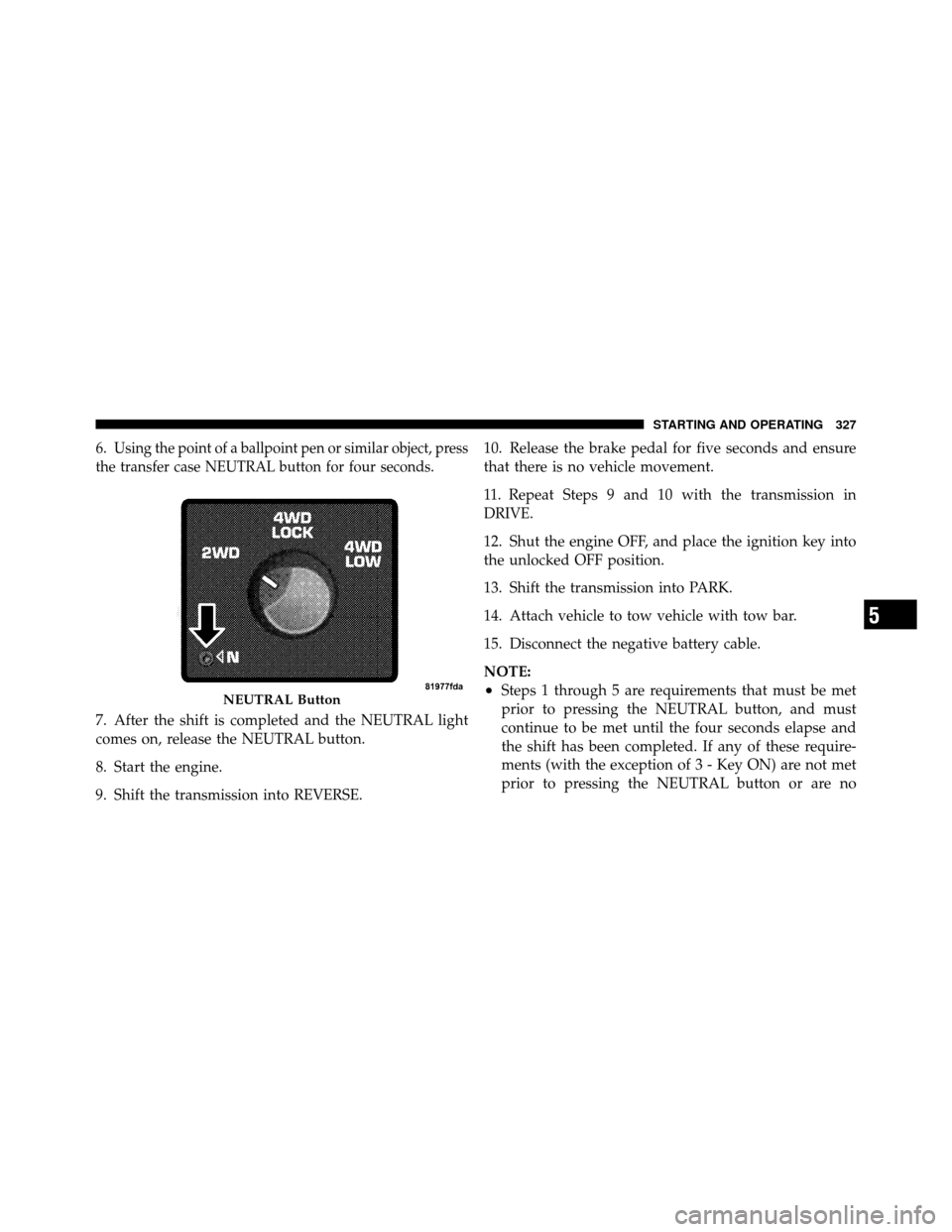
6.Using the point of a ballpoint pen or similar object, press
the transfer case NEUTRAL button for four seconds.
7. After the shift is completed and the NEUTRAL light
comes on, release the NEUTRAL button.
8. Start the engine.
9. Shift the transmission into REVERSE. 10. Release the brake pedal for five seconds and ensure
that there is no vehicle movement.
11. Repeat Steps 9 and 10 with the transmission in
DRIVE.
12. Shut the engine OFF, and place the ignition key into
the unlocked OFF position.
13. Shift the transmission into PARK.
14. Attach vehicle to tow vehicle with tow bar.
15. Disconnect the negative battery cable.
NOTE:
•Steps 1 through 5 are requirements that must be met
prior to pressing the NEUTRAL button, and must
continue to be met until the four seconds elapse and
the shift has been completed. If any of these require-
ments (with the exception of 3 - Key ON) are not met
prior to pressing the NEUTRAL button or are noNEUTRAL Button
5
STARTING AND OPERATING 327
Page 333 of 450
HAZARD WARNING FLASHER
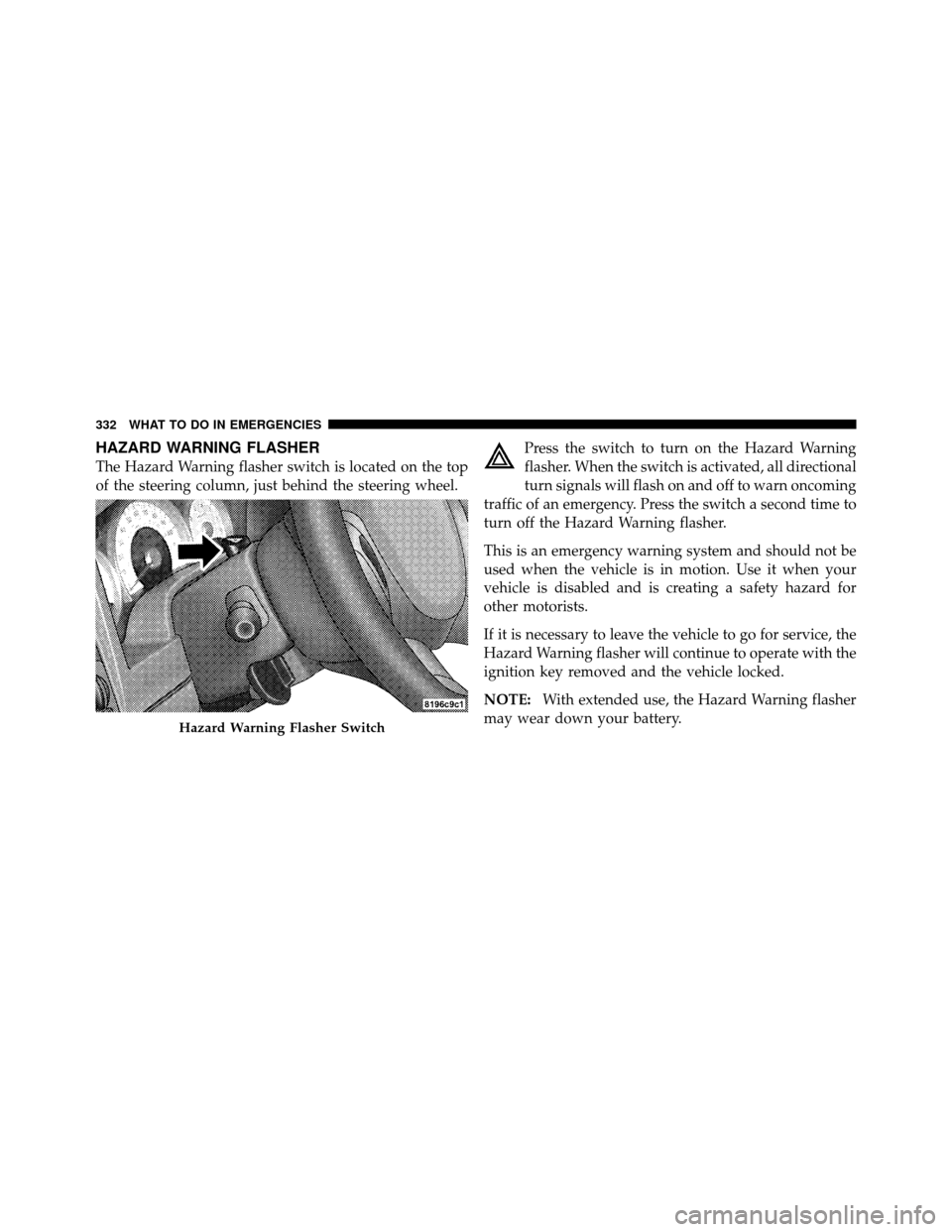
The Hazard Warning flasher switch is located on the top
of the steering column, just behind the steering wheel.Press the switch to turn on the Hazard Warning
flasher. When the switch is activated, all directional
turn signals will flash on and off to warn oncoming
traffic of an emergency. Press the switch a second time to
turn off the Hazard Warning flasher.
This is an emergency warning system and should not be
used when the vehicle is in motion. Use it when your
vehicle is disabled and is creating a safety hazard for
other motorists.
If it is necessary to leave the vehicle to go for service, the
Hazard Warning flasher will continue to operate with the
ignition key removed and the vehicle locked.
NOTE: With extended use, the Hazard Warning flasher
may wear down your battery.
Hazard Warning Flasher Switch
332 WHAT TO DO IN EMERGENCIES
Page 336 of 450
WARNING!
The jack is designed as a tool for changing tires only.
The jack should not be used to lift the vehicle for
service purposes, unless suitable supports are placed
under the vehicle as a safety measure. The vehicle
should be jacked on a firm level surface only. Avoid
icy or slippery areas.
Removing The Spare Tire
Remove the spare tire before attempting to jack the truck.
Attach the wheel wrench to the jack extension tube. Insert
the tube through the access hole in the rear bumper and
into the winch mechanism tube. Rotate the wheel wrench
handle counterclockwise until the spare tire is on the
ground with enough cable slack to allow you to pull it
out from under the vehicle. When the spare is clear, tilt
the retainer at the end of the cable and pull it through the
center of the wheel.Steps for Removing the Spare Tire
•Remove the jack from the stowage compartment using
the supplied finger-assist tool.
•Remove the finger-assist tool from jack and set aside
until jack is stowed.
•Assemble the jack tools.
•Locate the tire carrier access hole on the rear bumper.
•Place assembled jack tool extension rod into the access
hole in the direction of the arrow on the bumper trim.
•Rotate the tool counterclockwise to release and lower
the spare tire to the ground so that it can be pulled
from under the vehicle.
6
WHAT TO DO IN EMERGENCIES 335
Page 337 of 450
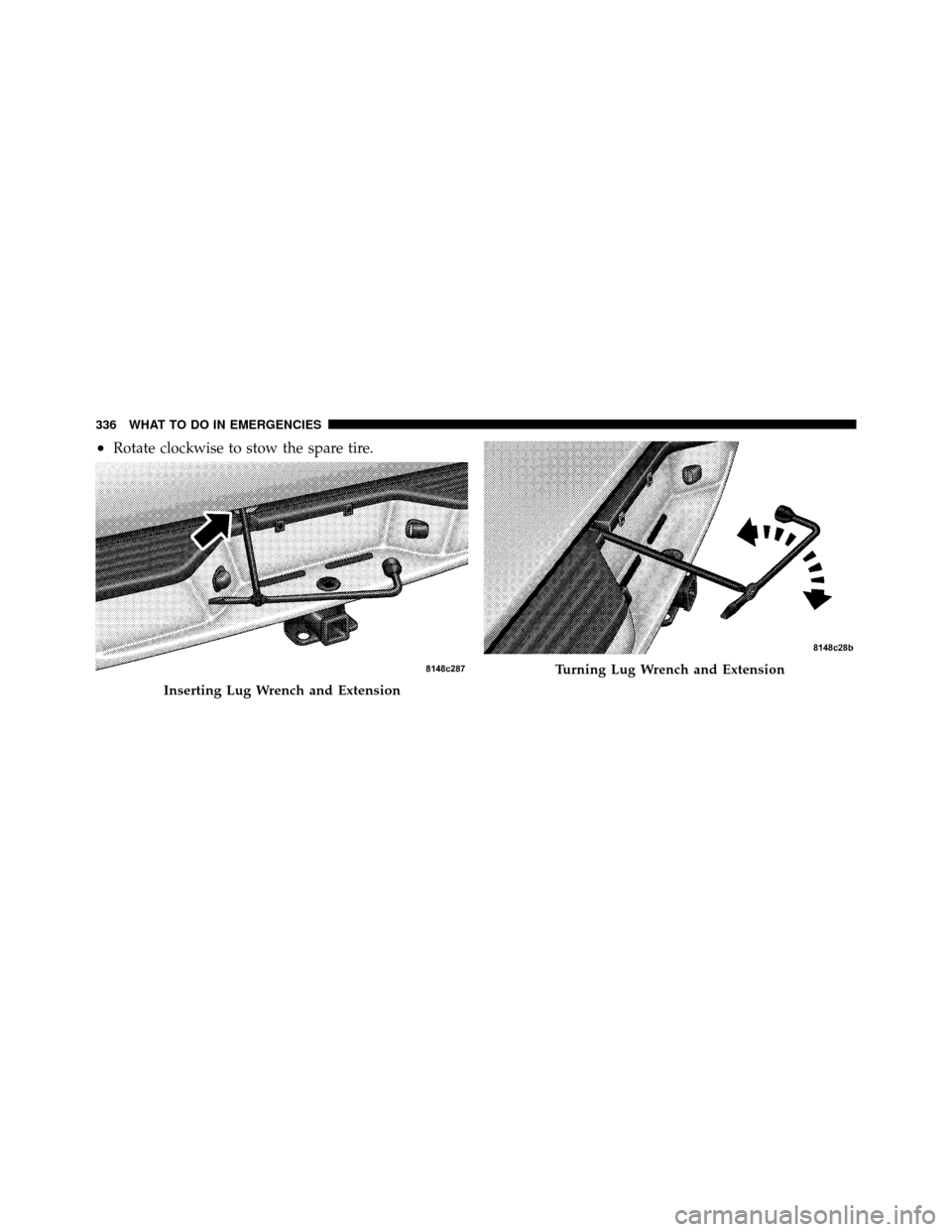
•Rotate clockwise to stow the spare tire.
Inserting Lug Wrench and Extension
Turning Lug Wrench and Extension
336 WHAT TO DO IN EMERGENCIES