automatic transmission DODGE DAKOTA 2010 3.G User Guide
[x] Cancel search | Manufacturer: DODGE, Model Year: 2010, Model line: DAKOTA, Model: DODGE DAKOTA 2010 3.GPages: 450, PDF Size: 9.32 MB
Page 255 of 450
WARNING! (Continued)
•It is dangerous to move the shift lever out of PARK
or NEUTRAL if the engine speed is higher than
idle speed. If your foot is not firmly on the brake
pedal, the vehicle could accelerate quickly forward
or in reverse. You could lose control of the vehicle
and hit someone or something. Only shift into
gear when the engine is idling normally and when
your right foot is firmly on the brake pedal.
REVERSE
This range is for moving the vehicle backward. Use only
after the vehicle has come to a complete stop.
NEUTRAL
This range is used when vehicle is standing for pro-
longed periods with engine running. Engine may be
started in this range. Set the parking brake if you must
leave the vehicle.
DRIVE
This range is for most city and highway driving.
2 (Second)
This range is for driving slowly in heavy city traffic or on
mountain roads where more precise speed control is
desirable, use second gear. Use it also when climbing
long grades, and for engine braking when descending
moderately steep grades. To prevent excessive engine
speed, do not exceed 45 mph (72 km/h) in this range.
1 (First)
This range is for driving up very steep hills and for
engine braking at low speeds, 25 mph (40 km/h) or less,
when going down hill, use first gear. To prevent excessive
engine speed do not exceed 25 mph (40 km/h) in this
range.
Overdrive Operation
The Overdrive automatic transmission contains an
electronically-controlled fourth and fifth (if equipped)
254 STARTING AND OPERATING
Page 256 of 450
gear (Overdrive). The transmission will automatically
shift from Drive to Overdrive, if the following conditions
are present:
•the shift lever is in DRIVE;
•the engine coolant has reached normal operating tem-
perature;
•vehicle speed is above approximately 30 mph
(48 km/h);
•the TOW/HAUL switch has not been activated;
•transmission has reached normal operating
temperature.
NOTE:
•If the vehicle is started in extremely cold temperatures,
the transmission may not shift into Overdrive and will automatically select the most desirable gear for opera-
tion at this temperature. Normal operation will re-
sume when the transmission fluid temperature has
risen to a suitable level. Refer to “Torque Converter
Clutch” in this section.
•If the transmission temperature gets extremely hot, the
transmission will automatically select the most desir-
able gear for operation at this temperature. If the
transmission temperature becomes hot enough, the
“Transmission Temperature Warning Light” may illu-
minate and the transmission may downshift out of
Overdrive until the transmission cools down. After
cool down, the transmission will resume normal
operation.
The transmission will downshift from Overdrive to
DRIVE if the accelerator pedal is fully pressed at vehicle
speeds above approximately 35 mph (56 km/h).
5
STARTING AND OPERATING 255
Page 257 of 450
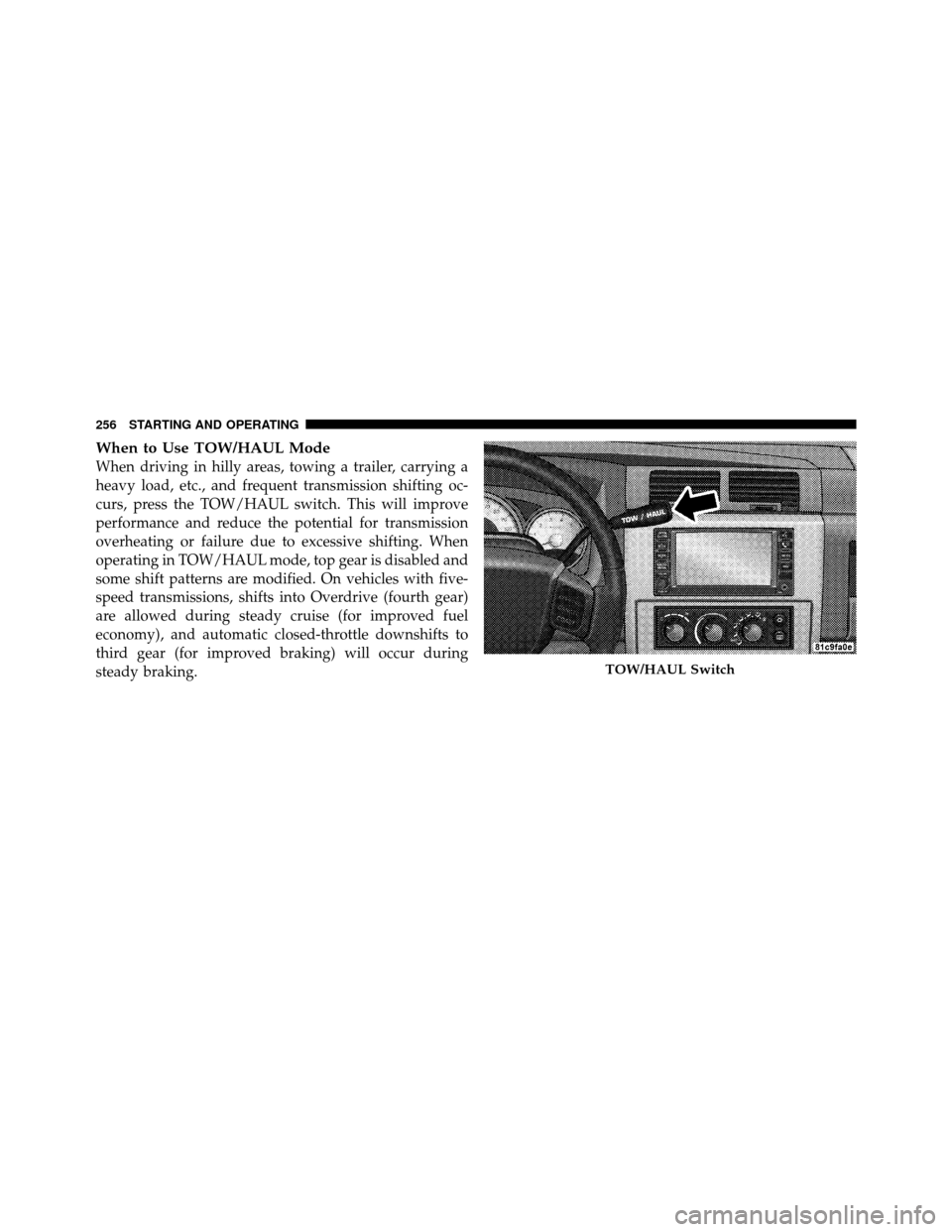
When to Use TOW/HAUL Mode
When driving in hilly areas, towing a trailer, carrying a
heavy load, etc., and frequent transmission shifting oc-
curs, press the TOW/HAUL switch. This will improve
performance and reduce the potential for transmission
overheating or failure due to excessive shifting. When
operating in TOW/HAUL mode, top gear is disabled and
some shift patterns are modified. On vehicles with five-
speed transmissions, shifts into Overdrive (fourth gear)
are allowed during steady cruise (for improved fuel
economy), and automatic closed-throttle downshifts to
third gear (for improved braking) will occur during
steady braking.
TOW/HAUL Switch
256 STARTING AND OPERATING
Page 258 of 450
The “TOW/HAUL Indicator Light” will illuminate in the
instrument cluster to indicate when the switch has been
activated. Pressing the switch a second time restores
normal operation. If the TOW/HAUL mode is desired,
the switch must be pressed each time the engine is
started.
Torque Converter Clutch
A feature designed to improve fuel economy is included
in all automatic transmissions. A clutch, within the
torque converter, engages automatically at a calibrated
speed at light throttle. It engages at higher speeds under
heavier acceleration. This may result in a slightly differ-
ent feeling or response during normal operation in high
gear. When the vehicle speed drops below a calibrated
speed, or during acceleration, the clutch automatically
and smoothly disengages. The feature is operational in
Overdrive and in Drive.NOTE:
•The torque converter clutch will not engage until the
transmission fluid and engine coolant are warm (usu-
ally after 1-3 miles [1.6 - 4.8 km] of driving). Because
the engine speed is higher when the torque converter
clutch is not engaged, it may seem as if the transmis-
sion is not shifting into Overdrive when cold. This is
normal. Pressing the TOW/HAUL switch, when the
transmission is sufficiently warm, will demonstrate
that the transmission is able to shift into, and out of
Overdrive.
•If the vehicle has not been driven in several days, the
first few seconds of operation after shifting the trans-
mission into gear may seem sluggish. This is due to the
fluid partially draining from the torque converter into
the transmission. This condition is normal and will not
cause damage to the transmission. The torque con-
verter will refill within five seconds of shifting from
PARK into any other gear position.
5
STARTING AND OPERATING 257
Page 271 of 450
WARNING!
•Always fully apply the parking brake when leav-
ing your vehicle, or it may roll and cause damage
or injury. Also, be certain to leave the transmission
in PARK. Failure to do so may cause the vehicle to
roll and cause damage or injury.
•Never leave children alone in a vehicle. Leaving
unattended children in a vehicle is dangerous for a
number of reasons. A child or others could be
seriously or fatally injured. Do not leave the key in
the ignition. A child could operate power win-
dows, other controls, or move the vehicle.
When parking on a hill, turn the front wheels toward the
curb on a downhill grade and away from the curb on an
uphill grade.
The parking brake should be applied whenever the
driver is not in the vehicle.
BRAKE SYSTEM
In the event power assist is lost for any reason (for
example, repeated brake applications with the engine
off), the brakes will still function. The effort required to
brake the vehicle will be significantly more than that
required with the power system operating.
If either the front or rear hydraulic system loses normal
capability, the remaining system will still function with
some loss of braking effectiveness. This will be evident by
increased pedal travel during application, greater pedal
force required to slow or stop, and activation of the
“Brake Warning Light” and the “ABS Warning Light”
during brake use.
Rear-Wheel Anti-Lock Brake System (ABS)
The Rear-Wheel ABS provides increased vehicle stability
and brake performance under most braking conditions.
The system automatically controls the operation of the
rear brakes to prevent rear wheel lockup.
270 STARTING AND OPERATING
Page 320 of 450
WARNING! (Continued)
•When hauling cargo or towing a trailer, do not
overload your vehicle or trailer. Overloading can
cause a loss of control, poor performance or dam-
age to brakes, axle, engine, transmission, steering,
suspension, chassis structure or tires.
•Safety chains must always be used between your
vehicle and trailer. Always connect the chains to
the frame or hook retainers of the vehicle hitch.
Cross the chains under the trailer tongue and
allow enough slack for turning corners.
•Vehicles with trailers should not be parked on a
grade. When parking, apply the parking brake on
the tow vehicle. Put the tow vehicle automatic
transmission in PARK. For four-wheel drive ve-
hicles, make sure the transfer case is not in NEU-
TRAL. Always, block or\bchock\bthe trailer wheels.
(Continued)
WARNING! (Continued)
•GCWR must not be exceeded.
•Total weight must be distributed between the tow
vehicle and the trailer so that the following four
ratings are not exceeded:
1. GVWR
2. GTW
3. GAWR
4. Tongue weight rating for the trailer hitch uti-
lized (This requirement may limit the ability to
always achieve the 10% to 15% range of tongue
weight as a percentage of total trailer weight.)
5
STARTING AND OPERATING 319
Page 324 of 450
Towing Tips
Before setting out on a trip, practice turning, stopping
and backing the trailer in an area away from heavy
traffic.
Automatic Transmission
The “DRIVE” range can be selected when towing. How-
ever, if frequent shifting occurs while in this range, the
TOW/HAUL feature should be selected.
NOTE:Using the TOW/HAUL feature while operating
the vehicle under heavy operating conditions will im-
prove performance and extend transmission life by re-
ducing excessive shifting and heat build up. This action
will also provide better engine braking.
The automatic transmission fluid and filter should be
changed if you REGULARLY tow a trailer for more than
45 minutes of continuous operation. Refer to “Mainte-
nance Schedule” for the proper maintenance intervals.
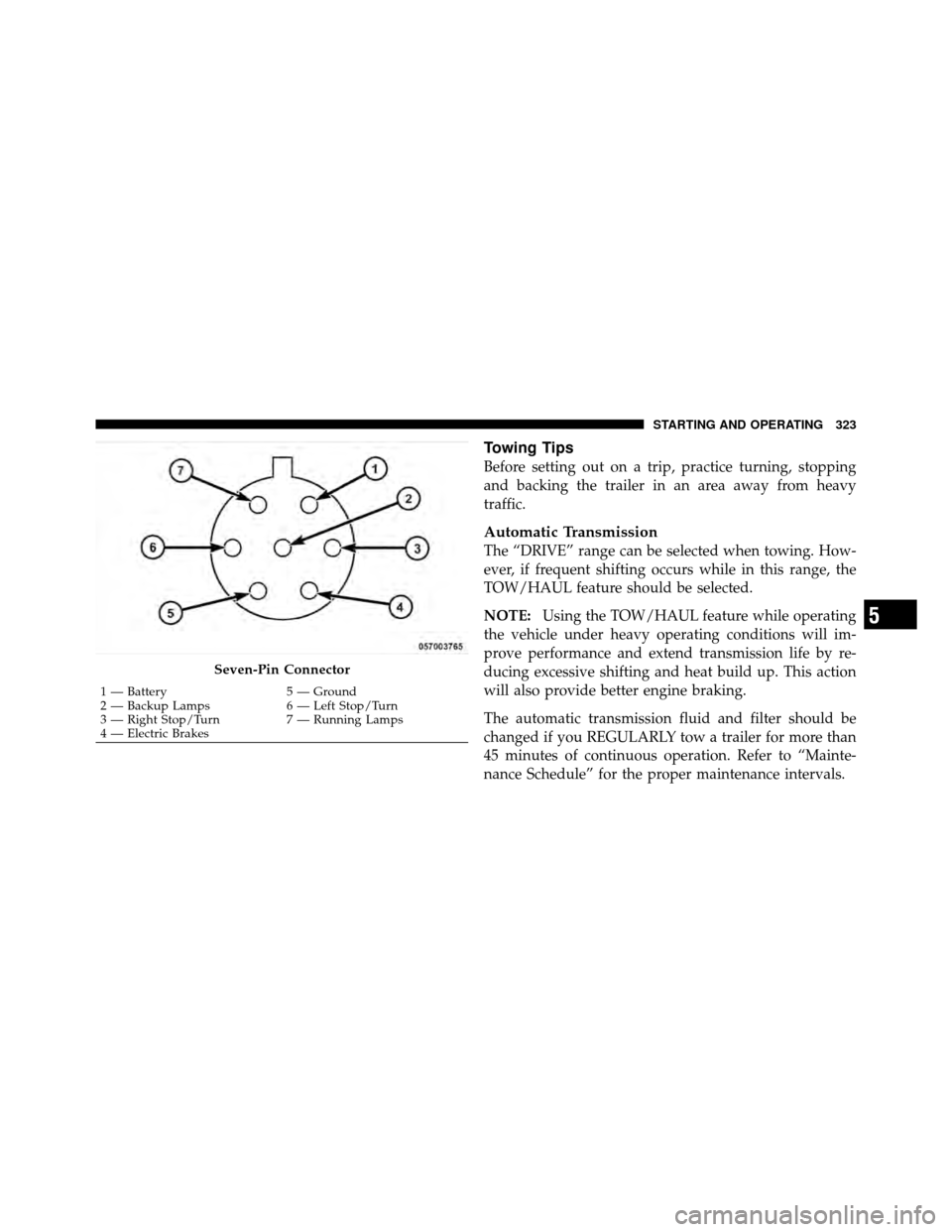
Seven-Pin Connector
1 — Battery 5 — Ground
2 — Backup Lamps 6 — Left Stop/Turn
3 — Right Stop/Turn 7 — Running Lamps
4 — Electric Brakes
5
STARTING AND OPERATING 323
Page 325 of 450
NOTE:Check the automatic transmission fluid level
before towing.
Tow/Haul – If Equipped
To reduce potential for automatic transmission overheat-
ing, turn the TOW/HAUL feature ON when driving in
hilly areas or shift the transmission to Drive position 2 on
more severe grades.
Electronic Speed Control – If Equipped
Do not use in hilly terrain or with heavy loads.
When using the speed control, if you experience speed
drops greater than 10 mph (16 km/h), disengage until
you can resume cruising speed.
Use speed control in flat terrain and with light loads to
maximize fuel efficiency.
Cooling System
To reduce potential for engine and transmission over-
heating, take the following actions:
City Driving
When stopped for short periods of time, shift the trans-
mission into NEUTRAL and increase engine idle speed.
Highway Driving
Reduce speed.
Air Conditioning
Turn off temporarily.
SNOWPLOW
Snow plows, winches, and other aftermarket equipment
should notbe added to the front end of your vehicle. The
airbag crash sensors may be affected by the change in the
front end structure. The airbags could deploy unexpect-
edly or could fail to deploy during a collision.
324 STARTING AND OPERATING
Page 326 of 450
WARNING!
Do not add a snow plow, winches, or any other
aftermarket equipment to the front of your vehicle.
This could adversely affect the functioning of the
airbag system and you could be injured.
RECREATIONAL TOWING (BEHIND
MOTORHOME, ETC.)
Two-Wheel Drive Models
Recreational towing of two-wheel drive models is not
allowable. Towing the vehicle with the transmission in
NEUTRAL can cause severe transmission damage. Re-
moval of the driveshaft for towing is not recommended,
since this would allow fluid to drain from the
transmission.
Four-Wheel Drive Models
CAUTION!
•Internal damage to the transfer case will occur if a
front or rear wheel lift is used when recreational
towing.
•The transfer case must be shifted into NEUTRAL
for recreational towing. The NEUTRAL button is
located on the lower left hand corner of the trans-
fer case switch. Shifts into and out of transfer case
NEUTRAL can take place with the transfer case
switch in any mode position.
•Automatic transmissions must be placed in PARK
position for recreational towing.
•Failure to follow these procedures can cause se-
vere transmission and/or transfer case damage.
5
STARTING AND OPERATING 325
Page 339 of 450
Preparations
1. Park the vehicle on a firm, level surface. Avoid icy or
slippery areas.
WARNING!
Do not attempt to change a tire on the side of the
vehicle close to moving traffic. Pull far enough off
the road to avoid the danger of being hit when
operating the jack or changing the wheel.
2. Set the parking brake.
3. Place the shift lever in PARK (automatic transmission).
On 4-Wheel Drive vehicles, shift the transfer case to the
4L position.
4. Turn the ignition OFF.
5. Turn on the Hazard Warning flasher. 6. Block both the front and rear of the
wheel diagonally opposite the jacking
position. For example, if the right front
wheel is being changed, block the left
rear wheel.
NOTE: Passengers should not remain in the vehicle
when the vehicle is being jacked.
Instructions
WARNING!
Carefully follow these tire changing warnings to help
prevent personal injury or damage to your vehicle:
•Always park on a firm, level surface as far from
the edge of the roadway as possible before raising
the vehicle.
(Continued)
338 WHAT TO DO IN EMERGENCIES