check engine DODGE DAKOTA 2010 3.G Owner's Manual
[x] Cancel search | Manufacturer: DODGE, Model Year: 2010, Model line: DAKOTA, Model: DODGE DAKOTA 2010 3.GPages: 450, PDF Size: 9.32 MB
Page 373 of 450
WARNING!
•The warning words “DO NOT OPEN HOT” on
the cooling system pressure cap are a safety pre-
caution. Never add engine coolant (antifreeze)
when the engine is overheated. Do not loosen or
remove the cap to cool an overheated engine. Heat
causes pressure to build up in the cooling system.
To prevent scalding or injury, do not remove the
pressure cap while the system is hot or under
pressure.
•Do not use a pressure cap other than the one
specified for your vehicle. Personal injury or en-
gine damage may result.
Disposal of Used Engine Coolant
Used ethylene glycol-based engine coolant (antifreeze) is
a regulated substance, requiring proper disposal. Check
with your local authorities to determine the disposal
rules for your community. To prevent ingestion by ani-
mals or children do not store ethylene glycol-based
engine coolant (antifreeze) in open containers or allow it
to remain in puddles on the ground. If ingested by a child
or pet, seek emergency assistance immediately. Clean up
any ground spills immediately.
Coolant Level
The coolant recovery bottle provides a quick visual
method for determining that the engine coolant (anti-
freeze) level is adequate. With the engine cold, the level
of the engine coolant (antifreeze) in the coolant recovery
bottle should be between the ranges indicated on the
bottle.
372 MAINTAINING YOUR VEHICLE
Page 374 of 450
The radiator normally remains completely full, so there is
no need to remove the radiator cap unless checking for
the engine coolant (antifreeze) freeze point or replacing
the engine coolant (antifreeze). Advise your service at-
tendant of this. As long as the engine operating tempera-
ture is satisfactory, the coolant recovery bottle need only
be checked once a month.
When additional engine coolant (antifreeze) is needed to
maintain the proper level, it should be added to the
coolant recovery bottle. Do not overfill.
Points to Remember
NOTE:When the vehicle is stopped after a few miles
(kilometers) of operation, you may observe vapor coming
from the front of the engine compartment. This is nor-
mally a result of moisture from rain, snow, or high
humidity accumulating on the radiator and being vapor-
ized when the thermostat opens, allowing hot coolant to
enter the radiator. If an examination of your engine compartment shows no
evidence of radiator or hose leaks, the vehicle may be
safely driven. The vapor will soon dissipate.
•Do not overfill the coolant recovery bottle.
•Check the coolant freeze point in the radiator and in
the coolant recovery bottle. If antifreeze needs to be
added, the contents of the coolant recovery bottle must
also be protected against freezing.
•If frequent engine coolant (antifreeze) additions are
required, or if the level in the coolant recovery bottle
does not drop when the engine cools, the cooling
system should be pressure tested for leaks.
•Maintain engine coolant (antifreeze) concentration at
50% HOAT engine coolant (antifreeze) (minimum)
and distilled/deionized water for proper corrosion
protection of your engine, which contains aluminum
components.
7
MAINTAINING YOUR VEHICLE 373
Page 375 of 450
•Make sure that the radiator and coolant recovery
bottle overflow hoses are not kinked or obstructed.
•Keep the front of the radiator clean. If your vehicle is
equipped with air conditioning, also keep the front of
the condenser clean.
•Do not change the thermostat for Summer or Winter
operation. If replacement is ever necessary, install
ONLY the correct type thermostat. Other designs may
result in unsatisfactory engine coolant (antifreeze)
performance, poor gas mileage, and increased
emissions.
Brake System
Fluid Level Check – Brake Master Cylinder
The fluid level in the master cylinder should be checked
whenever the vehicle is serviced, or immediately if the
“Brake Warning Light” is on. If necessary, add fluid to
bring level to the full mark on the side of the reservoir of
the brake master cylinder. Be sure to clean the top of the
master cylinder area before removing the cap. With disc
brakes, the fluid level can be expected to fall as the brake
pads wear. Brake fluid level should be checked when
pads are replaced. If the brake fluid level is abnormally
low, check the system for leaks.
Refer to “Fluids, Lubricants, and Genuine Parts” in
“Maintaining Your Vehicle” for further information.
374 MAINTAINING YOUR VEHICLE
Page 377 of 450
WARNING! (Continued)
•Do not allow petroleum based fluid to contami-
nate the brake fluid. Brake seal components could
be damaged, causing partial or complete brake
failure. This could result in an accident.
Automatic Transmission
NOTE:If your vehicle is equipped with a dipstick, use
the following procedure. If your vehicle has a capped
dipstick, it is sealed and should not be tampered with.
Your authorized dealer has the proper tools to ensure that
the fluid level is set properly.
Fluid Level Check
Check the fluid level while the transmission is at normal
operating temperature 180° F (82° C). This occurs after at
least 15 miles (24 km) of driving. At normal operating
temperature the fluid cannot be held comfortably be-
tween the fingertips. To check the automatic transmission fluid level properly,
the following procedure must be used:
1. Operate the engine at idle speed and normal operating
temperature.
2. The vehicle must be on level ground.
3. Fully apply the parking brake and press the brake
pedal.
4. Place the shift lever momentarily into each gear posi-
tion, ending with the shift lever in PARK.
5. Remove the dipstick, wipe it clean and reinsert it until
seated.
6. Remove the dipstick again and note the fluid level on
both sides. The fluid level should be between the “HOT”
(upper) reference holes on the dipstick at normal operat-
ing temperature. Verify that solid coating of oil is seen on
both sides of the dipstick. If the fluid is low, add as
376 MAINTAINING YOUR VEHICLE
Page 406 of 450
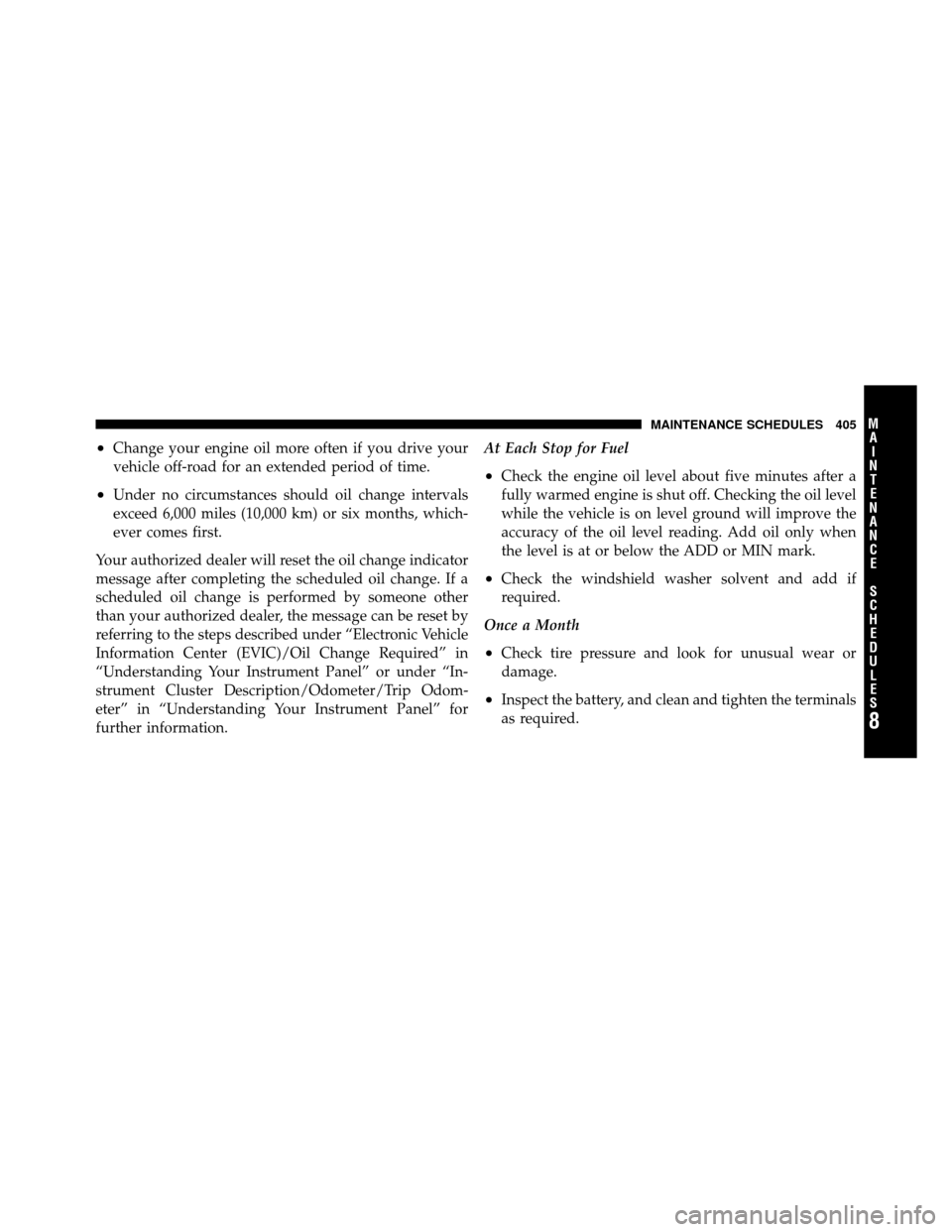
•Change your engine oil more often if you drive your
vehicle off-road for an extended period of time.
•Under no circumstances should oil change intervals
exceed 6,000 miles (10,000 km) or six months, which-
ever comes first.
Your authorized dealer will reset the oil change indicator
message after completing the scheduled oil change. If a
scheduled oil change is performed by someone other
than your authorized dealer, the message can be reset by
referring to the steps described under “Electronic Vehicle
Information Center (EVIC)/Oil Change Required” in
“Understanding Your Instrument Panel” or under “In-
strument Cluster Description/Odometer/Trip Odom-
eter” in “Understanding Your Instrument Panel” for
further information. At Each Stop for Fuel
•Check the engine oil level about five minutes after a
fully warmed engine is shut off. Checking the oil level
while the vehicle is on level ground will improve the
accuracy of the oil level reading. Add oil only when
the level is at or below the ADD or MIN mark.
•Check the windshield washer solvent and add if
required.
Once a Month
•Check tire pressure and look for unusual wear or
damage.
•Inspect the battery, and clean and tighten the terminals
as required.
8
M A I
N T
E
N A
N CE
S
C
H E
D
U L
E
SMAINTENANCE SCHEDULES 405
Page 407 of 450
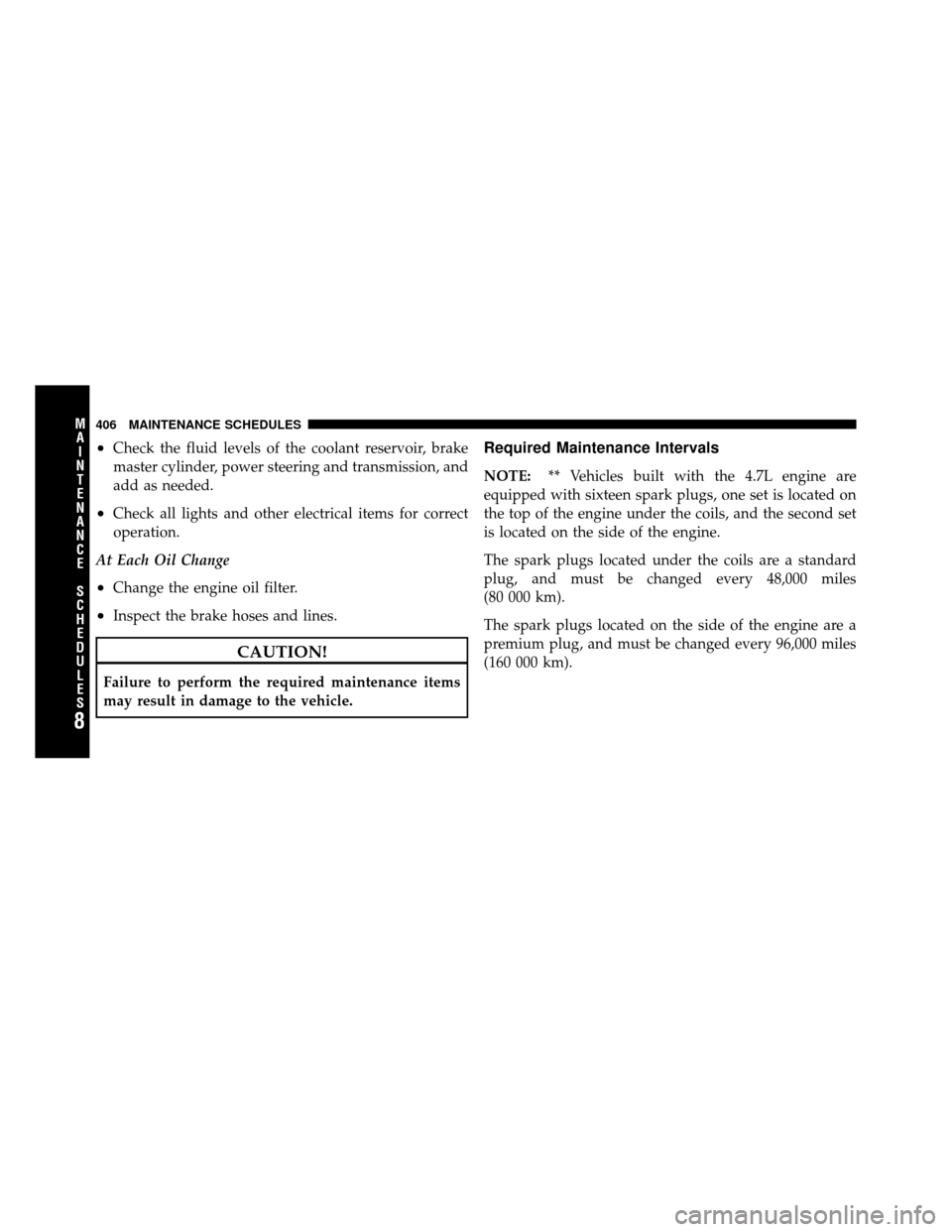
•Check the fluid levels of the coolant reservoir, brake
master cylinder, power steering and transmission, and
add as needed.
•Check all lights and other electrical items for correct
operation.
At Each Oil Change
•Change the engine oil filter.
•Inspect the brake hoses and lines.
CAUTION!
Failure to perform the required maintenance items
may result in damage to the vehicle.
Required Maintenance Intervals
NOTE: ** Vehicles built with the 4.7L engine are
equipped with sixteen spark plugs, one set is located on
the top of the engine under the coils, and the second set
is located on the side of the engine.
The spark plugs located under the coils are a standard
plug, and must be changed every 48,000 miles
(80 000 km).
The spark plugs located on the side of the engine are a
premium plug, and must be changed every 96,000 miles
(160 000 km).
8
M A I
N T
E
N A
N CE
S
C
H E
D
U L
E
S406 MAINTENANCE SCHEDULES
Page 433 of 450
Adding Fuel........................... 307
Air Cleaner, Engine (Engine Air Cleaner Filter) . . . 362
Air Conditioner Maintenance ............... 363
Air Conditioning ........................ 237
Air Conditioning, Operating Tips ..........237,240
Air Conditioning Refrigerant .............363,364
Air Conditioning System ................237,363
Air Filter .............................. 362
Air Pressure, Tires ....................... 284
Airbag ........................... 46,54,186
Airbag Deployment ....................... 56
Airbag Light ........................ 53,58,76
Airbag Maintenance ....................... 57
Airbag, Side .......................... 52,54
Airbag, Window (Side Curtain) ...........49,52,54
Alarm, Panic ............................ 24
Alarm (Security Alarm) .................19,176
Alarm System (Security Alarm) ............... 19
Alterations/Modifications, Vehicle ............. 7Antenna, Satellite Radio
................... 231
Antifreeze (Engine Coolant) ..............370,399
Disposal ............................ 372
Anti-Lock Brake System (ABS) ............270,271
Anti-Lock Warning Light .................. 176
Anti-Theft Security Alarm (Theft Alarm) ........ 19
Anti-Theft System ..................... 19,176
Appearance Care ........................ 380
Assistance Towing ....................... 101
Auto Unlock, Doors ....................... 32
Automatic Dimming Mirror ................. 84
Automatic Door Locks ..................... 31
Automatic Transaxle .................... 12,252
Interlock System ....................... 15
Automatic Transmission .............249,253,376
Adding Fluid ......................... 376
Fluid Level Check ..................... 376
Fluid Type ........................... 401
Gear Ranges ......................... 253
432 INDEX
Page 434 of 450
Special Additives...................... 378
Torque Converter ...................... 257
Axle Fluid ............................. 401
Axle Lubrication (Axle Fluid) ............... 379
Battery ............................... 362
Keyless Transmitter Replacement (RKE) ....... 25
Saving Feature (Protection) ............... 130
Belts, Seat ............................ 37,76
Body Mechanism Lubrication ............... 364
Box, Sound ............................ 229
B-Pillar Location ........................ 279
Brake Fluid ............................ 401
Brake System ........................ 270,374
Anti-Lock (ABS) .................... 270,271
Fluid Check .......................... 374
Master Cylinder ....................... 374
Parking ............................. 269
Warning Light ..................... 176,181Brake/Transmission Interlock
............... 253
Break-In Recommendations, New Vehicle ........ 74
Bulb Replacement ....................... 391
Bulbs, Light .......................... 77,390
Calibration, Compass ..................... 146
Camper ............................... 164
Capacities, Fluid ........................ 399
Caps, Filler Oil (Engine) .......................... 360
Power Steering ........................ 268
Radiator (Coolant Pressure) ............... 371
Car Washes ............................ 380
Carbon Monoxide Warning ............75,164,302
Cargo Light ............................ 133
Cargo (Vehicle Loading) ................... 309
Cellular Phone ........................ 86,237
Center High Mounted Stop Light ............ 395
Certification Label ....................... 309
10
INDEX 433
Page 435 of 450
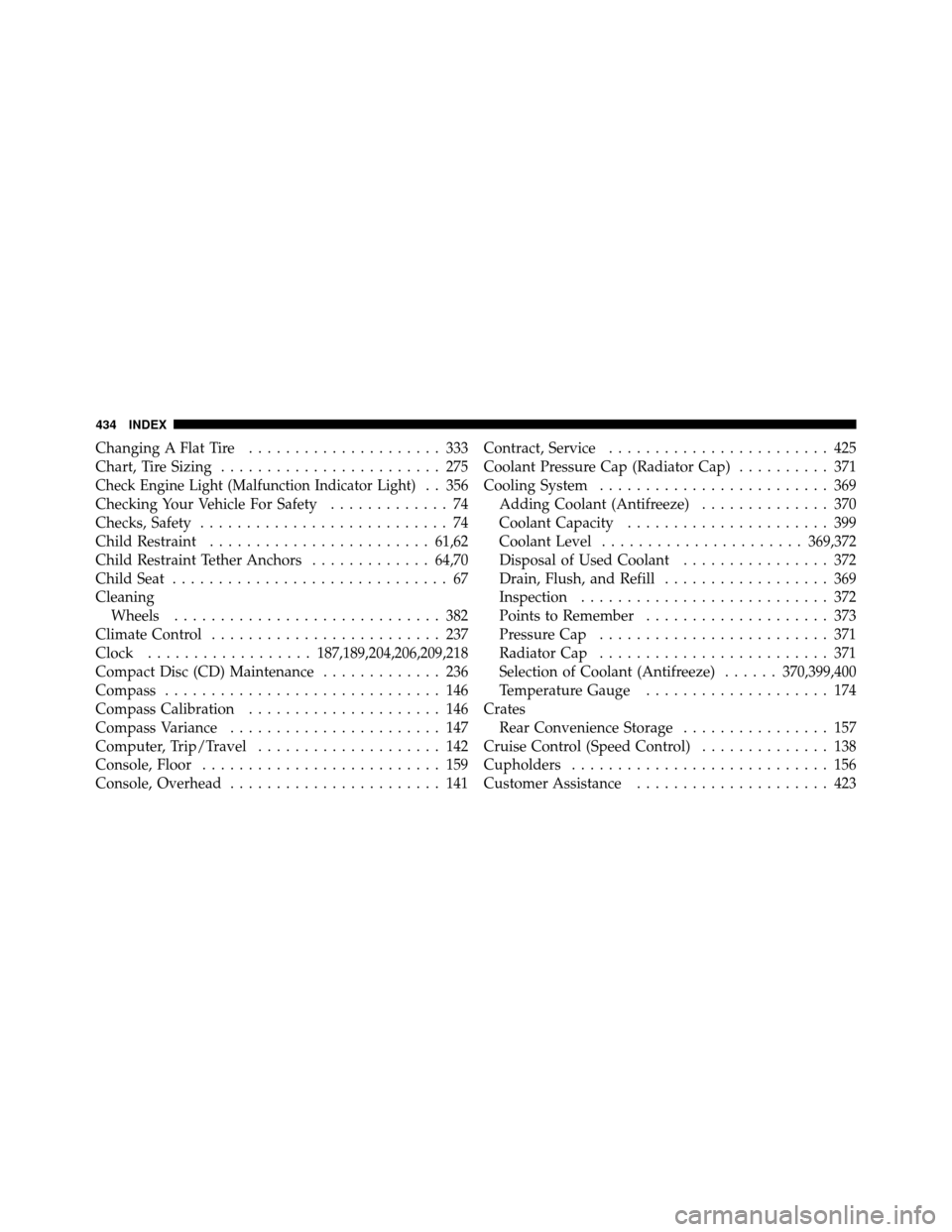
Changing A Flat Tire..................... 333
Chart, Tire Sizing ........................ 275
Check Engine Light (Malfunction Indicator Light). . 356
Checking Your Vehicle For Safety ............. 74
Checks, Safety ........................... 74
Child Restraint ........................ 61,62
Child Restraint Tether Anchors .............64,70
Child Seat .............................. 67
Cleaning Wheels ............................. 382
Climate Control ......................... 237
Clock .................. 187,189,204,206,209,218
Compact Disc (CD) Maintenance ............. 236
Compass .............................. 146
Compass Calibration ..................... 146
Compass Variance ....................... 147
Computer, Trip/Travel .................... 142
Console, Floor .......................... 159
Console, Overhead ....................... 141 Contract, Service
........................ 425
Coolant Pressure Cap (Radiator Cap) .......... 371
Cooling System ......................... 369
Adding Coolant (Antifreeze) .............. 370
Coolant Capacity ...................... 399
Coolant Level ...................... 369,372
Disposal of Used Coolant ................ 372
Drain, Flush, and Refill .................. 369
Inspection ........................... 372
Points to Remember .................... 373
Pressure Cap ......................... 371
Radiator Cap ......................... 371
Selection of Coolant (Antifreeze) ......370,399,400
Temperature Gauge .................... 174
Crates Rear Convenience Storage ................ 157
Cruise Control (Speed Control) .............. 138
Cupholders ............................ 156
Customer Assistance ..................... 423
434 INDEX
Page 437 of 450
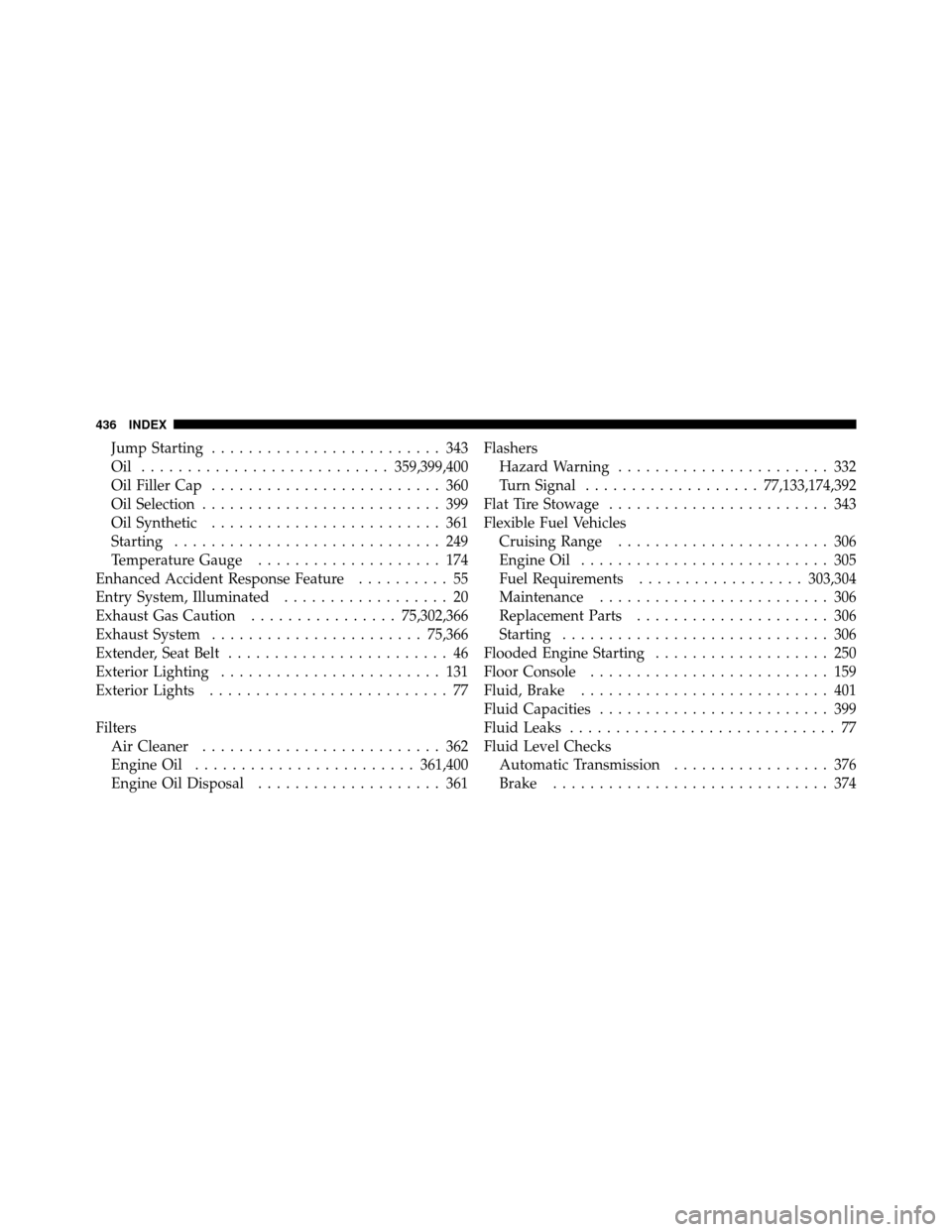
Jump Starting......................... 343
Oil ........................... 359,399,400
Oil Filler Cap ......................... 360
Oil Selection .......................... 399
Oil Synthetic ......................... 361
Starting ............................. 249
Temperature Gauge .................... 174
Enhanced Accident Response Feature .......... 55
Entry System, Illuminated .................. 20
Exhaust Gas Caution ................75,302,366
Exhaust System ....................... 75,366
Extender, Seat Belt ........................ 46
Exterior Lighting ........................ 131
Exterior Lights .......................... 77
Filters Air Cleaner .......................... 362
Engine Oil ........................ 361,400
Engine Oil Disposal .................... 361 Flashers
Hazard Warning ....................... 332
Turn Signal ................... 77,133,174,392
Flat Tire Stowage ........................ 343
Flexible Fuel Vehicles Cruising Range ....................... 306
Engine Oil ........................... 305
Fuel Requirements .................. 303,304
Maintenance ......................... 306
Replacement Parts ..................... 306
Starting ............................. 306
Flooded Engine Starting ................... 250
Floor Console .......................... 159
Fluid, Brake ........................... 401
Fluid Capacities ......................... 399
Fluid Leaks ............................. 77
Fluid Level Checks Automatic Transmission ................. 376
Brake .............................. 374
436 INDEX