lock DODGE DAKOTA 2010 3.G Owner's Manual
[x] Cancel search | Manufacturer: DODGE, Model Year: 2010, Model line: DAKOTA, Model: DODGE DAKOTA 2010 3.GPages: 450, PDF Size: 9.32 MB
Page 33 of 450
Auto Unlock On Exit Feature — If Equipped
This feature unlocks all of the doors of the vehicle when
any door is opened. This will occur only after the vehicle
has been shifted into the PARK position after the vehicle
has been driven (shifted out of PARK and the doors
closed).
Auto Unlock Feature Programming
The Customer Programming sequence to disable or en-
able Auto Unlock:
1. Enter your vehicle and close all the doors.
2. Fasten your seat belt. (Fastening the seat belt will
cancel any chiming that may be confusing during this
programming procedure.)
3. Insert the key into the ignition.4. Within 15 seconds, cycle the key from the LOCK
position to the ON position and back to LOCK position,
a minimum of four times; ending in the LOCK position.
(Do not start the engine.)
5. Within 30 seconds, press the driver’s door LOCK
switch in the UNLOCK direction.
6. A single chime will sound to indicate the feature has
been changed.
7. To reactivate the feature, repeat the above steps.
8. If a chime is not heard, program mode was canceled
before the feature could be changed. If necessary, repeat
the above procedure.
32 THINGS TO KNOW BEFORE STARTING YOUR VEHICLE
Page 34 of 450
Child Protection Door Lock
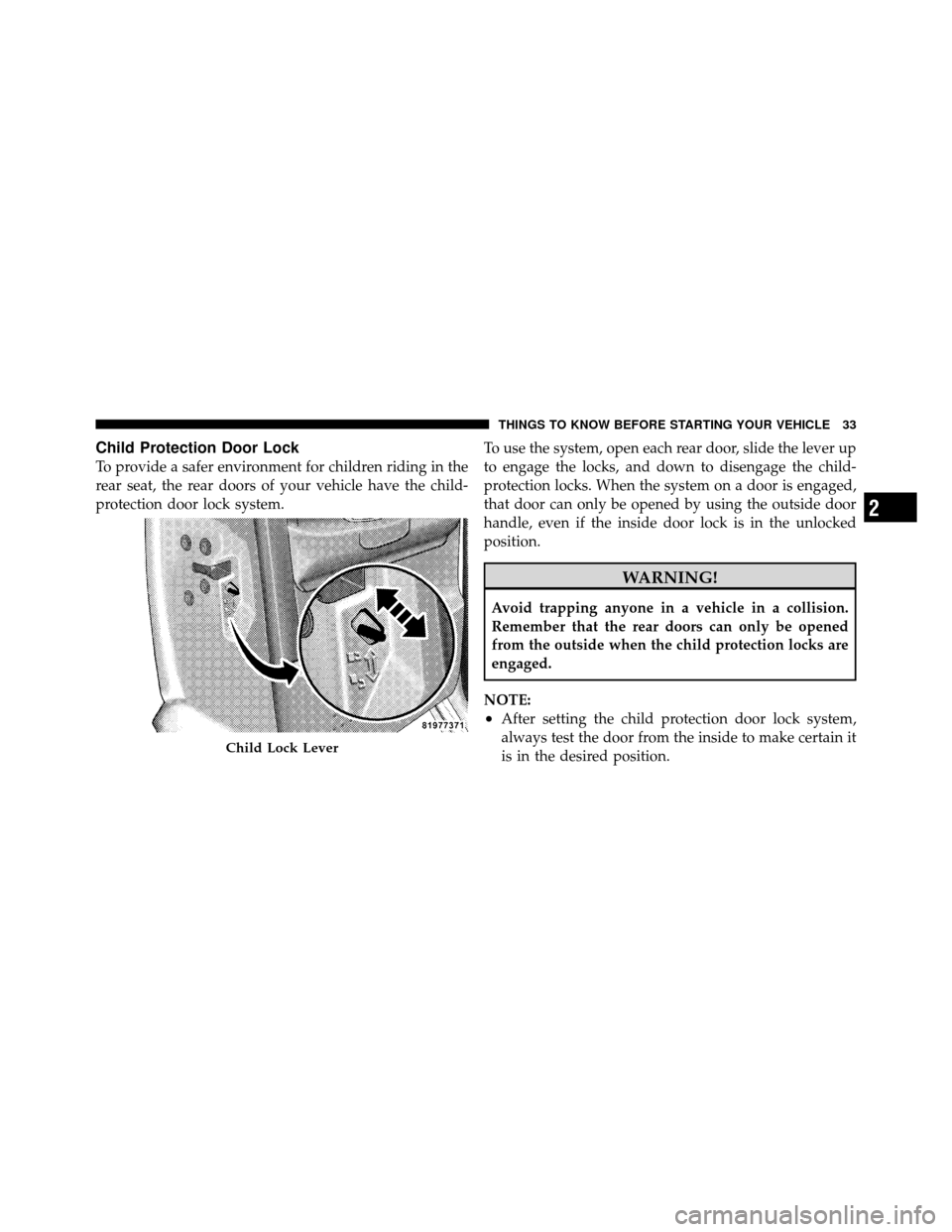
To provide a safer environment for children riding in the
rear seat, the rear doors of your vehicle have the child-
protection door lock system.To use the system, open each rear door, slide the lever up
to engage the locks, and down to disengage the child-
protection locks. When the system on a door is engaged,
that door can only be opened by using the outside door
handle, even if the inside door lock is in the unlocked
position.
WARNING!
Avoid trapping anyone in a vehicle in a collision.
Remember that the rear doors can only be opened
from the outside when the child protection locks are
engaged.
NOTE:
•After setting the child protection door lock system,
always test the door from the inside to make certain it
is in the desired position.
Child Lock Lever
2
THINGS TO KNOW BEFORE STARTING YOUR VEHICLE 33
Page 35 of 450
•For emergency exit with the system engaged, move
the door lock switch to the UNLOCK position, roll
down the window and open the door with the outside
door handle.
WINDOWS
Power Windows
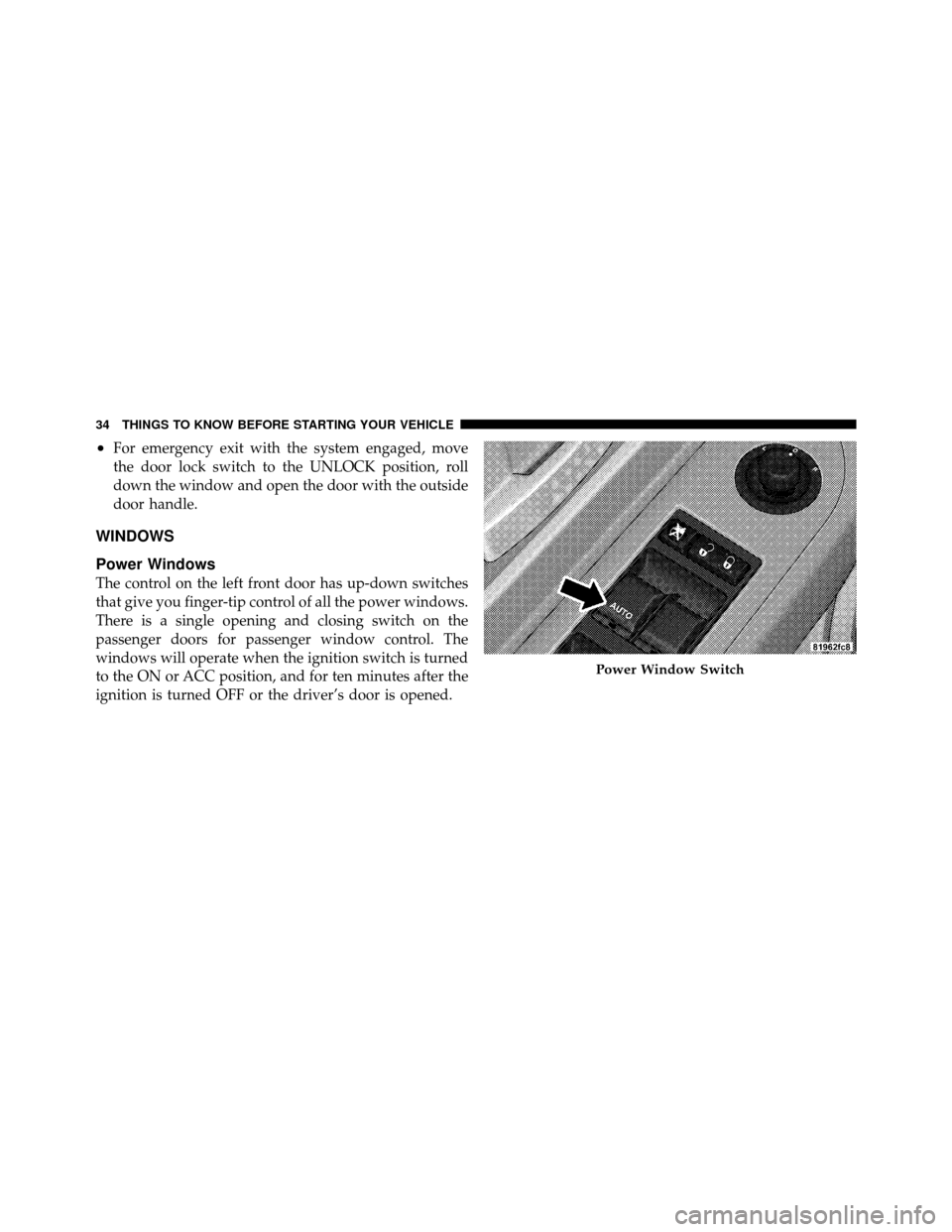
The control on the left front door has up-down switches
that give you finger-tip control of all the power windows.
There is a single opening and closing switch on the
passenger doors for passenger window control. The
windows will operate when the ignition switch is turned
to the ON or ACC position, and for ten minutes after the
ignition is turned OFF or the driver’s door is opened.
Power Window Switch
34 THINGS TO KNOW BEFORE STARTING YOUR VEHICLE
Page 36 of 450
WARNING!
Never leave children alone in a vehicle. Leaving
unattended children in a vehicle is dangerous for a
number of reasons. A child or others could be seri-
ously or fatally injured. Don’t leave the key in the
ignition. A child could operate power windows,
other controls, or move the vehicle.
Auto-Down — Driver’s Side Only
The driver’s window switch has an Auto-Down feature.
Push the window switch past the first detent, release, and
the window will go down automatically. To cancel the
Auto-Down movement, operate the switch in either the
up or down direction and release the switch.
Window Lockout Switch
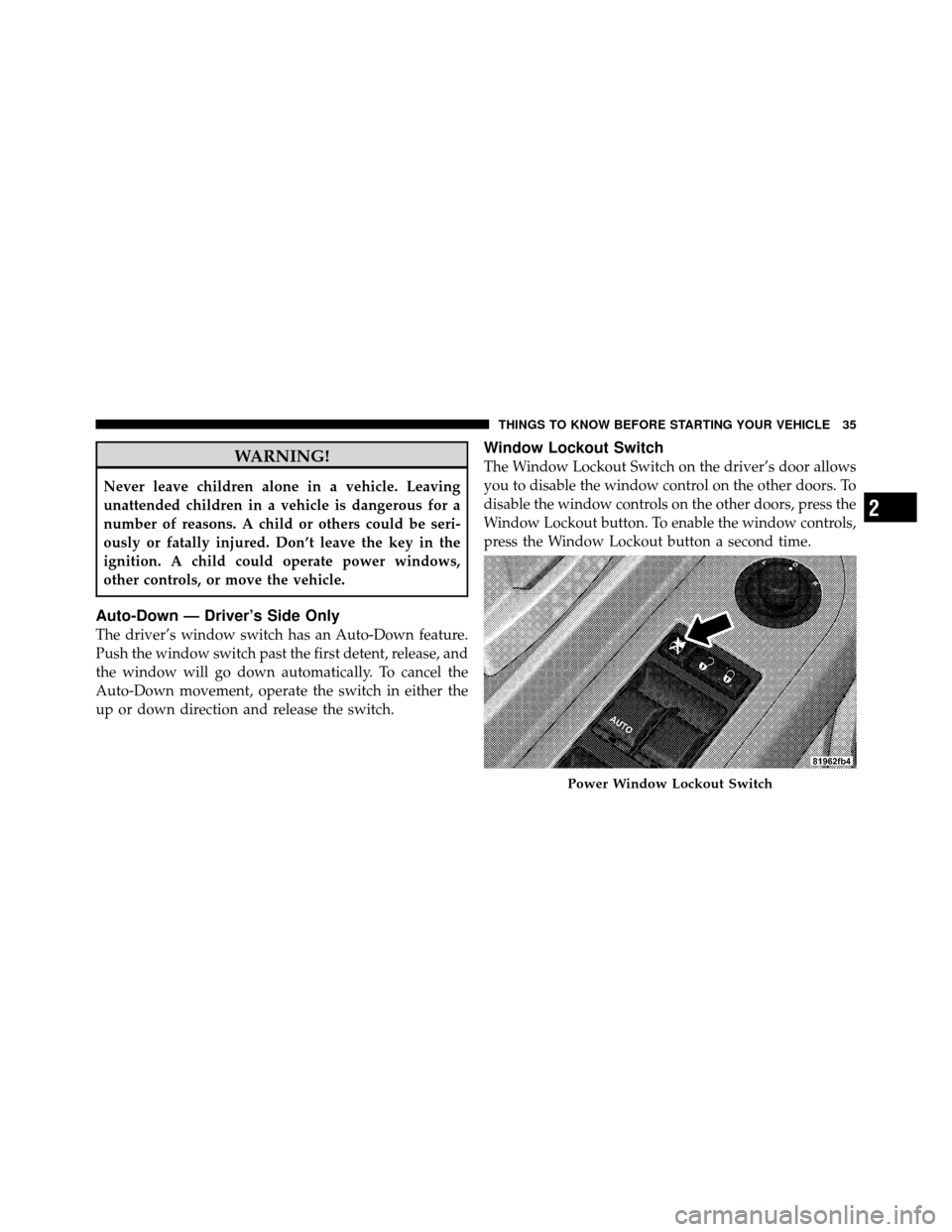
The Window Lockout Switch on the driver’s door allows
you to disable the window control on the other doors. To
disable the window controls on the other doors, press the
Window Lockout button. To enable the window controls,
press the Window Lockout button a second time.
Power Window Lockout Switch
2
THINGS TO KNOW BEFORE STARTING YOUR VEHICLE 35
Page 37 of 450
Wind Buffeting
Wind buffeting can be described as the perception of
pressure on the ears or a helicopter-type sound in the
ears. Your vehicle may exhibit wind buffeting with the
windows down or partially open. This is a normal
occurrence and can be minimized. If the buffeting occurs
with the rear windows open, open the front and rear
windows together to minimize the buffeting.
OCCUPANT RESTRAINTS
Some of the most important safety features in your
vehicle are the restraint systems:
•Three-point lap and shoulder belts for all seating
positions
•Advanced Front Airbags for driver and front passen-
ger
•Supplemental Side Airbag Inflatable Curtains (SABIC)
for the driver and passengers seated next to a window
— if equipped
•An energy-absorbing steering column and steering
wheel
•Knee bolsters/blockers for front seat occupants
•Front seat belts incorporate pretensioners to enhance
occupant protection by managing occupant energy
during an impact event — if equipped
If you will be carrying children too small for adult-sized
seat belts, the seat belts or the Lower Anchors and Tether
for CHildren (LATCH) feature can be used to hold infant
and child restraint systems. For more information on
LATCH, see Lower Anchors and Tether for CHildren
(LATCH).
36 THINGS TO KNOW BEFORE STARTING YOUR VEHICLE
Page 38 of 450
NOTE:The Advanced Front Airbags have a multistage
inflator design. This allows the airbag to have different
rates of inflation based on severity and type of collision.
Please pay close attention to the information in this
section. It tells you how to use your restraint system
properly, to keep you and your passengers as safe as
possible.
WARNING!
In a collision, you and your passengers can suffer
much greater injuries if you are not properly buckled
up. You can strike the interior of your vehicle or other
passengers, or you can be thrown out of the vehicle.
Always be sure you and others in your vehicle are
buckled up properly.
Buckle up even though you are an excellent driver, even
on short trips. Someone on the road may be a poor driver and cause a collision that includes you. This can happen
far away from home or on your own street.
Research has shown that seat belts save lives, and they
can reduce the seriousness of injuries in a collision. Some
of the worst injuries happen when people are thrown
from the vehicle. Seat belts reduce the possibility of
ejection and the risk of injury caused by striking the
inside of the vehicle.
Everyone in a motor vehicle should
be belted at all times.Lap/Shoulder Belts
All seating positions, except the front center seating
position (with full bench seat), have combination lap/
shoulder belts. The belt webbing retractor is designed to
lock during very sudden stops or collisions. This feature
allows the shoulder part of the belt to move freely with
you under normal conditions. But in a collision, the belt
will lock and reduce the risk of you striking the inside of
the vehicle or being thrown out.
2
THINGS TO KNOW BEFORE STARTING YOUR VEHICLE 37
Page 44 of 450
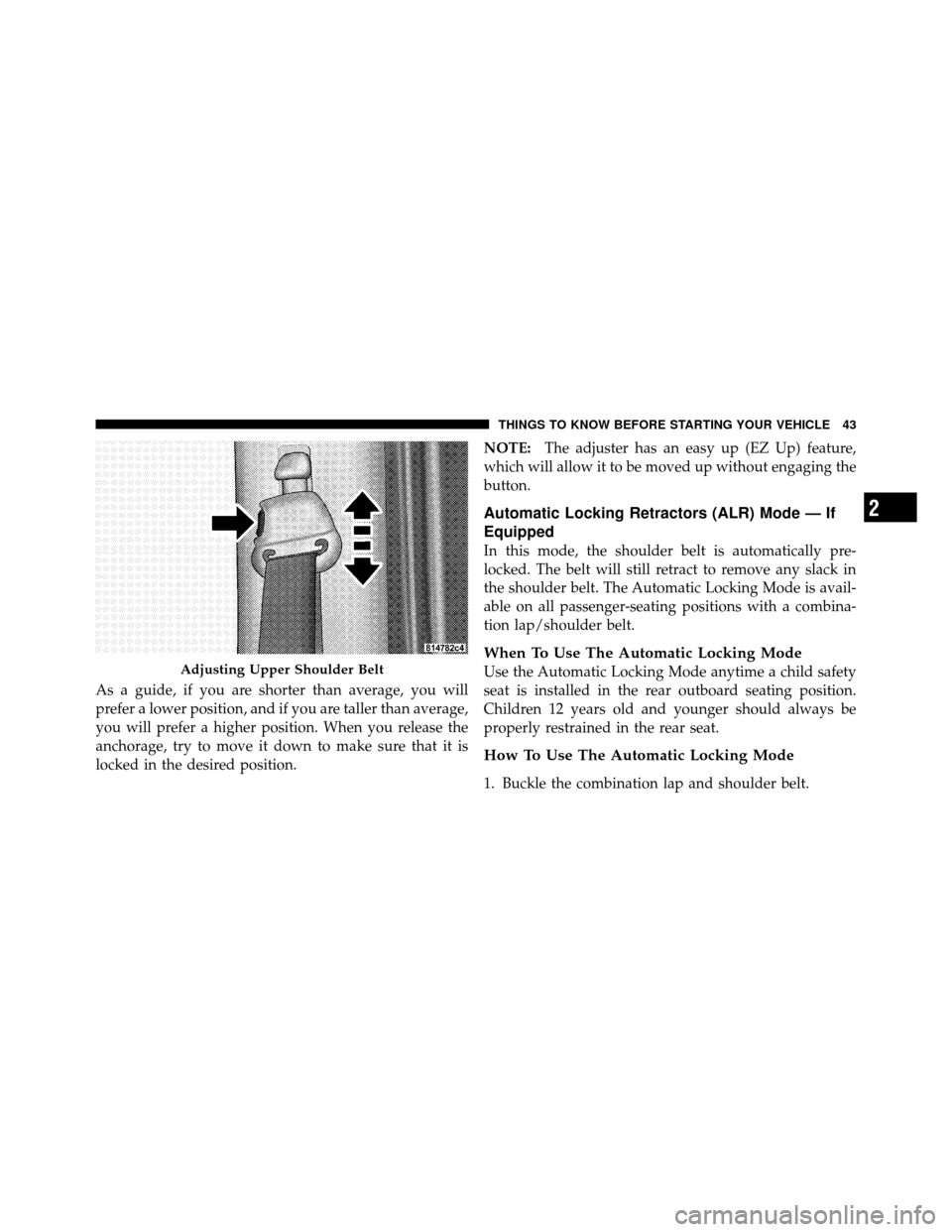
As a guide, if you are shorter than average, you will
prefer a lower position, and if you are taller than average,
you will prefer a higher position. When you release the
anchorage, try to move it down to make sure that it is
locked in the desired position.NOTE:
The adjuster has an easy up (EZ Up) feature,
which will allow it to be moved up without engaging the
button.
Automatic Locking Retractors (ALR) Mode — If
Equipped
In this mode, the shoulder belt is automatically pre-
locked. The belt will still retract to remove any slack in
the shoulder belt. The Automatic Locking Mode is avail-
able on all passenger-seating positions with a combina-
tion lap/shoulder belt.
When To Use The Automatic Locking Mode
Use the Automatic Locking Mode anytime a child safety
seat is installed in the rear outboard seating position.
Children 12 years old and younger should always be
properly restrained in the rear seat.
How To Use The Automatic Locking Mode
1. Buckle the combination lap and shoulder belt.
Adjusting Upper Shoulder Belt
2
THINGS TO KNOW BEFORE STARTING YOUR VEHICLE 43
Page 45 of 450
2. Grasp the shoulder portion and pull downward until
the entire belt is extracted.
3. Allow the belt to retract. As the belt retracts, you will
hear a clicking sound. This indicates the safety belt is
now in the Automatic Locking Mode.
How to Disengage The Automatic Locking Mode
Disconnect the combination lap/shoulder belt from the
buckle and allow it to retract completely to disengage the
Automatic Locking Mode and activate the vehicle sensi-
tive (emergency) locking mode.
Center Lap Belts
The center seat position on the front seat bench has a lap
belt only. To fasten the lap belt, slide the latch plate into
the buckle until you hear a “click.” To lengthen the lap
belt, tilt the latch plate and pull. To remove slack, pull the
loose end of the webbing. Wear the lap belt snug against
the hips. Sit back and erect in the seat, then adjust the belt
as tightly as is comfortable.
Seat Belt Pretensioners — If Equipped
The seat belts for both front seating positions may be
equipped with pretensioning devices that are designed to
remove slack from the seat belt in the event of a collision.
These devices improve the performance of the seat belt
by assuring that the belt is tight about the occupant early
in a collision. Pretensioners work for all size occupants,
including those in child restraints.
NOTE:These devices are not a substitute for proper seat
belt placement by the occupant. The seat belt still must be
worn snugly and positioned properly.
The pretensioners are triggered by the Occupant Re-
straint Controller (ORC). Like the airbags, the pretension-
ers are single use items. After a collision deploys the
airbags and/or pretensioners, a deployed airbag and/or
pretensioner must be replaced immediately.
44 THINGS TO KNOW BEFORE STARTING YOUR VEHICLE
Page 51 of 450
The system includes sensors adjacent to both front and
rear seat occupants that are calibrated to deploy the
SABIC airbags during impacts that require airbag occu-
pant protection.
WARNING!
•If your vehicle is equipped with left and right Side
Airbag Inflatable Curtain (SABIC), do not stack
luggage or other cargo up high enough to block
the location of the SABIC. The area where the side
curtain airbag is located should remain free from
any obstructions.
•Do not use accessory seat covers or place objects
between you and the side airbags; the performance
could be adversely affected and/or objects could
be pushed into you, causing serious injury.
Knee Impact Bolsters
The Knee Impact Bolsters help protect the knees of the
driver and the front passenger, and position everyone for
the best interaction with the Advanced Front Airbag.
Along with seat belts and pretensioners, Advanced Front
Airbags work with the knee bolsters to provide improved
protection for the driver and front passenger. Side airbags
also work with seat belts to improve occupant protection.
Here are some simple steps you can take to minimize the
risk of harm from a deploying airbag:
Children 12 years old and younger should always ride
buckled up in a rear seat.
50 THINGS TO KNOW BEFORE STARTING YOUR VEHICLE
Page 54 of 450
The Advanced Front Airbags will not deploy in all frontal
collisions, including some that may produce substantial
vehicle damage — for example, some pole collisions,
truck underrides, and angle offset collisions. On the other
hand, depending on the type and location of impact,
Advanced Front Airbags may deploy in crashes with
little vehicle front-end damage but that produce a severe
initial deceleration.
The side airbags will not deploy in all side collisions. Side
airbag deployment will depend on the severity and type
of collision.
Because airbag sensors measure vehicle deceleration over
time, vehicle speed and damage by themselves are not
good indicators of whether or not an airbag should have
deployed.
Seat belts are necessary for your protection in all colli-
sions, and also are needed to help keep you in position,
away from an inflating airbag.The ORC monitors the readiness of the electronic parts of
the system whenever the ignition switch is in the START
or ON position. If the key is in the LOCK position, in the
ACC position, or not in the ignition, the airbags are not
on and will not inflate.
The ORC contains a backup power supply system that
may deploy the airbags even if the battery loses power or
it becomes disconnected prior to deployment.
Also, the ORC turns on the Airbag Warning
Light in the instrument panel for approxi-
mately six to eight seconds for a self-check
when the ignition is first turned on. After the
self-check, the Airbag Warning Light will turn off. If the
ORC detects a malfunction in any part of the system, it
turns on the Airbag Warning Light, either momentarily
or continuously. A single chime will sound if the light
comes on again after initial startup.
2
THINGS TO KNOW BEFORE STARTING YOUR VEHICLE 53