brake DODGE DAKOTA 2010 3.G Owner's Manual
[x] Cancel search | Manufacturer: DODGE, Model Year: 2010, Model line: DAKOTA, Model: DODGE DAKOTA 2010 3.GPages: 76, PDF Size: 10.76 MB
Page 51 of 76
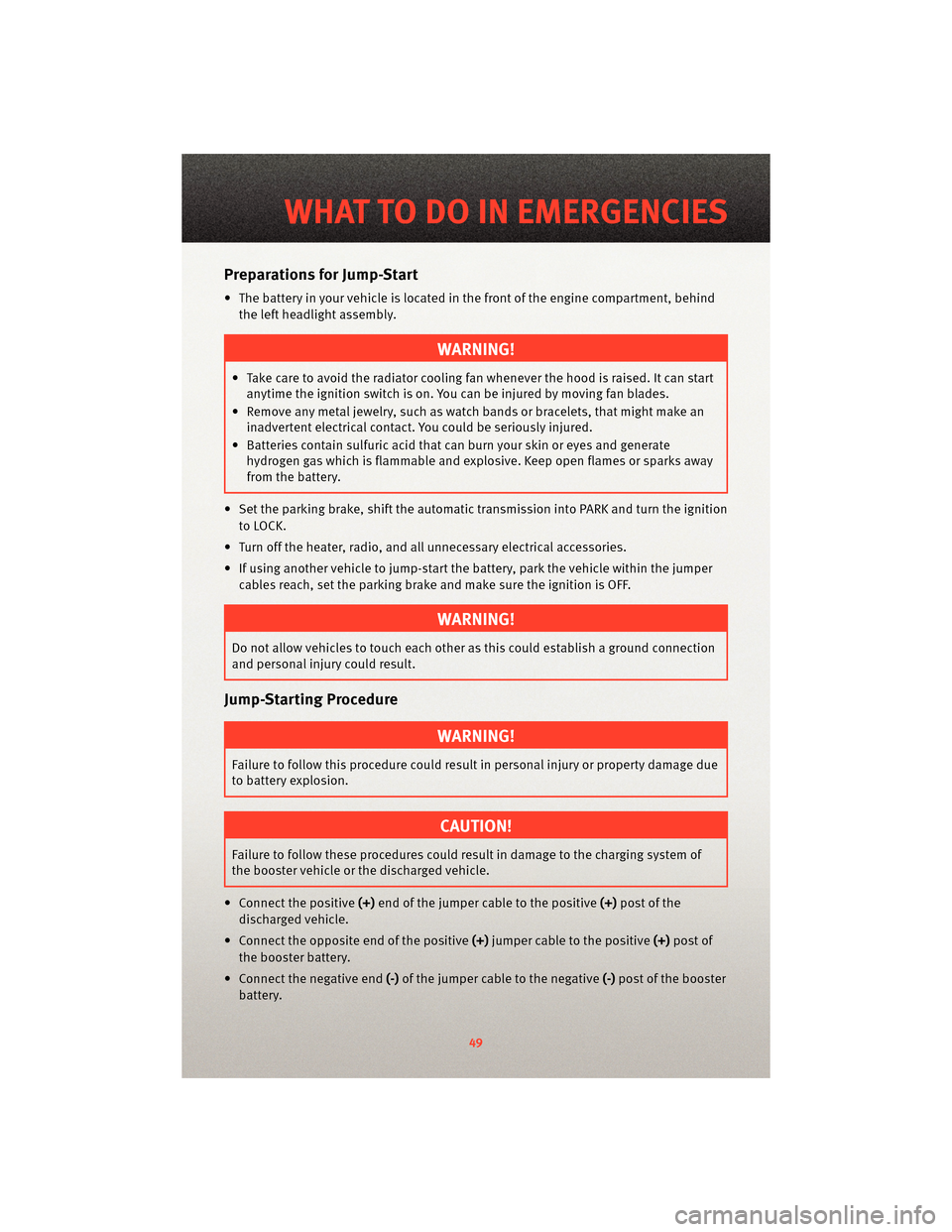
Preparations for Jump-Start
• The battery in your vehicle is located in the front of the engine compartment, behind
the left headlight assembly.
WARNING!
• Take care to avoid the radiator coolin g fan whenever the hood is raised. It can start
anytime the ignition switch is on. You can be injured by moving fan blades.
• Remove any metal jewelry, such as watch bands or bracelets, that might make an inadvertent electrical contact. You could be seriously injured.
• Batteries contain sulfuric acid that can burn your skin or eyes and generate hydrogen gas which is flammable and explosive. Keep open flames or sparks away
from the battery.
• Set the parking brake, shift the autom atic transmission into PARK and turn the ignition
to LOCK.
• Turn off the heater, radio, and all unnecessary electrical accessories.
• If using another vehicle to jump-start the battery, park the vehicle within the jumper cables reach, set the parking brake and make sure the ignition is OFF.
WARNING!
Do not allow vehicles to touch each other as this could establish a ground connection
and personal injury could result.
Jump-Starting Procedure
WARNING!
Failure to follow this procedure could result in personal injury or property damage due
to battery explosion.
CAUTION!
Failure to follow these procedures could result in damage to the charging system of
the booster vehicle or the discharged vehicle.
• Connect the positive (+)end of the jumper cable to the positive (+)post of the
discharged vehicle.
• Connect the opposite end of the positive (+)jumper cable to the positive (+)post of
the booster battery.
• Connect the negative end (-)of the jumper cable to the negative (-)post of the booster
battery.
49
WHAT TO DO IN EMERGENCIES
Page 56 of 76
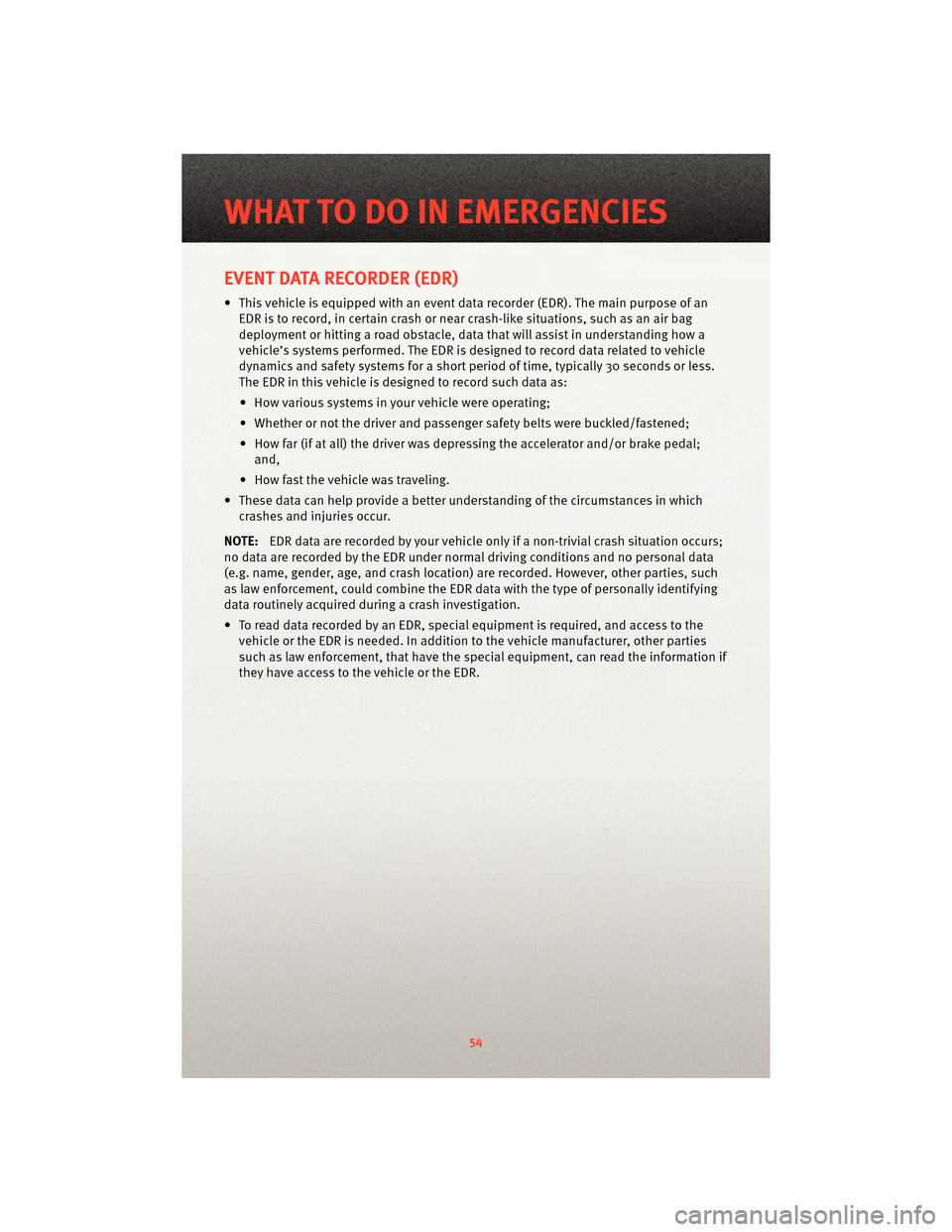
EVENT DATA RECORDER (EDR)
• This vehicle is equipped with an event data recorder (EDR). The main purpose of anEDR is to record, in certain crash or near crash-like situations, such as an air bag
deployment or hitting a road obst acle, data that willassist in understanding how a
vehicle’s systems performed. The EDR is designed to record data related to vehicle
dynamics and safety systems for a short period of time, typically 30 seconds or less.
The EDR in this vehicle is designed to record such data as:
• How various systems in your vehicle were operating;
• Whether or not the driver and passenger s afety belts were buckled/fastened;
• How far (if at all) the driver was depressing the accelerator and/or brake pedal; and,
• How fast the vehicle was traveling.
• These data can help provide a better u nderstanding of the circumstances in which
crashes and injuries occur.
NOTE: EDR data are recorded by your vehicle only if a non-trivial crash situation occurs;
no data are recorded by the EDR under normal driving conditions and no personal data
(e.g. name, gender, age, and crash location) are recorded. However, other parties, such
as law enforcement, could combine the EDR data with the type of personally identifying
data routinely acquired during a crash investigation.
• To read data recorded by an EDR, special equipment is required, and access to the vehicle or the EDR is needed. In addition to the vehicle manufacturer, other parties
such as law enforcement, that have the special equipment, can read the information if
they have access to the vehicle or the EDR.
WHAT TO DO IN EMERGENCIES
54
Page 61 of 76
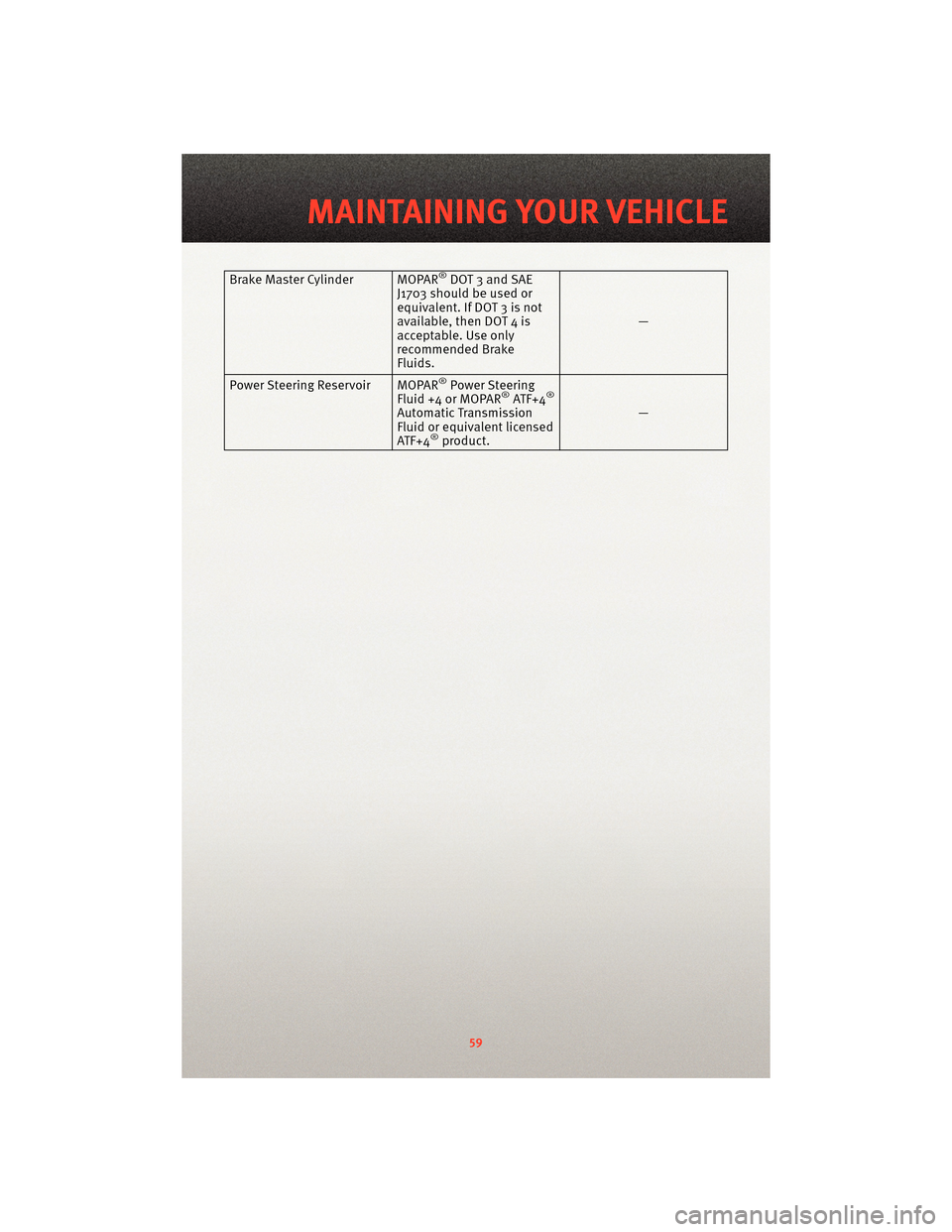
Brake Master Cylinder MOPAR®DOT 3 and SAE
J1703 should be used or
equivalent. If DOT 3 is not
available, then DOT 4 is
acceptable. Use only
recommended Brake
Fluids. —
Power Steering Reservoir MOPAR
®Power Steering
Fluid +4 or MOPAR®ATF+4®
Automatic Tr ansmission
Fluid or equivalent licensed
ATF+4
®product. —
59
MAINTAINING YOUR VEHICLE
Page 62 of 76
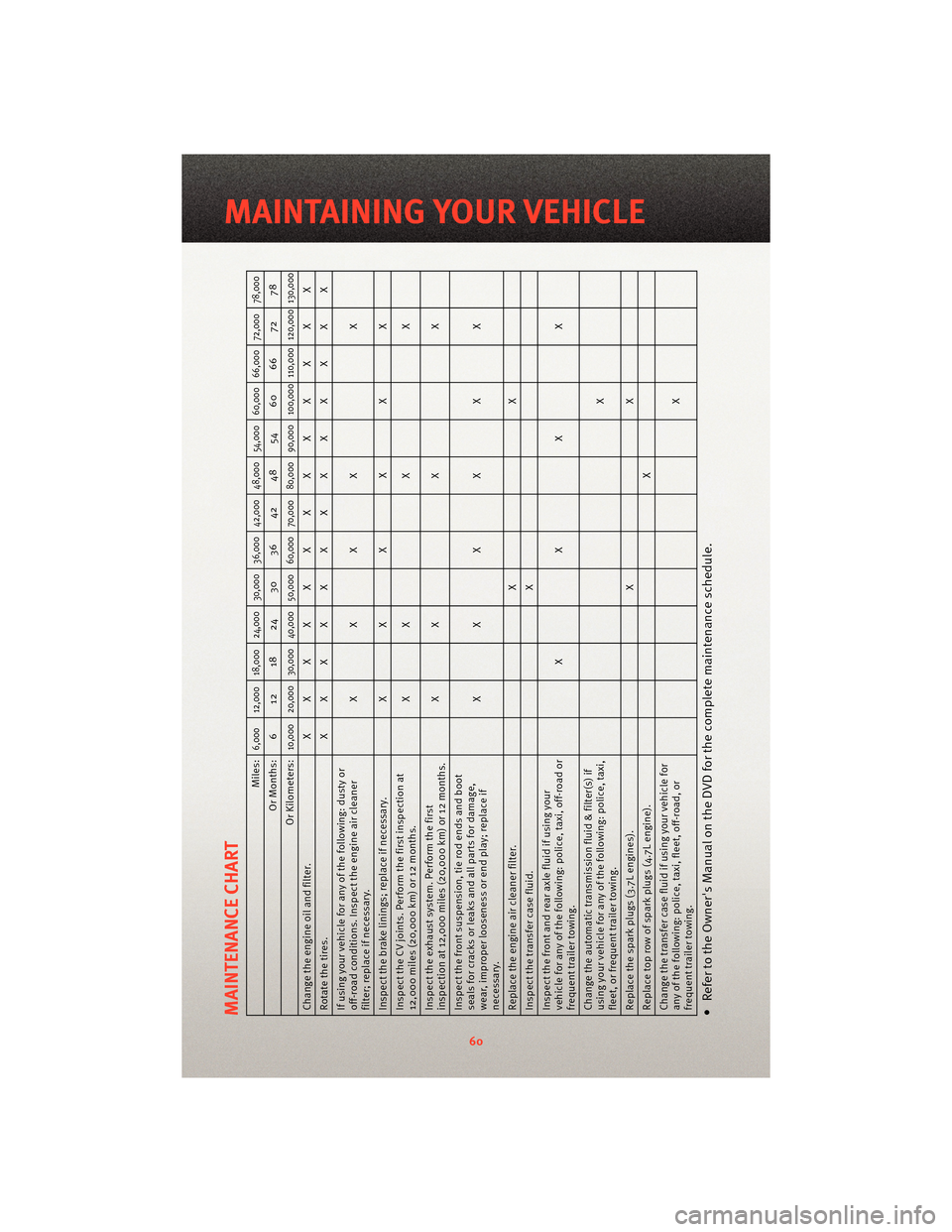
MAINTENANCE CHART
Miles:
6,000 12,000 18,000 24,000 30,000 36,000 42,000 48,000 54,000 60,000 66,000 72,000 78,000
Or Months: 6 12 18 24 30 36 42 48 54 60 66 72 78
Or Kilometers:
10,000 20,000 30,000 40,000 50,000 60,000 70,000 80,000 90,000 100,000 110,000 120,000 130,000
Change the engine oil and filter. XXXXXXXXXXXXX
Rotatethetires. XXXXXXXXXXXXX
If using your vehicle for any of the following: dusty or
off-road conditions. Inspect the engine air cleaner
filter; replace if necessary. XXXX
X
Inspect the brake linings; replace if necessary. XXXXXX
Inspect the CV joints. Perform the first inspection at
12,000 miles (20,000 km) or 12 months. X
XXX
Inspect the exhaust system. Perform the first
inspection at 12,000 miles (20,000 km) or 12 months. X
XXX
Inspect the front suspe nsion, tie rod ends and boot
seals for cracks or leaks and all parts for damage,
wear, improper looseness or end play; replace if
necessary. XXXXXX
Replace the engine air cleaner filter. XX
Inspect the transfer case fluid. X
Inspect the front and rear axle fluid if using your
vehicle for any of the following: police, taxi, off-road or
frequent trailer towing. XXXX
Change the autom atic transmissionfluid & filter(s) if
using your vehicle for any of the following: police, taxi,
fleet, or frequent trailer towing. X
Replace the spark plugs (3.7L engines). XX
Replace top row of spark plugs (4.7L engine). X
Change the transfer case fluid if using your vehicle for
any of the following: police, taxi, fleet, off-road, or
frequent trailer towing. X• Refer to the Owner's Manual on the DVD for the complete maintenance schedule.
60
MAINTAINING YOUR VEHICLE
Page 65 of 76
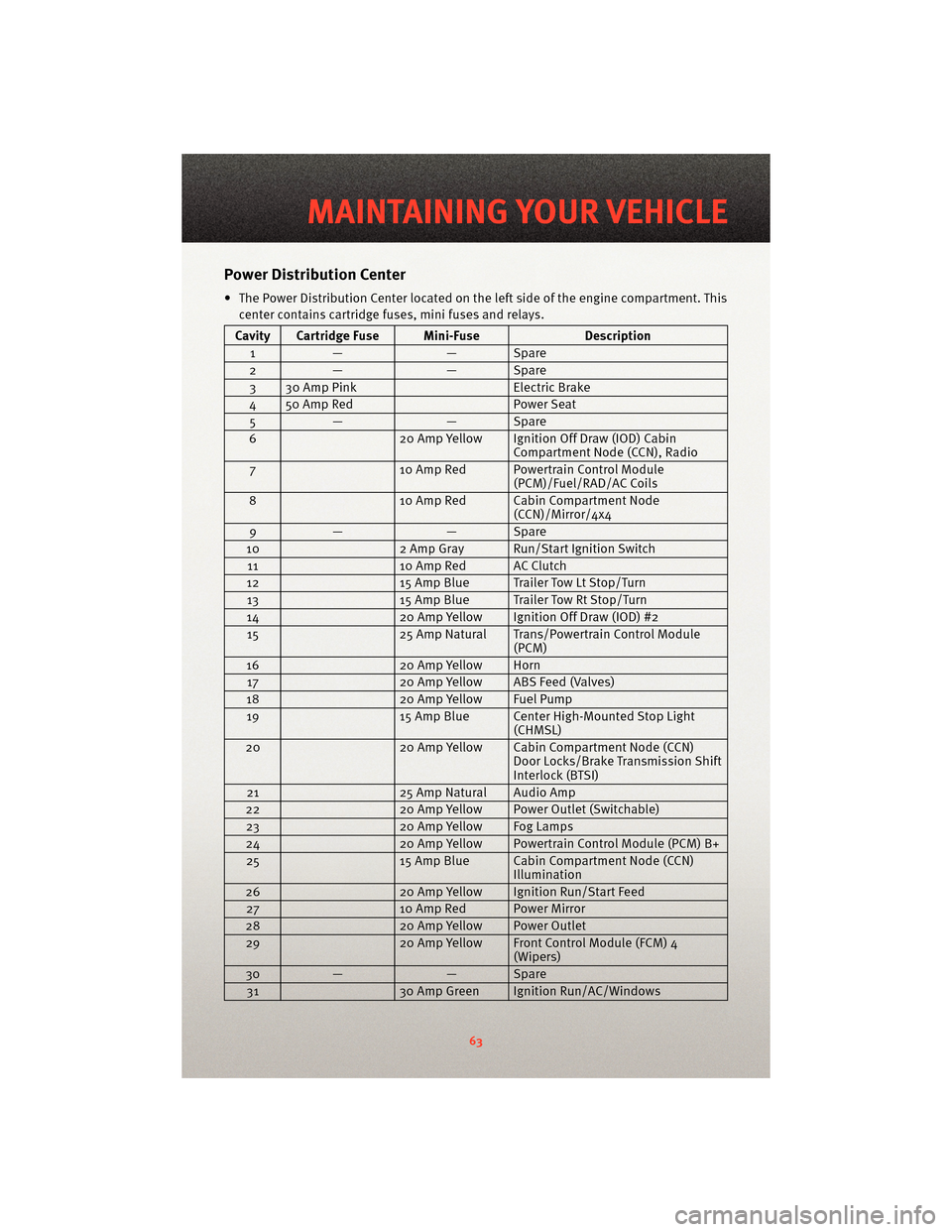
Power Distribution Center
• The Power Distribution Center located on theleft side of the engine compartment. This
center contains cartridge fuses, mini fuses and relays.
Cavity Cartridge Fuse Mini-Fuse Description
1 — — Spare
2 — — Spare
3 30 Amp Pink Electric Brake
4 50 Amp Red Power Seat
5 — — Spare
6 20 Amp Yellow Ignition Off Draw (IOD) Cabin
Compartment Node (CCN), Radio
7 10 Amp Red Powertrain Control Module
(PCM)/Fuel/RAD/AC Coils
8 10 Amp Red Cabin Compartment Node
(CCN)/Mirror/4x4
9 — — Spare
10 2 Amp Gray Run/Start Ignition Switch
11 10 Amp Red AC Clutch
12 15 Amp Blue Trailer Tow Lt Stop/Turn
13 15 Amp Blue Trailer Tow Rt Stop/Turn
14 20 Amp Yellow Ignition Off Draw (IOD) #2
15 25 Amp Natural Trans/Powertrain Control Module
(PCM)
16 20 Amp Yellow Horn
17 20 Amp Yellow ABS Feed (Valves)
18 20 Amp Yellow Fuel Pump
19 15 Amp Blue Center High-Mounted Stop Light
(CHMSL)
20 20 Amp Yellow Cabin Compartment Node (CCN)
Door Locks/Brake Tra nsmission Shift
Interlock (BTSI)
21 25 Amp Natural Audio Amp
22 20 Amp Yellow Power Outlet (Switchable)
23 20 Amp Yellow Fog Lamps
24 20 Amp Yellow Powertrain Control Module (PCM) B+
25 15 Amp Blue Cabin Compartment Node (CCN)
Illumination
26 20 Amp Yellow Ignition Run/Start Feed
27 10 Amp Red Power Mirror
28 20 Amp Yellow Power Outlet
29 20 Amp Yellow Front Control Module (FCM) 4
(Wipers)
30 — — Spare
31 30 Amp Green Ignition Run/AC/Windows
63
MAINTAINING YOUR VEHICLE
Page 66 of 76
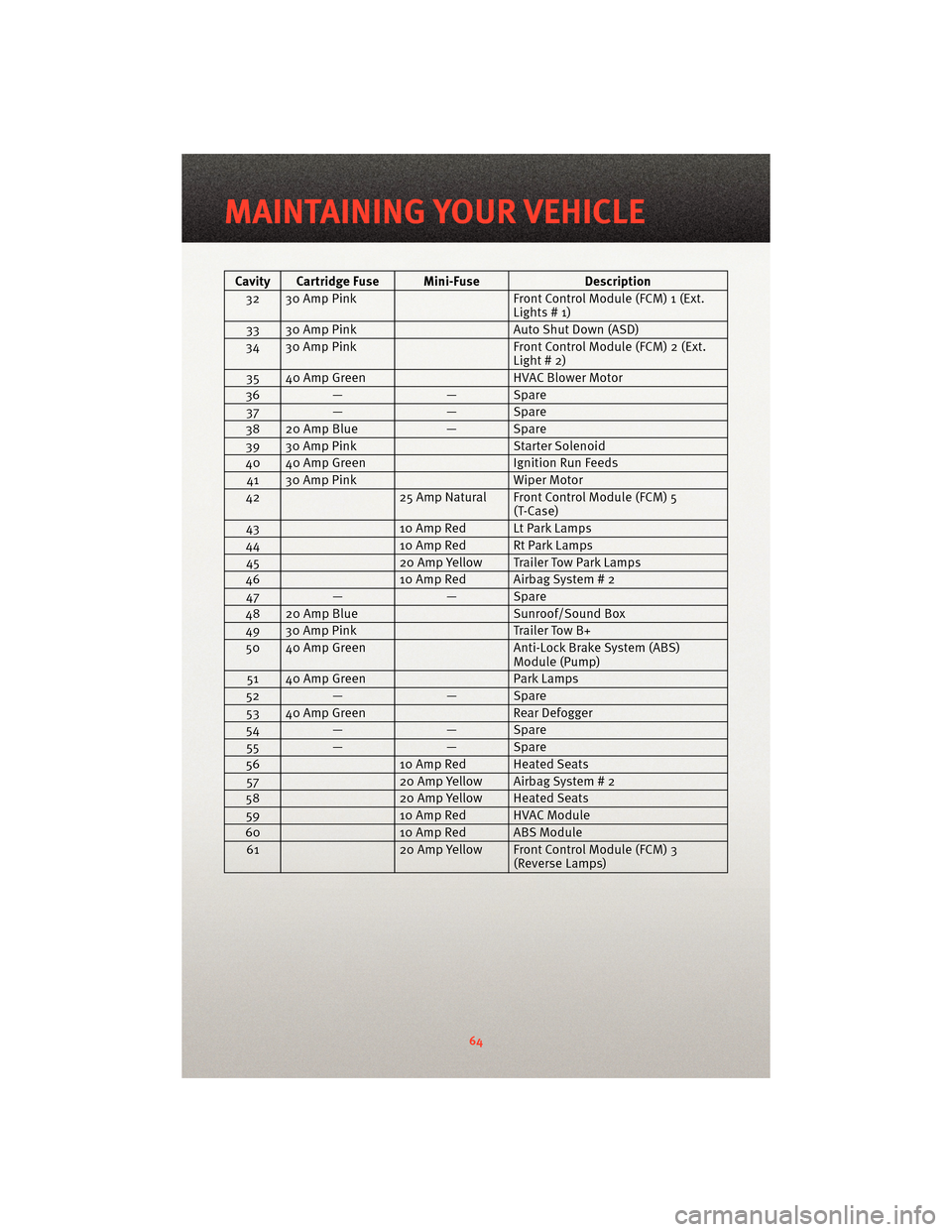
Cavity Cartridge Fuse Mini-FuseDescription
32 30 Amp Pink Front Control Module (FCM) 1 (Ext.
Lights # 1)
33 30 Amp Pink Auto Shut Down (ASD)
34 30 Amp Pink Front Control Module (FCM) 2 (Ext.
Light # 2)
35 40 Amp Green HVAC Blower Motor
36 — — Spare
37 — — Spare
38 20 Amp Blue — Spare
39 30 Amp Pink Starter Solenoid
40 40 Amp Green Ignition Run Feeds
41 30 Amp Pink Wiper Motor
42 25 Amp Natural Front Control Module (FCM) 5
(T-Case)
43 10 Amp Red Lt Park Lamps
44 10 Amp Red Rt Park Lamps
45 20 Amp Yellow Trailer Tow Park Lamps
46 10 Amp Red Airbag System # 2
47 — — Spare
48 20 Amp Blue Sunroof/Sound Box
49 30 Amp Pink Trailer Tow B+
50 40 Amp Green Anti-Lock Brake System (ABS)
Module (Pump)
51 40 Amp Green Park Lamps
52 — — Spare
53 40 Amp Green Rear Defogger
54 — — Spare
55 — — Spare
56 10 Amp Red Heated Seats
57 20 Amp Yellow Airbag System # 2
58 20 Amp Yellow Heated Seats
59 10 Amp Red HVAC Module
60 10 Amp Red ABS Module
61 20 Amp Yellow Front Control Module (FCM) 3
(Reverse Lamps)
MAINTAINING YOUR VEHICLE
64
Page 67 of 76
TIRE PRESSURES
• Check the inflation pressure of each tire, including the spare tire, at least monthly andinflate to the recommended pressure for your vehicle.
• The tire pressures recommended for your vehicle are found on the “Tire and Loading Information” label located on the driver’s side door opening.
NOTE: Refer to the Owner's Manual on the DVD for more information on the life of tires.
WARNING!
Overloading of your tires is dangerous. Ov erloading can causetire failure, affect
vehicle handling, and increase your stopping distance. Use tires of the recommended
load capacity for your vehicle. Never overload them.
WARNING!
Improperly inflated tires are dangerous and can cause accidents. Under-inflation is
the leading cause of tire failure and may result in severe cracking, component
separation, or “blow out”. Over-inflation r educes a tire’s ability to cushion shock.
Objects on the road and chuck holes can cause damage that results in tire failure.
Unequal tire pressures can cause steering problems. You could lose control of your
vehicle. Over-inflated or under-inflated ti res can affect vehicle handling and can fail
suddenly, resulting in loss of vehicle control.
WHEEL AND WHEEL TRIM CARE
• All wheels and wheel trim, especially aluminum and chrome plated wheels, should be cleaned regularly with a mild soap and water to prevent corrosion.
• To remove heavy soil and/or excessive brake dust, use MOPAR
®Wheel Cleaner or
equivalent or select a non-ab rasive,non-acidic cleaner.
CAUTION!
Do not use scouring pads, steel wool, a bristle brush, or metal polishes. Do not use
oven cleaner. These products may damage the wheel's protective finish. Avoid
automatic car washes that use acidic solution s or harsh brushes that may damage the
wheel's protective finish. Only MOPAR
®Wheel Cleaner or equivalent is recommended.
65
MAINTAINING YOUR VEHICLE