ECU DODGE DAKOTA 2011 3.G User Guide
[x] Cancel search | Manufacturer: DODGE, Model Year: 2011, Model line: DAKOTA, Model: DODGE DAKOTA 2011 3.GPages: 452, PDF Size: 4.92 MB
Page 29 of 452
•The transmission is moved out of PARK
•The brake pedal is pressed
To Exit Remote Start Mode Without Driving The
Vehicle
Press and release the REMOTE START button one time,
or allow the engine to run for the entire 15-minute cycle.
NOTE:To avoid unintentional shut downs, the system
will disable the one time press of the REMOTE START
button for two seconds after receiving a valid Remote
Start request.
To Exit Remote Start Mode And Drive The Vehicle
Before the end of the 15-minute cycle, press and release
the UNLOCK button on the RKE transmitter to unlock
the doors and disarm the Vehicle Security Alarm (if
equipped). Then, prior to the end of the 15-minute cycle,
insert the key into the ignition switch and turn the switch
to the ON/RUN position.
NOTE: The ignition switch must be in the ON/RUN
position in order to drive the vehicle.
2
THINGS TO KNOW BEFORE STARTING YOUR VEHICLE 27
Page 30 of 452
DOOR LOCKS
Manual Door Locks
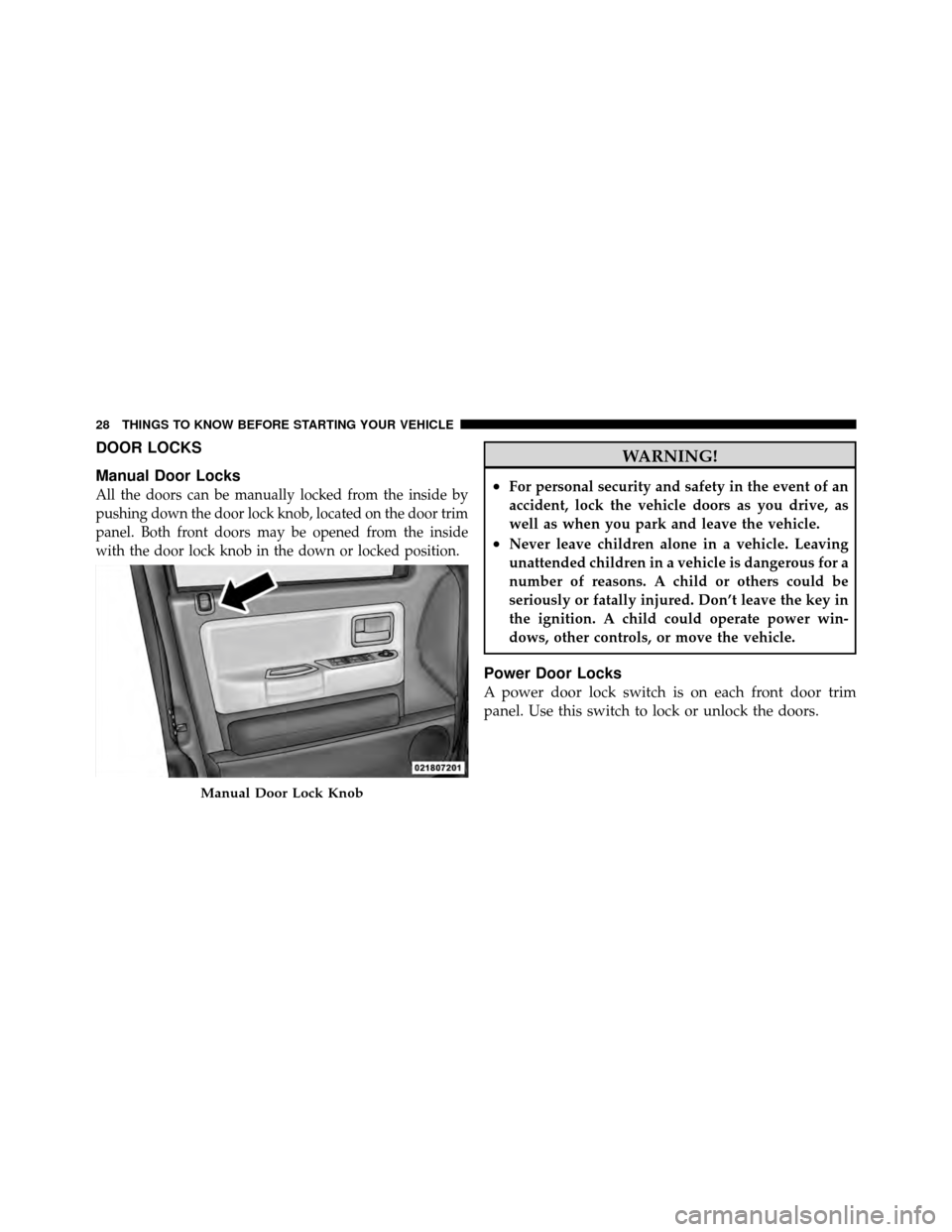
All the doors can be manually locked from the inside by
pushing down the door lock knob, located on the door trim
panel. Both front doors may be opened from the inside
with the door lock knob in the down or locked position.
WARNING!
•For personal security and safety in the event of an
accident, lock the vehicle doors as you drive, as
well as when you park and leave the vehicle.
•Never leave children alone in a vehicle. Leaving
unattended children in a vehicle is dangerous for a
number of reasons. A child or others could be
seriously or fatally injured. Don’t leave the key in
the ignition. A child could operate power win-
dows, other controls, or move the vehicle.
Power Door Locks
A power door lock switch is on each front door trim
panel. Use this switch to lock or unlock the doors.
Manual Door Lock Knob
28 THINGS TO KNOW BEFORE STARTING YOUR VEHICLE
Page 38 of 452
If you will be carrying children too small for adult-sized
seat belts, the seat belts or the Lower Anchors and Tether
for CHildren (LATCH) feature also can be used to hold
infant and child restraint systems. For more information
on LATCH, refer to Lower Anchors and Tether for
CHildren (LATCH).
NOTE:The Advanced Front Air Bags have a multistage
inflator design. This allows the air bag to have different
rates of inflation based on the severity and type of
collision.
Here are some simple steps you can take to minimize the
risk of harm from a deploying air bag:
1. Children 12 years old and under should always ride
buckled up in a rear seat.WARNING!
Infants in rear facing child restraints should never
ride in the front seat of a vehicle with a passenger
Advanced Front Air Bag. An air bag deployment can
cause severe injury or death to infants in that posi-
tion.
Children that are not big enough to wear the vehicle seat
belt properly (see section on Child Restraints) should be
secured in the rear seat in child restraints or belt-
positioning booster seats. Older children who do not use
child restraints or belt-positioning booster seats should
ride properly buckled up in the rear seat. Never allow
children to slide the shoulder belt behind them or under
their arm.
36 THINGS TO KNOW BEFORE STARTING YOUR VEHICLE
Page 41 of 452
Lap/Shoulder Belts
All seating positions, have combination lap/shoulder
belts. The belt webbing retractor is designed to lock
during very sudden stops or accidents. This feature
allows the shoulder part of the belt to move freely with
you under normal conditions. However, in an accident
the belt will lock and reduce the risk of you striking the
inside of the vehicle or being thrown out.
The seat belts in the passenger seating positions are
equipped with an Automatic Locking Retractor (ALR) to
secure a Child Restraint System (CRS). For additional
information on ALR, refer to “Automatic Locking Mode”
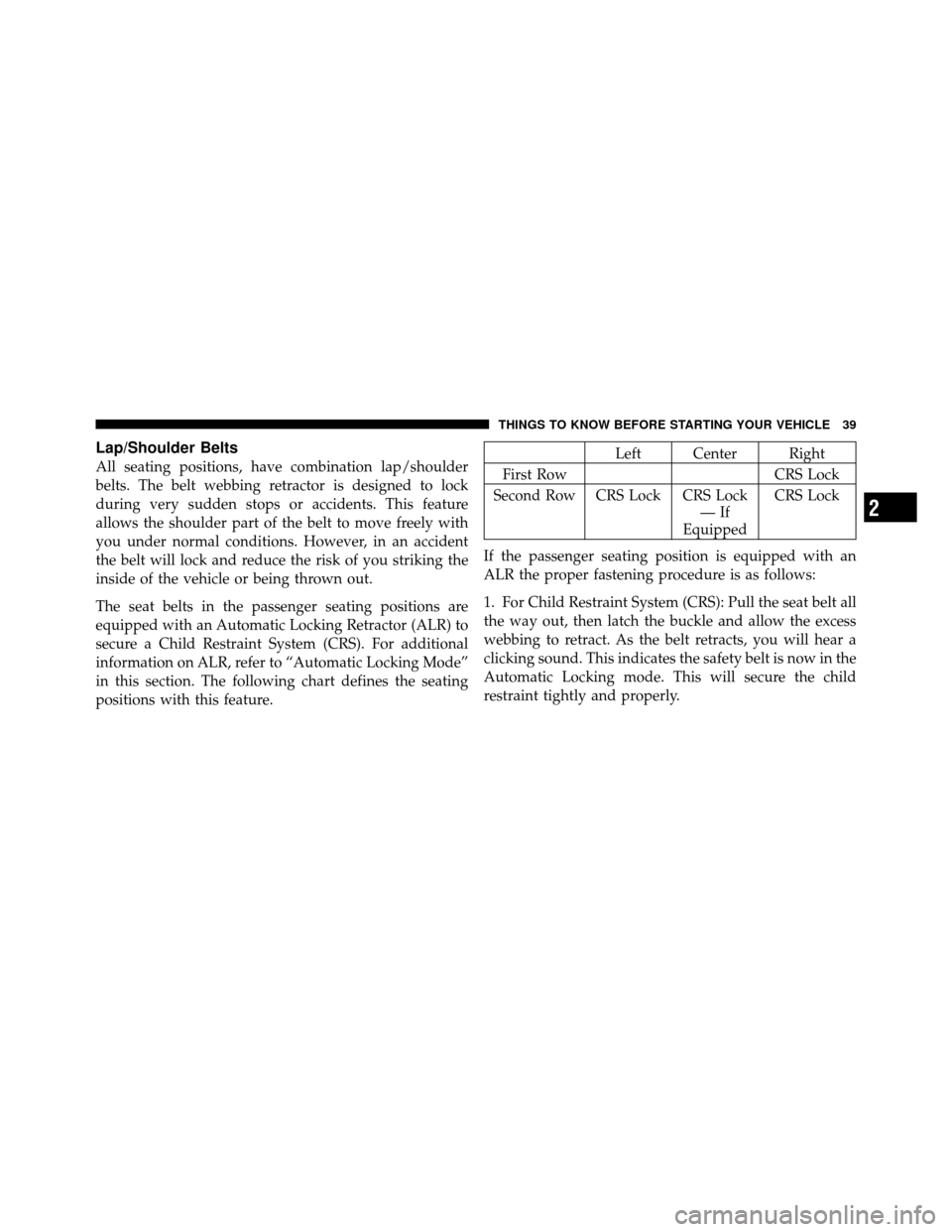
in this section. The following chart defines the seating
positions with this feature.Left Center Right
First Row CRS Lock
Second Row CRS Lock CRS Lock —If
Equipped CRS Lock
If the passenger seating position is equipped with an
ALR the proper fastening procedure is as follows:
1. For Child Restraint System (CRS): Pull the seat belt all
the way out, then latch the buckle and allow the excess
webbing to retract. As the belt retracts, you will hear a
clicking sound. This indicates the safety belt is now in the
Automatic Locking mode. This will secure the child
restraint tightly and properly.
2
THINGS TO KNOW BEFORE STARTING YOUR VEHICLE 39
Page 48 of 452
WARNING!
•A lap belt worn too loose or too high is dangerous.
•A belt worn too loose can allow you to slip down
and under the belt in a collision.
•A belt that is too loose or too high will apply crash
forces to the abdomen, not to the stronger hip
bones. In either case, the risk of internal injuries is
greater. Wear a lap belt low and snug.
Lap/Shoulder Belt Untwisting Procedure
Use the following procedure to untwist a twisted lap/
shoulder belt.
1. Position the latch plate as close as possible to the
anchor point.
2. At about 6 to 12 in (15 to 30 cm) above the latch plate,
grasp and twist the belt webbing 180 degrees to create a
fold that begins immediately above the latch plate.3. Slide the latch plate upward over the folded webbing.
The folded webbing must enter the slot at the top of the
latch plate.
4. Continue to slide the latch plate up until it clears the
folded webbing.
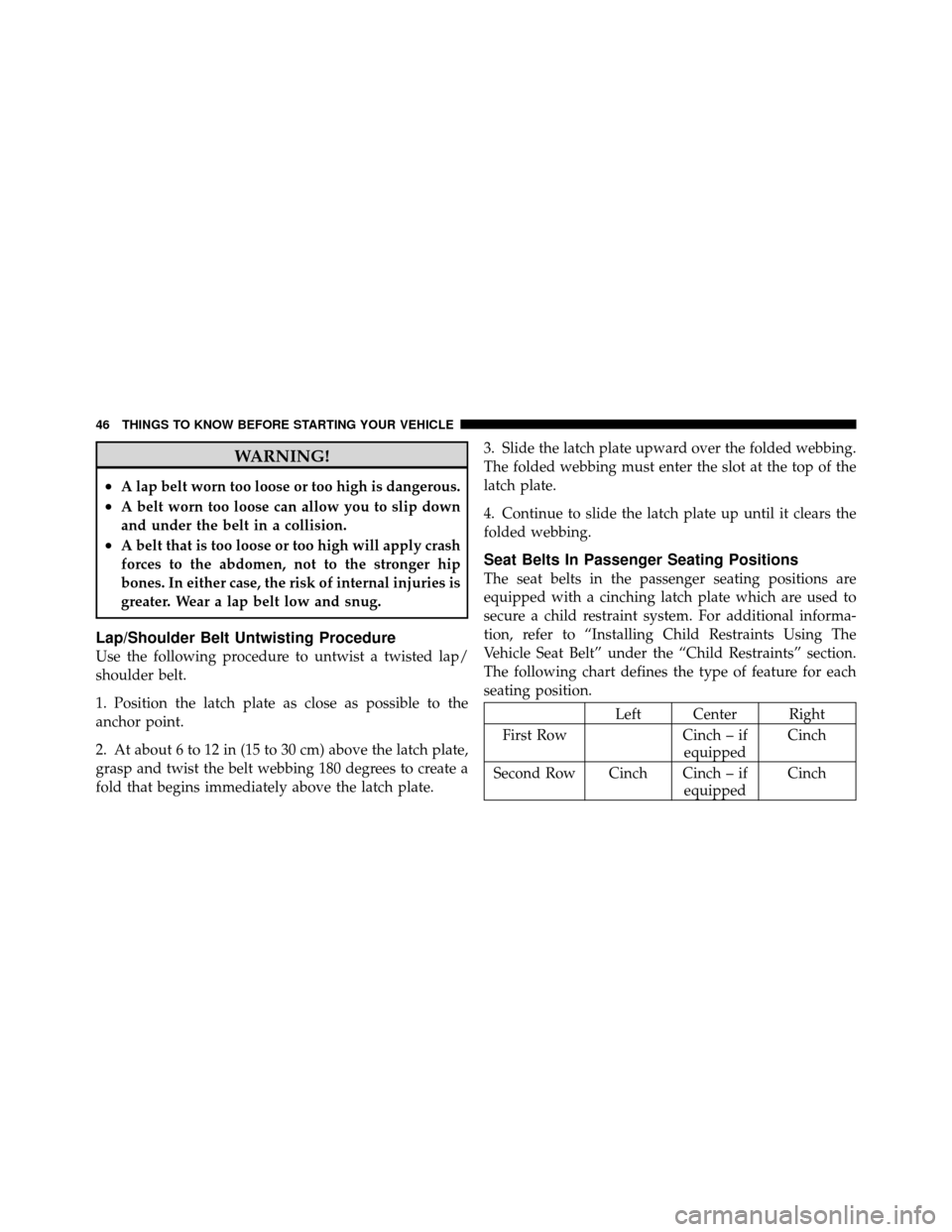
Seat Belts In Passenger Seating Positions
The seat belts in the passenger seating positions are
equipped with a cinching latch plate which are used to
secure a child restraint system. For additional informa-
tion, refer to “Installing Child Restraints Using The
Vehicle Seat Belt” under the “Child Restraints” section.
The following chart defines the type of feature for each
seating position.
Left Center Right
First Row Cinch – if equippedCinch
Second Row Cinch Cinch – if equippedCinch
46 THINGS TO KNOW BEFORE STARTING YOUR VEHICLE
Page 65 of 452
In addition to the vehicle manufacturer, other parties,
such as law enforcement, that have the special equip-
ment, can read the information if they have access to the
vehicle or the EDR.
Child Restraints
Everyone in your vehicle needs to be buckled up all the
time, including babies and children. Every state in the
United States, and all Canadian provinces, require that
small children ride in proper restraint systems. This is the
law, and you can be prosecuted for ignoring it. Children
12 years or younger should ride properly buckled up in
a rear seat, if available. According to crash statistics,
children are safer when properly restrained in the rear
seats rather than in the front.
WARNING!
In a collision, an unrestrained child, even a tiny baby,
can become a projectile inside the vehicle. The force
required to hold even an infant on your lap can
become so great that you could not hold the child, no
matter how strong you are. The child and others
could be badly injured. Any child riding in your
vehicle should be in a proper restraint for the child’s
size.
There are different sizes and types of restraints for
children from newborn size to the child almost large
enough for an adult seat belt. Always check the child seat
owner’s manual to ensure you have the right seat for
your child. Use the restraint that is correct for your child.
2
THINGS TO KNOW BEFORE STARTING YOUR VEHICLE 63
Page 69 of 452
belt system will loosen with time, so check the belt
occasionally and pull it tight, if necessary.
•Buckle the child into the restraint exactly as the
manufacturer’s instructions tell you.
WARNING!
When your child restraint is not in use, secure it in
the vehicle with the seat belt or remove it from the
vehicle. Do not leave it loose in the vehicle. In a
sudden stop or accident, it could strike the occupants
or seatbacks and cause serious personal injury.
LATCH - Child Seat Anchorage System (Lower
Anchors and Tether for CHildren) — If Equipped
Each vehicle is equipped with the child restraint anchor-
age system called LATCH, which stands for Lower
Anchors and Tethers for CHildren. The LATCH system
provides for the installation of the child restraint withoutusing the vehicle’s seat belts, instead securing the child
restraint using lower anchorages and upper tether straps
from the child restraint to the vehicle structure. LATCH-
compatible child restraint systems are now available.
However, because the lower anchorages are to be intro-
duced over a period of years, child restraint systems
having attachments for those anchorages will continue to
also have features for installation using the vehicle’s seat
belts. Child restraints having tether straps and hooks for
connection to the top tether anchorages have been avail-
able for some time. For some older child restraints, many
child restraint manufacturers offer add-on tether strap
kits or retro-fit kits. You are urged to take advantage of all
the available attachments provided with your child re-
straint in any vehicle.
2
THINGS TO KNOW BEFORE STARTING YOUR VEHICLE 67
Page 73 of 452
Installing Child Restraints Using The Vehicle Seat
Belt
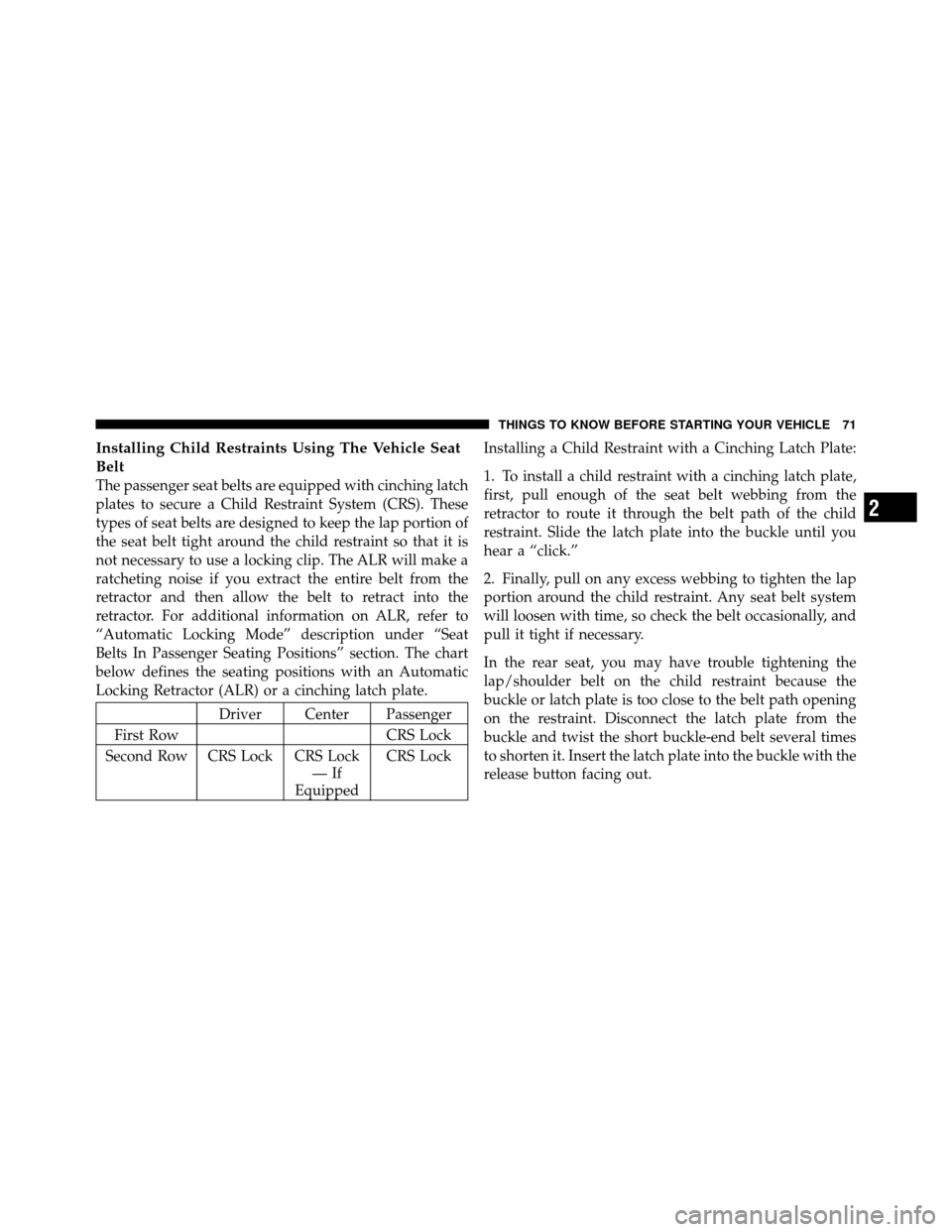
The passenger seat belts are equipped with cinching latch
plates to secure a Child Restraint System (CRS). These
types of seat belts are designed to keep the lap portion of
the seat belt tight around the child restraint so that it is
not necessary to use a locking clip. The ALR will make a
ratcheting noise if you extract the entire belt from the
retractor and then allow the belt to retract into the
retractor. For additional information on ALR, refer to
“Automatic Locking Mode” description under “Seat
Belts In Passenger Seating Positions” section. The chart
below defines the seating positions with an Automatic
Locking Retractor (ALR) or a cinching latch plate.
Driver Center Passenger
First Row CRS Lock
Second Row CRS Lock CRS Lock —If
Equipped CRS Lock Installing a Child Restraint with a Cinching Latch Plate:
1. To install a child restraint with a cinching latch plate,
first, pull enough of the seat belt webbing from the
retractor to route it through the belt path of the child
restraint. Slide the latch plate into the buckle until you
hear a “click.”
2. Finally, pull on any excess webbing to tighten the lap
portion around the child restraint. Any seat belt system
will loosen with time, so check the belt occasionally, and
pull it tight if necessary.
In the rear seat, you may have trouble tightening the
lap/shoulder belt on the child restraint because the
buckle or latch plate is too close to the belt path opening
on the restraint. Disconnect the latch plate from the
buckle and twist the short buckle-end belt several times
to shorten it. Insert the latch plate into the buckle with the
release button facing out.
2
THINGS TO KNOW BEFORE STARTING YOUR VEHICLE 71
Page 74 of 452
If the belt still can’t be tightened, or if pulling and
pushing on the restraint loosens the belt, disconnect the
latch plate from the buckle, turn the buckle around, and
insert the latch plate into the buckle again. If you still
can’t make the child restraint secure, try a different
seating position.
Child Restraint Tether Anchor
The Extended Cab model has one routing strap
located at the bottom of the rear outboard
seating position. The tether anchor itself is
located in the center of vehicle, in between the
two seating positions. When there is a rear seat delete
option, the tether anchorage located on the cab back
panel is designed to be used for the front seat center
seating position. The Crew Cab model has three anchor-
ages located behind each of the rear seating positions
(rear left, rear center, and rear right).
WARNING!
•With a child restraint installed in the rear passen-
ger side locations, use care when adjusting the
front seat(s) rearward, to avoid the front seatback
coming in contact with the belted child directly
behind the seat. The child could be injured.
•Improper installation can lead to failure of an
infant or child restraint. It could come loose in a
collision. The child could be seriously injured or
killed. Make sure the child restraint tether strap is
always routed through the proper anchor strap
inner loop.
72 THINGS TO KNOW BEFORE STARTING YOUR VEHICLE
Page 77 of 452
WARNING!
An incorrectly anchored tether strap could lead to
seat failure and injury to the child. In a collision, the
seat could come loose and allow the child to crash
into the inside of the vehicle or other passengers, or
even be thrown from the vehicle. Use only the anchor
positions directly behind the child restraint to secure
a child restraint top tether strap. See your authorized
dealer for help, if necessary.
Transporting Pets
Air Bags deploying in the front seat could harm your pet.
An unrestrained pet will be thrown about and possibly
injured, or injure a passenger during panic braking or in
an accident. Pets should be restrained in the rear seat in
pet harnesses or pet carriers that are secured by seat belts.
ENGINE BREAK-IN RECOMMENDATIONS
A long break-in period is not required for the engine and
drivetrain (transmission and axle) in your vehicle.
Drive moderately during the first 300 miles (500 km).
After the initial 60 miles (100 km), speeds up to 50 or
55 mph (80 or 90 km/h) are desirable.
While cruising, brief full-throttle acceleration within the
limits of local traffic laws contributes to a good break-in.
Wide-open throttle acceleration in low gear can be detri-
mental and should be avoided.
The engine oil installed in the engine at the factory is a
high-quality energy conserving type lubricant. Oil
changes should be consistent with anticipated climate
conditions under which vehicle operations will occur. For
the recommended viscosity and quality grades, refer to
“Maintenance Procedures” in “Maintaining Your Ve-
hicle”. NON-DETERGENT OR STRAIGHT MINERAL
OILS MUST NEVER BE USED.
2
THINGS TO KNOW BEFORE STARTING YOUR VEHICLE 75