heating DODGE DAKOTA 2011 3.G User Guide
[x] Cancel search | Manufacturer: DODGE, Model Year: 2011, Model line: DAKOTA, Model: DODGE DAKOTA 2011 3.GPages: 452, PDF Size: 4.92 MB
Page 329 of 452
NOTE:Check the automatic transmission fluid level
before towing.
Tow/Haul – If Equipped
To reduce potential for automatic transmission overheat-
ing, turn the TOW/HAUL feature ON when driving in
hilly areas or shift the transmission to Drive position 2 on
more severe grades.
Electronic Speed Control – If Equipped
Do not use in hilly terrain or with heavy loads.
When using the speed control, if you experience speed
drops greater than 10 mph (16 km/h), disengage until
you can resume cruising speed.
Use speed control in flat terrain and with light loads to
maximize fuel efficiency.
Cooling System
To reduce potential for engine and transmission over-
heating, take the following actions:
City Driving
When stopped for short periods of time, shift the trans-
mission into NEUTRAL and increase engine idle speed.
Highway Driving
Reduce speed.
Air Conditioning
Turn off temporarily.
SNOWPLOW
Snow plows, winches, and other aftermarket equipment
should notbe added to the front end of your vehicle. The
airbag crash sensors may be affected by the change in the
front end structure. The airbags could deploy unexpect-
edly or could fail to deploy during a collision.
5
STARTING AND OPERATING 327
Page 351 of 452
8. Disconnect the opposite end of the positive(+)jumper
cable from the positive (+)post of the booster battery.
9. Disconnect the positive (+)end of the jumper cable
from the positive (+)post of the discharged vehicle.
10. Reinstall the air intake duct.
If frequent jump-starting is required to start your vehicle
you should have the battery and charging system in-
spected at your authorized dealer.
CAUTION!
Accessories that can be plugged into the vehicle
power outlets draw power from the vehicle’s battery,
even when not in use (i.e., cellular phones, etc.).
Eventually, if plugged in long enough, the vehicle’s
battery will discharge sufficiently to degrade battery
life and/or prevent the engine from starting.
FREEING A STUCK VEHICLE
If vehicle becomes stuck in snow, sand, or mud, it can
often be moved by a rocking motion. Move the shift lever
rhythmically between FIRST and REVERSE, while apply-
ing slight pressure to the accelerator.
CAUTION!
Racing the engine or spinning the wheels may lead to
transmission overheating and failure. Allow the en-
gine to idle with the shift lever in NEUTRAL for at
least one minute after every five rocking-motion
cycles. This will minimize overheating and reduce
the risk of transmission failure during prolonged
efforts to free a stuck vehicle.
6
WHAT TO DO IN EMERGENCIES 349
Page 352 of 452
WARNING!
Fast spinning tires can be dangerous. Forces gener-
ated by excessive wheel speeds may cause damage, or
even failure, of the axle and tires. A tire could
explode and injure someone. Do not spin your vehi-
cle’s wheels faster than 30 mph (48 km/h) or for
longer than 30 seconds continuously without stop-
ping when you are stuck. And do not let anyone near
a spinning wheel, no matter what the speed.
The least amount of accelerator pedal pressure to main-
tain the rocking motion without spinning the wheels or
racing the engine is most effective. Allow the engine to idle with the shift lever in NEUTRAL for at least one
minute after every five rocking-motion cycles. This will
minimize overheating and reduce the risk of transmis-
sion failure during prolonged efforts to free a stuck
vehicle.
CAUTION!
Revving the engine or spinning the wheels too fast
may lead to transmission overheating and failure. It
can also damage the tires. Do not spin the wheels
above 30 mph (48 km/h). Do not spin the wheels
continuously for more than 30 seconds.
350 WHAT TO DO IN EMERGENCIES
Page 372 of 452
CAUTION! (Continued)
•Damage to the catalytic converter can result if your
vehicle is not kept in proper operating condition.
In the event of engine malfunction, particularly
involving engine misfire or other apparent loss of
performance, have your vehicle serviced promptly.
Continued operation of your vehicle with a severe
malfunction could cause the converter to overheat,
resulting in possible damage to the converter and
vehicle.
Under normal operating conditions, the catalytic con-
verter will not require maintenance. However, it is im-
portant to keep the engine properly tuned to assure
proper catalyst operation and prevent possible catalyst
damage. NOTE:
Intentional tampering with emissions control
systems can result in civil penalties being assessed
against you.
In unusual situations involving grossly malfunctioning
engine operation, a scorching odor may suggest severe
and abnormal catalyst overheating. If this occurs, stop
the vehicle, turn off the engine and allow it to cool.
Service, including a tune-up to manufacturer’s specifica-
tions, should be obtained immediately.
To minimize the possibility of catalytic converter dam-
age:
•Do not shut off the engine or interrupt the ignition,
when the transmission is in gear and the vehicle is in
motion.
•Do not try to start the engine by pushing or towing the
vehicle.
370 MAINTAINING YOUR VEHICLE
Page 444 of 452
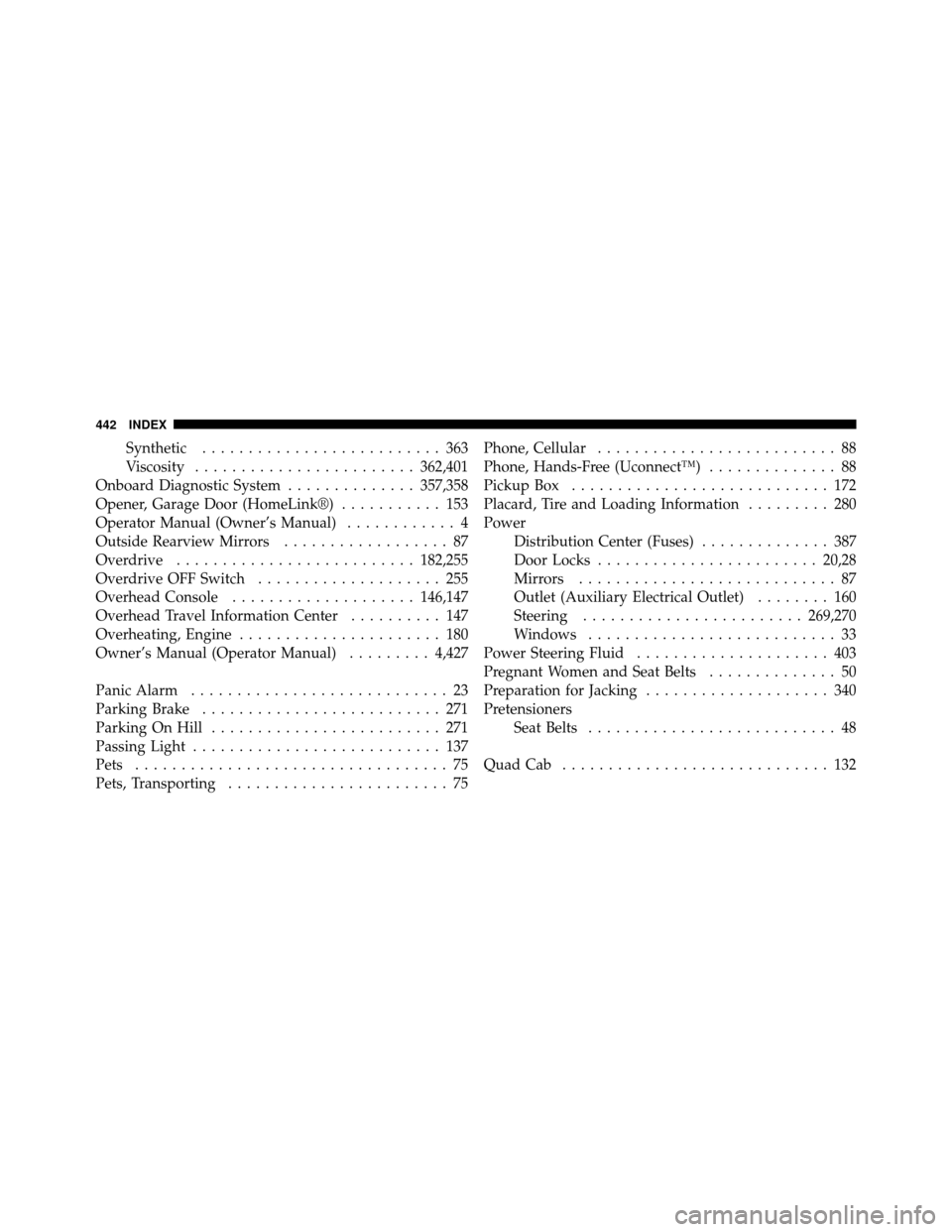
Synthetic.......................... 363
Viscosity ........................ 362,401
Onboard Diagnostic System ..............357,358
Opener, Garage Door (HomeLink®) ........... 153
Operator Manual (Owner’s Manual) ............ 4
Outside Rearview Mirrors .................. 87
Overdrive .......................... 182,255
Overdrive OFF Switch .................... 255
Overhead Console .................... 146,147
Overhead Travel Information Center .......... 147
Overheating, Engine ...................... 180
Owner’s Manual (Operator Manual) .........4,427
Panic Alarm ............................ 23
Parking Brake .......................... 271
Parking On Hill ......................... 271
Passing Light ........................... 137
Pets .................................. 75
Pets, Transporting ........................ 75 Phone, Cellular
.......................... 88
Phone, Hands-Free (Uconnect™) .............. 88
Pickup Box ............................ 172
Placard, Tire and Loading Information ......... 280
Power Distribution Center (Fuses) .............. 387
Door Locks ........................ 20,28
Mirrors ............................ 87
Outlet (Auxiliary Electrical Outlet) ........ 160
Steering ........................ 269,270
Windows ........................... 33
Power Steering Fluid ..................... 403
Pregnant Women and Seat Belts .............. 50
Preparation for Jacking .................... 340
Pretensioners Seat Belts ........................... 48
Quad Cab ............................. 132
442 INDEX