transmission DODGE DAKOTA 2011 3.G Owner's Manual
[x] Cancel search | Manufacturer: DODGE, Model Year: 2011, Model line: DAKOTA, Model: DODGE DAKOTA 2011 3.GPages: 452, PDF Size: 4.92 MB
Page 255 of 452
Key Ignition Park Interlock
This vehicle is equipped with a Key Ignition Park Inter-
lock which requires the shift lever to be placed in PARK
prior to rotating the key to the LOCK position. The key
can only be removed from the ignition when the ignition
is in the LOCK position and once removed the shift lever
is locked in PARK.
Brake/Transmission Interlock System
This vehicle is equipped with a Brake Transmission Shift
Interlock System (BTSI) that holds the shift lever in the
PARK position when the ignition switch is in the LOCK
position. To move the shift lever out of the PARK
position, the ignition switch must be turned to any other
switch position (ACC, ON, or START) (engine running or
not) and the brake pedal must be pressed.
Automatic Transmission
The electronic PRNDL on the instrument cluster indicates
the transmission gear selected. The shift lever is mounted
on the right side of the steering column. To drive, move
the shift lever from PARK or NEUTRAL to the desired
drive position. Pull the shift lever toward you when
shifting into REVERSE, SECOND, FIRST or PARK, or
when shifting out of PARK.
Gear Ranges
DO NOT race the engine when shifting from PARK or
NEUTRAL position into another gear range.
PARK
This range supplements the parking brake by locking the
transmission. The engine can be started in this range.
Never use PARK while the vehicle is in motion. Apply
the parking brake when leaving the vehicle in this range.
Always apply the parking brake first, then place the shift
lever into the PARK position.
5
STARTING AND OPERATING 253
Page 256 of 452

WARNING!
•Never use the PARK position as a substitute for
the parking brake. Always apply the parking
brake fully when parked to guard against vehicle
movement and possible injury or damage.
•It is dangerous to move the shift lever out of PARK
or NEUTRAL if the engine speed is higher than
idle speed. If your foot is not firmly on the brake
pedal, the vehicle could accelerate quickly forward
or in reverse. You could lose control of the vehicle
and hit someone or something. Only shift into
gear when the engine is idling normally and when
your right foot is firmly on the brake pedal.(Continued)
WARNING! (Continued)
•Unintended movement of a vehicle could injure
those in and near the vehicle. As with all vehicles,
you should never exit a vehicle while the engine is
running. Before exiting a vehicle, you should
always shift the transmission into PARK, remove
the key from the ignition, and apply the parking
brake. Once the key is removed from the ignition,
the shift lever is locked in the PARK position,
securing the vehicle against unwanted movement.
Furthermore, you should never leave unattended
children inside a vehicle.
REVERSE
This range is for moving the vehicle backward. Use only
after the vehicle has come to a complete stop.
254 STARTING AND OPERATING
Page 257 of 452
NEUTRAL
This range is used when vehicle is standing for pro-
longed periods with engine running. Engine may be
started in this range. Set the parking brake and shift the
transmission into PARK if you must leave the vehicle.
DRIVE
This range is for most city and highway driving.
2 (Second)
This range is for driving slowly in heavy city traffic or on
mountain roads where more precise speed control is
desirable, use second gear. Use it also when climbing
long grades, and for engine braking when descending
moderately steep grades. To prevent excessive engine
speed, do not exceed 45 mph (72 km/h) in this range.
1 (First)
This range is for driving up very steep hills and for
engine braking at low speeds, 25 mph (40 km/h) or less,when going down hill, use first gear. To prevent excessive
engine speed do not exceed 25 mph (40 km/h) in this
range.
Overdrive Operation
The Overdrive automatic transmission contains an
electronically-controlled fourth and fifth (if equipped)
gear (Overdrive). The transmission will automatically
shift from Drive to Overdrive, if the following conditions
are present:
•the shift lever is in DRIVE;
•the engine coolant has reached normal operating tem-
perature;
•vehicle speed is above approximately 30 mph
(48 km/h);
•the TOW/HAUL switch has not been activated;
•transmission has reached normal operating
temperature.
5
STARTING AND OPERATING 255
Page 258 of 452
NOTE:
•If the vehicle is started in extremely cold temperatures,
the transmission may not shift into Overdrive and will
automatically select the most desirable gear for opera-
tion at this temperature. Normal operation will re-
sume when the transmission fluid temperature has
risen to a suitable level. Refer to “Torque Converter
Clutch” in this section.
•If the transmission temperature gets extremely hot, the
transmission will automatically select the most desir-
able gear for operation at this temperature. If the
transmission temperature becomes hot enough, the
“Transmission Temperature Warning Light” may illu-
minate and the transmission may downshift out of
Overdrive until the transmission cools down. After
cool down, the transmission will resume normal
operation.The transmission will downshift from Overdrive to
DRIVE if the accelerator pedal is fully pressed at vehicle
speeds above approximately 35 mph (56 km/h).
When to Use TOW/HAUL Mode
When driving in hilly areas, towing a trailer, carrying a
heavy load, etc., and frequent transmission shifting oc-
curs, press the TOW/HAUL switch. This will improve
performance and reduce the potential for transmission
overheating or failure due to excessive shifting. When
operating in TOW/HAUL mode, top gear is disabled and
some shift patterns are modified. On vehicles with five-
speed transmissions, shifts into Overdrive (fourth gear)
are allowed during steady cruise (for improved fuel
economy), and automatic closed-throttle downshifts to
third gear (for improved braking) will occur during
steady braking.
256 STARTING AND OPERATING
Page 259 of 452
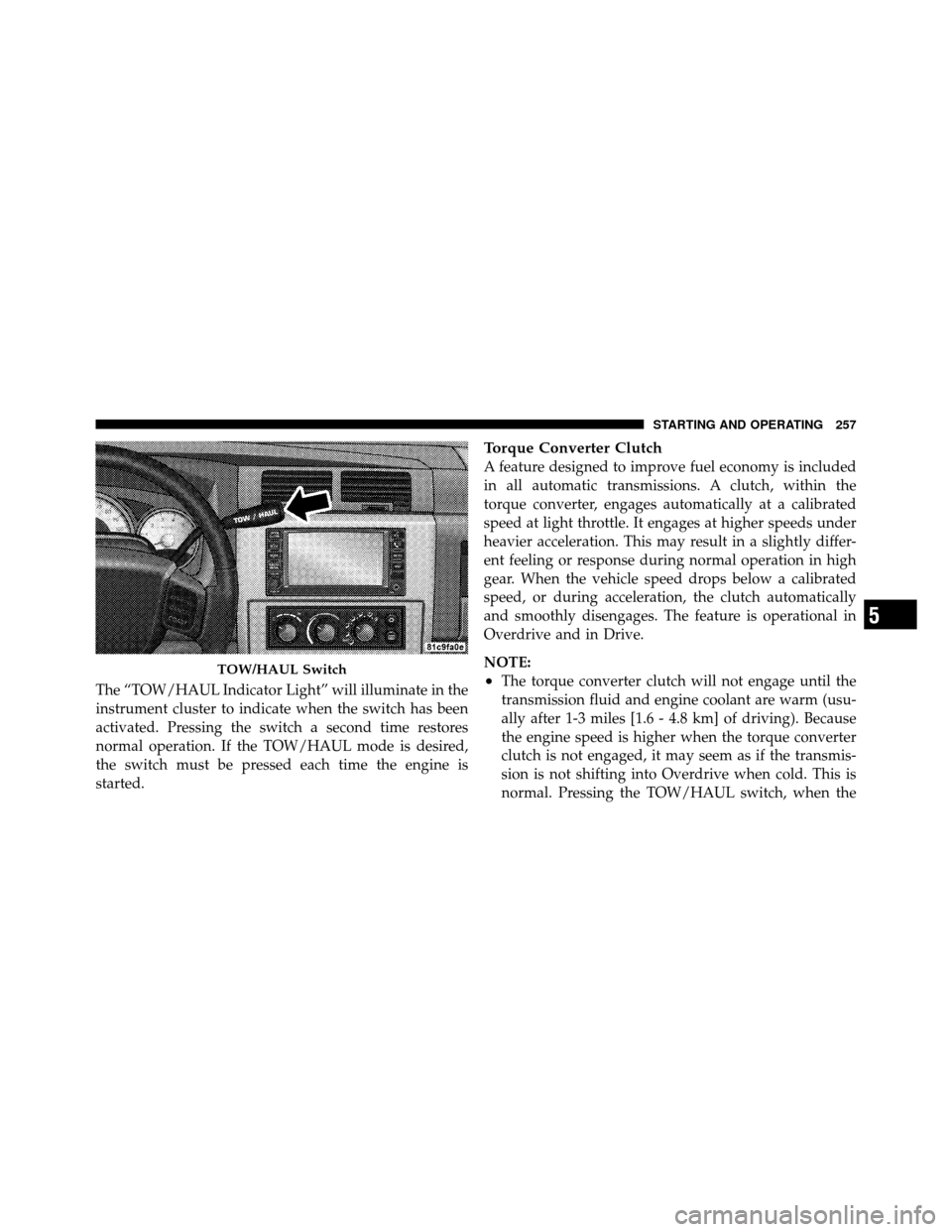
The “TOW/HAUL Indicator Light” will illuminate in the
instrument cluster to indicate when the switch has been
activated. Pressing the switch a second time restores
normal operation. If the TOW/HAUL mode is desired,
the switch must be pressed each time the engine is
started.
Torque Converter Clutch
A feature designed to improve fuel economy is included
in all automatic transmissions. A clutch, within the
torque converter, engages automatically at a calibrated
speed at light throttle. It engages at higher speeds under
heavier acceleration. This may result in a slightly differ-
ent feeling or response during normal operation in high
gear. When the vehicle speed drops below a calibrated
speed, or during acceleration, the clutch automatically
and smoothly disengages. The feature is operational in
Overdrive and in Drive.
NOTE:
•The torque converter clutch will not engage until the
transmission fluid and engine coolant are warm (usu-
ally after 1-3 miles [1.6 - 4.8 km] of driving). Because
the engine speed is higher when the torque converter
clutch is not engaged, it may seem as if the transmis-
sion is not shifting into Overdrive when cold. This is
normal. Pressing the TOW/HAUL switch, when theTOW/HAUL Switch
5
STARTING AND OPERATING 257
Page 260 of 452
transmission is sufficiently warm, will demonstrate
that the transmission is able to shift into, and out of
Overdrive.
•If the vehicle has not been driven in several days, the
first few seconds of operation after shifting the trans-
mission into gear may seem sluggish. This is due to the
fluid partially draining from the torque converter into
the transmission. This condition is normal and will not
cause damage to the transmission. The torque con-
verter will refill within five seconds of shifting from
PARK into any other gear position.
FOUR-WHEEL DRIVE OPERATION —
IF EQUIPPED
Transfer Case Operating Information/Precautions
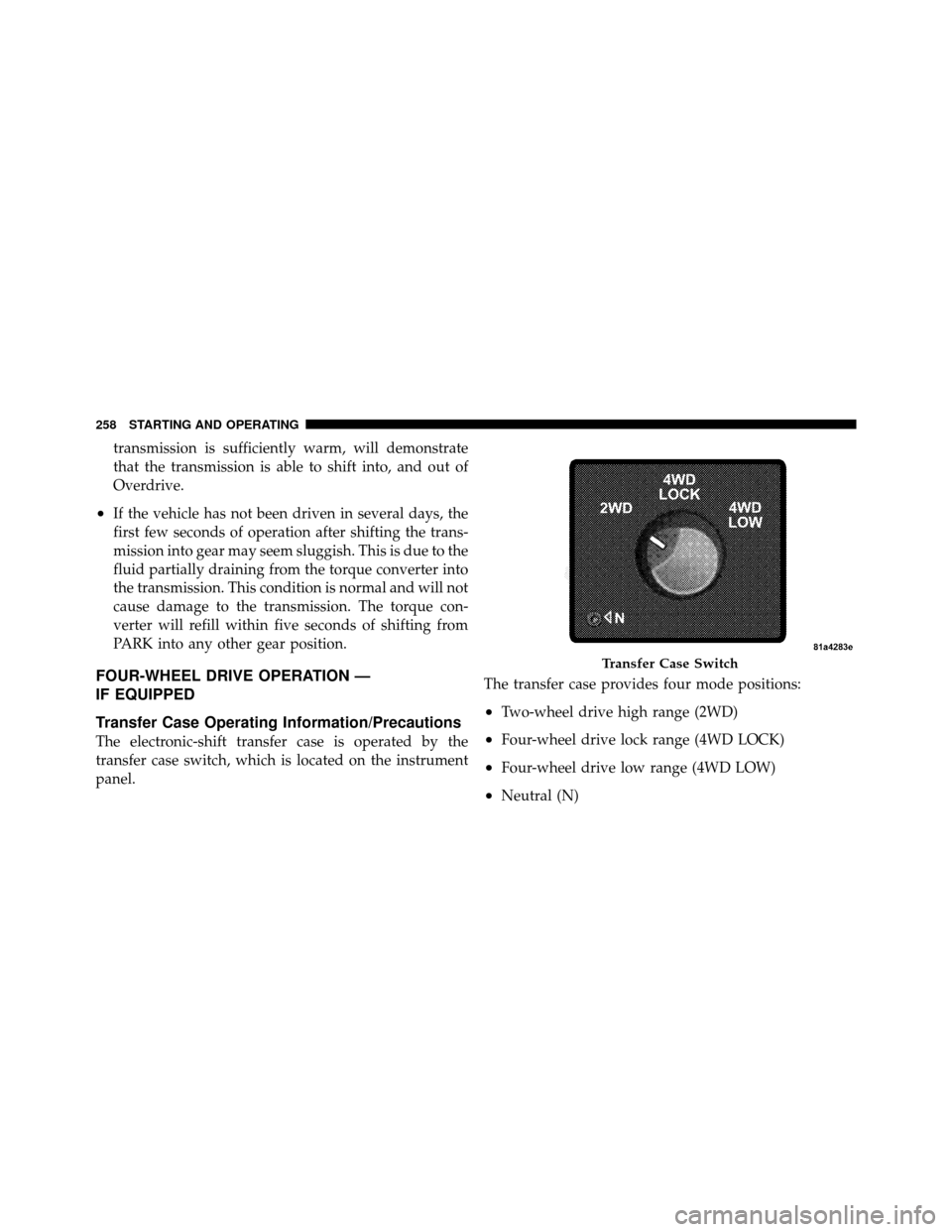
The electronic-shift transfer case is operated by the
transfer case switch, which is located on the instrument
panel.The transfer case provides four mode positions:
•Two-wheel drive high range (2WD)
•Four-wheel drive lock range (4WD LOCK)
•Four-wheel drive low range (4WD LOW)
•Neutral (N)
Transfer Case Switch
258 STARTING AND OPERATING
Page 263 of 452
WARNING!
You or others could be injured if you leave the
vehicle unattended with the transfer case in the
NEUTRAL position without first fully engaging the
parking brake. The transfer case NEUTRAL position
disengages both the front and rear driveshafts from
the powertrain and will allow the vehicle to move
regardless of the transmission position. The parking
brake should always be applied when the driver is
not in the vehicle.
For additional information on the appropriate use of each
transfer case mode position, refer to the following infor-
mation:
2WD
Rear-Wheel Drive High — This range is used for normal
street and highway driving on dry, hard-surfaced roads. 4WD LOCK
Four-Wheel Drive Lock — This range locks the front and
rear driveshafts together forcing the front and rear
wheels to rotate at the same speed. This range provides
additional traction for loose or slippery road surfaces
only.
4WD LOW
Four-Wheel Drive Low — This range provides low speed
four-wheel drive. It locks the front and rear driveshafts
together, forcing the front and rear wheels to rotate at the
same speed. This range provides additional traction and
maximum pulling power for loose or slippery road
surfaces only. Do not exceed 25 mph (40 km/h).
N
Neutral — This range disengages both the front and rear
driveshafts from the powertrain, and is used for flat towing
behind another vehicle. Refer to “Recreational Towing” in
“Starting and Operating” for further information.
5
STARTING AND OPERATING 261
Page 265 of 452
Shifting can be performed with the vehicle rolling 2 to
3 mph (3 to 5 km/h), or completely stopped. USE
EITHER OF THE FOLLOWING PROCEDURES:
Preferred Procedure
1. With the engine running, slow the vehicle to 2 to
3 mph (3 to 5 km/h).
2. Shift the transmission into NEUTRAL.
3. While still rolling, turn the transfer case switch to the
desired position.
4. After the desired position indicator light is ON (not
flashing), shift the transmission back into gear.
Alternate Procedure
1. Bring the vehicle to complete stop.
2. With the key ON and the engine either OFF or
running, shift the transmission into NEUTRAL.3. Turn the transfer case switch to the desired position.
4. After the desired position indicator light is ON (not
flashing), shift the transmission back into gear.
NOTE:
•If Steps 1 or 2 of the Preferred or Alternate Procedure
are not satisfied prior to attempting the shift, or if they
no longer are being met while the shift attempt is in
process, then the indicator light will flash and the
current transfer case position will be maintained. To
retry the selection, turn the transfer case switch back to
the current position, wait five seconds, and retry shift.
•The ignition key must be ON for a shift to take place
and for the position indicator lights to be operable. If
the key is not ON, then the shift will not take place and
no position indicator lights will be on or flashing.
5
STARTING AND OPERATING 263
Page 269 of 452
CAUTION! (Continued)
•Driving through standing water may cause dam-
age to your vehicle’s drivetrain components. Al-
ways inspect your vehicle’s fluids (i.e., engine oil,
transmission, axle, etc.) for signs of contamination
(i.e., fluid that is milky or foamy in appearance)
after driving through standing water. Do not con-
tinue to operate the vehicle if any fluid appears
contaminated, as this may result in further dam-
age. Such damage is not covered by the New
Vehicle Limited Warranty.
•Getting water inside your vehicle’s engine can
cause it to lock up and stall out, and cause serious
internal damage to the engine. Such damage is not
covered by the New Vehicle Limited Warranty.
WARNING!
•Driving through standing water limits your vehi-
cle’s traction capabilities. Do not exceed 5 mph
(8 km/h) when driving through standing water.
•Driving through standing water limits your vehi-
cle’s braking capabilities, which increases stop-
ping distances. Therefore, after driving through
standing water, drive slowly and lightly press on
the brake pedal several times to dry the brakes.
•Getting water inside your vehicle’s engine can
cause it to lock up and stall out, and leave you
stranded.
•Failure to follow these warnings may result in
injuries that are serious or fatal to you, your
passengers, and others around you.
5
STARTING AND OPERATING 267
Page 274 of 452
When parking on a hill, it is important to turn the front
wheels toward the curb on a downhill grade and away
from the curb on an uphill grade. Apply the parking
brake before placing the shift lever in PARK, otherwise
the load on the transmission locking mechanism may
make it difficult to move the shift lever out of PARK.
The parking brake should always be applied whenever
the driver is not in the vehicle.
WARNING!
•Never use the PARK position of the transmission
as a substitute for the parking brake. Always
apply the parking brake fully when parked to
guard against vehicle movement and possible in-
jury or damage.(Continued)
WARNING! (Continued)
•Never leave children alone in a vehicle. Leaving
unattended children in a vehicle is dangerous for a
number of reasons. A child or others could be
seriously or fatally injured.
•Do not leave the key in the ignition. A child could
operate power windows, other controls, or move
the vehicle.
•Be sure the parking brake is fully disengaged
before driving; failure to do so can lead to brake
failure and a collision.
•Always fully apply the parking brake when leav-
ing your vehicle, or it may roll and cause damage
or injury. Also be certain to leave the transmission
in PARK. Failure to do so may allow the vehicle to
roll and cause damage or injury.
272 STARTING AND OPERATING