brakes DODGE DART 2013 PF / 1.G User Guide
[x] Cancel search | Manufacturer: DODGE, Model Year: 2013, Model line: DART, Model: DODGE DART 2013 PF / 1.GPages: 604, PDF Size: 4.72 MB
Page 420 of 604
If both the “Brake System Warning Light” and the “ABS
Warning Light” remain on, the ABS and Electronic Brake
Force Distribution (EBD) systems are not functioning.
Immediate repair to the ABS system is required.
Brake Assist System (BAS)
The BAS is designed to optimize the vehicle’s braking
capability during emergency braking maneuvers. The
system detects an emergency braking situation by sens-
ing the rate and amount of brake application and then
applies optimum pressure to the brakes. This can help
reduce braking distances. The BAS complements the
ABS. Applying the brakes very quickly results in the best
BAS assistance. To receive the benefit of the system, you
must apply continuous braking pressure during the
stopping sequence, (do not “pump” the brakes). Do not
reduce brake pedal pressure unless braking is no longer
desired. Once the brake pedal is released, the BAS is
deactivated.
WARNING!
The BAS cannot prevent the natural laws of physics
from acting on the vehicle, nor can it increase the
traction afforded by prevailing road conditions. BAS
cannot prevent collisions, including those resulting
from excessive speed in turns, driving on very slip-
pery surfaces, or hydroplaning. The capabilities of a
BAS-equipped vehicle must never be exploited in a
reckless or dangerous manner, which could jeopar-
dize the user’s safety or the safety of others.
Traction Control System (TCS)
The system monitors the amount of wheel spin at each
wheel by using individual wheel speed sensors. If wheel
spin is detected, brake pressure is applied to the slipping
wheel(s) and engine power is reduced to provide en-
hanced acceleration and stability. A feature of the TCS
functions similar to a limited slip differential and controls
418 STARTING AND OPERATING
Page 424 of 604
•Vehicle must be on a 2–7% approximate grade (de-
pending on equipped transmission).
•Gear selection matches vehicle direction (i.e., vehicle
facing uphill is in forward gear; vehicle backing uphill
is in REVERSE gear).
HSA will work in all forward gears, reverse and neutral
(if equipped with a manual transmission) when the
activation criteria have been met. The system will not
activate if the vehicle is placed in NEUTRAL or PARK.
WARNING!
There may be situations on minor hills (i.e., less than
7%), with a loaded vehicle, or while pulling a trailer,
when the system will not activate and slight rolling
may occur. This could cause a collision with another
vehicle or object. Always remember the driver is
responsible for braking the vehicle.
Towing With HSA
HSA will provide assistance when starting on a grade
when pulling a trailer.
WARNING!
•If you use a trailer brake controller with your
trailer, your trailer brakes may be activated and
deactivated with the brake switch. If so, when the
brake pedal is released, there may not be enough
brake pressure to hold the vehicle and trailer on a
hill and this could cause a collision with another
vehicle or object behind you. In order to avoid
rolling down the hill while resuming acceleration,
manually activate the trailer brake prior to releas-
ing the brake pedal. Always remember the driver
is responsible for braking the vehicle. (Continued)
422 STARTING AND OPERATING
Page 468 of 604
Curb Weight
The curb weight of a vehicle is defined as the total weight
of the vehicle with all fluids, including vehicle fuel, at full
capacity conditions, and with no occupants or cargo
loaded into the vehicle. The front and rear curb weight
values are determined by weighing your vehicle on a
commercial scale before any occupants or cargo are
added.
Overloading
The load carrying components (springs, tires, wheels,
etc.) of your vehicle will provide satisfactory service as
long as you do not exceed the GVWR.
The best way to figure out the total weight of your
vehicle is to weigh it when it is fully loaded and ready for
operation. Weigh it on a commercial scale to ensure that
it is not over the GVWR.Overloading can cause potential safety hazards and
shorten useful service life. Heavier suspension compo-
nents do not necessarily increase the vehicle’s GVWR.
Loading
To load your vehicle properly, first figure out its empty
weight. Store heavier items down low and be sure you
distribute their weight as evenly as possible. Stow all
loose items securely before driving. Improper weight
distribution can have an adverse effect on the way your
vehicle steers and handles, and the way the brakes
operate.
CAUTION!
Do not load your vehicle any heavier than the
GVWR. If you do, parts on your vehicle can break, or
it can change the way your vehicle handles. This
could cause you to lose control. Also, overloading can
shorten the life of your vehicle.
466 STARTING AND OPERATING
Page 474 of 604
Towing Requirements
To promote proper break-in of your new vehicle drive-
train components, the following guidelines are recom-
mended:
CAUTION!
•Do not tow a trailer at all during the first 500 miles
(805 km) the new vehicle is driven. The engine,
axle or other parts could be damaged.
•Then, during the first 500 miles (805 km) that a
trailer is towed, do not drive over 50 mph
(80 km/h) and do not make starts at full throttle.
This helps the engine and other parts of the
vehicle wear in at the heavier loads.
Perform the maintenance listed in the Maintenance
Schedule. Refer to “Maintenance Schedule” for further
information. When towing a trailer, never exceed the
GAWR or GCWR ratings.
WARNING!
Improper towing can lead to a collision. Follow these
guidelines to make your trailer towing as safe as
possible:
•Make certain that the load is secured in the trailer
and will not shift during travel. When trailering
cargo that is not fully secured, dynamic load shifts
can occur that may be difficult for the driver to
control. You could lose control of your vehicle and
have a collision.
•When hauling cargo or towing a trailer, do not
overload your vehicle or trailer. Overloading can
cause a loss of control, poor performance or dam-
age to the brakes, axle, engine, transmission, steer-
ing, suspension, chassis structure or tires. (Continued)
472 STARTING AND OPERATING
Page 476 of 604
Check for signs of tire wear or visible tire damage
before towing a trailer. Refer to “Tires – General
Information” in “Starting and Operating” for the
proper inspection procedure.
When replacing tires, refer to “Tires – General Infor-
mation” in “Starting and Operating” for proper tire
replacement procedures. Replacing tires with a higher
load carrying capacity will not increase the vehicle’s
GVWR and GAWR limits.
Towing Requirements – Trailer Brakes
Do not interconnect the hydraulic brake system or
vacuum system of your vehicle with that of the trailer.
This could cause inadequate braking and possible
personal injury.
An electronically actuated trailer brake controller is
required when towing a trailer with electronically
actuated brakes. When towing a trailer equipped with
a hydraulic surge actuated brake system, an electronic
brake controller is not required.
Trailer brakes are recommended for trailers over
1,000 lbs (450 kg) and required for trailers in excess of
2,000 lbs (907 kg).
CAUTION!
If the trailer weighs more than 1,000 lbs (450 kg)
loaded, it should have its own brakes and they
should be of adequate capacity. Failure to do this
could lead to accelerated brake lining wear, higher
brake pedal effort, and longer stopping distances.
474 STARTING AND OPERATING
Page 477 of 604
WARNING!
•Do not connect trailer brakes to your vehicle’s
hydraulic brake lines. It can overload your brake
system and cause it to fail. You might not have
brakes when you need them and could have a
collision.
•Towing any trailer will increase your stopping
distance. When towing, you should allow for ad-
ditional space between your vehicle and the ve-
hicle in front of you. Failure to do so could result
in a collision.
Towing Requirements – Trailer Lights And Wiring
Whenever you pull a trailer, regardless of the trailer size,
stop lights and turn signals on the trailer are required for
motoring safety.
The Trailer Tow Package may include a four-pin and
seven-pin wiring harness. Use a factory approved trailer
harness and connector.
NOTE:Do not cut or splice wiring into the vehicle’s
wiring harness.
The electrical connections are all complete to the vehicle,
but you must mate the harness to a trailer connector.
Refer to the following illustrations.
5
STARTING AND OPERATING 475
Page 478 of 604
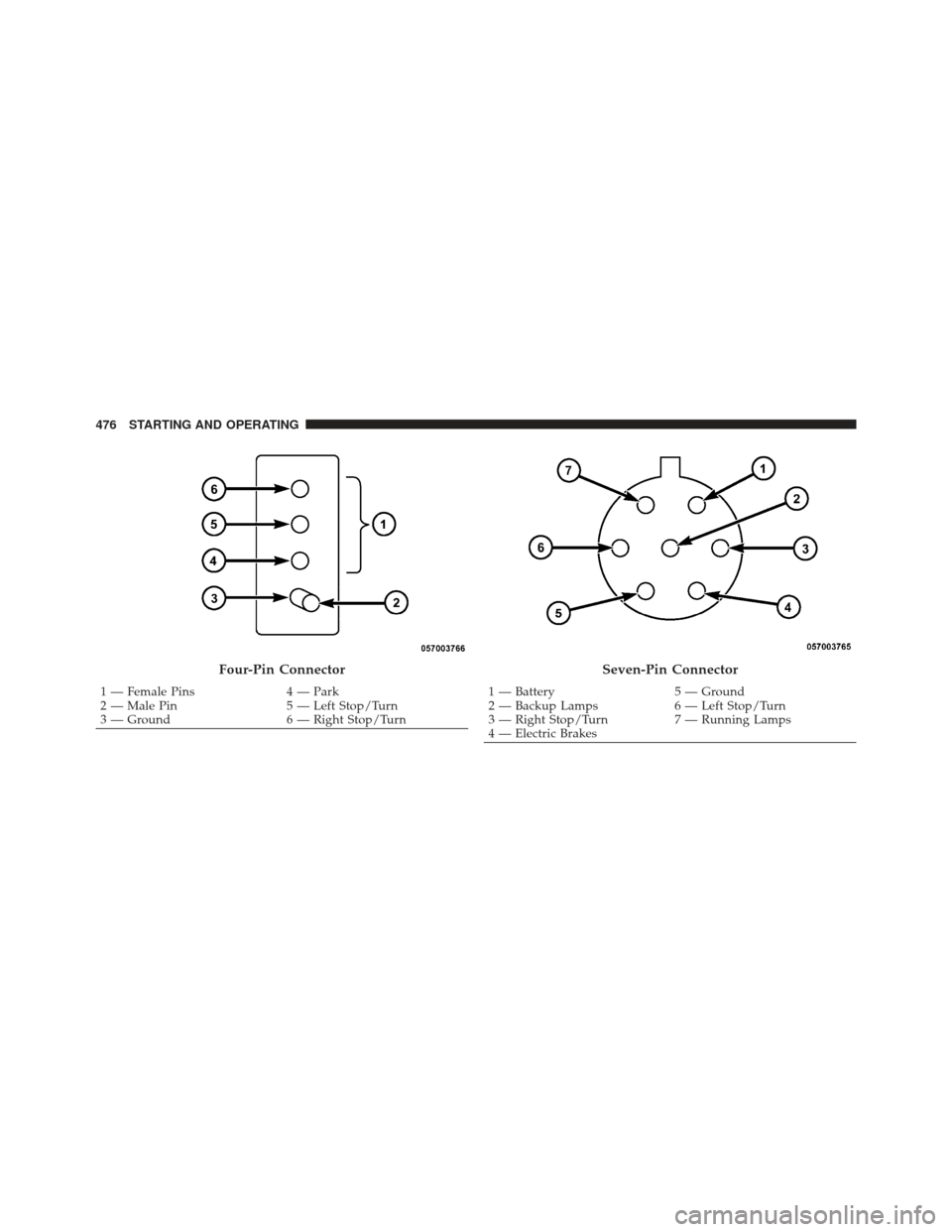
Four-Pin Connector
1 — Female Pins4 — Park
2 — Male Pin 5 — Left Stop/Turn
3 — Ground 6 — Right Stop/Turn
Seven-Pin Connector
1 — Battery5 — Ground
2 — Backup Lamps 6 — Left Stop/Turn
3 — Right Stop/Turn 7 — Running Lamps
4 — Electric Brakes
476 STARTING AND OPERATING
Page 544 of 604
Brake System
In order to assure brake system performance, all brake
system components should be inspected periodically.
Refer to the “Maintenance Schedule” for the proper
maintenance intervals.
WARNING!
Riding the brakes can lead to brake failure and
possibly a collision. Driving with your foot resting or
riding on the brake pedal can result in abnormally
high brake temperatures, excessive lining wear, and
possible brake damage. You would not have your full
braking capacity in an emergency.
Brake Master Cylinder
The fluid level in the master cylinder should be checked
when performing under hood services, or immediately if
the brake system warning light is on.Be sure to clean the top of the master cylinder area before
removing the cap. If necessary, add fluid to bring the
fluid level up to the requirements described on the brake
fluid reservoir. Fluid level can be expected to fall as the
brake pads wear. The brake fluid level should be checked
when the pads are replaced. However, low fluid level
may be caused by a leak and a checkup may be needed.
NOTE:
If your vehicle is equipped with a manual
transmission , the brake fluid reservoir supplies fluid to
both the brake system and the clutch release system. The
two systems are separated in the reservoir, and a leak in
one system will not affect the other system. The manual
transmission clutch release system should not require
fluid replacement during the life of the vehicle. If the
brake fluid reservoir is low and the brake system does
not indicate any leaks or other problems, it may be a
result of a leak in the hydraulic clutch release system. See
your local authorized dealer for service.
542 MAINTAINING YOUR VEHICLE
Page 585 of 604
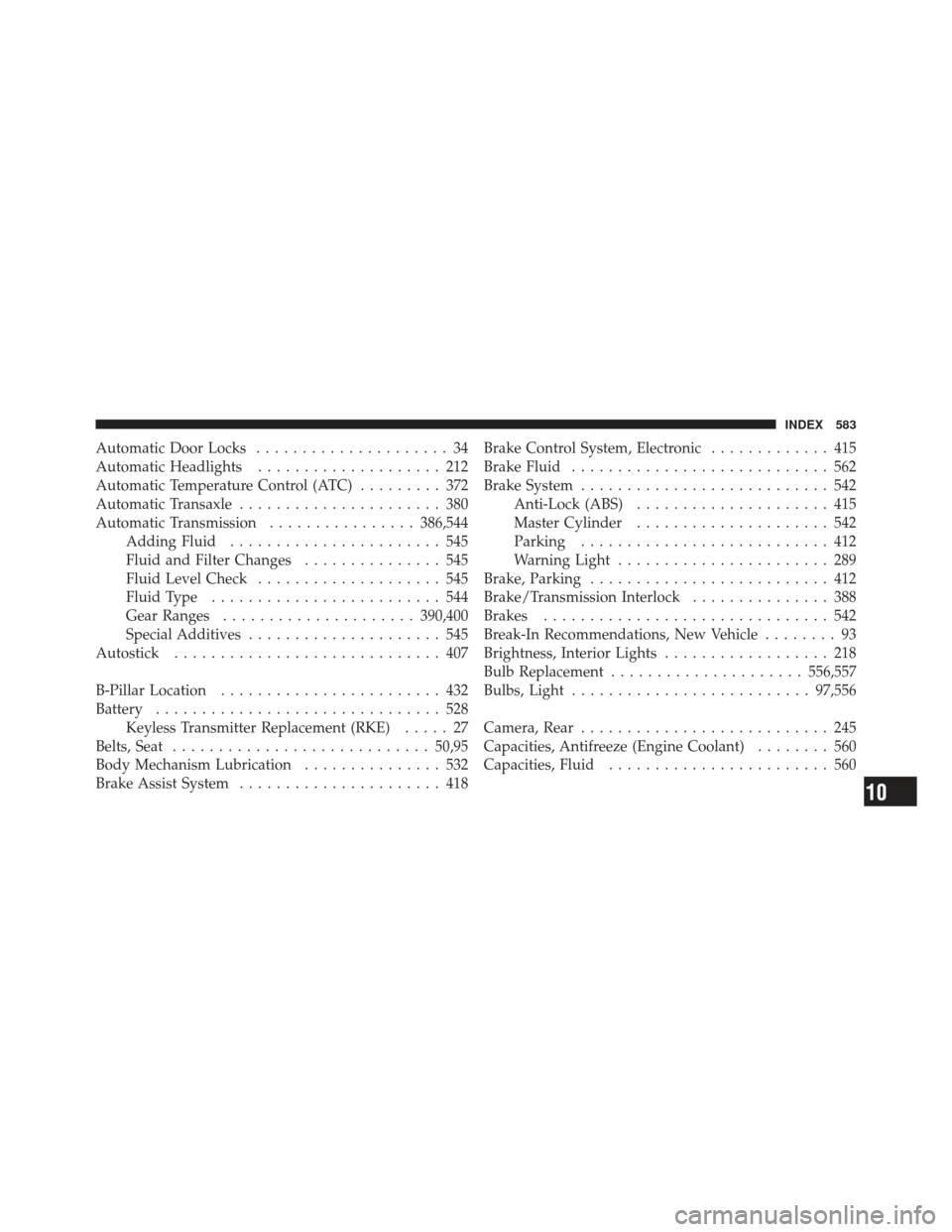
Automatic Door Locks..................... 34
Automatic Headlights .................... 212
Automatic Temperature Control (ATC) ......... 372
Automatic Transaxle ...................... 380
Automatic Transmission ................386,544
Adding Fluid ....................... 545
Fluid and Filter Changes ............... 545
Fluid Level Check .................... 545
Fluid Type ......................... 544
Gear Ranges ..................... 390,400
Special Additives ..................... 545
Autostick ............................. 407
B-Pillar Location ........................ 432
Battery ............................... 528
Keyless Transmitter Replacement (RKE) ..... 27
Belts, Seat ............................ 50,95
Body Mechanism Lubrication ............... 532
Brake Assist System ...................... 418 Brake Control System, Electronic
............. 415
Brake Fluid ............................ 562
Brake System ........................... 542
Anti-Lock (ABS) ..................... 415
Master Cylinder ..................... 542
Parking ........................... 412
Warning Light ....................... 289
Brake, Parking .......................... 412
Brake/Transmission Interlock ............... 388
Brakes ............................... 542
Break-In Recommendations, New Vehicle ........ 93
Brightness, Interior Lights .................. 218
Bulb Replacement ..................... 556,557
Bulbs, Light .......................... 97,556
Camera, Rear ........................... 245
Capacities, Antifreeze (Engine Coolant) ........ 560
Capacities, Fluid ........................ 560
10
INDEX 583
Page 594 of 604
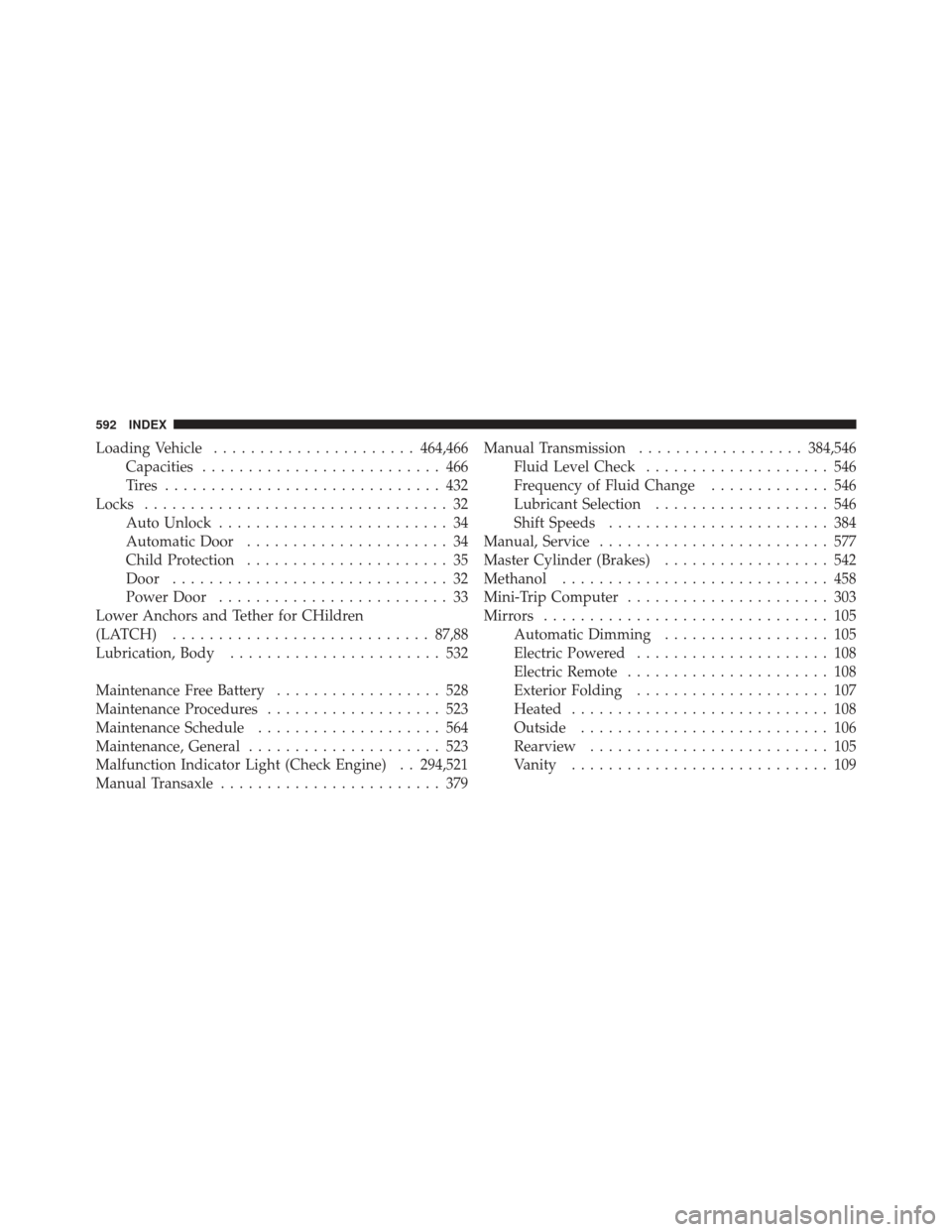
Loading Vehicle...................... 464,466
Capacities .......................... 466
Tires .............................. 432
Locks ................................. 32
Auto Unlock ......................... 34
Automatic Door ...................... 34
Child Protection ...................... 35
Door .............................. 32
Power Door ......................... 33
Lower Anchors and Tether for CHildren
(LATCH) ............................ 87,88
Lubrication, Body ....................... 532
Maintenance Free Battery .................. 528
Maintenance Procedures ................... 523
Maintenance Schedule .................... 564
Maintenance, General ..................... 523
Malfunction Indicator Light (Check Engine) . . 294,521
Manual Transaxle ........................ 379 Manual Transmission
.................. 384,546
Fluid Level Check .................... 546
Frequency of Fluid Change ............. 546
Lubricant Selection ................... 546
Shift Speeds ........................ 384
Manual, Service ......................... 577
Master Cylinder (Brakes) .................. 542
Methanol ............................. 458
Mini-Trip Computer ...................... 303
Mirrors ............................... 105
Automatic Dimming .................. 105
Electric Powered ..................... 108
Electric Remote ...................... 108
Exterior Folding ..................... 107
Heated ............................ 108
Outside ........................... 106
Rearview .......................... 105
Vanity ............................ 109
592 INDEX