tire DODGE DART 2015 PF / 1.G Owners Manual
[x] Cancel search | Manufacturer: DODGE, Model Year: 2015, Model line: DART, Model: DODGE DART 2015 PF / 1.GPages: 664, PDF Size: 16.96 MB
Page 553 of 664
5. Lower the jack until it is free. Remove the wheel
blocks. Reassemble the lug wrench to the jack assem-
bly and stow it in the spare tire area. Secure the
assembly using the means provided. Release the park-
ing brake before driving the vehicle.
6. After 25 miles (40 km) check the wheel bolt torque
with a torque wrench to ensure that all wheel bolts are
properly seated against the wheel.
JUMP-STARTING PROCEDURES
If your vehicle has a discharged battery it can be jump-
started using a set of jumper cables and a battery in
another vehicle or by using a portable battery booster
pack. Jump-starting can be dangerous if done improperly
so please follow the procedures in this section carefully.
NOTE:When using a portable battery booster pack
follow the manufacturer ’s operating instructions and
precautions.
CAUTION!
Do not use a portable battery booster pack or any
other booster source with a system voltage greater
than 12 Volts or damage to the battery, starter motor,
alternator or electrical system may occur.
WARNING!
Do not attempt jump-starting if the battery is frozen.
It could rupture or explode and cause personal injury.
Preparations For Jump-Start
The battery in your vehicle is located in the front of the
engine compartment, behind the left headlight assembly.
NOTE:The positive battery post is covered with a
protective cap. Lift up on the cap to gain access to the
positive battery post.
6
WHAT TO DO IN EMERGENCIES 551
Page 558 of 664
NOTE:Press the#ESC Off#switch, to place the Electronic
Stability Control (ESC) system in “partial off” mode,
before rocking the vehicle. Refer to “Electronic Brake
Control” in “Starting And Operating” for further infor-
mation. Once the vehicle has been freed, press the#ESC
Off#switch again to restore#ESC On#mode.
CAUTION!
•When “rocking” a stuck vehicle by shifting be-
tween DRIVE/2nd gear and REVERSE, do not spin
the wheels faster than 15 mph (24 km/h), or drive-
train damage may result.
•Revving the engine or spinning the wheels too fast
may lead to transmission overheating and failure.
It can also damage the tires. Do not spin the wheels
above 30 mph (48 km/h) while in gear (no trans-
mission shifting occurring).
WARNING!
Fast spinning tires can be dangerous. Forces gener-
ated by excessive wheel speeds may cause damage, or
even failure, of the axle and tires. A tire could
explode and injure someone. Do not spin your vehi-
cle’s wheels faster than 30 mph (48 km/h) or for
longer than 30 seconds continuously without stop-
ping when you are stuck and do not let anyone near
a spinning wheel, no matter what the speed.
SHIFT LEVER OVERRIDE
If a malfunction occurs and the shift lever cannot be
moved out of the PARK position, you can use the
following procedure to temporarily move the shift lever:
1. Turn the engine OFF.
2. Firmly apply the parking brake.
556 WHAT TO DO IN EMERGENCIES
Page 578 of 664
Tires
Checking For Tire Wear
Once a month, check the tire inflation pressures and look
for unusual wear or damage. Rotate at the first sign of
irregular wear, even if it occurs before the oil indicator
system turns on.
Maintenance-Free Battery
Your vehicle is equipped with a maintenance-free battery.
You will never have to add water, nor is periodic main-
tenance required.
WARNING!
•Battery fluid is a corrosive acid solution and can
burn or even blind you. Do not allow battery fluid
to contact your eyes, skin, or clothing. Do not lean
over a battery when attaching clamps. If acid
splashes in eyes or on skin, flush the area imme-
diately with large amounts of water. Refer to
“Jump-Starting Procedures” in “What To Do In
Emergencies” for further information.
•Battery gas is flammable and explosive. Keep
flame or sparks away from the battery. Do not use
a booster battery or any other booster source with
an output greater than 12 Volts. Do not allow cable
clamps to touch each other.
•Battery posts, terminals, and related accessories
contain lead and lead compounds. Wash hands
after handling.
(Continued)
576 MAINTAINING YOUR VEHICLE
Page 612 of 664
Exterior Bulbs
Bulb Number
Low Beam/High Beam (Bi-Halogen Headlamp)HIR2
Low Beam/High Beam (Bi-Xenon Headlamp)D3S **
Front Park/Turn Signal Lamp7442NALL
Sidemarker Lamp194
Front Fog LampH11
Center High-Mounted Stop Lamp (CHMSL)LED (Serviced at Authorized Dealer) *
Rear Tail/Stop/Turn Signal LampLED (Serviced at Authorized Dealer) *
Backup Lamp7440
License Lamp168
* Lamp is not serviceable. It is a LED lamp. To replace the
LED, the entire assembly must be replaced.
** The headlamps are a type of high-voltage discharge
tube. High voltage can remain in the circuit even with the
headlamp switch off and the key removed. Because of
this, you should not attempt to service a headlamp bulb
yourself. If a headlamp bulb fails, take your vehicle to an
authorized dealer for service.
610 MAINTAINING YOUR VEHICLE
Page 625 of 664
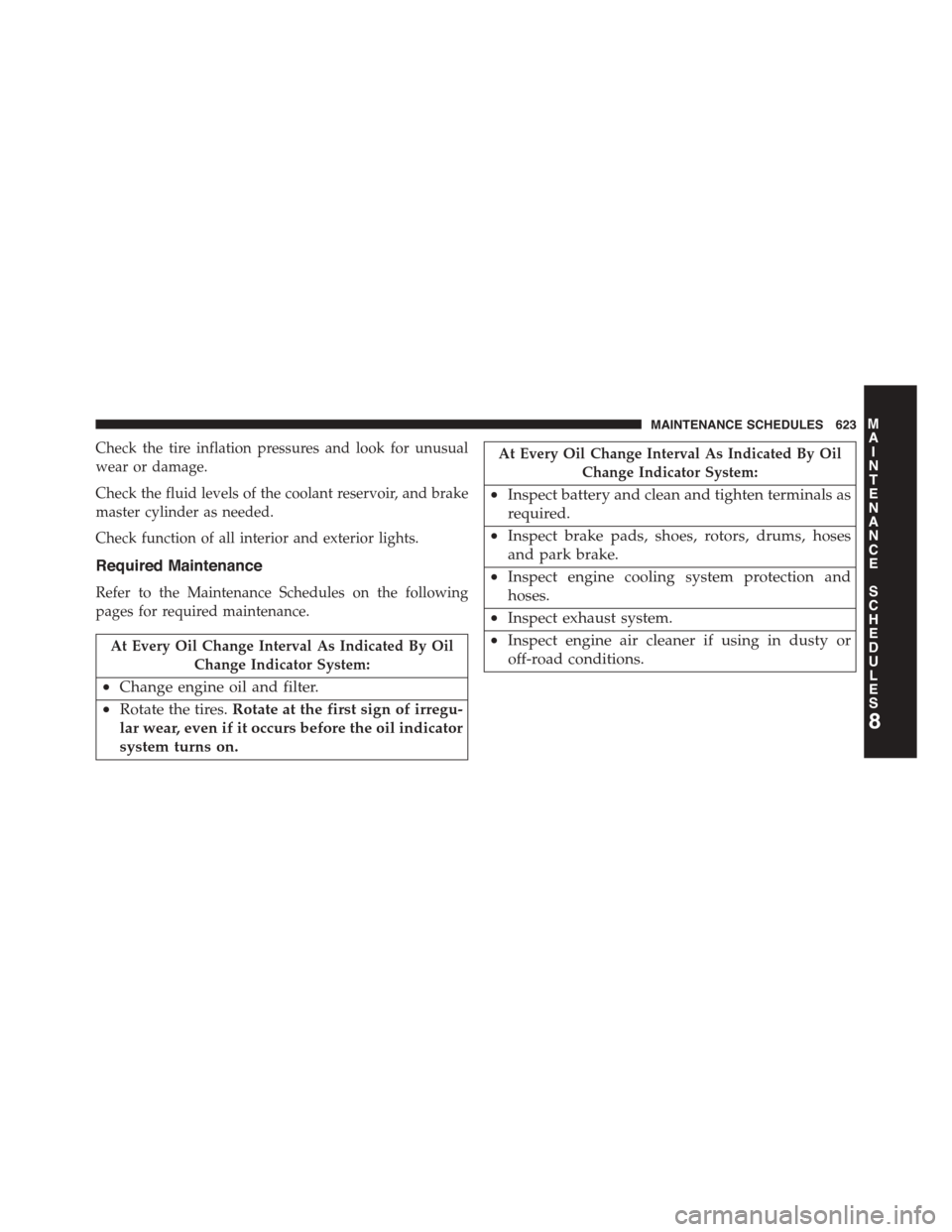
Check the tire inflation pressures and look for unusual
wear or damage.
Check the fluid levels of the coolant reservoir, and brake
master cylinder as needed.
Check function of all interior and exterior lights.
Required Maintenance
Refer to the Maintenance Schedules on the following
pages for required maintenance.
At Every Oil Change Interval As Indicated By Oil
Change Indicator System:
•Change engine oil and filter.
•Rotate the tires.Rotate at the first sign of irregu-
lar wear, even if it occurs before the oil indicator
system turns on.
At Every Oil Change Interval As Indicated By Oil
Change Indicator System:
•Inspect battery and clean and tighten terminals as
required.
•Inspect brake pads, shoes, rotors, drums, hoses
and park brake.
•Inspect engine cooling system protection and
hoses.
•Inspect exhaust system.
•Inspect engine air cleaner if using in dusty or
off-road conditions.
8
MAINTENANCE
SCHEDULES
MAINTENANCE SCHEDULES 623
Page 632 of 664

!DEPARTMENT OF TRANSPORTATION UNIFORM
TIRE QUALITY GRADES.................637
▫Treadwear...........................637
▫Traction Grades.......................637
▫Temperature Grades....................638
630 IF YOU NEED CONSUMER ASSISTANCE
Page 639 of 664

Call toll free at:
•1–800–890–4038 (U.S.)
•1–800–387–1143 (Canada)
Or
Visit us on the Worldwide Web at:
•www.techauthority.com
DEPARTMENT OF TRANSPORTATION UNIFORM
TIRE QUALITY GRADES
The following tire grading categories were established by
the National Highway Traffic Safety Administration. The
specific grade rating assigned by the tire’s manufacturer
in each category is shown on the sidewall of the tires on
your vehicle.
All passenger car tires must conform to Federal safety
requirements in addition to these grades.
Treadwear
The Treadwear grade is a comparative rating, based on
the wear rate of the tire when tested under controlled
conditions on a specified government test course. For
example, a tire graded 150 would wear one and one-half
times as well on the government course as a tire graded
100. The relative performance of tires depends upon the
actual conditions of their use, however, and may depart
significantly from the norm due to variations in driving
habits, service practices, and differences in road charac-
teristics and climate.
Traction Grades
The Traction grades, from highest to lowest, are AA, A, B,
and C. These grades represent the tire’s ability to stop on
wet pavement, as measured under controlled conditions
on specified government test surfaces of asphalt and
concrete. A tire marked C may have poor traction perfor-
mance.
9
IF YOU NEED CONSUMER ASSISTANCE 637
Page 640 of 664

WARNING!
The traction grade assigned to this tire is based on
straight-ahead braking traction tests, and does not
include acceleration, cornering, hydroplaning, or
peak traction characteristics.
Temperature Grades
The temperature grades are A (the highest), B, and C,
representing the tire’s resistance to the generation of heat
and its ability to dissipate heat, when tested under
controlled conditions on a specified indoor laboratory
test wheel. Sustained high temperature can cause the
material of the tire to degenerate and reduce tire life, and
excessive temperature can lead to sudden tire failure. The
grade C corresponds to a level of performance, which all
passenger car tires must meet under the Federal Motor
Vehicle Safety Standard No. 109. Grades B and A repre-
sent higher levels of performance on the laboratory test
wheel, than the minimum required by law.
WARNING!
The temperature grade for this tire is established for
a tire that is properly inflated and not overloaded.
Excessive speed, under-inflation, or excessive load-
ing, either separately or in combination, can cause
heat buildup and possible tire failure.
638 IF YOU NEED CONSUMER ASSISTANCE
Page 642 of 664
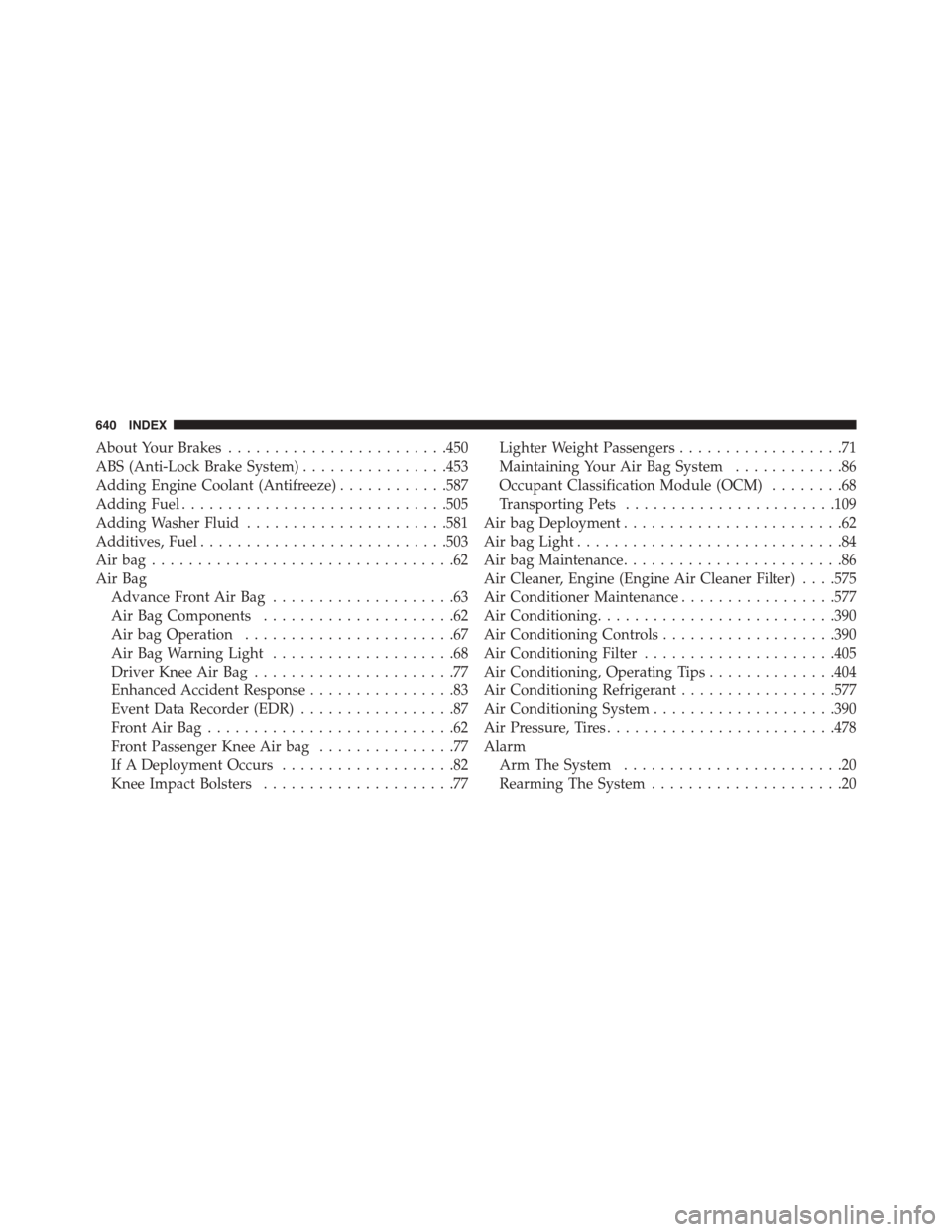
About Your Brakes........................450
ABS (Anti-Lock Brake System)................453
Adding Engine Coolant (Antifreeze)............587
Adding Fuel.............................505
Adding Washer Fluid......................581
Additives, Fuel...........................503
Air bag . . . . . . . . . . . . . . . . . . . . . . . . . . . . . . . . .62
Air Bag
Advance Front Air Bag....................63
Air Bag Components.....................62
Air bag Operation.......................67
Air Bag Warning Light....................68
Driver Knee Air Bag......................77
Enhanced Accident Response................83
Event Data Recorder (EDR).................87
Front Air Bag . . . . . . . . . . . . . . . . . . . . . . . . . . .62
Front Passenger Knee Air bag...............77
If A Deployment Occurs...................82
Knee Impact Bolsters.....................77
Lighter Weight Passengers..................71
Maintaining Your Air Bag System............86
Occupant Classification Module (OCM)........68
Transporting Pets.......................109
Air bag Deployment........................62
Air bag Light.............................84
Air bag Maintenance........................86
Air Cleaner, Engine (Engine Air Cleaner Filter) . . . .575
Air Conditioner Maintenance.................577
Air Conditioning..........................390
Air Conditioning Controls...................390
Air Conditioning Filter.....................405
Air Conditioning, Operating Tips..............404
Air Conditioning Refrigerant.................577
Air Conditioning System....................390
Air Pressure, Tires.........................478
Alarm
Arm The System........................20
Rearming The System.....................20
640 INDEX
Page 644 of 664
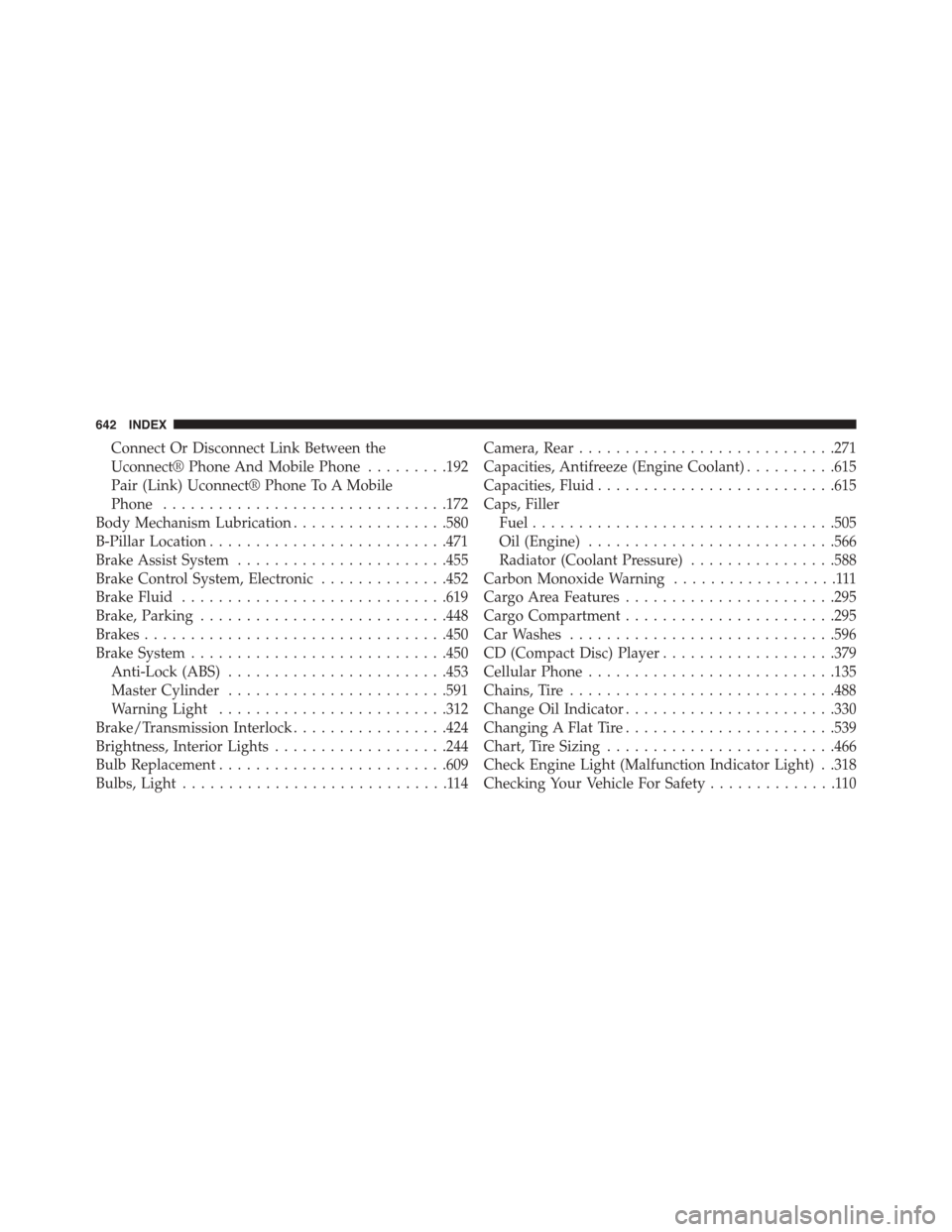
Connect Or Disconnect Link Between the
Uconnect® Phone And Mobile Phone.........192
Pair (Link) Uconnect® Phone To A Mobile
Phone...............................172
Body Mechanism Lubrication.................580
B-Pillar Location..........................471
Brake Assist System.......................455
Brake Control System, Electronic..............452
Brake Fluid.............................619
Brake, Parking...........................448
Brakes.................................450
Brake System............................450
Anti-Lock (ABS)........................453
Master Cylinder........................591
Warning Light.........................312
Brake/Transmission Interlock.................424
Brightness, Interior Lights...................244
Bulb Replacement.........................609
Bulbs, Light.............................114
Camera, Rear............................271
Capacities, Antifreeze (Engine Coolant)..........615
Capacities, Fluid..........................615
Caps, Filler
Fuel.................................505
Oil (Engine)...........................566
Radiator (Coolant Pressure)................588
Carbon Monoxide Warning..................111
Cargo Area Features.......................295
Cargo Compartment.......................295
Car Washes.............................596
CD (Compact Disc) Player...................379
Cellular Phone...........................135
Chains, Tire.............................488
Change Oil Indicator.......................330
Changing A Flat Tire.......................539
Chart, Tire Sizing.........................466
Check Engine Light (Malfunction Indicator Light) . .318
Checking Your Vehicle For Safety..............110
642 INDEX