check oil DODGE DURANGO 2004 2.G User Guide
[x] Cancel search | Manufacturer: DODGE, Model Year: 2004, Model line: DURANGO, Model: DODGE DURANGO 2004 2.GPages: 386, PDF Size: 6.22 MB
Page 306 of 386
freezing the fluid on the cold windshield. MopartAll
Weather Windshield Washer Solution used with water as
directed on the container, aids cleaning action, reduces
freezing point to avoid line clogging, and is not harmful
to paint or trim.
Exhaust System
The best protection against carbon monoxide entry into
the vehicle body is a properly maintained engine exhaust
system.
Whenever a change is noticed in the sound of the exhaust
system, when exhaust fumes can be detected inside the
vehicle, or when the underside or rear of the vehicle is
damaged, have a competent mechanic inspect the com-
plete exhaust system and adjacent body areas for broken,
damaged, deteriorated, or mispositioned parts. Open
seams or loose connections could permit exhaust fumes
to seep into the passenger compartment. In addition,inspect the exhaust system each time the vehicle is raised
for lubrication or oil change. Replace as required.
WARNING!
Exhaust gases can injure or kill. They contain carbon
monoxide (CO) which is colorless and odorless.
Breathing it can make you unconscious and can
eventually poison you. To avoid breathing CO, fol-
low the preceding safety tips.
Cooling System
Inspection
Coolant protection checks should be made at every 12
months (before the onset of freezing weather, where
applicable). If coolant is dirty or rusty in appearance, the
system should be drained, flushed and refilled with fresh
coolant. Check face of radiator for any accumulation of
306 MAINTAINING YOUR VEHICLE
Page 312 of 386

swelling suggest deterioration of the rubber. Particular
attention should be given to examining hose surfaces
nearest to high heat sources, such as the exhaust mani-
fold.
Insure nylon tubing in these areas has not melted or
collapsed.
Inspect all hose clamps and couplings to make sure they
are secure and no leaks are present.
NOTE:Fluids such as oil, power steering fluid, and
brake fluid are used during assembly plant operations to
ease the assembly of hoses to couplings. Therefore, oil
wetness at the hose-coupling area is not necessarily an
indication of leakage. Actual dripping of hot fluid when
systems are under pressure (during vehicle operation),
should be noted before hose is replaced based on leakage.
You are urged to use only the manufacturer's specified
hoses and clamps, or their equivalent in material andspecification, in any fuel system servicing. It is manda-
tory to replace all clamps that have been loosened or
removed during service. Care should be taken in install-
ing new clamps to insure they are properly torqued.
Positive Crankcase Ventilation (PCV) Valve
Proper operation of the crankcase ventilation system
requires that the PCV valve be free of sticking or plug-
ging because of deposits. Deposits can accumulate in the
PCV valve and passage with increasing mileage. Have
the PCV valve, hoses, and passages checked for proper
operation at the intervals specified. If the valve is
plugged or sticking, replace with a new valve ±Do not
attempt to clean the oil PCV valve!Check ventilating
hose for indication of damage or plugging with deposits.
Replace if necessary.
312 MAINTAINING YOUR VEHICLE
Page 317 of 386
4. Place the gear selector momentarily in each gear
position ending with the lever in P (Park).
5. Remove the dipstick, wipe it clean and reinsert it until
seated.
6. Remove the dipstick again and note the fluid level on
both sides. The fluid level should be between the ªHOTº
(upper) reference holes on the dipstick at normal operat-
ing temperature. Verify that solid coating of oil is seen on
both sides of the dipstick. If the fluid is low, add as
required into the dipstick tube.Do not overfill.After
adding any quantity of oil through the oil fill tube, wait
a minimum of two (2) minutes for the oil to fully drain
into the transmission before rechecking the fluid level.
NOTE:If it is necessary to check the transmissionbelow
the operating temperature, the fluid level should be
between the two ªCOLDº (lower) holes on the dipstick
with the fluid at approximately 70ÉF ( 21ÉC) (room
temperature). If the fluid level is correctly established atroom temperature, it should be between the ªHOTº
(upper) reference holes when the transmission reaches
180ÉF ( 82ÉC). Remember it is best to check the level at the
normal operating temperature.
CAUTION!
Be aware that if the fluid temperature is below 50ÉF
(10ÉC) it may not register on the dipstick. Do not add
fluid until the temperature is elevated enough to
produce an accurate reading.
7. Check for leaks. Release parking brake.
To prevent dirt and water from entering the transmission
after checking or replenishing fluid, make certain that the
dipstick cap is properly reseated. It is normal for the
MAINTAINING YOUR VEHICLE 317
7
Page 342 of 386
CAUTION!
Failure to perform the required maintenance items
may result in damage to the vehicle.
At Each Stop for Fuel
²Check the engine oil level about 5 minutes after a fully
warmed engine is shut off. Checking the oil level while
the vehicle is on level ground will improve the accu-
racy of the oil level reading. Add oil only when the
level is at or below the ADD or MIN mark.
²Check the windshield washer solvent and add if
required.
Once a Month
²Check tire pressure and look for unusual wear or
damage.
²Inspect the battery and clean and tighten the terminals
as required.
²Check the fluid levels of coolant reservoir, brake
master cylinder, and transmission and add as needed.
²Check all lights and all other electrical items for correct
operation.
At Each Oil Change
²Change the engine oil filter.
²Inspect the exhaust system.
²Inspect the brake hoses.
²Inspect the CV joints (if equipped) and front suspen-
sion components.
²Check the automatic transmission fluid level.
²Check the coolant level, hoses, and clamps.
342 MAINTENANCE SCHEDULES
8
M
A
I
N
T
E
N
A
N
C
E
S
C
H
E
D
U
L
E
S
Page 345 of 386
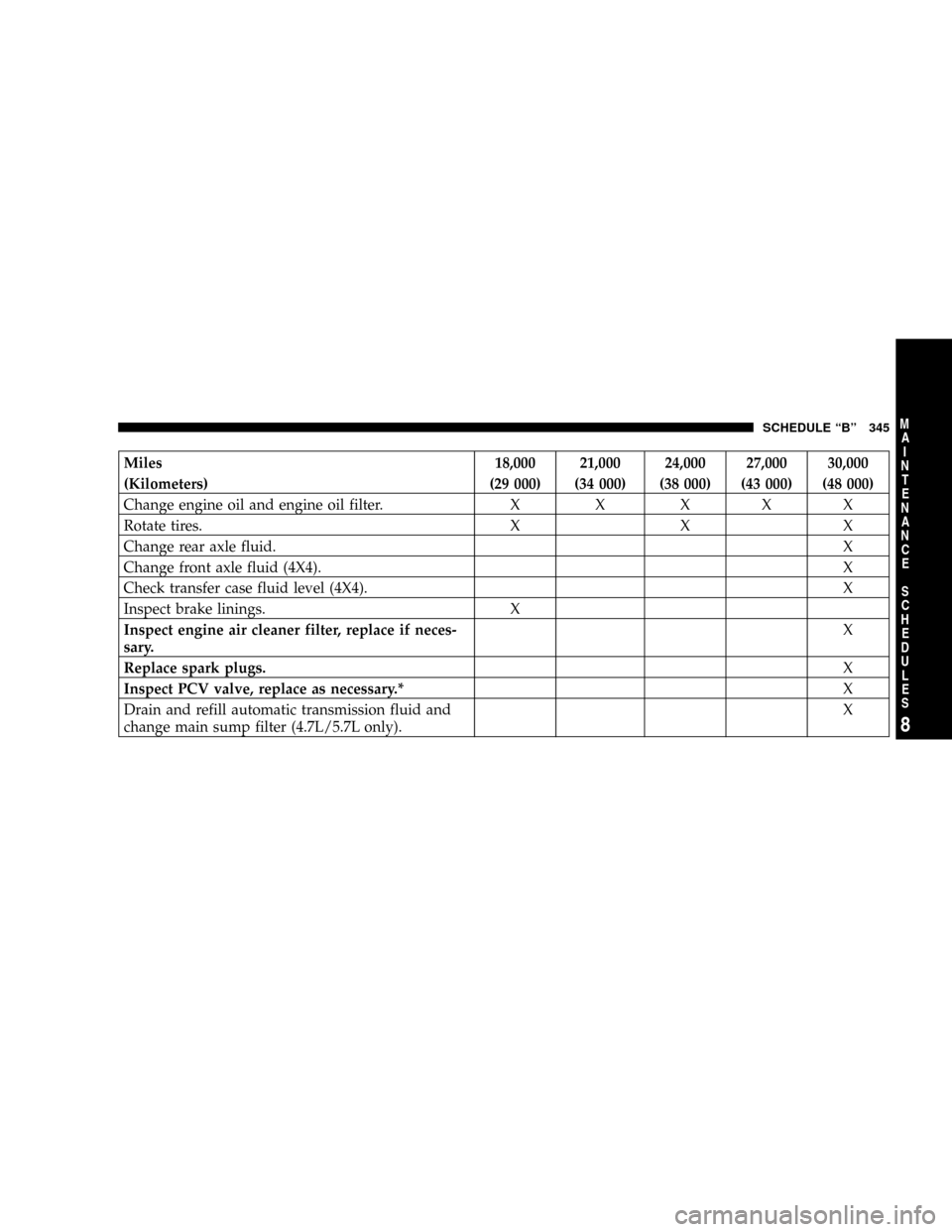
Miles 18,000 21,000 24,000 27,000 30,000
(Kilometers) (29 000) (34 000) (38 000) (43 000) (48 000)
Change engine oil and engine oil filter. X X X X X
Rotate tires. X X X
Change rear axle fluid.X
Change front axle fluid (4X4).X
Check transfer case fluid level (4X4).X
Inspect brake linings. X
Inspect engine air cleaner filter, replace if neces-
sary.X
Replace spark plugs.X
Inspect PCV valve, replace as necessary.*X
Drain and refill automatic transmission fluid and
change main sump filter (4.7L/5.7L only).X
SCHEDULE ªBº 345
8
M
A
I
N
T
E
N
A
N
C
E
S
C
H
E
D
U
L
E
S
Page 349 of 386
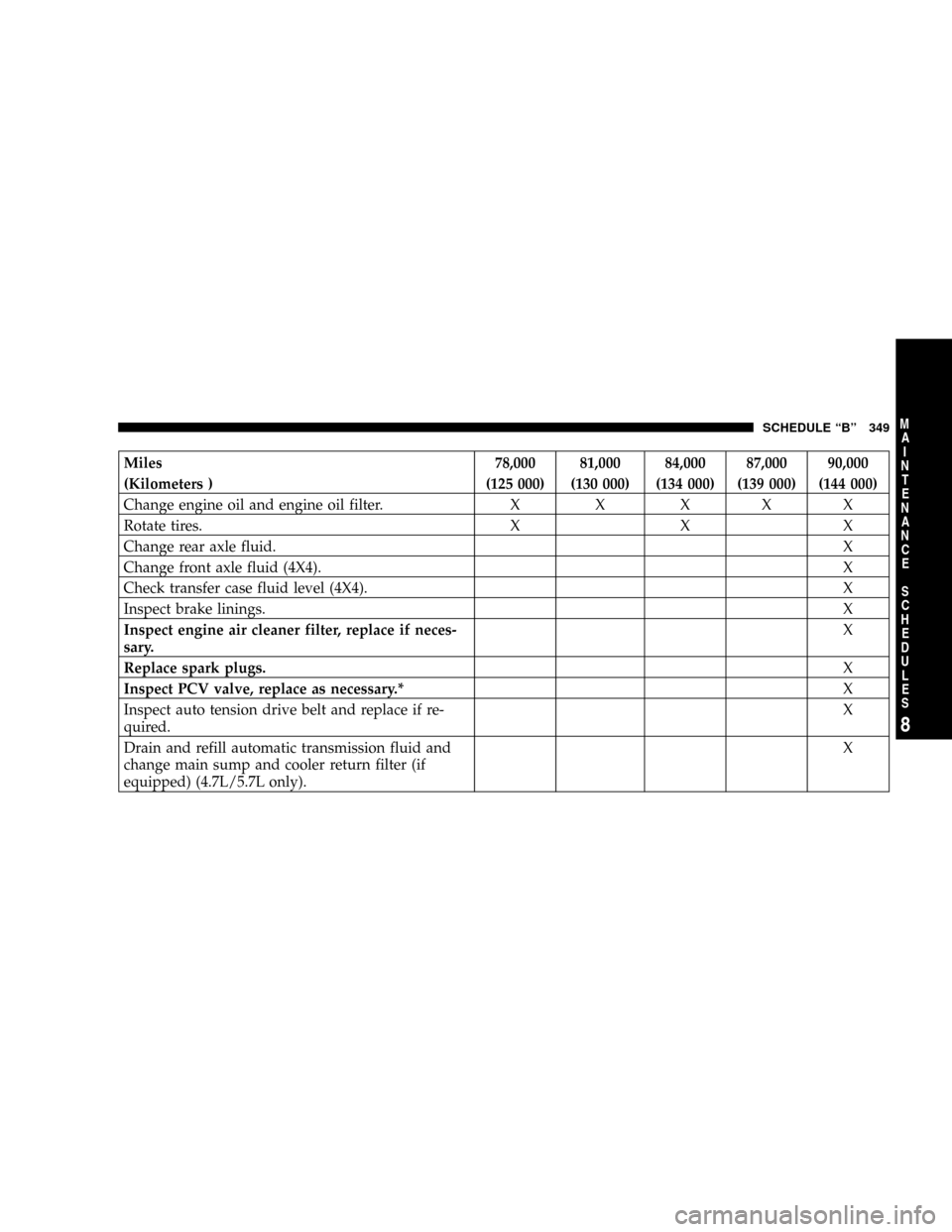
Miles 78,000 81,000 84,000 87,000 90,000
(Kilometers ) (125 000) (130 000) (134 000) (139 000) (144 000)
Change engine oil and engine oil filter. X X X X X
Rotate tires. X X X
Change rear axle fluid.X
Change front axle fluid (4X4).X
Check transfer case fluid level (4X4).X
Inspect brake linings.X
Inspect engine air cleaner filter, replace if neces-
sary.X
Replace spark plugs.X
Inspect PCV valve, replace as necessary.*X
Inspect auto tension drive belt and replace if re-
quired.X
Drain and refill automatic transmission fluid and
change main sump and cooler return filter (if
equipped) (4.7L/5.7L only).X
SCHEDULE ªBº 349
8
M
A
I
N
T
E
N
A
N
C
E
S
C
H
E
D
U
L
E
S
Page 353 of 386
![DODGE DURANGO 2004 2.G User Guide Schedule ªAº
Miles 6,000 12,000 18,000 24,000 30,000
(Kilometers) (10 000) (19 000) (29 000) (38 000) (48 000)
[Months] [6] [12] [18] [24] [30]
Change engine oil and engine oil filter. X X X X X
Rot](/img/12/5603/w960_5603-352.png "DODGE DURANGO 2004 2.G User Guide Schedule ªAº
Miles 6,000 12,000 18,000 24,000 30,000
(Kilometers) (10 000) (19 000) (29 000) (38 000) (48 000)
[Months] [6] [12] [18] [24] [30]
Change engine oil and engine oil filter. X X X X X
Rot")
Schedule ªAº
Miles 6,000 12,000 18,000 24,000 30,000
(Kilometers) (10 000) (19 000) (29 000) (38 000) (48 000)
[Months] [6] [12] [18] [24] [30]
Change engine oil and engine oil filter. X X X X X
Rotate tires. X X X X X
Check transfer case fluid level (4X4).X
Inspect brake linings. X
Replace engine air cleaner filter.X
Replace spark plugs.X
SCHEDULE ªAº 353
8
M
A
I
N
T
E
N
A
N
C
E
S
C
H
E
D
U
L
E
S
Page 354 of 386
![DODGE DURANGO 2004 2.G User Guide Miles 36,000 42,000 48,000 54000 60,000 66,000
(Kilometers) (58 000) (67 000) (77 000) (84 000) (96 000) (106 000)
[Months] [36] [42] [48] [54] [60] [66]
Change engine oil and engine oil filter. X XXX](/img/12/5603/w960_5603-353.png "DODGE DURANGO 2004 2.G User Guide Miles 36,000 42,000 48,000 54000 60,000 66,000
(Kilometers) (58 000) (67 000) (77 000) (84 000) (96 000) (106 000)
[Months] [36] [42] [48] [54] [60] [66]
Change engine oil and engine oil filter. X XXX")
Miles 36,000 42,000 48,000 54000 60,000 66,000
(Kilometers) (58 000) (67 000) (77 000) (84 000) (96 000) (106 000)
[Months] [36] [42] [48] [54] [60] [66]
Change engine oil and engine oil filter. X XXXXX
Rotate tires. X XXXXX
Check transfer case fluid level (4X4). X
Flush and replace engine coolant at 60
months, regardless of mileage.X
Inspect brake linings. X X
Replace engine air cleaner filter.X
Replace spark plugs.X
Inspect PCV valve, replace as necessary. *X
Inspect and replace ignition cables if
necessary (5.7L only).X
Inspect auto tension drive belt and replace if
required.X
354 SCHEDULE ªAº
8
M
A
I
N
T
E
N
A
N
C
E
S
C
H
E
D
U
L
E
S
Page 355 of 386
![DODGE DURANGO 2004 2.G User Guide Miles 72,000 78,000 84,000 90,000 96,000 100,000
(Kilometers) (115 000) (125 000) (134 000) (144 000) (154 000) (160 000)
[Months] [72] [78] [84] [90] [96]
Change engine oil and engine oil filter. X X](/img/12/5603/w960_5603-354.png "DODGE DURANGO 2004 2.G User Guide Miles 72,000 78,000 84,000 90,000 96,000 100,000
(Kilometers) (115 000) (125 000) (134 000) (144 000) (154 000) (160 000)
[Months] [72] [78] [84] [90] [96]
Change engine oil and engine oil filter. X X")
Miles 72,000 78,000 84,000 90,000 96,000 100,000
(Kilometers) (115 000) (125 000) (134 000) (144 000) (154 000) (160 000)
[Months] [72] [78] [84] [90] [96]
Change engine oil and engine oil filter. X X X X X
Rotate tires. X X X X X X
Check transfer case fluid level (4X4). X
Inspect brake linings. X X
Replace engine air cleaner filter.X
Replace spark plugs.X
Inspect PCV valve, replace as necessary.*X
Inspect auto tension drive belt and replace if
required.³X
Drain and refill automatic transmission fluid
and change sump and cooler return filter (if
equipped) (4.7L/5.7L only).X
SCHEDULE ªAº 355
8
M
A
I
N
T
E
N
A
N
C
E
S
C
H
E
D
U
L
E
S
Page 374 of 386

Exhaust Gas Caution..................62,248
Fails to Start.......................... 201
Flooded, Starting...................... 201
Fuel Requirements..................... 335
Jump Starting......................... 280
Oil ...........................292,335,337
Oil Selection.......................... 335
Oil Synthetic......................... 296
Overheating.......................... 310
Starting............................. 200
Temperature Gauge..................... 146
Engine Oil Viscosity Chart................. 295
Entry System, Illuminated.................. 13
Equipment Identification Plate.............. 267
Ethylene Glycol Antifreeze................. 308
Exhaust Gas Caution................62,248,306
Exhaust System.......................62,306
Extender, Seat Belt........................ 37
Exterior Lighting........................ 106Filters
Air Cleaner.......................... 298
Engine Fuel.......................... 299
Engine Oil........................297,337
Engine Oil Disposal.................... 296
Flashers
Hazard Warning....................... 270
Turn Signal.....................108,146,329
Flat Tire Stowage.....................273,279
Flooded Engine Starting................... 201
Floor Console.......................... 137
Fluid, Brake........................... 338
Fluid Capacities......................... 335
Fluid Level Checks
Automatic Transmission................. 316
Brake............................... 313
Cooling System....................... 306
Engine Oil........................... 292
Power Steering........................ 303
374 INDEX