cooling DODGE DURANGO 2004 2.G User Guide
[x] Cancel search | Manufacturer: DODGE, Model Year: 2004, Model line: DURANGO, Model: DODGE DURANGO 2004 2.GPages: 386, PDF Size: 6.22 MB
Page 307 of 386

bugs, leaves, etc. If dirty, clean the radiator core by gently
spraying water from a garden hose at the back of the core.
Check the coolant bottle tubing for condition and tight-
ness of connection at coolant bottle and radiator. Inspect
the entire system for leaks.
With the engine at normal operating temperature (but
not running), check the coolant pressure cap for proper
vacuum sealing by draining a small amount of coolant
from the radiator drain cock. If the cap is sealing prop-
erly, the coolant will begin to drain from the coolant
bottle. Do not remove the pressure cap when the cooling
system is hot.WARNING!
You or others can be badly burned by hot coolant or
steam from your radiator. If you see or hear steam
coming from under the hood don't open the hood
until the radiator has had time to cool. If you open
the hood and see steam or hot coolant escaping from
the radiator, don't touch anything. Get away quickly.
Never try to open a pressure cap when the radiator is
hot.
Cooling System Maintenance
At the intervals shown in the Maintenance Schedules
section of this manual, the system should be drained,
flushed and refilled. See your authorized dealer for
proper cooling system maintenance.
MAINTAINING YOUR VEHICLE 307
7
Page 308 of 386

Cooling System Ð Drain, Flush And Refill
If the solution is dirty and contains a considerable
amount of sediment, it should be cleaned and flushed.
See your authorized dealer for proper draining, flushing
and refilling of your vehicle's cooling system.
Disposal of Used Engine Coolant
Used ethylene glycol based engine coolant is a regulated
substance requiring proper disposal. Check with your
local authorities to determine the disposal rules for your
community. Do not store ethylene glycol based engine
coolant in open containers or allow it to remain in
puddles on the ground. Prevent ingestion by animals and
children. If ingested by a child contact a physician
immediately. Clean up any ground spills immediately.
Recommended Engine Coolant
This vehicle has been factory filled with an Ethylene
Glycol based engine coolant with long life corrosion
inhibitors (called HOAT, for Hybrid Organic Additive
Technology). Follow the ªMaintenance Scheduleº for the
recommended coolant change intervals. Refer to Recom-
mended Fluids, Lubricants and Genuine Parts for correct
fluid type.
308 MAINTAINING YOUR VEHICLE
Page 309 of 386

CAUTION!
Mixing of coolants other than specified (non-
HOAT), may result in engine damage that may not
be covered under the new vehicle warranty, and
decreased corrosion protection. If a non-HOAT cool-
ant is introduced into the cooling system in an
emergency, it should be replaced with the specified
coolant as soon as possible.
Do not use plain water alone or alcohol base anti-
freeze products. Do not use additional rust inhibi-
tors or antirust products, as they may not be compat-
ible with the radiator coolant and may plug the
radiator.
This vehicle has not been designed for use with
Propylene Glycol based coolants. Use of Propylene
Glycol based coolants is not recommended.
Adding Coolant
When adding coolant or refilling system, a 50% solution
of ethylene glycol antifreeze coolant in water should be
used. Higher concentrations (not to exceed 65%) are
required if temperatures below -37ÉF (-38ÉC) are antici-
pated.
Use only high purity water such as distilled or deionized
water when mixing the water/antifreeze solution. The
use of lower quality water will reduce the amount of
corrosion protection in the engine cooling system.
NOTE:It is the owner's responsibility to maintain the
proper level of protection against freezing according to
the temperatures occurring in the area where the vehicle
is operated.
MAINTAINING YOUR VEHICLE 309
7
Page 310 of 386

WARNING!
Never add coolant to the radiator when the engine is
overheated. Do not loosen or remove pressure cap to
cool overheated engine. The coolant is under pres-
sure and severe scalding could result.
Coolant Pressure Cap
The coolant pressure cap must be fully tightened to
prevent loss of coolant, and to insure that coolant will
return to the radiator from the coolant coolant bottle.
The pressure cap should be inspected and cleaned if there
is any accumulation of foreign material on the sealing
surfaces.
WARNING!
The warning words ªDO NOT OPEN HOTº on the
coolant pressure cap are a safety precaution. Heat
causes pressure to build up in the cooling system. To
prevent scalding or injury, do not remove the pres-
sure cap when the system is hot or under pressure.
Coolant Level
The coolant bottle system provides a quick visual method
for determining that the coolant level is adequate. With
the engine idling, and warmed to normal operating
temperature, remove the cap from the bottle, remove the
dipstick and wipe the excess coolant from it. Reinsert the
dipstick and remove. Observe the dipstick checking the
holes along the stem for coolant. Check the coolant level
whenever the hood is raised.
310 MAINTAINING YOUR VEHICLE
Page 311 of 386

The radiator normally remains completely full, so there is
no need to remove the pressure cap except checking
coolant freeze point or replacement with new antifreeze
coolant. Your service attendant should be advised of this.
When additional coolant is needed to maintain the
proper level, it should be added to the coolant bottle. Do
not overfill.
Points To Remember
A. Do not overfill the coolant bottle.
B. Check coolant freeze point in the radiator and in the
coolant bottle. If antifreeze needs to be added, contents of
coolant bottle also must be protected against freezing.
C. If frequent coolant additions are required, or if the
level in the coolant bottle does not drop when the engine
cools, the cooling system should be pressure tested for
leaks.D. Maintain a minimum coolant concentration of 50%
ethylene glycol.
E. Make sure that the radiator and coolant bottle over-
flow hoses are not kinked or obstructed.
F. Keep the front of the radiator clean. If your vehicle is
equipped with air conditioning, keep the front of the
condenser clean also.
G. The thermostat should not be changed for summer or
winter operation. If replacement is ever necessary, install
ONLY the correct type thermostat. Other designs may
result in unsatisfactory cooling performance.
Emission Related Components
Fuel System Hoses And Vapor/Vacuum Harnesses
When the vehicle is serviced for scheduled maintenance,
inspect surface of hoses and nylon tubing for evidence of
heat and mechanical damage. Hard and brittle rubber,
cracking, checking, tears, cuts, abrasions, and excessive
MAINTAINING YOUR VEHICLE 311
7
Page 335 of 386
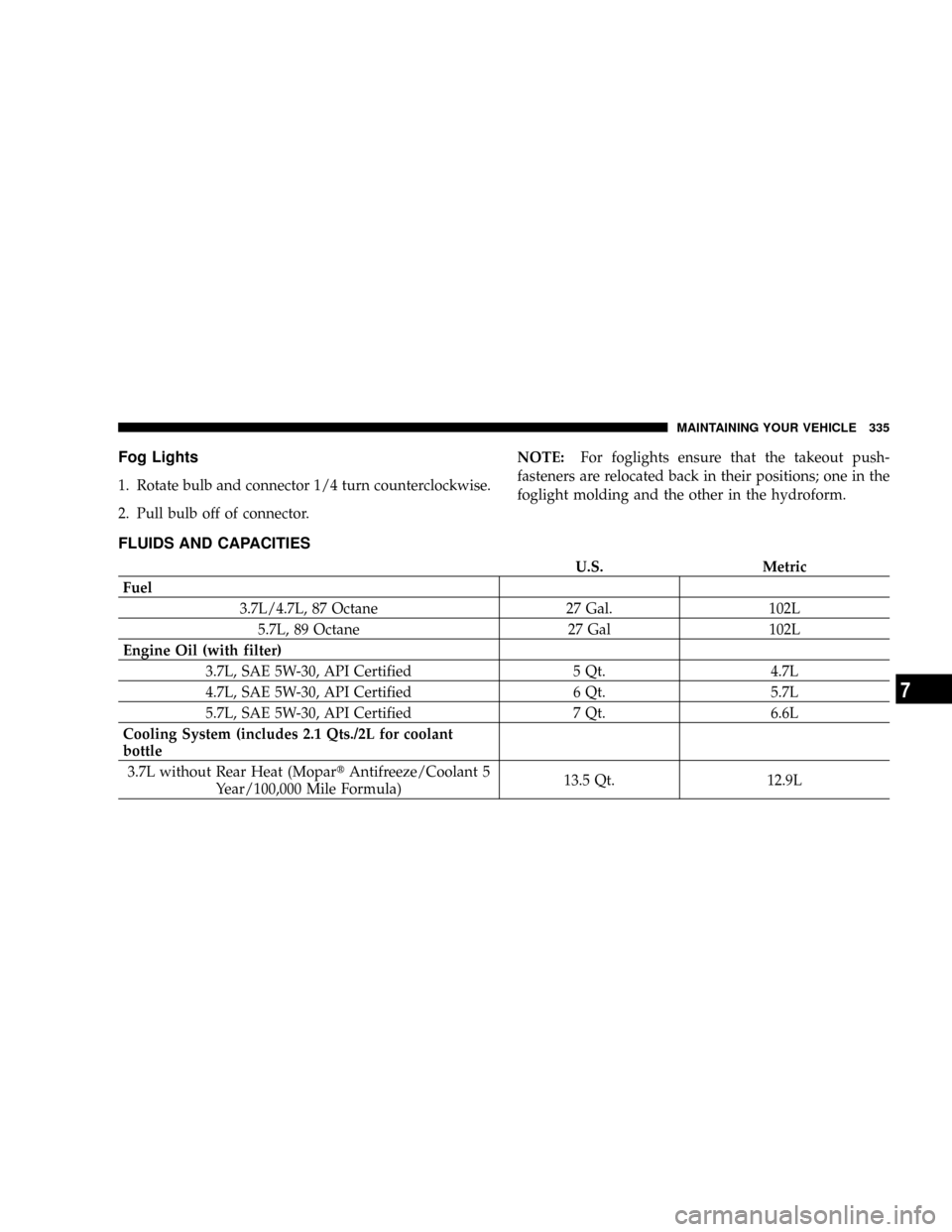
Fog Lights
1. Rotate bulb and connector 1/4 turn counterclockwise.
2. Pull bulb off of connector.NOTE:For foglights ensure that the takeout push-
fasteners are relocated back in their positions; one in the
foglight molding and the other in the hydroform.
FLUIDS AND CAPACITIES
U.S. Metric
Fuel
3.7L/4.7L, 87 Octane 27 Gal. 102L
5.7L, 89 Octane 27 Gal 102L
Engine Oil (with filter)
3.7L, SAE 5W-30, API Certified 5 Qt. 4.7L
4.7L, SAE 5W-30, API Certified 6 Qt. 5.7L
5.7L, SAE 5W-30, API Certified 7 Qt. 6.6L
Cooling System (includes 2.1 Qts./2L for coolant
bottle
3.7L without Rear Heat (MopartAntifreeze/Coolant 5
Year/100,000 Mile Formula)13.5 Qt. 12.9L
MAINTAINING YOUR VEHICLE 335
7
Page 372 of 386

Center High Mounted Stop Light............ 334
Certification Label....................... 250
Changing A Flat Tire..................... 272
Charging.............................. 280
Chart, Tire Sizing........................ 223
Child Restraint......................50,51,61
Child Restraint Tether Anchors.............54,60
Child Restraint with Automatic Belts........... 35
Child Seat.............................. 55
Circuit Breakers......................... 325
Climate Control......................... 179
Clock................................ 154
Compact Disc Maintenance................. 178
Compact Spare Tire...................... 234
Compass.............................. 124
Compass Calibration..................... 124
Compass Variance....................... 125
Computer, Trip/Travel.................... 120
Console, Floor.......................... 137Console, Overhead....................... 119
Contract, Service........................ 362
Converter, Catalytic...................... 249
Coolant............................... 310
Coolant Pressure Cap..................... 310
Cooling System......................... 306
Adding Coolant (Antifreeze).............. 309
Coolant Capacity...................... 335
Coolant Level......................... 310
Disposal of Used Coolant................ 308
Drain, Flush, and Refill.................. 308
Inspection........................... 306
Points to Remember.................... 311
Radiator Cap......................... 310
Selection of Coolant...............308,335,337
Temperature Gauge..................... 146
Cruise Control.......................... 116
Cup Holder............................ 138
Customer Assistance..................... 360
372 INDEX
Page 373 of 386

Daytime Running Lights................... 107
Dealer Service.......................... 291
Defroster, Rear Window................... 195
Defroster, Windshield................63,182,187
Delay Wipers........................... 110
Diagnostic System, Onboard................ 289
Dimmer Switch, Headlight................. 147
Dipsticks
Automatic Transmission................. 316
Oil (Engine).......................... 292
Power Steering........................ 303
Disarming, Theft System................... 25
Disc Brakes............................ 313
Disposal
Used Coolant......................... 308
Door Ajar Light......................... 151
Door Locks............................. 13
Door Opener, Garage..................... 126
Drive Belts............................ 297Drive Shaft Universal Joints................ 304
Electric Remote Mirrors.................... 72
Electrical Power Outlets................... 135
Electronic Speed Control................... 116
Emergency, In Case of
Freeing Vehicle When Stuck............... 221
Jacking............................. 275
Overheating.......................... 310
Towing............................. 282
Emission Control System Maintenance......... 340
Emission Related Components.............. 311
Engine
Air Cleaner.......................... 298
Block Heater......................... 202
Break-In Recommendations................ 62
Compartment......................287,288
Coolant..........................308,337
Cooling............................. 306
INDEX 373
10
Page 374 of 386

Exhaust Gas Caution..................62,248
Fails to Start.......................... 201
Flooded, Starting...................... 201
Fuel Requirements..................... 335
Jump Starting......................... 280
Oil ...........................292,335,337
Oil Selection.......................... 335
Oil Synthetic......................... 296
Overheating.......................... 310
Starting............................. 200
Temperature Gauge..................... 146
Engine Oil Viscosity Chart................. 295
Entry System, Illuminated.................. 13
Equipment Identification Plate.............. 267
Ethylene Glycol Antifreeze................. 308
Exhaust Gas Caution................62,248,306
Exhaust System.......................62,306
Extender, Seat Belt........................ 37
Exterior Lighting........................ 106Filters
Air Cleaner.......................... 298
Engine Fuel.......................... 299
Engine Oil........................297,337
Engine Oil Disposal.................... 296
Flashers
Hazard Warning....................... 270
Turn Signal.....................108,146,329
Flat Tire Stowage.....................273,279
Flooded Engine Starting................... 201
Floor Console.......................... 137
Fluid, Brake........................... 338
Fluid Capacities......................... 335
Fluid Level Checks
Automatic Transmission................. 316
Brake............................... 313
Cooling System....................... 306
Engine Oil........................... 292
Power Steering........................ 303
374 INDEX
Page 384 of 386

Jacking............................. 275
Load Capacity.....................226,227
Radial.............................. 234
Replacement......................... 237
Rotation............................. 241
Safety...........................221,230
Sizes............................... 223
Snow Tires........................... 240
Spare Tire........................... 273
Spinning............................ 236
Tread Wear Indicators................... 236
Wheel Mounting....................... 275
Wheel Nut Torque..................... 278
Tongue Weight/Trailer Weight.............. 256
Torque Converter Clutch.................. 207
Towing............................... 254
Disabled Vehicle....................... 282
Guide.............................. 258
Recreational.......................... 262Weight.............................. 258
Traction.............................. 267
Traction Control...................... 112,150
Traction Control Switch................... 112
Trailer Towing.......................... 254
Cooling System Tips.................... 260
Hitches............................. 257
Minimum Requirements................. 258
Trailer and Tongue Weight................ 256
Wiring.............................. 259
Trailer Towing Guide..................... 258
Trailer Weight.......................... 258
Transaxle............................. 203
Automatic........................... 203
Operation........................... 203
Transfer Case........................... 319
Fluid............................... 338
Transmission........................203,315
Automatic........................203,315
384 INDEX