towing DODGE DURANGO 2004 2.G Owner's Manual
[x] Cancel search | Manufacturer: DODGE, Model Year: 2004, Model line: DURANGO, Model: DODGE DURANGO 2004 2.GPages: 386, PDF Size: 6.22 MB
Page 262 of 386
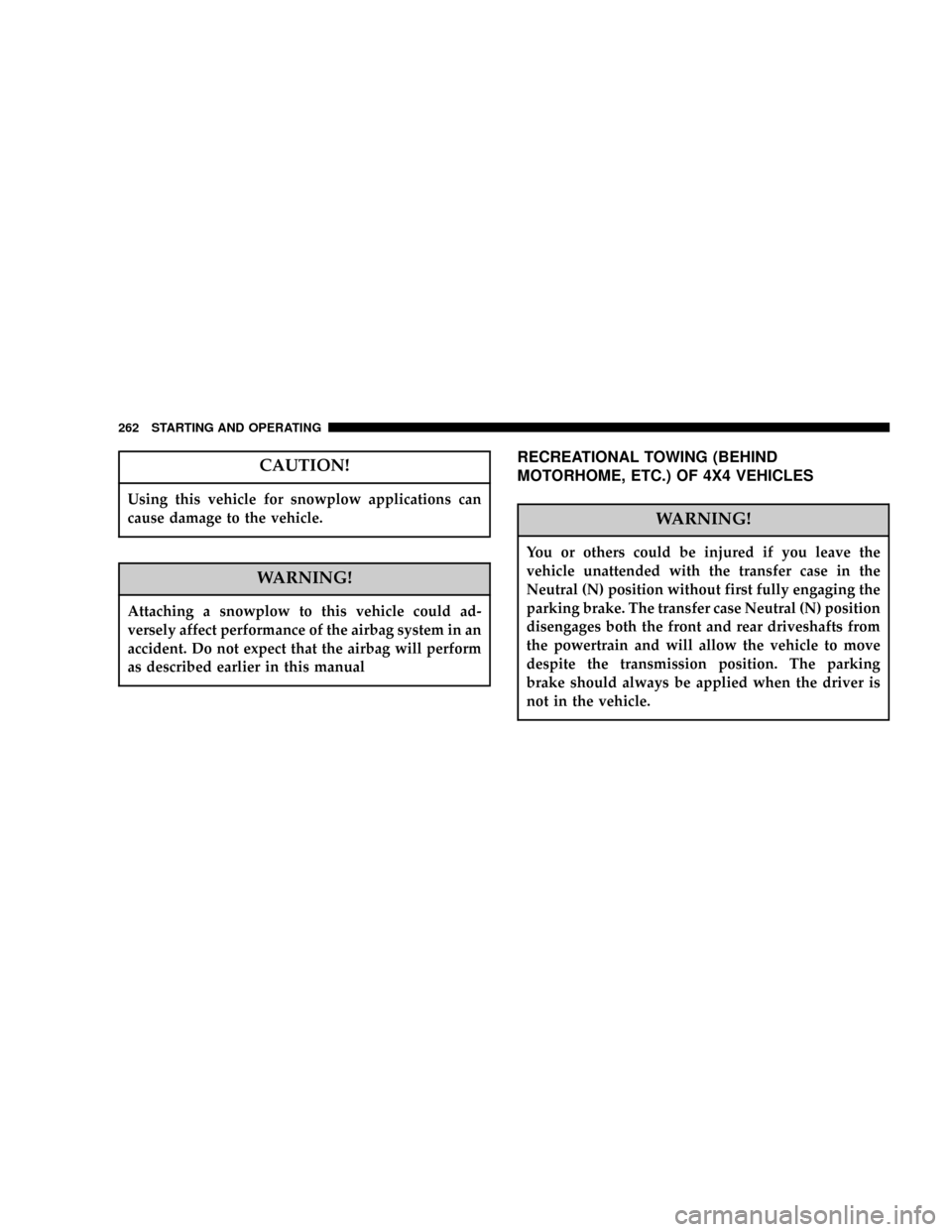
CAUTION!
Using this vehicle for snowplow applications can
cause damage to the vehicle.
WARNING!
Attaching a snowplow to this vehicle could ad-
versely affect performance of the airbag system in an
accident. Do not expect that the airbag will perform
as described earlier in this manual
RECREATIONAL TOWING (BEHIND
MOTORHOME, ETC.) OF 4X4 VEHICLES
WARNING!
You or others could be injured if you leave the
vehicle unattended with the transfer case in the
Neutral (N) position without first fully engaging the
parking brake. The transfer case Neutral (N) position
disengages both the front and rear driveshafts from
the powertrain and will allow the vehicle to move
despite the transmission position. The parking
brake should always be applied when the driver is
not in the vehicle.
262 STARTING AND OPERATING
Page 263 of 386

CAUTION!
Internal damage to the transfer case will occur if a
front or rear wheel lift is used when recreational
towing.
NOTE:The NV 244 Generation II transfer case must be
shifted into Neutral (N) for recreational towing. The
Neutral (N) selection button is located on the lower left
hand corner of the 4WD Control Switch. Shifts into and
out of transfer case Neutral (N) can take place with the
selector switch in any mode position.
Shifting into Neutral (N)
Use the following procedure to prepare your vehicle for
recreational towing.
CAUTION!
It is necessary to follow these steps to be certain that
the transfer case is fully in Neutral (N) before
recreational towing to prevent damage to internal
parts.
1. Bring vehicle to a complete stop.
2. Shut engine OFF.
3. Place ignition key in the ON position.
4. Depress brake pedal.
5. Shift automatic transmission to Neutral (N).
6. Using the point of a ballpoint pen or similar object,
depress the recessed transfer case Neutral (N) button for
4 seconds.
STARTING AND OPERATING 263
5
Page 269 of 386

WHAT TO DO IN EMERGENCIES
CONTENTS
mHazard Warning Flasher..................270
mAdding Fuel..........................270
mChanging A Flat Tire....................272
NJack Location........................272
NRemoving The Spare Tire................273NTire Changing Procedure................275
mJump Starting.........................280
mTowing A Disabled Vehicle................282
NFour-Wheel Drive Vehicles...............282
NTwo-Wheel Drive Vehicles...............282
6
Page 282 of 386

WARNING!
Any procedure other than above could result in:
1. Personal injury caused by electrolyte squirting
out the battery vent;
2. Personal injury or property damage due to battery
explosion;
3. Damage to charging system of booster vehicle or
of immobilized vehicle.
TOWING A DISABLED VEHICLE
Proper towing or lifting equipment is required to prevent
damage to your vehicle. Use of safety chains is recom-
mended.Attach towing device to main structural mem-
bers of the vehicle Ð not to bumpers or associated
brackets. State and local laws applying to vehicles
under tow must be observed.
Four-Wheel Drive Vehicles
The manufacturer recommends towing with all wheels
off the ground. Acceptable methods are to tow the vehicle
on a flatbed or with one end of the vehicle raised and the
opposite end on a towing dolly.
Two-Wheel Drive Vehicles
Provided that the transmission is operable, tow with the
transmission in Neutral and the ignition key in the OFF
position along with the front wheels raised and the rear
wheels on the ground. The speed must not exceed 30
mph (50 km/h) and the distance must not exceed 15
miles (25 km).
If the vehicle is to be towed more than 15 miles (25 km ),
it must be towed on a flatbed, or with the rear wheels
raised and the front wheels on the ground, or with the
front end raised and the rear wheels on a towing dolly.
282 WHAT TO DO IN EMERGENCIES
Page 289 of 386

ONBOARD DIAGNOSTIC SYSTEM Ð OBD II
Your vehicle is equipped with a sophisticated onboard
diagnostic system called OBD II. This system monitors
the performance of the emissions, engine, and automatic
transmission control systems. When these systems are
operating properly, your vehicle will provide excellent
performance and fuel economy, as well as engine emis-
sions well within current government regulations.
If any of these systems require service, the OBD II system
will turn on the ªMalfunction Indicator Light.º It will
also store diagnostic codes and other information to
assist your service technician in making repairs. Al-
though your vehicle will usually be drivable and not
need towing, see your dealer for service as soon as
possible.CAUTION!
²Prolonged driving with the ªMalfunction Indica-
tor Lightº on could cause further damage to the
emission control system. It could also affect fuel
economy and driveability. The vehicle must be
serviced before any emissions tests can be per-
formed.
²If the ªMalfunction Indicator Lightº is flashing
while the engine is running, severe catalytic con-
verter damage and power loss will soon occur.
Immediate service is required.
MAINTAINING YOUR VEHICLE 289
7
Page 294 of 386

Frequency Of Oil Change
Road conditions and your style of driving affect the
interval at which your oil should be changed. Check the
following to determine ifANYapply to you:
²Day or night temperatures are below 32ÉF (0ÉC).
²Stop and Go driving.
²Extensive engine idling.
²Driving in dusty conditions.
²Short trips of less than 10 miles (16.2 km).
²More than 50% of your driving is at sustained high
speeds during hot weather, above 90ÉF (32ÉC).
²Trailer towing, Taxi, Police or delivery service (com-
mercial service).
²Off-Road or desert operation.
²If equipped for and operating with E-85 (ethanol)
fuel.
NOTE:IfANYof these apply to you then change your
engine oil every 3,000 miles (5 000 km) or 3 months,
whichever comes first and follow schedule ªBº of the
9Maintenance Schedules9section of this manual.
If none of these apply to you, then change your engine oil
at every interval shown on schedule9A9of the9Mainte-
nance Schedules9section of this manual.
4x4 Models, If Used Primarily For Off-Road Operation
Every 50 hours of use.
Dusty Conditions
Driving through dust-laden air increases the problems of
keeping abrasive materials out of the engine. Under these
conditions, special attention should be given to the
engine air cleaner and the crankcase inlet air cleaner. The
crankcase ventilation system should also be checked
294 MAINTAINING YOUR VEHICLE
Page 300 of 386

WARNING!
A hot exhaust system can start a fire if you park over
materials that can burn. Such materials might be
grass or leaves coming into contact with your ex-
haust system. Do not park or operate your vehicle in
areas where your exhaust system can contact any-
thing that can burn.
In unusual situations involving grossly malfunctioning
engine operation, a scorching odor may indicate severe
and abnormal catalyst overheating. If this occurs, the
vehicle should be stopped, the engine shut off and the
vehicle allowed to cool. Thereafter, service, including a
tune-up to manufacturer's specifications, should be ob-
tained immediately.To minimize the possibility of catalyst damage:
²Do not shut off the engine or interrupt the ignition
when the transmission is in gear and the vehicle is in
motion.
²Do not try to start engine by pushing or towing the
vehicle.
²Do not idle the engine with any spark plug wires
disconnected or removed, such as when diagnostic
testing, or for prolonged periods during very rough
idling or malfunctioning operating conditions.
Maintenance-Free Battery
All Dodge trucks are equipped with maintenance-free
batteries. You will never have to add water, nor is
periodic maintenance required.
300 MAINTAINING YOUR VEHICLE
Page 341 of 386

MAINTENANCE SCHEDULES
There are two maintenance schedules that show the
requiredservice for your vehicle.
First is ScheduleªBº. It is for vehicles that are operated
under the conditions that are listed below and at the
beginning of the schedule.
²Day or night temperatures are below 32É F (0É C).
²Stop and go driving.
²Extensive engine idling.
²Driving in dusty conditions.
²Short trips of less than 10 miles (16 km).
²More than 50% of your driving is at sustained high
speeds during hot weather, above 90É F (32É C).
²Trailer towing.
²Taxi, police, or delivery service (commercial service).
²Off-road or desert operation.
²If equipped for and operating with E-85 (ethanol)
fuel.
NOTE:IfANYof these apply to you then change your
engine oil every 3,000 miles (5 000 km) or 3 months,
whichever comes first and follow schedule ªBº of the
9Maintenance Schedules9section of this manual.
NOTE:Most vehicles are operated under the conditions
listed for Schedule9B9.
Second is ScheduleªAº. It is for vehicles that are not
operated under any of the conditions listed under Sched-
ule9B9.
Use the schedule that best describes your driving condi-
tions. Where time and mileage are listed, follow the
interval that occurs first.
NOTE:Under no circumstances should oil change in-
tervals exceed 6000 miles (10 000 km) or 6 months
whichever comes first.
MAINTENANCE SCHEDULES 341
8
M
A
I
N
T
E
N
A
N
C
E
S
C
H
E
D
U
L
E
S
Page 343 of 386

Schedule ªBº
Follow schedule ªBº if you usually operate your vehicle
under one or more of the following conditions.
²Day or night temperatures are below 32É F (0É C).
²Stop and go driving.
²Extensive engine idling.
²Driving in dusty conditions.
²Short trips of less than 10 miles (16 km).
²More than 50% of your driving is at sustained high
speeds during hot weather, above 90É F (32É C).
²Trailer towing.
²Taxi, police, or delivery service (commercial service).
²Off-road or desert operation.
²If equipped for and operating with E-85 (ethanol)
fuel.
NOTE:IfANYof these apply to you then change your
engine oil every 3,000 miles (5 000 km) or 3 months,
whichever comes first and follow schedule ªBº of the
9Maintenance Schedules9section of this manual.
SCHEDULE ªBº 343
8
M
A
I
N
T
E
N
A
N
C
E
S
C
H
E
D
U
L
E
S
Page 347 of 386
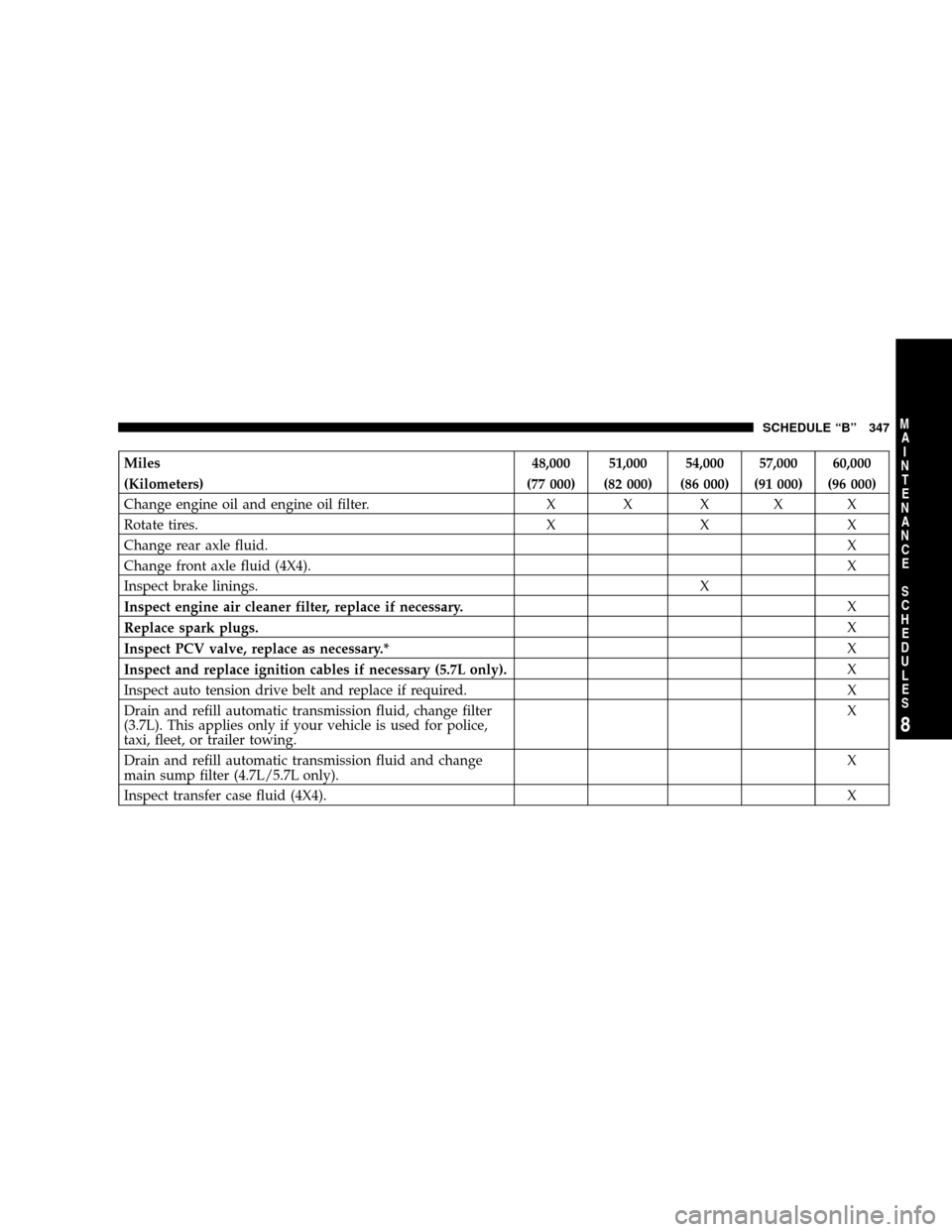
Miles 48,000 51,000 54,000 57,000 60,000
(Kilometers) (77 000) (82 000) (86 000) (91 000) (96 000)
Change engine oil and engine oil filter. X X X X X
Rotate tires. X X X
Change rear axle fluid.X
Change front axle fluid (4X4).X
Inspect brake linings. X
Inspect engine air cleaner filter, replace if necessary.X
Replace spark plugs.X
Inspect PCV valve, replace as necessary.*X
Inspect and replace ignition cables if necessary (5.7L only).X
Inspect auto tension drive belt and replace if required. X
Drain and refill automatic transmission fluid, change filter
(3.7L). This applies only if your vehicle is used for police,
taxi, fleet, or trailer towing.X
Drain and refill automatic transmission fluid and change
main sump filter (4.7L/5.7L only).X
Inspect transfer case fluid (4X4).X
SCHEDULE ªBº 347
8
M
A
I
N
T
E
N
A
N
C
E
S
C
H
E
D
U
L
E
S