belt DODGE DURANGO 2004 2.G Owners Manual
[x] Cancel search | Manufacturer: DODGE, Model Year: 2004, Model line: DURANGO, Model: DODGE DURANGO 2004 2.GPages: 386, PDF Size: 6.22 MB
Page 8 of 386

mSecurity Alarm System Ð If Equipped.........24
NTo Set The Alarm......................25
NTo Disarm The System...................25
mLiftgate...............................26
mWindows.............................27
NPower Windows.......................27
NAuto Down..........................28
NWindow Lockout Switch.................28
mOccupant Restraints......................28
NLap/Shoulder Belts.....................29
NAdjustable Upper Shoulder Belt Anchorage....34
NSecond Row Center Seat Belt..............34
NSeat Belt Pretensioners...................35NEnhanced Driver Seat Belt Reminder System
(BeltAlert)...........................35
NSeat Belts And Pregnant Women............37
NSeat Belt Extender......................37
NDriver And Right Front Passenger Supplemental
Restraint System (SRS)ÐAirbags...........38
NChild Restraint........................50
mEngine Break-In Recommendations...........62
mSafety Tips............................62
NExhaust System.......................62
NSafety Checks You Should Make Inside The
Vehicle..............................63
NSafety Checks You Should Make Outside The
Vehicle..............................64
8 THINGS TO KNOW BEFORE STARTING YOUR VEHICLE
Page 15 of 386

Vehicles equipped with power door locks can be locked
or unlocked from inside by either the use of the door lock
switches located on the front doors or by pressing the
LOCK or UNLOCK buttons on the Remote Keyless Entry
key fob.
As a safety feature the doors will not lock when using the
door lock switches during the following conditions:
²The driver's door is open while the key is in the
ignition.
Automatic Door Locks
If this feature is enabled, your door locks will lock
automatically when the vehicle's speed exceeds 15 mph
(24 km/h).
This feature is enabled when your vehicle is shipped
from the assembly plant and can be disabled by using the
following procedure:
1. Enter your vehicle and Close all doors.
2. Fasten your seat belt (Fastening the seat belt will
cancel any chiming that may confuse you during this
programming procedure).
3. Place the key into the ignition.
THINGS TO KNOW BEFORE STARTING YOUR VEHICLE 15
2
Page 17 of 386

2. Fasten your seat belt (fastening the seat belt will cancel
any chiming that may be confusing during this program-
ming procedure).
3. Insert the key into the ignition.
4. Within 10 seconds, cycle the key from the OFF position
to the ON position four times ending in the ON position
(do not start the engine).
5. Within 30 seconds, press the driver's door lock switch
in the UNLOCK direction.
6. A single chime will sound to indicate the feature has
been changed.
7. To reactivate the feature, repeat the above steps.
8. If a chime is not heard, program mode was canceled
before the feature could be changed. If necessary repeat
the above procedure.Child Protection Door Lock
To provide a safer environment for children riding in the
rear seat, the rear doors of your vehicle have the child-
protection door lock system.
THINGS TO KNOW BEFORE STARTING YOUR VEHICLE 17
2
Page 23 of 386

2. Fasten your seat belt (Fastening the seatbelt will cancel
any chiming that may confuse you during this program-
ming procedure).
3. Place the key into the ignition.
4. Turn the ignition to the ON position (Do not start the
engine).
5. Press and hold the UNLOCK button on the key fob.
6. After holding the UNLOCK button for four seconds,
also press the PANIC button within 6 seconds.
7. When a single chime is heard release both buttons. The
chime is an indication that you have successfully entered
program mode. All fobs that are to be programmed must
be done so within 60 seconds of when the chime was
heard.
8. Using the fob to be programmed, press and release
both the LOCK and UNLOCK buttons, simultaneously.9. A single chime will be heard.
10. Within four seconds of hearing the chime, press and
release the UNLOCK button on the fob.
11. A single chime will be heard.
12. Repeat steps 8 through 10 to program up to six
additional fobs.
13. Turn the ignition to the OFF position.
14. Your vehicle will remain in program mode up to 60
seconds from when the original chime was heard. After
60 seconds, all programmed fobs function normally.
NOTE:If you do not have a programmed transmitter,
contact your dealer for details.
THINGS TO KNOW BEFORE STARTING YOUR VEHICLE 23
2
Page 28 of 386

ignition is turned OFF or the driver's door is opened.
This feature can be turned off by your authorized dealer.
NOTE:The Power Accessory Delay feature will allow
the power windows to operate for ten minutes after the
ignition it turned OFF.
Auto Down
The driver's window switch has an Auto Down feature.
Push the window switch past the first detent, release, and
the window will go down automatically. To cancel the
Auto Down movement, operate the switch in either the
up or down direction and release the switch.
Window Lockout Switch
The window lockout switch on the driver's door allows
you to disable the window control on the other doors. To
disable the window controls on the other doors, press the
window lock button. To enable the window controls,
press the window control button again.
OCCUPANT RESTRAINTS
Some of the most important safety features in your
vehicle are the restraint systems. These include the front
and rear seat belts for the driver and all passengers, knee
bolsters, front airbags for both the driver and front
passenger, and if equipped left and right side curtain
airbags for the driver and passengers seated next to a
28 THINGS TO KNOW BEFORE STARTING YOUR VEHICLE
Page 29 of 386
window. If you will be carrying children too small for
adult-size seat belts, your seat belts or the LATCH feature
(refer to the Child Restraint section in this manual), can
be used to hold infant and child restraint systems.
Please pay close attention to the information in this
section. It tells you how to use your restraint system
properly to keep you and your passengers as safe as
possible.
WARNING!
In a collision, you and your passengers can suffer
much greater injuries if you are not properly buck-
led up. You can strike the interior of your vehicle or
other passengers, or you can be thrown out of the
vehicle. Always be sure you and others in your
vehicle are buckled up properly.
Buckle up even though you are an excellent driver, even
on short trips. Someone on the road may be a poor driver
and cause a collision that includes you. This can happen
far away from home or on your own street.
Research has shown that seat belts save lives, and that
they can reduce the seriousness of injuries in a collision.
Some of the worst injuries happen when people are
thrown from the vehicle. Seat belts reduce the possibility
of ejection and the risk of injury caused by striking the
inside of the vehicle.Everyonein a motor vehicle should
be belted at all times.
Lap/Shoulder Belts
All seating positions in your vehicle have combination
lap/shoulder belts. The belt webbing retractor is de-
signed to lock during very sudden stops or collisions.
This feature allows the shoulder part of the belt to move
THINGS TO KNOW BEFORE STARTING YOUR VEHICLE 29
2
Page 30 of 386
freely with you under normal conditions. But in a colli-
sion, the belt will lock and reduce the risk of your striking
the inside of the vehicle or being thrown out.
WARNING!
It is extremely dangerous to ride in a cargo area,
inside or outside of a vehicle. In a collision, people
riding in these areas are more likely to be seriously
injured or killed.
Do not allow people to ride in any area of your
vehicle that is not equipped with seats and seat belts.
Be sure everyone in your vehicle is in a seat and
using a seat belt properly.
WARNING!
²Wearing a seat belt incorrectly is dangerous. Seat
belts are designed to go around the large bones of
your body. These are the strongest parts of your
body and can take the forces of a collision the
best. Wearing your belt in the wrong place could
make your injuries in a collision much worse. You
might suffer internal injuries, or you could even
slide out of part of the belt. Follow these instruc-
tions to wear your seat belt safely and to keep
your passengers safe, too.
²Two people should never be belted into a single
seat belt. People belted together can crash into one
another in an accident, hurting one another badly.
Never use a lap/shoulder belt or a lap belt for
more than one person, no matter what their size.
30 THINGS TO KNOW BEFORE STARTING YOUR VEHICLE
Page 31 of 386

Lap/Shoulder Belt Operating Instructions
1. Enter the vehicle and close the door. Sit back and
adjust the seat.
2. The seat belt latch plate is above the back of the front
seat, next to your arm in the rear seat. Grasp the latchplate and pull out the belt. Slide the latch plate up the
webbing as far as necessary to allow the belt to go around
your lap.
3. When the belt is long enough to fit, insert the latch
plate into the buckle until you hear a ªclick.º
THINGS TO KNOW BEFORE STARTING YOUR VEHICLE 31
2
Page 32 of 386
WARNING!
²A belt buckled into the wrong buckle will not protect
you properly. The lap portion could ride too high on
your body, possibly causing internal injuries. Always
buckle your belt into the buckle nearest you.
²A belt that is too loose will not protect you as well. In
a sudden stop you could move too far forward, increas-
ing the possibility of injury. Wear your seat belt snugly.
²A belt that is worn under your arm is very dangerous.
Your body could strike the inside surfaces of the vehicle
in a collision, increasing head and neck injury. And a
belt worn under the arm can cause internal injuries.
Ribs aren't as strong as shoulder bones. Wear the belt
over your shoulder so that your strongest bones will
take the force in a collision.
²A shoulder belt placed behind will not protect you
from injury during a collision. You are more likely to
hit your head in a collision if you do not wear your
shoulder belt. The lap and shoulder belt are meant to be
used together.
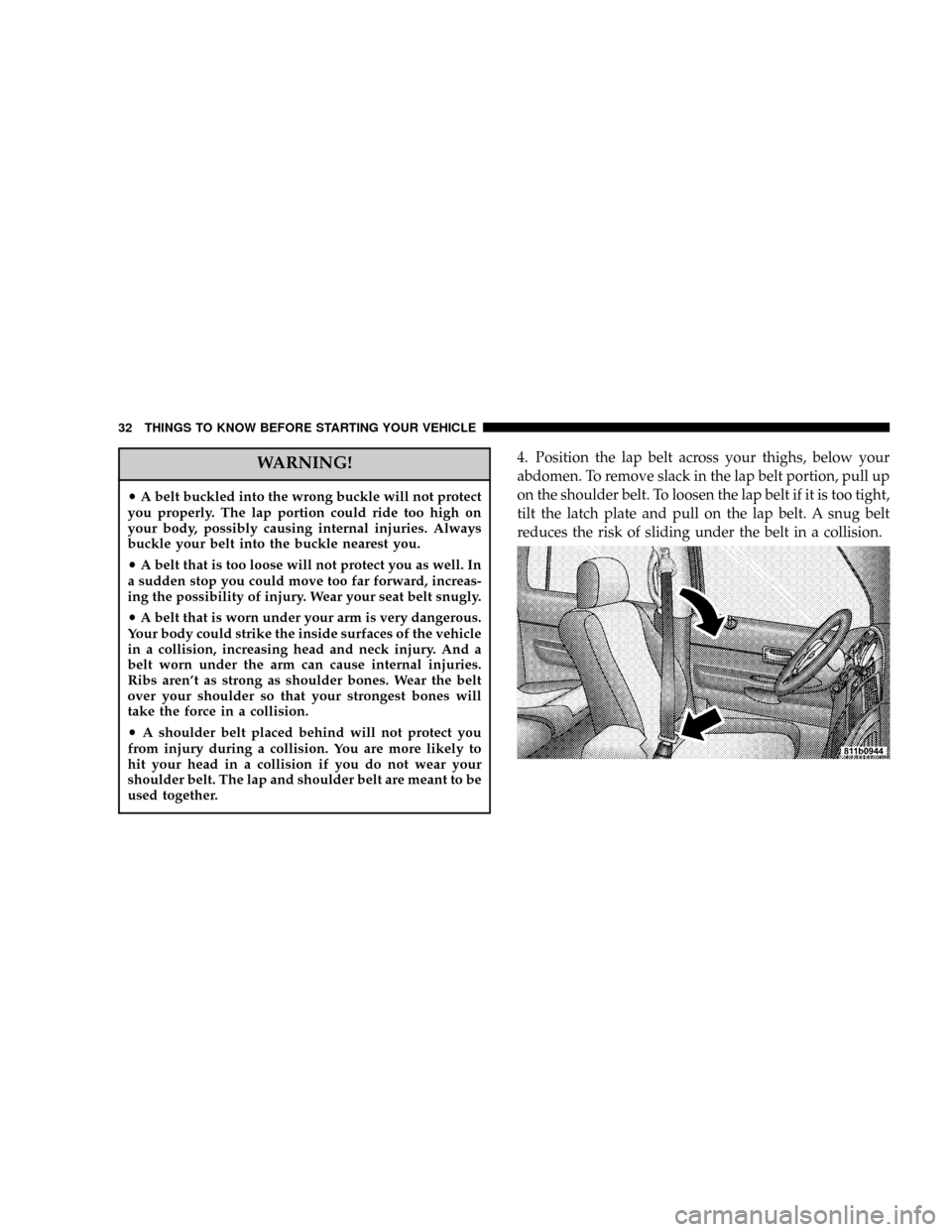
4. Position the lap belt across your thighs, below your
abdomen. To remove slack in the lap belt portion, pull up
on the shoulder belt. To loosen the lap belt if it is too tight,
tilt the latch plate and pull on the lap belt. A snug belt
reduces the risk of sliding under the belt in a collision.
32 THINGS TO KNOW BEFORE STARTING YOUR VEHICLE
Page 33 of 386
WARNING!
²A lap belt worn too high can increase the risk of
internal injury in a collision. The belt forces won't
be at the strong hip and pelvic bones, but across your
abdomen. Always wear the lap belt as low as pos-
sible and keep it snug.
²A twisted belt can't do its job as well. In a collision
it could even cut into you. Be sure the belt is straight.
If you can't straighten a belt in your vehicle, take it
to your dealer and have it fixed.
5. Position the shoulder belt on your chest so that it is
comfortable and not resting on your neck. The retractor
will withdraw any slack in the belt.6. To release the belt, push the red button on the buckle.
The belt will automatically retract to its stowed position.
If necessary, slide the latch plate down the webbing to
allow the belt to retract fully.
WARNING!
A frayed or torn belt could rip apart in a collision
and leave you with no protection. Inspect the belt
system periodically, checking for cuts, frays, or loose
parts. Damaged parts must be replaced immediately.
Do not disassemble or modify the system. Seat belt
assemblies must be replaced after a collision if they
have been damaged (bent retractor, torn webbing,
etc.).
THINGS TO KNOW BEFORE STARTING YOUR VEHICLE 33
2