maintenance schedule DODGE DURANGO 2004 2.G Owners Manual
[x] Cancel search | Manufacturer: DODGE, Model Year: 2004, Model line: DURANGO, Model: DODGE DURANGO 2004 2.GPages: 386, PDF Size: 6.22 MB
Page 1 of 386
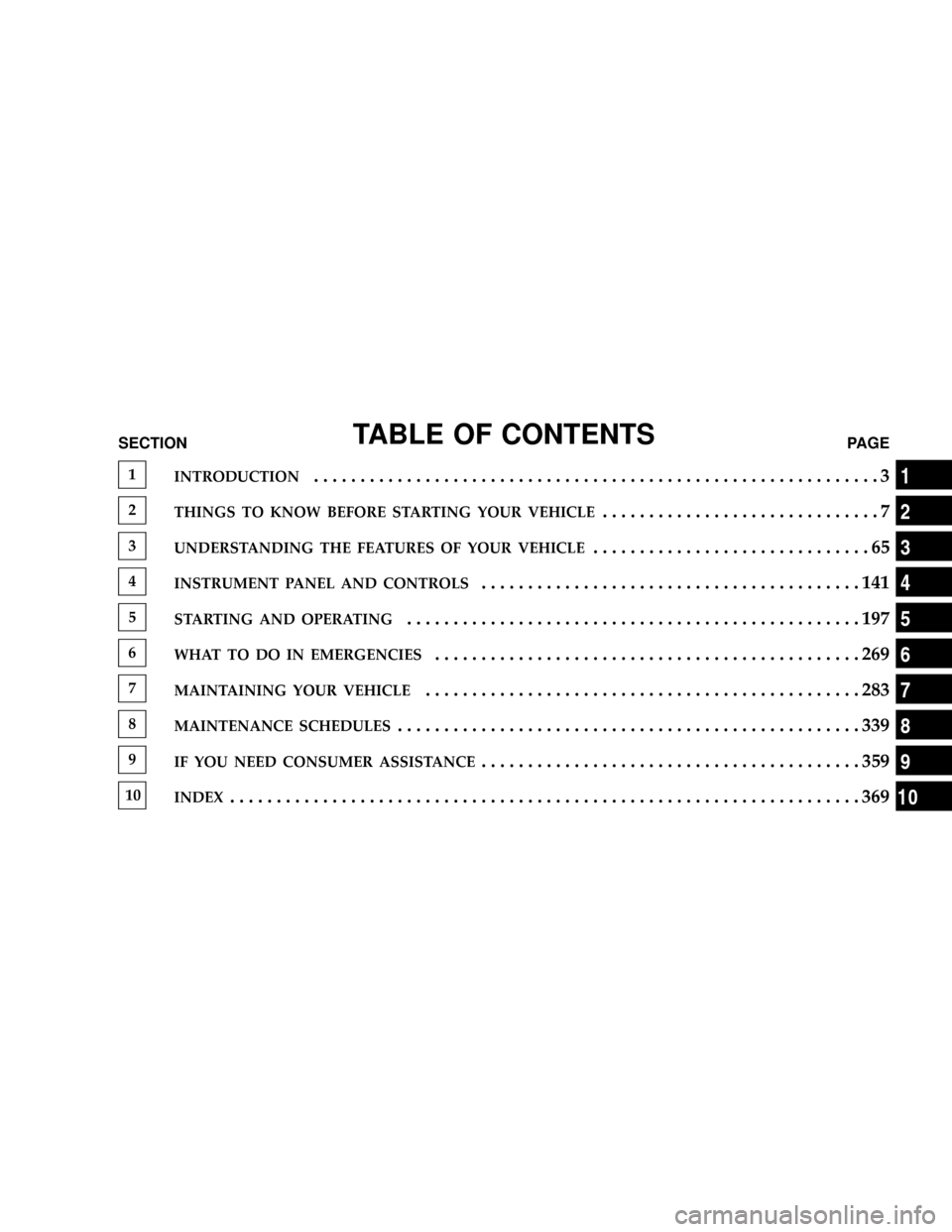
TABLE OF CONTENTSSECTIONPAGE
1INTRODUCTION.............................................................3
2THINGS TO KNOW BEFORE STARTING YOUR VEHICLE..............................7
3UNDERSTANDING THE FEATURES OF YOUR VEHICLE..............................65
4INSTRUMENT PANEL AND CONTROLS.........................................141
5STARTING AND OPERATING.................................................197
6WHAT TO DO IN EMERGENCIES..............................................269
7MAINTAINING YOUR VEHICLE...............................................283
8MAINTENANCE SCHEDULES..................................................339
9IF YOU NEED CONSUMER ASSISTANCE.........................................359
10INDEX....................................................................369
1
2
3
4
5
6
7
8
9
10
Page 241 of 386

TIRE ROTATION RECOMMENDATIONS
Tires on the front and rear axles of vehicles operate at
different loads and perform different steering, driving,
and braking functions. For these reasons, they wear at
unequal rates and tend to develop irregular wear pat-
terns. These effects can be reduced by timely rotation of
tires. The benefits of rotation are especially worthwhile
with aggressive tread designs such as those on all season
type tires. Rotation will increase tread life, help to main-
tain mud, snow and wet traction levels, and contribute to
a smooth, quiet ride.
Follow the recommended tire rotation frequency for your
type of driving found in the ªMaintenance Schedulesº
Section of this manual. More frequent rotation is permis-
sible if desired. The reasons for any rapid or unusual
wear should be corrected prior to rotation being per-
formed.
STARTING AND OPERATING 241
5
Page 291 of 386

the key is turned off. This means that your vehicle's
OBD system isnot readyand you shouldnotproceed
to the I/M station.
b. The MIL light will remain fully illuminated until the
first engine crank or the key is turned off. This means
that your vehicle's OBD system isreadyand you can
proceed to the I/M station.
If your OBD system isnot ready,you should see your
dealer or repair facility. If your vehicle was recently
serviced or had a battery failure or replacement, you may
need to do nothing more than drive your vehicle as you
normally would in order for your OBD system to update.
A recheck with the above test routine may then indicate
that the system is now ready.
Regardless of whether your vehicle's OBD system is
ready or not ready, if the MIL symbol is illuminated
during normal vehicle operation, you should have yourvehicle serviced before going to the I/M station. The I/M
station can fail your vehicle because the MIL symbol is on
with the engine running.
REPLACEMENT PARTS
Use of genuine Mopartparts for normal/scheduled
maintenance and repairs is highly recommended to in-
sure the designed performance. Damage or failures
caused by the use of non-Mopartparts for maintenance
and repairs will not be covered by the manufacturer's
warranty.
DEALER SERVICE
Your dealer has the qualified service personnel, special
tools and equipment to perform all service operations in
an expert manner. Service manuals are available which
include detailed service information for your vehicle.
Refer to these manuals before attempting any procedure
yourself.
MAINTAINING YOUR VEHICLE 291
7
Page 294 of 386

Frequency Of Oil Change
Road conditions and your style of driving affect the
interval at which your oil should be changed. Check the
following to determine ifANYapply to you:
²Day or night temperatures are below 32ÉF (0ÉC).
²Stop and Go driving.
²Extensive engine idling.
²Driving in dusty conditions.
²Short trips of less than 10 miles (16.2 km).
²More than 50% of your driving is at sustained high
speeds during hot weather, above 90ÉF (32ÉC).
²Trailer towing, Taxi, Police or delivery service (com-
mercial service).
²Off-Road or desert operation.
²If equipped for and operating with E-85 (ethanol)
fuel.
NOTE:IfANYof these apply to you then change your
engine oil every 3,000 miles (5 000 km) or 3 months,
whichever comes first and follow schedule ªBº of the
9Maintenance Schedules9section of this manual.
If none of these apply to you, then change your engine oil
at every interval shown on schedule9A9of the9Mainte-
nance Schedules9section of this manual.
4x4 Models, If Used Primarily For Off-Road Operation
Every 50 hours of use.
Dusty Conditions
Driving through dust-laden air increases the problems of
keeping abrasive materials out of the engine. Under these
conditions, special attention should be given to the
engine air cleaner and the crankcase inlet air cleaner. The
crankcase ventilation system should also be checked
294 MAINTAINING YOUR VEHICLE
Page 297 of 386

governmental agency for advice on how and where used
oil and oil filters can be safely discarded in your area.
Engine Oil Filter
The engine oil filter should be replaced at every engine
oil change.
Engine Oil Filter Selection
The manufacturer's engines have a full-flow type oil
filter. Use a filter of this type for replacement. The quality
of replacement filters varies considerably. Only high
quality filters should be used to assure most efficient
service. MopartEngine Oil Filters are a high quality oil
filter and are recommended.
Drive Belts Ð Check Condition and Tension
At the mileage indicated in the maintenance schedule, all
belts should be checked for condition and proper tension.
Improper belt tension can cause belt slippage and failure.Belts should be inspected for evidence of cuts, cracks, or
glazing, and replaced if there is indication of damage
which could result in belt failure. If adjustment is re-
quired, see your authorized dealer for service. Low
generator belt tension can cause battery failure. A special
tool is required to properly measure tension and to
restore belt tension to factory specifications.
Also check belt routing to make sure there is no interfer-
ence between the belts and other engine components.
Spark Plugs
Spark plugs must fire properly to assure proper engine
performance and emission control. The plugs installed in
your vehicle should operate satisfactorily in normal
service for the mileage indicated in the Maintenance
Chart. New plugs should be installed at this mileage. The
entire set should be replaced if there is any malfunction
MAINTAINING YOUR VEHICLE 297
7
Page 298 of 386
due to a faulty spark plug. Check the Vehicle Emissions
Control Information label for the proper type of spark
plug for your vehicle.
CAUTION!
When replacing plugs, do not overtighten. You could
damage them and cause them to leak.
Ignition Cables
Replace the ignition cables (5.7L engines only) at the
mileage interval shown in the maintenance charts.
Engine Air Cleaner Filter
Under normal driving conditions, replace the air filter at
the intervals shown on Schedule ªAº. If, however, youdrive the vehicle frequently under dusty or severe con-
ditions, the filter element should be inspected periodi-
cally and replaced if necessary at the intervals shown on
Schedule ªBº.
WARNING!
The air cleaner can provide a measure of protection
in the case of engine backfire. Do not remove the air
cleaner unless such removal is necessary for repair or
maintenance. Make sure that no one is near the
engine compartment before starting the vehicle with
the air cleaner removed. Failure to do so can result in
serious personal injury.
298 MAINTAINING YOUR VEHICLE
Page 307 of 386
bugs, leaves, etc. If dirty, clean the radiator core by gently
spraying water from a garden hose at the back of the core.
Check the coolant bottle tubing for condition and tight-
ness of connection at coolant bottle and radiator. Inspect
the entire system for leaks.
With the engine at normal operating temperature (but
not running), check the coolant pressure cap for proper
vacuum sealing by draining a small amount of coolant
from the radiator drain cock. If the cap is sealing prop-
erly, the coolant will begin to drain from the coolant
bottle. Do not remove the pressure cap when the cooling
system is hot.WARNING!
You or others can be badly burned by hot coolant or
steam from your radiator. If you see or hear steam
coming from under the hood don't open the hood
until the radiator has had time to cool. If you open
the hood and see steam or hot coolant escaping from
the radiator, don't touch anything. Get away quickly.
Never try to open a pressure cap when the radiator is
hot.
Cooling System Maintenance
At the intervals shown in the Maintenance Schedules
section of this manual, the system should be drained,
flushed and refilled. See your authorized dealer for
proper cooling system maintenance.
MAINTAINING YOUR VEHICLE 307
7
Page 308 of 386

Cooling System Ð Drain, Flush And Refill
If the solution is dirty and contains a considerable
amount of sediment, it should be cleaned and flushed.
See your authorized dealer for proper draining, flushing
and refilling of your vehicle's cooling system.
Disposal of Used Engine Coolant
Used ethylene glycol based engine coolant is a regulated
substance requiring proper disposal. Check with your
local authorities to determine the disposal rules for your
community. Do not store ethylene glycol based engine
coolant in open containers or allow it to remain in
puddles on the ground. Prevent ingestion by animals and
children. If ingested by a child contact a physician
immediately. Clean up any ground spills immediately.
Recommended Engine Coolant
This vehicle has been factory filled with an Ethylene
Glycol based engine coolant with long life corrosion
inhibitors (called HOAT, for Hybrid Organic Additive
Technology). Follow the ªMaintenance Scheduleº for the
recommended coolant change intervals. Refer to Recom-
mended Fluids, Lubricants and Genuine Parts for correct
fluid type.
308 MAINTAINING YOUR VEHICLE
Page 311 of 386

The radiator normally remains completely full, so there is
no need to remove the pressure cap except checking
coolant freeze point or replacement with new antifreeze
coolant. Your service attendant should be advised of this.
When additional coolant is needed to maintain the
proper level, it should be added to the coolant bottle. Do
not overfill.
Points To Remember
A. Do not overfill the coolant bottle.
B. Check coolant freeze point in the radiator and in the
coolant bottle. If antifreeze needs to be added, contents of
coolant bottle also must be protected against freezing.
C. If frequent coolant additions are required, or if the
level in the coolant bottle does not drop when the engine
cools, the cooling system should be pressure tested for
leaks.D. Maintain a minimum coolant concentration of 50%
ethylene glycol.
E. Make sure that the radiator and coolant bottle over-
flow hoses are not kinked or obstructed.
F. Keep the front of the radiator clean. If your vehicle is
equipped with air conditioning, keep the front of the
condenser clean also.
G. The thermostat should not be changed for summer or
winter operation. If replacement is ever necessary, install
ONLY the correct type thermostat. Other designs may
result in unsatisfactory cooling performance.
Emission Related Components
Fuel System Hoses And Vapor/Vacuum Harnesses
When the vehicle is serviced for scheduled maintenance,
inspect surface of hoses and nylon tubing for evidence of
heat and mechanical damage. Hard and brittle rubber,
cracking, checking, tears, cuts, abrasions, and excessive
MAINTAINING YOUR VEHICLE 311
7
Page 318 of 386
dipstick cap to spring back slightly from its fully seated
position, as long as its seal remains engaged in the
dipstick tube.
Automatic Transmission Fluid And Filter Change
To obtain best performance and long life for automatic
transmissions, the manufacturer recommends that they
be given regular maintenance service by an Authorized
Dodge Dealer or Service Center. It is important that the
transmission be adjusted periodically, the fluid main-
tained at the correct level, and that it be drained and
refilled as specified.
Follow the proper Maintenance Schedule for your type of
driving.
It is important that proper lubricant is used in the
transmission. Refer to Recommended Fluids, Lubricants
and Genuine Parts for correct fluid type. It is important
that the transmission fluid be maintained at the pre-
scribed level using the recommended fluid.
CAUTION!
Using a transmission fluid other than the manufac-
turers recommended fluid may cause deterioration
in transmission shift quality and/or torque converter
shudder. Using a transmission fluid other than the
manufacturers recommended fluid will result in
more frequent fluid and filter changes. Refer to
Recommended Fluids, Lubricants and Genuine Parts
for correct fluid type.
Special Additives
The manufacturer strongly recommends against the ad-
dition of any additives to the transmission. Exception to
this policy is the use of special dyes to aid in detecting
fluid leaks. The use of transmission sealers should be
avoided, since they may adversely affect seals.
318 MAINTAINING YOUR VEHICLE